Loan-to-Value (LTV) Ratio: Formula and How Lenders Use It
Key Takeaways
- LTV = Loan Amount / Property Value, and on a purchase "property value" is the lesser of the contract price and the appraised value.
- 80% is the residential benchmark. Above it you pay PMI on a conventional loan; FHA and VA go higher at the cost of mortgage insurance.
- Commercial and investment LTV caps are lower, typically 65% - 75% for conventional commercial mortgages and 75% - 80% for multifamily agency debt.
- LTV is one of two loan-sizing tests. The lender also runs DSCR and funds the lower of the two loan amounts, so know which one binds your deal.
- CLTV captures the full picture when there is more than one lien; HCLTV goes further and uses the entire HELOC limit.
- On development, LTC usually binds before LTV. Construction lenders cap the loan at a share of cost and a share of completed value, and fund the smaller.
- LTV is dynamic. It falls as you amortize and as value rises, which is what unlocks PMI cancellation and refinancing.
Ready to run your own numbers? Size a loan from your LTV math in the loan amortisation calculator above, pair it with the debt service coverage ratio to find your binding constraint, and see both tests inside the full real estate development pro forma. For the complete underwriting build from gross rent to equity IRR, see our guide to building a real estate pro forma.
The loan-to-value (LTV) ratio divides the loan amount by the property's value, and it is the first number a lender checks to decide how much they will lend and on what terms. This guide covers the LTV formula and calculation, why lenders use the lesser of purchase price and appraised value, maximum LTV by loan type across residential and commercial real estate, how LTV interacts with DSCR to size a loan, and the related ratios (CLTV, HCLTV, and loan-to-cost) that appear in real term sheets.
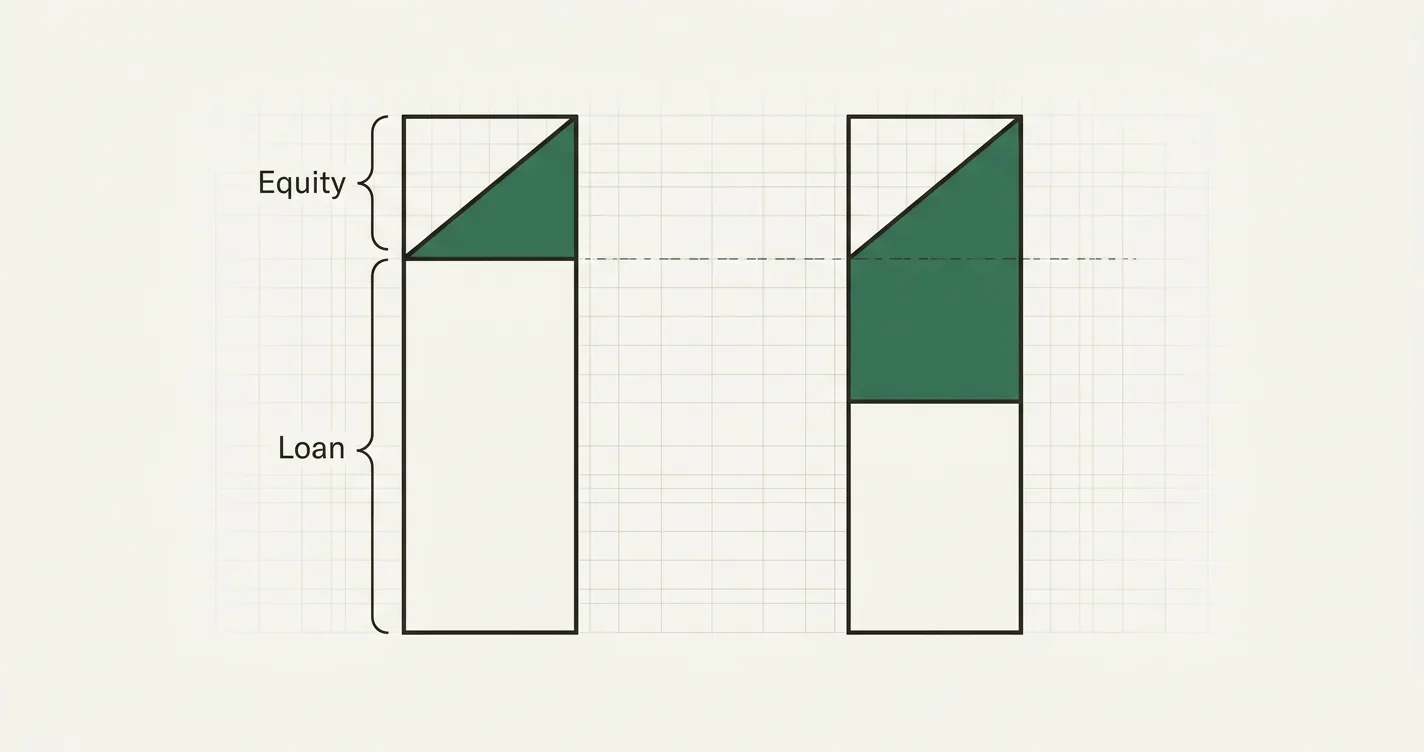
Every secured real estate loan starts with the same question: if the borrower stops paying, can the lender recover the balance by selling the collateral? The loan-to-value ratio is that question expressed as a percentage. A loan at 60% LTV has a 40% cushion of borrower equity absorbing any decline in value before the lender is underwater; a loan at 95% LTV has almost none. That cushion is why LTV drives not just approval but pricing, mortgage insurance, and how much cash the borrower brings to closing.
LTV rarely acts alone. On income-producing property it works alongside the debt service coverage ratio (DSCR), and lenders size the loan off whichever test is more restrictive. Understanding both, plus the handful of related ratios underwriters actually use, is what separates a financing plan that closes from one that stalls at the appraisal.
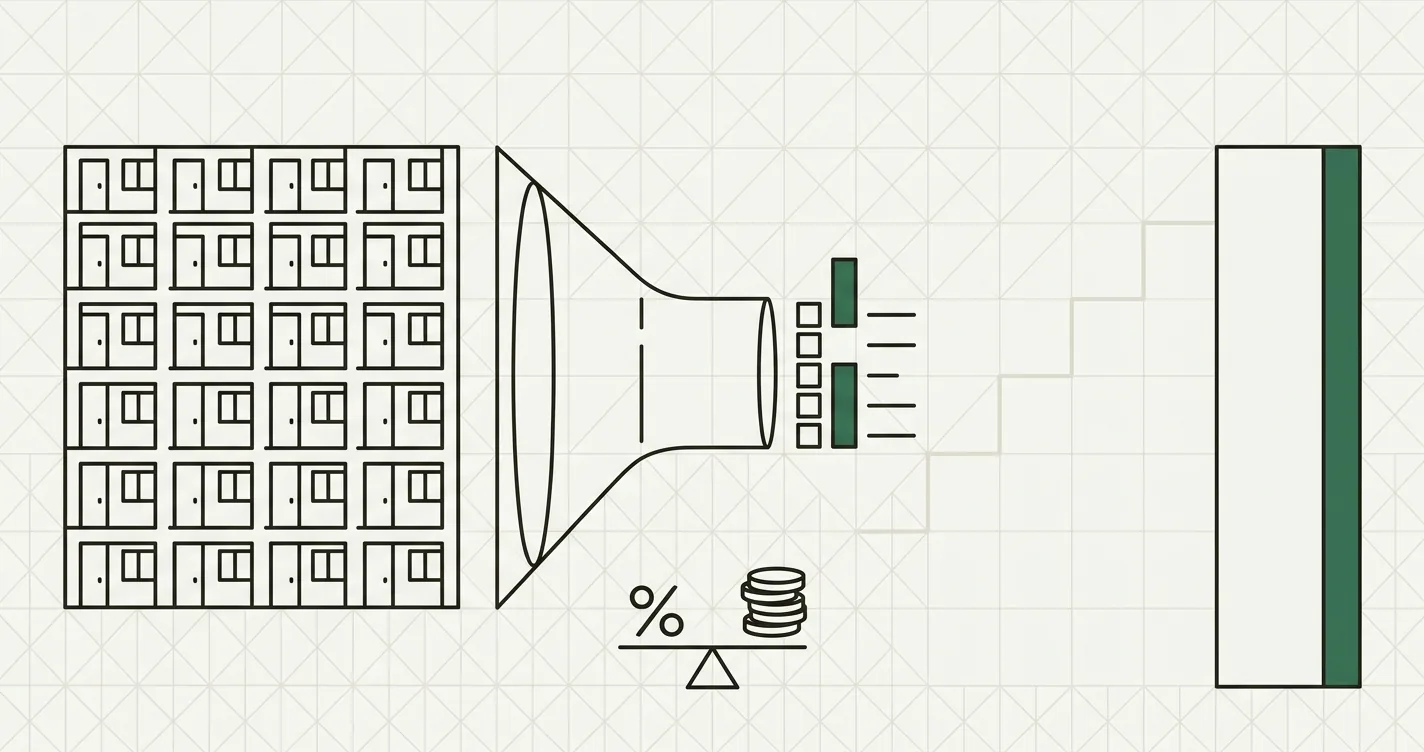
LTV is one of two loan-sizing tests. The lender funds whichever produces the smaller loan.
What LTV Measures and Why Lenders Use It
LTV answers a single question: for every dollar the lender advances, how many dollars of property value stand behind it? At 75% LTV, the lender has lent 75 cents against every dollar of value, and the borrower's 25 cents of equity is the first money to absorb a price decline. If values fall 15%, the 75% LTV loan is still covered (the property is worth 85 cents on the original dollar, the loan is 75); a 95% LTV loan is already underwater.
That equity cushion is the lender's protection in a foreclosure-and-resale scenario, so LTV directly shapes the loan:
- Approval. Every loan program has a maximum LTV. Exceed it and the loan is declined or resized down.
- Pricing. Rate sheets are tiered by LTV. The same borrower usually gets a better rate at 70% LTV than at 90%.
- Mortgage insurance. On a conventional residential loan, an LTV above 80% triggers private mortgage insurance (PMI) until the balance amortizes down.
- Cash to close. On a purchase, the borrower funds the gap between the price and the loan, so a lower maximum LTV means a bigger down payment.
This is distinct from what DSCR measures. LTV tests the collateral value; DSCR tests whether the property's cash flow can service the debt. Lenders on income property run both and lend against whichever produces the smaller loan.
The Loan-to-Value Formula
LTV = Loan Amount / Property Value
The numerator is straightforward: the principal balance of the loan being underwritten. The denominator is where care is needed.
On a purchase, "property value" is the lesser of the contract price and the appraised value. If you agree to pay $400,000 and the appraisal comes back at $410,000, the lender uses $400,000 (they will not lend against value you negotiated below). If the appraisal comes back at $380,000, the lender uses $380,000, and the shortfall becomes your problem, not theirs.
On a refinance there is no sale price, so LTV is based on the appraised value alone.
// LTV on a purchase -- always the LESSER of price and appraisal
= Loan_Amount / MIN(Purchase_Price, Appraised_Value)

// Maximum loan a lender will fund at its LTV cap
= Max_LTV * MIN(Purchase_Price, Appraised_Value)

// Down payment (or equity) the LTV cap forces the borrower to bring
= MIN(Purchase_Price, Appraised_Value) - (Max_LTV * MIN(Purchase_Price, Appraised_Value))
On a purchase with no costs financed, the down payment percentage is simply the complement of LTV: Down Payment % = 1 - LTV. An 80% LTV loan is a 20% down payment; a 95% LTV loan is 5% down.
Worked Example: LTV on a Residential Purchase
Assume the following:
| Input | Value |
|---|---|
| Contract price | $400,000 |
| Appraised value | $410,000 |
| Down payment | $80,000 |
| Loan amount | $320,000 |
The lender uses the lesser of price and appraisal, which is the $400,000 contract price.
LTV = Loan Amount / min(Price, Appraisal)
LTV = $320,000 / $400,000 = 0.80 = 80%
At exactly 80% LTV, this loan sits on the conventional PMI threshold: one dollar more of borrowing and the lender requires private mortgage insurance.
What happens when the appraisal comes in low
Now assume the appraisal disappoints at $380,000 instead of $410,000. The contract price is unchanged at $400,000, so the lender now values the collateral at $380,000.
Requested loan still $320,000
LTV = $320,000 / $380,000 = 0.8421 = 84.2%
The loan has drifted above 80% LTV purely because the appraisal moved. To hold the loan at 80% LTV, the lender caps it at:
Max loan = 80% x $380,000 = $304,000
The buyer must now bring $400,000 - $304,000 = $96,000 instead of $80,000, an extra $16,000 in cash. This is the "appraisal gap," and it is the single most common way a residential deal breaks between contract and closing.
From loan amount to monthly payment
Once LTV fixes the loan amount, the interest rate and term set the payment. Take the $320,000 base-case loan at a 6.5% fixed rate over 30 years:
= -PMT(6.5%/12, 30*12, 320000)
// = $2,022.62 per month
Over the full term that is roughly $728,000 paid in, of which about $408,000 is interest. Change any input and the payment moves; the calculator below lets you set the loan amount straight from your LTV math.
Maximum LTV by Loan Type
Every program sets its own ceiling. These are typical starting points; the specific number lives in the rate sheet or term sheet and moves with the credit cycle.
Residential
| Loan Type | Typical Maximum LTV |
|---|---|
| Conventional, no PMI | 80% |
| Conventional, first-time buyer | up to 97% |
| FHA | 96.5% |
| VA / USDA (eligible borrowers) | up to 100% |
| Jumbo | 80% - 90% |
| Conventional cash-out refinance | 80% |
| HELOC / second mortgage (combined) | 85% - 90% CLTV |
Commercial and Investment
| Loan Type | Typical Maximum LTV |
|---|---|
| Conventional commercial mortgage | 65% - 75% |
| Multifamily agency (Fannie Mae / Freddie Mac) | 75% - 80% |
| SBA 504 (bank + SBA combined) | up to 90% |
| Bridge / value-add (against as-is value) | 70% - 80% |
| Construction loan | 65% - 75% of cost (loan-to-cost, see below) |
The pattern: owner-occupied residential debt goes highest because it is government-supported and diversified across millions of borrowers; commercial LTV caps are lower because cash flow is lumpier and the collateral is harder to resell quickly. "Max LTV commercial real estate" is almost always a 65% - 75% conversation, not the 90%+ available on a primary residence.
LTV vs. CLTV and Second Liens
First-lien LTV only counts the senior loan. When a property carries more than one lien, lenders look at combined loan-to-value (CLTV):
CLTV = (First Mortgage Balance + All Junior Liens) / Property Value
Worked example. A home is worth $500,000:
| Lien | Balance | Ratio |
|---|---|---|
| First mortgage | $350,000 | 70.0% LTV |
| HELOC (drawn) | $50,000 | -- |
| Combined | $400,000 | 80.0% CLTV |
The first mortgage alone is a comfortable 70% LTV, but the HELOC pushes combined leverage to 80% CLTV, and that is the number the HELOC lender underwrites against.
A stricter variant, HCLTV (also called HTLTV), uses the HELOC's full credit limit rather than the drawn balance, because the borrower can redraw at any time. If the HELOC above had a $75,000 limit:
HCLTV = ($350,000 + $75,000) / $500,000 = 0.85 = 85%
// Combined LTV -- first mortgage plus all junior liens
= (First_Mortgage_Balance + Second_Lien_Balance) / Property_Value

// HCLTV / HTLTV -- uses the full HELOC line, not just the drawn balance
= (First_Mortgage_Balance + HELOC_Credit_Limit) / Property_Value
LTV vs. DSCR: Which Constrains the Loan?
On income-producing property, LTV is only half the underwrite. The lender also runs a DSCR test and funds the lower of the two loan amounts. Skipping this step is how sponsors talk themselves into leverage a lender will never provide.
Take a stabilized commercial property:
| Input | Value |
|---|---|
| Appraised value | $3,400,000 |
| Lender maximum LTV | 75% |
| Net operating income (NOI) | $246,384 |
| Lender minimum DSCR | 1.25x |
| Interest rate | 6.75% |
| Amortization | 30 years |
LTV-constrained loan:
= 75% x $3,400,000 = $2,550,000
DSCR-constrained loan: first find the maximum annual debt service the NOI can support at a 1.25x minimum, then reverse it into a loan balance with PV:
// Max annual debt service at 1.25x DSCR
= 246384 / 1.25                       // = $197,107

// Reverse into a maximum loan balance
= PV(6.75%/12, 30*12, -(197107/12))   // = $2,532,477
Compare the two:
| Test | Maximum Loan |
|---|---|
| LTV (75% of $3.4M) | $2,550,000 |
| DSCR (1.25x on $246,384 NOI) | $2,532,477 |
| Loan the lender funds (lower) | $2,532,477 |
Here DSCR binds: it caps the loan about $17,500 below what LTV alone would allow. Change one assumption, though, and LTV takes over. If the appraisal had come in at $3,300,000, the LTV cap would drop to 75% x $3,300,000 = $2,475,000, below the DSCR-constrained $2,532,477, and LTV would become the binding test. On lower-yielding, lower-cap-rate deals DSCR usually binds; on higher-yielding assets or conservative appraisals, LTV does.
// Loan sizing: take the lower of the LTV- and DSCR-constrained loan
= MIN( Max_LTV * Appraised_Value,
       PV(Rate/12, Years*12, -(NOI / Min_DSCR) / 12) )
For the full DSCR mechanics, minimum requirements by loan type, and stress testing, see our guide to the debt service coverage ratio. To see LTV and DSCR sized together inside a full underwriting model, the real estate development pro forma below carries both tests through construction, lease-up, and stabilized operations.
How LTV Affects Pricing, PMI, and Refinancing
Pricing. Lender rate sheets add a premium as LTV rises. The step-ups are largest crossing 80%, then again crossing 90% and 95%, because those are the bands where historical loss severity jumps.
PMI (conventional). Above 80% LTV, the borrower pays private mortgage insurance. Under the Homeowners Protection Act, PMI automatically terminates when the loan amortizes to 78% of the original value, and the borrower can request cancellation at 80% based on either the original value or a new appraisal showing appreciation.
MIP (FHA). FHA loans carry mortgage insurance regardless of LTV: for 11 years if the down payment was 10% or more (LTV at or below 90%), otherwise for the life of the loan.
Refinancing. LTV is not static. As the loan amortizes and, usually, the property appreciates, LTV falls, and that decline is what unlocks a PMI cancellation, a better rate, or a cash-out refinance. A borrower who bought at 95% LTV can often refinance out of PMI a few years later without bringing a dollar to the table.
LTV vs. LTC (Loan-to-Cost) in Development
On a ground-up or heavy value-add project there is no stabilized asset to appraise yet, so construction lenders underwrite to loan-to-cost (LTC) as well as LTV:
LTC = Loan Amount / Total Project Cost
Total project cost is land plus hard costs, soft costs, and contingency. Worked example:
| Cost Component | Amount |
|---|---|
| Land | $2,000,000 |
| Hard costs | $6,500,000 |
| Soft costs | $1,300,000 |
| Contingency | $200,000 |
| Total project cost | $10,000,000 |
With a $7,000,000 construction loan:
LTC = $7,000,000 / $10,000,000 = 0.70 = 70%
The developer funds the remaining $3,000,000 (30%) in equity.
The lender also checks that loan against the completed, stabilized value. If the finished project is expected to produce $845,000 of NOI and trades at a 6.5% cap rate, the stabilized value is $845,000 / 0.065 = $13,000,000, so:
LTV on completed value = $7,000,000 / $13,000,000 = 0.538 = 53.8%
At a 65% LTV cap on completed value, the loan could theoretically be as large as 0.65 x $13,000,000 = $8,450,000, but LTC holds it to $7,000,000. Early in a project, LTC is almost always the tighter of the two.
// Loan-to-Cost for a development deal
= Construction_Loan / (Land + Hard_Costs + Soft_Costs + Contingency)
Common Mistakes
- Sizing your plan off the contract price when the appraisal is lower. The lender always uses the lesser figure. Assuming the price holds can leave a five-figure cash gap at closing.
- Confusing LTV with down payment percentage. They are complements (down payment % = 1 - LTV) only on a clean purchase. On a refinance or when costs are financed, the relationship breaks.
- Ignoring CLTV when adding a second lien. A HELOC can be fine on its own and still blow through the lender's combined LTV cap.
- Assuming LTV is the binding constraint on income property. Run the DSCR test too and size off the lower loan. Eyeballing LTV alone routinely overstates achievable leverage.
- Mixing "as-is" and "as-stabilized" value. Value-add and construction lenders quote LTV against different value bases. A 75% LTV on stabilized value can be a 90%+ LTV on today's as-is value.
- Treating LTV as fixed. It falls as you amortize and as value rises, which is exactly what lets you drop PMI or refinance later.
- Overlooking LTC on development deals. A loan can pass the completed-value LTV test and still be capped by loan-to-cost, usually the tighter of the two early on.

Alex Tapio
Founder of Finamodel • Professional Financial Modeller • Ex-Deloitte