Net Operating Income (NOI): Formula and How to Calculate It
Key Takeaways
- NOI = Effective Gross Income − Operating Expenses, calculated before debt service, income taxes, depreciation, and capital expenditures.
- Above-the-line vs. below-the-line is the real battleground. Operating income and operating expenses sit above the line; financing, taxes, depreciation, and CapEx sit below it - and mixing them up is the most common NOI error.
- NOI is unlevered and capital-cost-free, which is what separates it from a corporate EBITDA margin (EBITDA doesn't exclude CapEx the way NOI does).
- The same NOI feeds two different formulas: divide by a market cap rate to get value; divide into annual debt service to get DSCR.
- Which "version" of NOI matters: trailing 12-month, in-place, pro forma, and stabilized NOI can differ significantly on the same property - always know which one you're looking at.
- Always re-underwrite a broker's pro forma NOI from the trailing financials and rent roll rather than accepting the offering memorandum's projected figure.
For the full property model NOI feeds into, see how to build a real estate pro forma, how NOI turns into a cap rate and property value, and how NOI is stress-tested against debt in the debt service coverage ratio guide. To build your own from scratch, start with the real estate development pro forma template.
Net Operating Income (NOI) is the single most important number in commercial real estate: a property's total income from operations, less operating expenses, before any financing costs, income taxes, depreciation, or capital expenditures. It is the number that sets a property's value through the cap rate, and the number lenders size loans against through the debt service coverage ratio. Get NOI wrong - by including the wrong line items or using the wrong rents - and every downstream number, from valuation to loan proceeds, is wrong too.
NOI exists to answer one question in a form every buyer, seller, appraiser, and lender can agree on: how much cash does this property generate from its operations alone, independent of who owns it, how it's financed, or what tax bracket the owner is in? That neutrality is what makes NOI comparable across deals. Two buyers evaluating the same building - one paying all cash, one financing 75% with a bank loan - will calculate the exact same NOI, even though their after-debt cash flow looks completely different.
That neutrality only holds if NOI is calculated consistently. The line between what belongs "above the line" (inside NOI) and "below the line" (excluded from it) is where most disputes between buyers, sellers, and lenders actually happen - not in the operating numbers themselves, which are usually not in question.
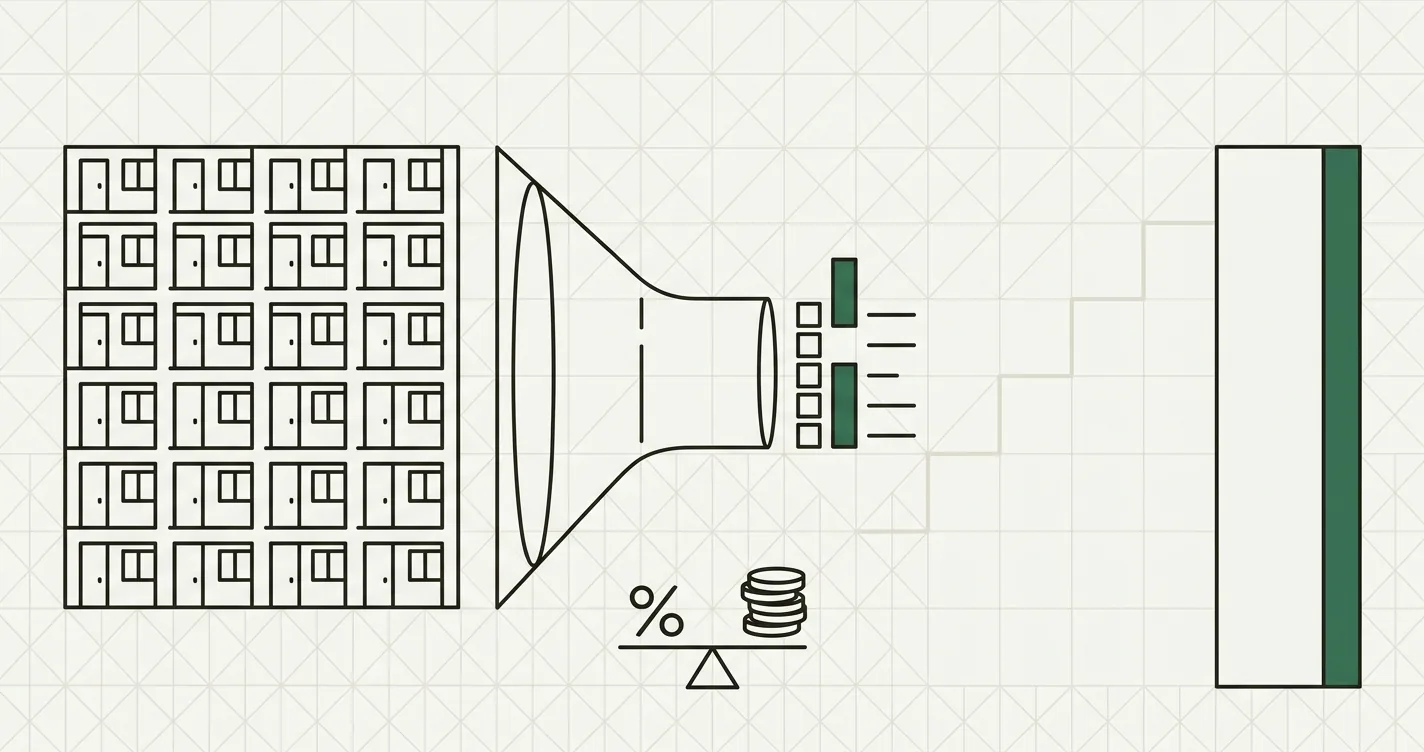
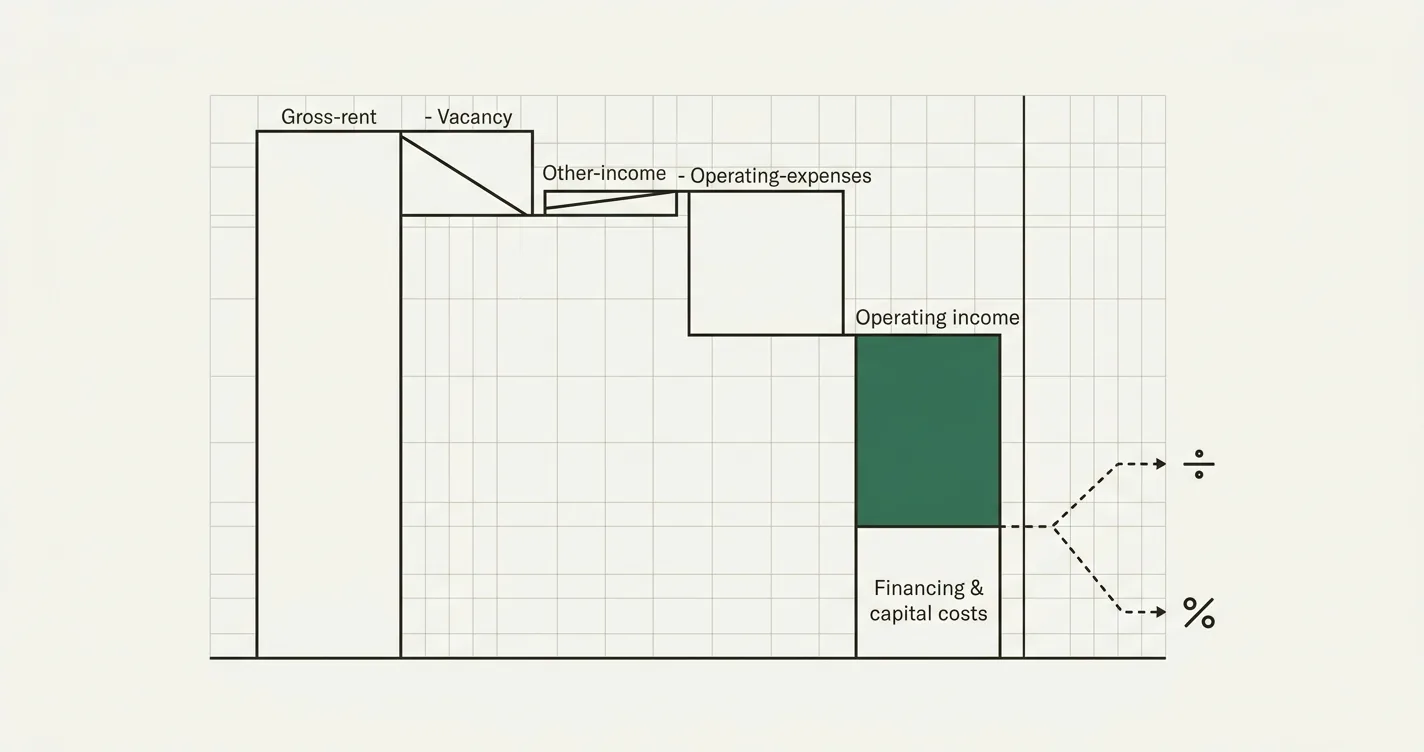
From Gross Potential Rent to NOI - Debt Service Sits Below the Line, Not Inside It
What Is Net Operating Income (NOI)?
NOI is a property's income after operating expenses, but before financing, taxes, depreciation, and capital costs:
Net Operating Income = Effective Gross Income − Operating Expenses
Where Effective Gross Income (EGI) is built up from rent:
Effective Gross Income = Gross Potential Rent − Vacancy & Credit Loss + Other Income
NOI is deliberately unlevered (calculated before debt service) and pre-tax (calculated before income taxes and depreciation). That's what makes it the common currency of real estate: a cap rate is NOI divided by price, a DSCR is NOI divided by annual debt service, and a lender's maximum loan size is usually solved backward from NOI. Every one of those calculations breaks if NOI already has debt service or taxes baked into it.
What's Included in NOI (Above the Line vs. Below the Line)
The most common source of disagreement over NOI isn't the rent roll - it's which expenses get subtracted before you arrive at the number. Above-the-line items are operating in nature and recur every year regardless of ownership or financing. Below-the-line items relate to how the property is owned, financed, or taxed, not to operating it.
Included in NOI (above the line):
- Rental income (base rent, percentage rent for retail, storage unit rent, etc.)
- Other operating income (late fees, application/admin fees, parking, laundry, tenant insurance, retail sales at the property)
- Vacancy and credit loss (a deduction from potential income)
- Property taxes and property insurance
- Utilities not billed back to tenants
- Repairs and routine maintenance
- Property management fees
- On-site payroll (management, leasing, maintenance staff)
- Marketing and leasing costs
- General and administrative (G&A) costs specific to operating the property
Excluded from NOI (below the line):
- Mortgage principal and interest (debt service)
- Depreciation and amortization
- Income taxes (the owner's, not the property's)
- Capital expenditures and capital reserves (roof replacement, new HVAC, parking lot resurfacing)
- Tenant improvements and leasing commissions on new leases
- Owner-specific costs that wouldn't transfer to a new buyer (e.g., a corporate overhead allocation)
The capital items are the ones people get wrong most often. A new roof is a real cash cost, but it's a capital cost, not an operating one - it belongs in a capital reserve or the cash flow statement below NOI, not buried in "repairs and maintenance." Inflate repairs and maintenance to smuggle capital spend into an operating line, and NOI (and therefore the appraised value) is misstated in the same direction.
NOI vs. EBITDA: What's the Difference?
NOI and EBITDA (Earnings Before Interest, Taxes, Depreciation, and Amortization) are close cousins - both strip out financing and tax effects to leave a comparable operating number. The difference is what else gets stripped out:
| NOI (Real Estate) | EBITDA (Corporate) | |
|---|---|---|
| Excludes interest & taxes | Yes | Yes |
| Excludes depreciation & amortization | Yes | Yes |
| Excludes capital expenditures | Yes | No - CapEx is a separate cash flow line, not excluded from EBITDA |
| Excludes owner/corporate overhead | Yes, if it wouldn't transfer to a buyer | No - normal corporate G&A is included |
| Used to size | Cap rate, property value, loan proceeds | Trading multiples (EV/EBITDA), leverage ratios |
The practical difference that trips people up: NOI is explicitly pre-CapEx, so a property can have strong NOI in a year it also needed a new roof - the roof just doesn't touch NOI. EBITDA doesn't make that same CapEx exclusion; a corporate EBITDA margin says nothing about how capital-intensive the business is. That's why real estate underwriting always layers a separate capital reserve or replacement reserve line beneath NOI before arriving at true free cash flow - see how this plays out in a full real estate pro forma.
Worked Example: Calculating NOI for a Self-Storage Facility
Take a 500-unit self-storage facility with an average achieved rent of $115 per unit per month.
Revenue build-up:
| Line Item | Annual Amount |
|---|---|
| Gross Potential Rent (500 units × $115 × 12) | $690,000 |
| Less: Vacancy & Credit Loss (10%) | ($69,000) |
| Effective Rental Income | $621,000 |
| Plus: Other Income (late fees, admin fees, tenant insurance, retail) | $39,000 |
| Effective Gross Income (EGI) | $660,000 |
Operating expenses:
| Expense | Annual Amount |
|---|---|
| Management fee (6% of EGI) | $39,600 |
| On-site payroll | $58,000 |
| Real estate taxes | $52,000 |
| Insurance | $16,000 |
| Utilities | $21,000 |
| Repairs & maintenance | $24,000 |
| Marketing | $12,000 |
| General & administrative | $9,400 |
| Total Operating Expenses | $232,000 |
Net Operating Income = $660,000 − $232,000 = $428,000
NOI Margin = $428,000 / $660,000 = 64.8%
That $428,000 NOI is now the input to two separate downstream calculations. If the market is pricing similar self-storage facilities at a 7.0% cap rate, the implied value is:
Value = NOI / Cap Rate = $428,000 / 0.07 = $6,114,286
And if the facility carries a loan with $280,000 in annual debt service, the debt service coverage ratio is:
DSCR = NOI / Annual Debt Service = $428,000 / $280,000 = 1.53x
Same NOI, two completely different uses - one values the asset (cap rate), one sizes the loan against it (DSCR). This is exactly why NOI has to be calculated the same way every time: an appraiser, a lender, and a buyer are all pulling the identical figure into different formulas, and any inconsistency in what sits above vs. below the line propagates into all three.
// Effective Rental Income
= Gross_Potential_Rent - Vacancy_and_Credit_Loss

// Effective Gross Income (EGI)
= Effective_Rental_Income + Other_Income

// Total Operating Expenses (sum of the operating expense block only - no debt service, no CapEx)
= SUM(Management_Fee:General_Admin)

// Net Operating Income (NOI)
= Effective_Gross_Income - Total_Operating_Expenses

// NOI Margin
= Net_Operating_Income / Effective_Gross_Income
Stabilized NOI vs. Pro Forma NOI
NOI isn't a single fixed number - which version you're looking at matters as much as the calculation itself:
- Trailing 12-Month (T-12) NOI: Actual, audited results from the last 12 months of operation. The most defensible number because it already happened.
- In-Place NOI: An annualized run-rate based on current leases and current expenses, projected forward from a single point in time (e.g., last month's rent roll × 12).
- Pro Forma NOI: A forward-looking projection that layers in assumptions - market rent increases, planned expense cuts, a renovation program - on top of current performance.
- Stabilized NOI: The NOI a property is expected to generate once it reaches normal, sustainable occupancy and operations - used heavily in development and value-add underwriting, where a property is intentionally below stabilized occupancy during lease-up or renovation.
The gap between in-place NOI and pro forma or stabilized NOI is where the underwriting risk lives. A seller's broker will almost always market a deal on pro forma NOI (rents pushed to "market," expenses trimmed to a best-case run-rate), because a higher NOI supports a higher asking price at the same cap rate. A disciplined buyer re-underwrites from T-12 or in-place NOI and treats the pro forma figure as a target to be earned, not a number to pay for on day one.
Common Mistakes When Calculating NOI
- Including capital expenditures in operating expenses. A new roof, parking lot resurfacing, or major HVAC replacement is a capital cost, not an operating one - it belongs in a capital reserve below NOI, not folded into repairs and maintenance.
- Omitting a market management fee on a self-managed property. If the owner self-manages and doesn't pay a fee, NOI should still deduct a market-rate management fee (typically 3–8% of EGI). Otherwise the property looks artificially profitable to a buyer who won't self-manage.
- Using pro forma rents without underwriting the path to get there. Marketing NOI at "achievable market rent" when in-place leases are 15% below market overstates value unless there's a credible, funded plan (and time) to actually push rents.
- Overstating other income or undercounting vacancy. A few points of understated vacancy and credit loss can move NOI - and therefore value - by tens of thousands of dollars on a mid-size property.
- Confusing NOI with cash flow. NOI is before debt service. A property can have healthy, growing NOI and still be cash-flow negative to the owner if it's over-leveraged - NOI alone doesn't tell you that.
- Folding income taxes or depreciation into the expense line. These are owner-specific, non-operating items. They never belong above NOI.
- Accepting a broker's pro forma NOI at face value. Broker pro formas are marketing documents. Always re-underwrite NOI from the trailing financials and rent roll, not from the offering memorandum's projected column.

Alex Tapio
Founder of Finamodel • Professional Financial Modeller • Ex-Deloitte