Purchase Price Allocation and Goodwill in M&A
Key Takeaways
- Goodwill is a plug, not a measurement. It equals total consideration minus the fair value of net identifiable assets acquired, and it absorbs synergies, assembled workforce, and going-concern value.
- Fair-value everything first. Step up inventory and PP&E, separately recognize identifiable intangibles (technology, customer relationships, trade names), and mark assumed liabilities - including debt - to fair value.
- The deferred tax liability is not optional in a stock deal. Book write-ups over carryover tax basis create a DTL that reduces net identifiable assets and increases goodwill. In our example it added $42.0M to goodwill.
- PPA drives post-close earnings for years. Incremental intangible amortization ($12.5M/year here), step-up depreciation ($4.0M/year), and the one-time inventory charge ($8.0M) are core inputs to any accretion / dilution analysis.
- Goodwill is impairment-tested, not amortized (for US public companies). Post-ASU 2017-04 the test is a single step: carrying amount minus fair value at the reporting unit level, capped at the goodwill balance, non-cash, and never reversed.
- Deal structure changes the answer. Asset deals and 338(h)(10) elections step up tax basis and make goodwill deductible over 15 years; plain stock deals do neither and carry the DTL.
- Tie the allocation before you move on. Identifiable assets minus liabilities assumed plus goodwill must equal consideration transferred, to the dollar.
For the surrounding deal mechanics, work through the merger model guide and the accretion / dilution analysis, or start from the M&A valuation model template.
Purchase price allocation (PPA) is the accounting process that takes the price an acquirer pays for a target and spreads it across every identifiable asset acquired and liability assumed at fair value, with whatever is left over booked as goodwill. Get the allocation wrong and you misstate the pro forma balance sheet, the post-close earnings drag, and the goodwill balance that gets impairment-tested every year afterward. This guide walks through the PPA framework under ASC 805 and IFRS 3, a full worked example with real numbers, the deferred tax liability that trips up most first-timers, and how goodwill impairment actually works.
Every M&A deal ends with a purchase price allocation. Once the deal closes, the acquirer has to answer a mechanical question: what did we actually buy? The purchase price is a single number, but the target is a bundle of receivables, inventory, equipment, brands, customer relationships, technology, debt, and deferred taxes. PPA in M&A is the exercise of assigning fair value to each of those pieces and letting goodwill absorb the residual.
This matters well beyond the accounting department. The allocation drives incremental depreciation and amortization that hits every future income statement, it creates a deferred tax liability that changes the goodwill number, and it sets the goodwill balance that analysts watch for impairment risk. A merger model that skips the PPA step will overstate pro forma EPS and understate the balance sheet.
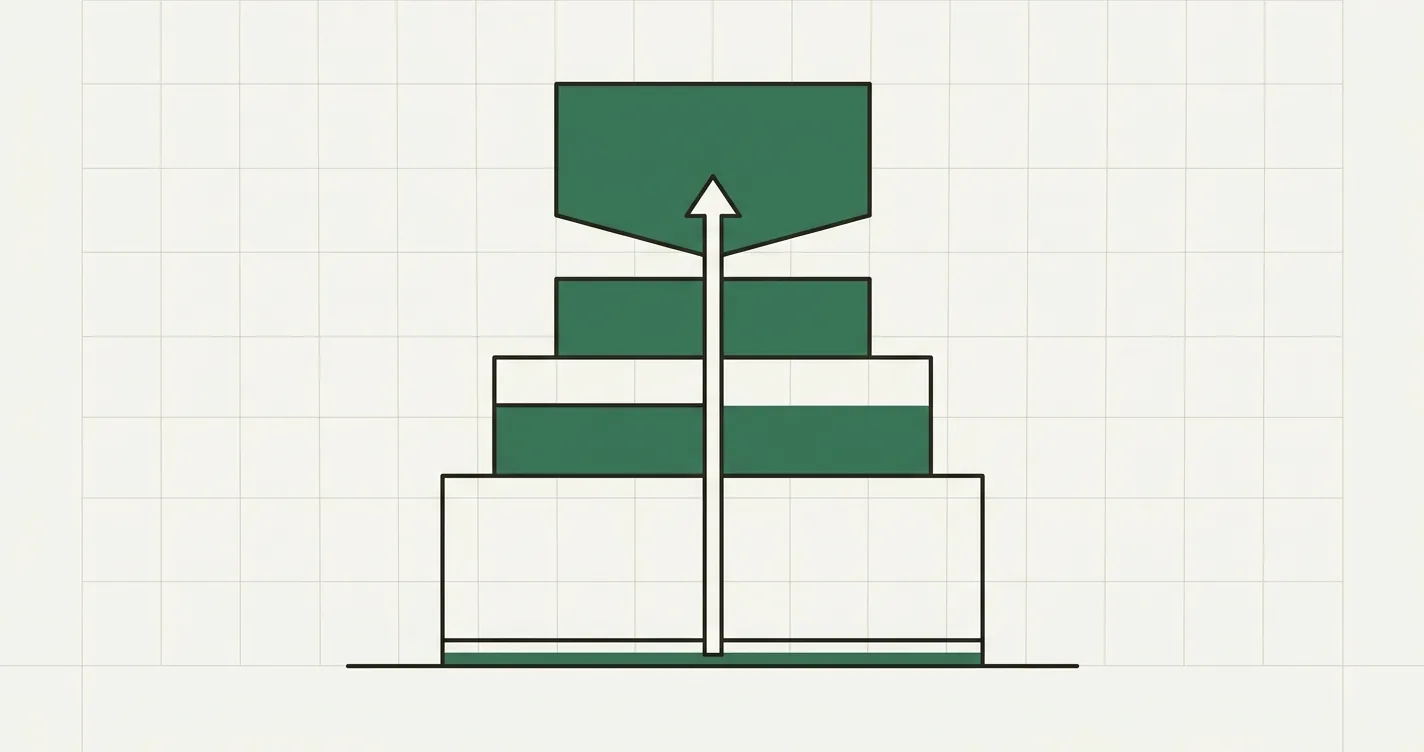
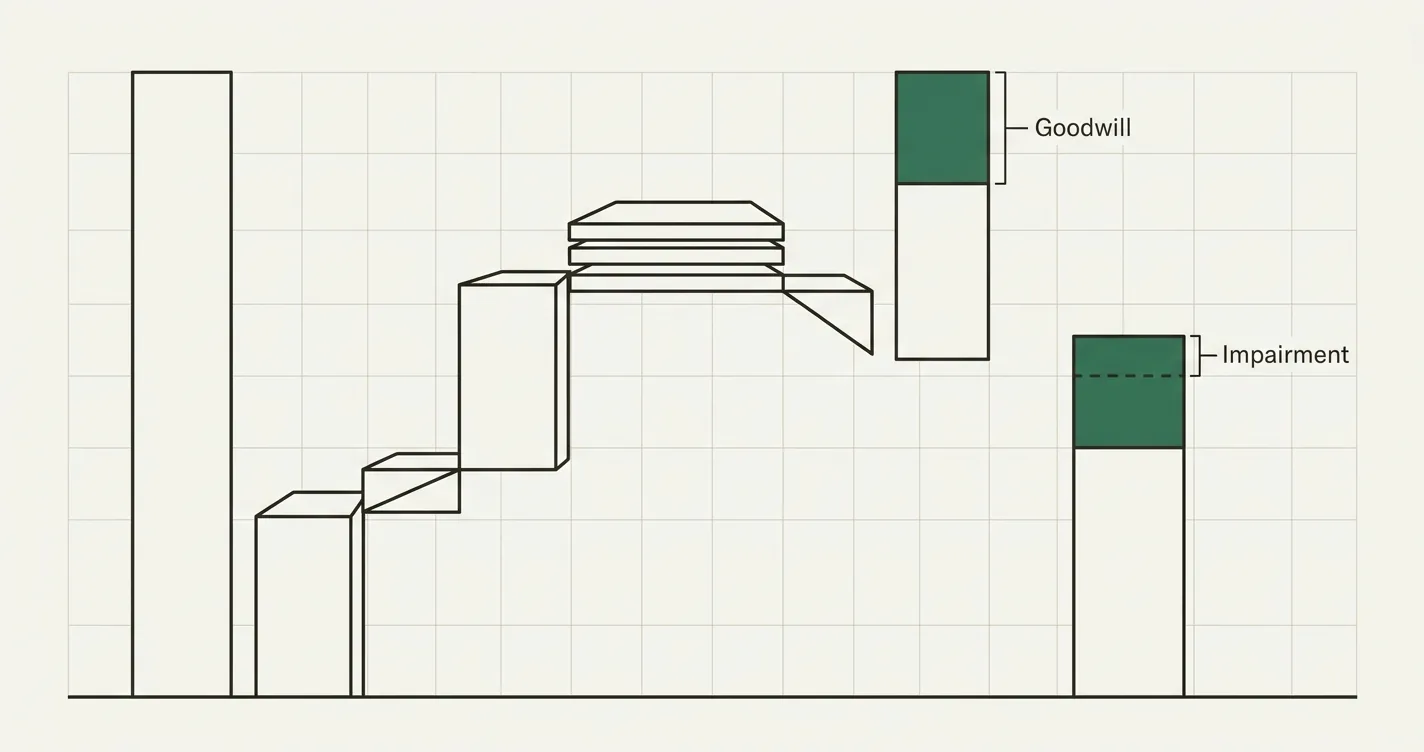
Purchase price allocation: from total consideration to goodwill, and the annual impairment test that follows.
What Purchase Price Allocation Is
Under US GAAP, business combinations are governed by ASC 805; under IFRS, the equivalent standard is IFRS 3. Both use the acquisition method, which requires the acquirer to:
- Identify the acquirer and the acquisition date.
- Measure the consideration transferred at fair value.
- Recognize and measure the identifiable assets acquired and liabilities assumed at fair value.
- Recognize goodwill (or, rarely, a bargain purchase gain) as the difference.
The core identity is simple:
Goodwill = Total Consideration Transferred - Fair Value of Net Identifiable Assets Acquired
Where:
Fair Value of Net Identifiable Assets = Fair Value of Identifiable Assets
                                        - Fair Value of Liabilities Assumed
                                        - Deferred Tax Liability on Write-Ups
Goodwill is not something you measure directly. It is a plug - the premium the buyer paid over the fair value of what can be individually identified, representing expected synergies, assembled workforce, and going-concern value.
Step 1: Total Consideration Transferred
Consideration is measured at fair value on the acquisition date and includes:
- Cash paid to target shareholders.
- Equity issued by the acquirer, valued at the acquirer's share price on the closing date (not the announcement date).
- Contingent consideration (earnouts) at fair value - the probability-weighted present value of expected future payments, not zero and not the maximum.
- Fair value of any previously held equity interest in the target (step acquisitions), remeasured to fair value with the gain or loss in earnings.
- Replacement share-based awards attributable to pre-combination service.
Consideration does not include acquisition-related costs (advisory, legal, due diligence). Those are expensed as incurred under ASC 805. Debt issuance costs follow the normal debt guidance.
For our example, assume the acquirer pays $500.0M total: $400.0M in cash plus $100.0M of acquirer stock. No earnout, no prior stake.
Step 2: Fair Value of Identifiable Assets and Liabilities
Start from the target's book balance sheet at close, then mark each line to fair value.
Target book balance sheet at acquisition
| Line item | Book value |
|---|---|
| Cash | $20.0M |
| Accounts receivable | $45.0M |
| Inventory | $60.0M |
| PP&E, net | $150.0M |
| Existing goodwill | $30.0M |
| Other intangibles, net | $10.0M |
| Total assets | $315.0M |
| Accounts payable | $40.0M |
| Accrued liabilities | $25.0M |
| Long-term debt | $70.0M |
| Total liabilities | $135.0M |
| Book equity (net assets) | $180.0M |
Fair value adjustments
| Adjustment | Detail | Amount |
|---|---|---|
| Inventory step-up | Finished goods marked to net realizable value less selling cost | +$8.0M |
| PP&E step-up | Appraisal fair value above net book value | +$40.0M |
| Developed technology | Newly recognized identifiable intangible, 8-year life | $60.0M |
| Customer relationships | Newly recognized identifiable intangible, 10-year life | $50.0M |
| Trade name | Newly recognized identifiable intangible, indefinite life | $20.0M |
| Remove target's existing goodwill | Not carried over; re-derived below | -$30.0M |
| Remove target's old book intangibles | Subsumed into the $130.0M of newly fair-valued intangibles | -$10.0M |
Two rules do most of the work in intangible asset allocation:
- The target's pre-existing goodwill is always eliminated. You never inherit the seller's goodwill. It is replaced by your own residual.
- Identifiable intangibles must be separated from goodwill if they arise from contractual or legal rights or are separable. The common categories: developed technology, customer relationships and customer contracts, trade names and trademarks, order backlog, non-compete agreements, and in-process R&D.
Assumed debt is marked to fair value too. Here we assume the target's $70.0M of long-term debt already carries a market rate, so fair value equals book value.
Step 3: The Deferred Tax Liability
This is the step first-timers skip. In a stock acquisition (the buyer purchases the target's shares), the target's tax basis in its assets carries over unchanged. But the acquirer's book basis is now the stepped-up fair value. Book basis above tax basis on assets that will be depreciated or amortized creates a taxable temporary difference, and ASC 740 requires a deferred tax liability (DTL) for it.
The DTL is measured on the write-ups that create future book-tax differences:
DTL = Tax Rate x (PP&E Step-Up + Net Intangible Uplift + Inventory Step-Up)
With a 25% tax rate:
Net intangible uplift = $130.0M fair value - $10.0M old book value = $120.0M
DTL = 25% x ($40.0M + $120.0M + $8.0M)
DTL = 25% x $168.0M
DTL = $42.0M
Two things to note:
- No DTL is recorded on goodwill itself when goodwill is not tax-deductible (the stock-deal case). ASC 740 contains a specific exception for non-deductible goodwill to avoid a circular calculation.
- The DTL is a liability assumed, so it reduces net identifiable assets and increases goodwill dollar-for-dollar.
Step 4: Goodwill as the Residual
Bridge from book equity to fair value of net identifiable assets
| Step | Amount | Running total |
|---|---|---|
| Target book equity | $180.0M | $180.0M |
| Remove target's existing goodwill | -$30.0M | $150.0M |
| Inventory step-up | +$8.0M | $158.0M |
| PP&E step-up | +$40.0M | $198.0M |
| Intangibles: $130.0M fair value less $10.0M book | +$120.0M | $318.0M |
| New deferred tax liability | -$42.0M | $276.0M |
Full acquisition-method allocation
| Asset / (Liability) | Fair value |
|---|---|
| Cash | $20.0M |
| Accounts receivable | $45.0M |
| Inventory | $68.0M |
| PP&E | $190.0M |
| Developed technology | $60.0M |
| Customer relationships | $50.0M |
| Trade name | $20.0M |
| Accounts payable | ($40.0M) |
| Accrued liabilities | ($25.0M) |
| Long-term debt | ($70.0M) |
| Deferred tax liability | ($42.0M) |
| Fair value of net identifiable assets | $276.0M |
| Goodwill (residual) | $224.0M |
| Total consideration transferred | $500.0M |
Check the arithmetic: identifiable assets at fair value sum to $453.0M ($20 + $45 + $68 + $190 + $60 + $50 + $20). Liabilities assumed sum to $177.0M ($40 + $25 + $70 + $42). Net identifiable assets = $453.0M - $177.0M = $276.0M. Goodwill = $500.0M - $276.0M = $224.0M. And $276.0M + $224.0M = $500.0M. It ties.
// Goodwill = consideration - fair value of net identifiable assets
= Consideration - (FV_Identifiable_Assets - FV_Liabilities_Assumed - Deferred_Tax_Liability)

// Deferred tax liability on stock-deal write-ups
= Tax_Rate * (PPE_StepUp + (Intangibles_FV - Intangibles_Book) + Inventory_StepUp)
The Earnings Impact After Close
The allocation is not a one-time journal entry - it changes reported earnings for years. Three effects flow through the pro forma income statement.
1. Incremental intangible amortization
| Intangible | Fair value | Useful life | Annual amortization |
|---|---|---|---|
| Developed technology | $60.0M | 8 years | $7.5M |
| Customer relationships | $50.0M | 10 years | $5.0M |
| Trade name | $20.0M | Indefinite | $0.0M (impairment-tested only) |
| Total | $130.0M | $12.5M / year (Years 1-8) |
From Year 9, only customer relationships remain, so amortization drops to $5.0M / year. Indefinite-lived intangibles like this trade name are never amortized; they are tested for impairment annually, the same as goodwill.
2. Incremental PP&E depreciation
The $40.0M PP&E step-up, depreciated straight-line over a 10-year remaining life, adds $4.0M / year of depreciation.
3. One-time inventory step-up
The $8.0M inventory step-up flows through COGS as that acquired inventory is sold - typically within the first one or two quarters. It is a non-recurring purchase-accounting charge that depresses first-year gross margin and is usually called out as an adjustment in non-GAAP reconciliations.
Putting the drag together
| Effect | Year 1 (pre-tax) | Years 2-8 (pre-tax) | Years 9-10 (pre-tax) |
|---|---|---|---|
| Intangible amortization | $12.5M | $12.5M | $5.0M |
| Incremental PP&E depreciation | $4.0M | $4.0M | $4.0M |
| Inventory step-up (one-time) | $8.0M | $0.0M | $0.0M |
| Total pre-tax drag | $24.5M | $16.5M | $9.0M |
| After-tax drag at 25% | $18.4M | $12.4M | $6.8M |
In a stock deal, the new amortization and step-up depreciation are not tax-deductible, but the DTL unwinds as those assets are consumed, producing a deferred tax benefit that offsets. The net income effect still works out to the pre-tax drag times (1 - tax rate). The Year 1 DTL reversal is 25% x ($8.0M + $4.0M + $12.5M) = $6.1M, taking the DTL from $42.0M to roughly $35.9M.
This is exactly why purchase price allocation feeds directly into an accretion / dilution analysis: the after-tax D&A drag is one of the largest dilutive line items in the first year after close.
Goodwill Impairment
Goodwill is not amortized under US GAAP for public companies. Instead, ASC 350 requires an impairment test at least annually, and immediately whenever a triggering event (lost customer, sustained share-price decline, adverse regulation) suggests the carrying amount may not be recoverable. The test is run at the reporting unit level.
Since ASU 2017-04, the test is a single step:
Goodwill Impairment = MIN( Reporting Unit Carrying Amount - Reporting Unit Fair Value , Goodwill Balance )
If carrying amount is at or below fair value, there is no impairment.
Worked impairment example
Two years after the deal, the acquired business is now a reporting unit:
| Input | Amount |
|---|---|
| Reporting unit carrying amount (including $224.0M goodwill) | $520.0M |
| Reporting unit fair value (from a DCF and market approach) | $460.0M |
| Excess of carrying amount over fair value | $60.0M |
| Goodwill balance available to write down | $224.0M |
| Impairment charge = min($60.0M, $224.0M) | $60.0M |
| Goodwill balance after impairment | $164.0M |
The $60.0M is a non-cash, pre-tax charge to operating income. If the goodwill was not tax-deductible, there is no offsetting tax benefit, so the full $60.0M hits net income. Impaired goodwill is never written back up, even if the reporting unit recovers.
// Single-step goodwill impairment, ASC 350 post ASU 2017-04
= MIN( MAX( ReportingUnit_CarryingAmount - ReportingUnit_FairValue , 0 ) , Goodwill_Balance )
IFRS and private-company differences
- IFRS (IAS 36): goodwill is tested at the cash-generating unit level; impairment equals carrying amount minus recoverable amount (the higher of value in use and fair value less costs of disposal). As with US GAAP, IFRS goodwill impairments cannot be reversed.
- US private companies (ASU 2014-02): may elect to amortize goodwill straight-line over 10 years (or less) and test for impairment only upon a triggering event - a simplification unavailable to public filers.
- Bargain purchase: if the fair value of net identifiable assets exceeds consideration, you first re-check every fair value, then recognize the remaining excess as a gain in earnings on the acquisition date. Negative goodwill is never carried on the balance sheet.
Asset Deal vs Stock Deal
Whether the transaction is structured as an asset purchase or a stock purchase changes the tax basis, the DTL, and whether goodwill shields cash taxes.
| Feature | Stock deal (no election) | Asset deal or 338(h)(10) / 336(e) election |
|---|---|---|
| Tax basis in acquired assets | Carryover (unchanged) | Stepped up to purchase price per IRC 1060 |
| Deferred tax liability on write-ups | Yes - book basis exceeds tax basis | Generally none - book and tax basis align |
| Goodwill and intangible amortization for tax | Not deductible | Deductible straight-line over 15 years under IRC 197 |
| Cash tax shield from the step-up | None | Meaningful - often a large share of deal value |
| Typical preference | Seller (single layer of tax) | Buyer (step-up plus liability isolation) |
A Section 338(h)(10) or 336(e) election lets a legal stock sale be treated as an asset sale for tax purposes - common for S-corporations and subsidiaries leaving a consolidated group. When an election applies, IRC 1060 allocates the purchase price across seven asset classes, with goodwill and going-concern value in the final residual class, mirroring the book PPA waterfall.
For how this allocation plugs into the broader deal build, see the merger model guide and, for the mechanics of the pro forma balance sheet it produces, how the three financial statements link together.
Common Mistakes to Avoid
- Forgetting the deferred tax liability. In a stock deal, skipping the DTL on write-ups overstates net identifiable assets and understates goodwill by the full DTL amount ($42.0M in our example).
- Carrying over the target's existing goodwill. The seller's goodwill is always eliminated and replaced by your own residual. Adding it on top double-counts.
- Mis-scoping intangible lives. Treating every intangible as indefinite-lived hides the amortization drag; treating an indefinite trade name as amortizing overstates it. Assign lives asset by asset.
- Ignoring the inventory step-up. The one-time COGS hit makes first-year margins look structurally worse than the run rate. Model it as non-recurring.
- Valuing earnouts at zero. Contingent consideration is measured at fair value at close. Booking it at zero understates consideration and goodwill, and later remeasurements hit earnings.
- Assuming goodwill shields taxes in a stock deal. It does not, absent a 338 or 336(e) election. Only asset deals and deemed-asset-deal elections produce a 15-year tax amortization of goodwill.
- Using book values for assumed debt and liabilities. Everything assumed is measured at fair value, including debt, leases, and off-market contracts.
- Expensing nothing. Advisory, legal, and diligence costs are expensed as incurred under ASC 805 - they are not part of consideration and not capitalized into goodwill.

Alex Tapio
Founder of Finamodel • Professional Financial Modeller • Ex-Deloitte