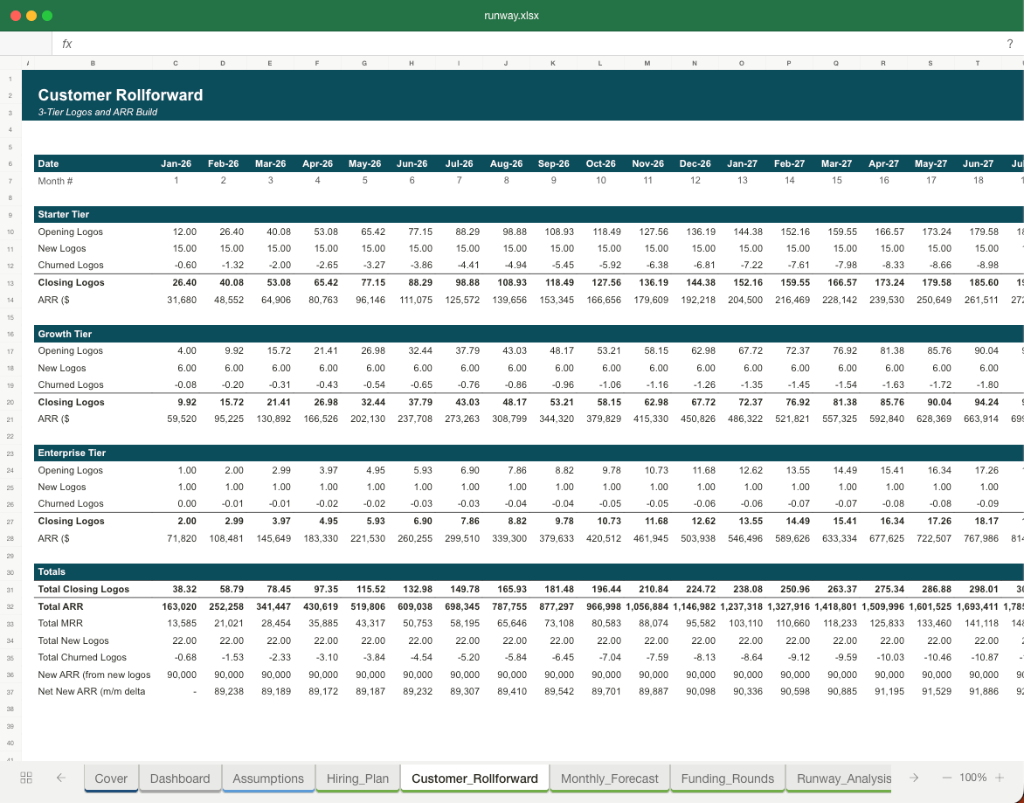
CACareerist Financial Model
Fintech Startup Financials (Free Excel Download)
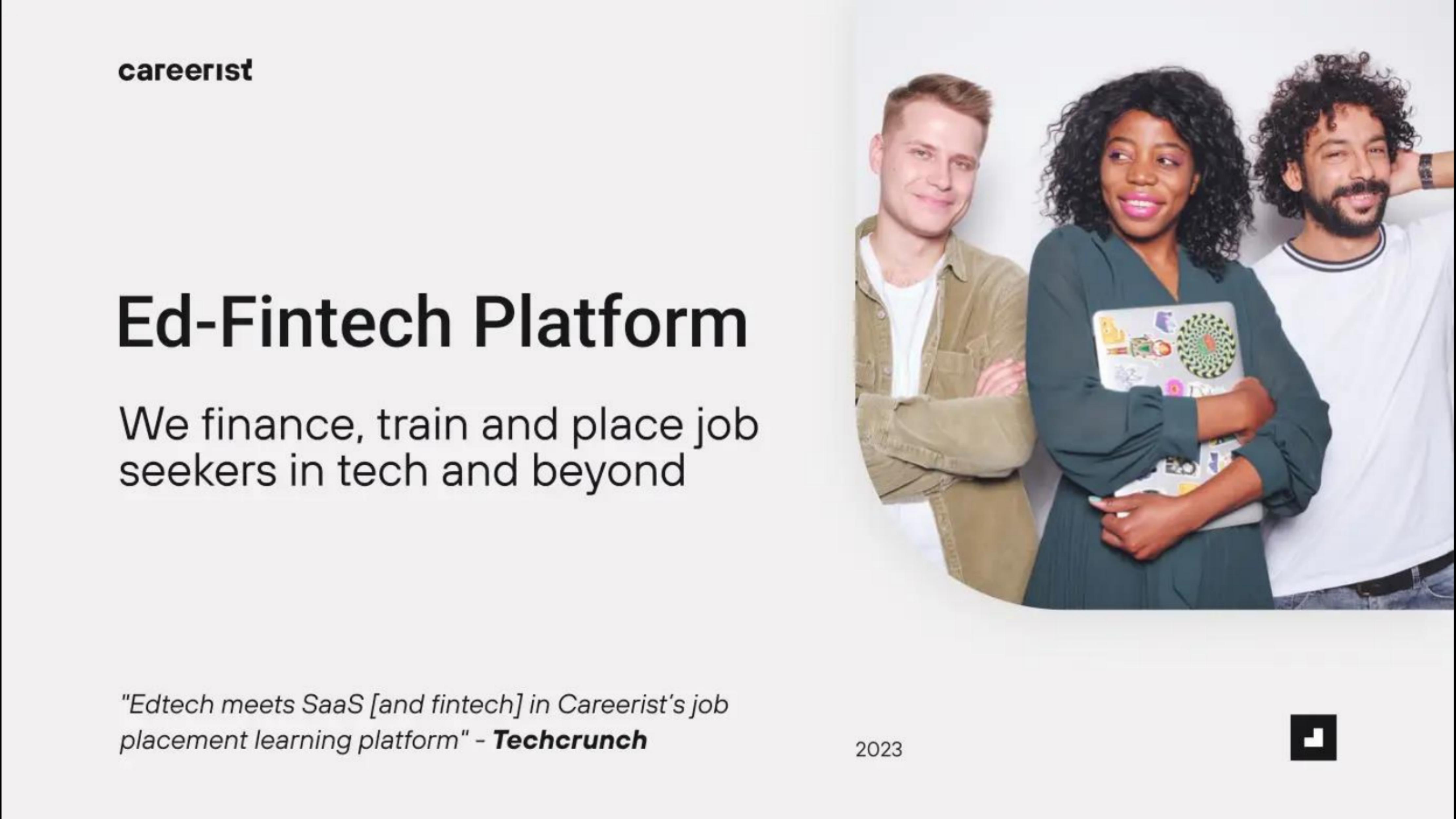
Ed-fintech platform that finances, trains, and places junior/mid-level job seekers in U.S. tech roles



professionals from Deloitte
Used by professionals from






About this model
Careerist is an education-fintech platform that trains and places junior and mid-level job seekers into US technology roles. It combines career programmes with financing, underwriting, and employer recruiting rather than operating as a conventional course provider.
Students can pay tuition upfront or use deferred-payment financing, while employers may pay recruiting fees when candidates are placed. That mix makes learner outcomes, collections, and employer demand as important as enrolment growth.
The model should forecast student cohorts, tuition mix, completion and placement rates, salary-linked recruiting fees, and cash-collection timing. Deferred tuition requires a separate loan-book schedule for originations, interest or fees, defaults, recoveries, and funding so revenue and cash are not conflated.
A turnkey financial model
Live formulas, no hardcoded values
Outputs are driven by live formulas, so the workbook updates from its assumptions instead of relying on hardcoded results.
All assumptions in one tab
Inputs are clearly marked in the Assumptions tab and separated from calculations, making it clear what to change and what to leave intact.
Statements always balancing
For integrated-statement models, the balance sheet, cash flow, and supporting schedules tie through properly.
Distinct schedules for clarity
Debt, working capital, taxes, and cash flow can get messy quickly. We group calculations in clear schedules, not across disconnected tabs.
No hidden macros or external links
There are no unexplained external workbook links or macros to undermine auditability or portability.
Changes flow through the model
Update a key driver and see the impact carry through the forecast, financing, and return outputs. We never use hardcoded numbers in formulas.
About Careerist
How to build a detailed financial model for Careerist
A complete walkthrough of the business, drivers, and assumptions behind the downloadable Careerist model - distilled from its pitch deck and publicly available information.
Product & value proposition
Three integrated components:
- Learning Marketplace - automated training via LMS software + freelance tutors
- Job Application Software - automated job hunting for job seekers; recruiter fee charged to employers on placement
- Financing - loans, deferred tuition plans, FinOps, proprietary underwriting using in-house data, collections
Value prop: removes all three barriers for junior/mid job-seekers simultaneously - skills gap, job-hunt friction, and upfront cost. TechCrunch: "Edtech meets SaaS [and fintech] in Careerist's job placement learning platform".
Market
- TAM: 50M+ people change jobs in the U.S. each year = $100B+ market
- SAM: 3M+ junior & mid-level professionals that change jobs in U.S. tech = $10B+ market
- SOM: Deck implies <20,000 consumer clients needed to reach $100M revenue (due to high LTV)
- E-learning market: surpassed $315B ($120B in North America) in 2021; projected 20% CAGR to ~$1T by end of 2020s
- No SOM figure explicitly stated; $100M revenue milestone at <20,000 clients is the implied near-term target
Revenue model
Three revenue streams:
- Upfront tuition - up to $12,500 per student, paid upfront
- Deferred payment / loan - monthly deferred payment plan or loan (terms not disclosed); Careerist acts as the lender/servicer using proprietary underwriting
- Employer recruiting fees - 10–20% of placed candidate's salary, paid by the hiring employer
Financing arm creates a fourth embedded revenue stream (interest / origination on loans) not explicitly broken out but implied by the "FinOps, underwriting, collections" description.
Traction & metrics
- Yearly cash revenue:
- 2019: $0.4M
- 2020: $1.7M
- 2021: $5M
- 2022: $12M
- 2023 (projected/run-rate): $25M+
- YoY growth rate described as ~250%
- Monthly revenue (at time of deck): ~$2M
- Monthly EBITDA: ~$500K (~25% EBITDA margin on monthly revenue)
- Clients placed at Fortune 500+ companies: 1,000+
- Employer logos cited: Amazon, Google, Apple, Facebook, Intel, Samsung, Salesforce, Visa, Uber, Tesla, JPMorgan, Walmart, Disney, Nike, Boeing, Slack, Oracle, Peloton, and others
- Q4'22 client acquisition breakdown (total 1,624 clients in the quarter):
- Organic: 569 (35%)
- Referrals: 409 (25%)
- Google: 224 (14%)
- Webinars: 176 (11%)
- Facebook: 168 (10%)
- Other: 78 (5%)
- NPS: 70+
- Review platform ratings: Career Karma 4.6/5 (688 reviews), Switchup 4.6/5 (132 reviews), Trustpilot 4.5/5 (78 reviews)
- Implied sub-NPS scores: Live lessons/instructors 74, Homework/assignments 95, Internship experience 71, Mentors 81, Overall 70
Unit economics
- Revenue per student: up to $12,500 upfront; deferred plan terms not given
- High LTV implied: deck states <20,000 clients needed to exceed $100M, implying blended LTV >$5,000 per client
- Monthly EBITDA margin: ~25% ($500K EBITDA / $2M revenue)
- Employer recruiting fee: 10–20% of placed salary; average placed salary not stated
Competition / moat
- Review platform benchmarks: Careerist 4.6 vs ~2.0 for Coursera and ~2.5 for Udemy
- Moat claims: proprietary underwriting using its own placement/repayment data; network effect from referrals (60% of Q4'22 intake was organic/referral); end-to-end integration of training + placement + financing
- No direct competitor analysis slide; only review score comparison
Team & funding ask / use of funds
- Ivan Tsybaev - Founder & CEO; serial entrepreneur; previously built Trucker Path (U.S. #1 trucking app with factoring monetization)
- Max Gusakov - Founder & CTO; 15 years engineering/full-stack/UX; co-built Trucker Path
- Max Glubochansky - Founder & CBO; 10+ years at Apple, Intel; mentored hundreds on careers
- Maria Pisareva - Finance; 10+ years CFO experience (Hyundai, RubyGarage, Lauffer, 4Service Group)
- Cosmo Grill - Marketing; General Assembly (acquired by Adecco for $413M)
- Kirill Myasnikov - Operations; GE, ExxonMobil
- Lei Aquino - Sales; COPC CX certified
- Roman Kurchaev - Sales; 10+ years EdTech sales (Skillbox, Mentorama)
- Alexey Ishchenko - Marketing; EdTech/FinTech background
- James Herbert - Fintech Advisor & Investor; Head of Student Loan Refinancing at First Republic Bank; co-founder LendingHome
Recommended financial model
- Archetype + why: Hybrid EdTech cohort P&L + FinTech loan book model. Careerist has two distinct economic engines that must be modelled separately and then consolidated: (1) a cohort-based training business with upfront + deferred tuition revenue, and (2) a growing loan/ISA book with interest income, default risk, and collections. The employer recruiting fee stream is a third line. A pure SaaS ARR model would miss the timing differences between cash collected, revenue recognized on deferred plans, and expected credit losses on the loan book. A 3-statement model sits on top.
- Forecast horizon & granularity: Monthly for Years 1–2 (2024–2025), quarterly for Years 3–5 (2026–2028). Starting base: 2023 run-rate of ~$24M cash revenue (~$2M/month).
- Key drivers & assumptions:
- New enrollments per month - Q4'22: ~541/month (1,624/quarter); implied ~650–800/month at $2M monthly revenue if avg. ticket ~$3K blended. model blended avg. tuition/enrollment at ~$3,000 given mix of upfront ($12,500) and deferred/partial-pay students; rationale: not all students pay full upfront price.
- Revenue per enrollment (upfront stream) - up to $12,500; blended realized tuition ~$3,000–$4,000 accounting for deferred/loan mix and employer fee offsets; flag as key sensitivity.
- Deferred / loan mix - 50% upfront / 50% deferred initially; rationale: deck presents both equally, no split given; key sensitivity.
- Loan book: interest rate - 12–18% APR; rationale: typical ISA/consumer fintech rates for unsecured income-share arrangements.
- Loan book: default / loss rate - 5–10% of loan principal; rationale: no placement/repayment data disclosed; conservative given proprietary underwriting claim.
- Collections recovery rate - 30–50% of defaulted loans; standard consumer fintech assumption.
- Employer recruiting fee per placement - 10–20% of placed salary; average placed salary $60K → fee $6K–$12K per placement; placement rate vs. enrolled students not given.
- Placement rate - 60–80%; rationale: high NPS (70+) and Fortune 500 logo list suggest strong outcomes, but no explicit stat.
- Blended CAC - $400–$600/enrollment; rationale: 60% organic+referral suggests low paid CAC, with Google/Facebook making up ~24% of spend.
- Gross margin on training - 60–70%; rationale: LMS-automated delivery + freelance tutors; no COGS data given.
- EBITDA margin - ~25% ($500K/$2M monthly); model should reconcile to this at current scale, then flex with investment.
- Revenue growth rate - ~250% YoY historically; deceleration to 80% in 2024, 50% in 2025, 30% in 2026 as base case; rationale: law of large numbers at $25M+ base.
- Headcount / OpEx - scale proportionally with enrollments; no headcount data in deck.
- Scenarios (Base / Bull / Bear - which variables flex):
- Base: 50% deferred mix, 5% default rate, 250→80% growth deceleration, 65% placement rate
- Bull: 30% deferred mix (more cash upfront), 3% default rate, sustain 100% growth, 80% placement rate, recruiting fee revenue scales
- Bear: 70% deferred mix, 12% default rate (loan book drag), growth slows to 40%, higher CAC as organic referral loop weakens
- Required sheets / outputs:
- Assumptions - all drivers with / tags
- Enrollment model - monthly new cohorts, channel mix, CAC by channel
- Revenue waterfall - upfront tuition, deferred tuition (recognized over program), employer recruiting fees, loan interest income
- Loan book - originations, outstanding balance, interest income, defaults, collections, net credit loss
- P&L (Income Statement) - gross profit by stream, EBITDA, net income
- Cash flow - cash vs. accrual gap from deferred plans; loan origination as cash out
- Balance sheet - loan book as asset, deferred revenue as liability
- Unit economics summary - LTV, CAC, payback, net LTV/CAC by cohort vintage
- Dashboard - KPI cards: enrollments, MRR, EBITDA margin, loan book size, default rate, NPS proxy
Frequently asked
Is the Careerist financial model free?+
Yes. The Careerist model is a free Excel (.xlsx) download with live formulas. Sign up with your email and the workbook is yours to keep, review, and edit.
What's included in the model?+
A 5-year monthly forecast with P&L, cash flow and runway, valuation (exit multiple plus a DCF cross-check), MOIC/IRR returns, and unit economics, with live formulas throughout.
How was this model built?+
It was built from Careerist's pitch deck and publicly available information, then structured to investment-banking standards as a fully editable Excel model.
Can I change the assumptions?+
Yes. You can change assumptions and the live formulas will recalculate in the downloadable Excel model.
Have more financial modelling questions? Contact us

Created by ex-finance professionals
Hey, I’m Alex and I created Finamodel.
Over my years in the finance industry I kept building the same models over and over again. Same structure, same assumptions, different logo. So I started building frameworks to turn them into clean, reusable templates.
Every model here is one I’d actually use for a client, and I personally vet each one before it goes up.
I’m not an expert in every industry, but I’ve built enough models to know what belongs in one. And when something is completely foreign to me, I reach out to my network for experts to work on our models with us.
Having a template library on hand cuts a first build from hours to minutes.
Need help finding your model? You’ll find me in the Finamodel app!
Other Fintech Startup Financial Models
Browse another startup in the same category.
Acin
SaaS and data subscription network for operational risk management at Tier 1 financial institutions

Ageras Group
B2B SME ecosystem - marketplace connecting SMEs with accountants + cloud accounting/payroll software + embedded financial services (lending, factoring, banking)

Airbase
Unified non-payroll spend management platform (corporate cards, AP/bill pay, expense reimbursement, approval workflows) for mid-market companies.

Altruist
Vertically integrated all-in-one platform for registered investment advisors (RIAs) - combining custodial, portfolio management, practice management, and client acquisition tools.
Amenitiz
All-in-one hotel management SaaS platform ("Shopify for hotels") for independent hoteliers - PMS, booking engine, channel manager, website builder, payments, and AI-driven revenue management.

Anrok
SaaS sales tax compliance platform - nexus monitoring, calculation, registration, filing, and remittance - built specifically for SaaS companies.
Arrival
Arrival is an EV manufacturer of commercial vans and buses using proprietary Microfactories and vertically integrated components, going public via SPAC merger with CIIG Merger Corp.

AtoB
AtoB is building financial infrastructure for commercial fleets, starting with a no-fee Visa fleet card for fuel and expanding into payroll, BNPL, and international.