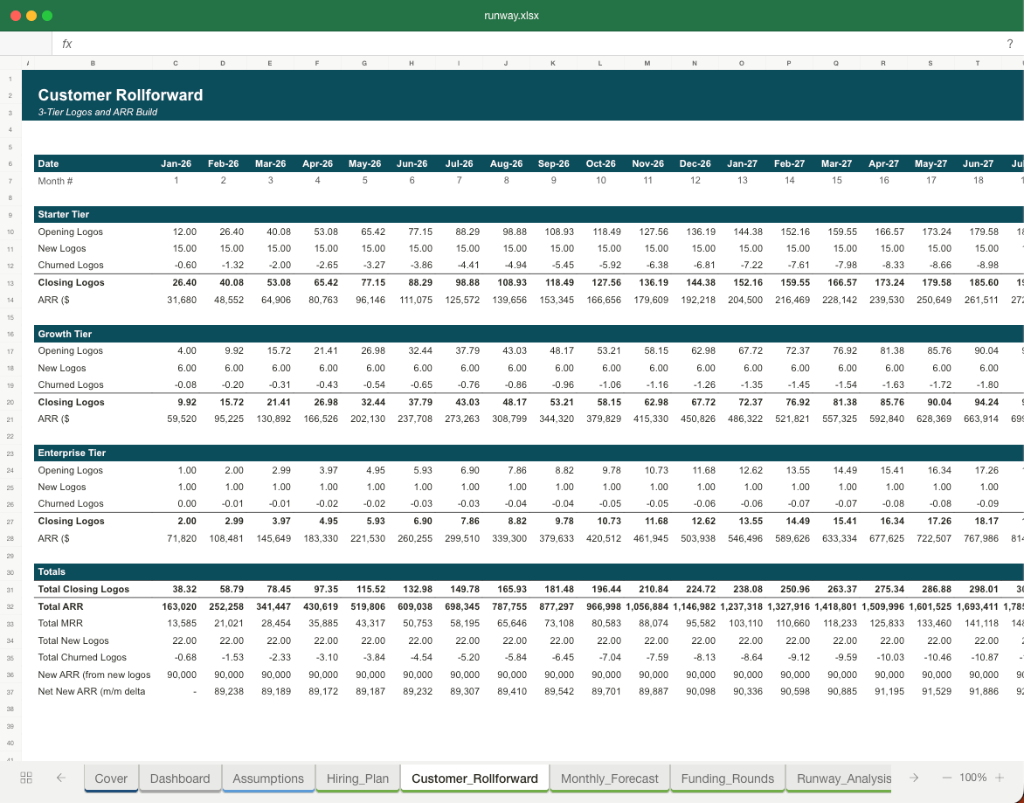
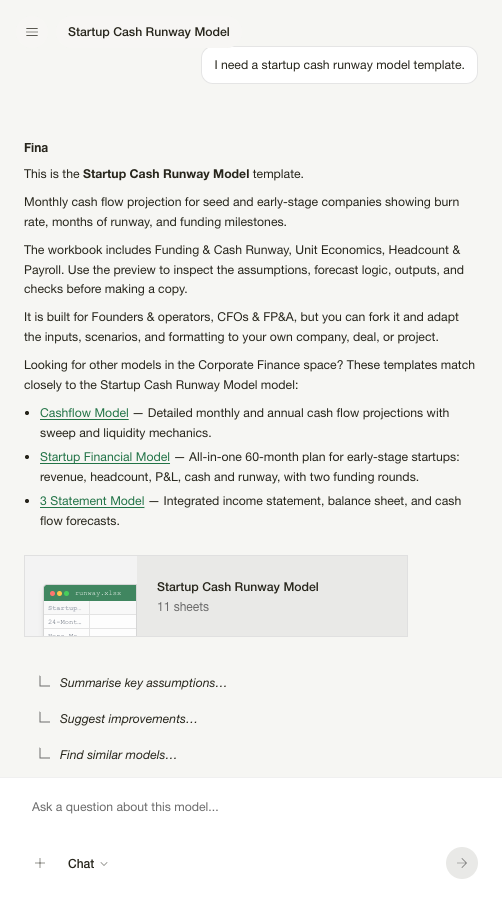
 CGHero Financial Model
Marketplace Startup Financials (Free Excel Download)
Two-sided talent marketplace connecting CGI, 3D, and VFX artists ("Heroes") with studios and production companies worldwide.



professionals from Deloitte
Used by professionals from






About this model
CGHero is a talent marketplace for CGI, 3D, and VFX work, connecting production studios with vetted artists worldwide. It supports individual freelance engagements as well as managed outsourcing, co-development, and larger distributed production teams.
The platform reported 5,500 registered artists, 400 studio clients, 1,000 completed productions, and talent in 100 countries. This gives CGHero a two-sided marketplace foundation, while its managed-service tiers address projects that need more coordination than a simple freelancer match.
The model separates marketplace commission from managed-service gross profit. Active studio clients, projects per client, artist matching, average project value, and take rate drive marketplace revenue; higher-touch tiers add studio billing less artist delivery cost. Supply growth, repeat studios, project mix, and service margin are the key forecasting levers.
A turnkey financial model
Live formulas, no hardcoded values
Outputs are driven by live formulas, so the workbook updates from its assumptions instead of relying on hardcoded results.
All assumptions in one tab
Inputs are clearly marked in the Assumptions tab and separated from calculations, making it clear what to change and what to leave intact.
Statements always balancing
For integrated-statement models, the balance sheet, cash flow, and supporting schedules tie through properly.
Distinct schedules for clarity
Debt, working capital, taxes, and cash flow can get messy quickly. We group calculations in clear schedules, not across disconnected tabs.
No hidden macros or external links
There are no unexplained external workbook links or macros to undermine auditability or portability.
Changes flow through the model
Update a key driver and see the impact carry through the forecast, financing, and return outputs. We never use hardcoded numbers in formulas.
About CGHero
cghero.com
How to build a detailed financial model for CGHero
A complete walkthrough of the business, drivers, and assumptions behind the downloadable CGHero model - distilled from its pitch deck and publicly available information.
Product & value proposition
CGHERO is a collaborative talent platform enabling production companies to source and manage CGI, 3D, and VFX talent at any scale - from individual freelancers to fully distributed "Liquid Super Teams." The platform addresses a supply/demand mismatch: complex CGI/VFX productions have outpaced studios' ability to hire in-house, while thousands of skilled artists globally lack a structured route to work. Studios get flexible, pre-vetted, production-ready talent; artists get access to professional productions they couldn't reach independently.
Service tiers (roadmap shown on slide 7, 2019–2023): Internal Hires → Freelance & Contract → Managed Outsource → Co-dev Studio → Liquid Super Teams
Market
- TAM: $270bn global studio market
- SAM (CGHERO opportunity - "value of non-core outsource production"): $8bn total across five verticals:
- Gaming: $2.1bn
- TV & Film: $3.3bn
- Retail: $1.6bn
- Automotive: $0.8bn
- Architecture: $0.3bn
- Market growth rate: Described as "high growth" but no CAGR cited
Revenue model
Not explicitly stated in deck. Based on platform description and service tiers, the model is likely one or more of:
- Take-rate / commission on freelance placements (marketplace fee on artist earnings or studio billing)
- Managed-service margin on outsourced production (studio-side billing with artist cost underneath)
- Subscription or platform-access fee
No pricing page, take-rate %, or revenue recognition detail shown.
Traction & metrics
All from slides 05 and 06:
- 5,500 Industry Heroes (supply side, registered artists)
- 400 Studio Clients (demand side)
- 1,000 Productions completed
- 100 countries represented in artist supply base
- Founded 2017
- No revenue figures, GMV, growth rates, or cohort data shown
Competition / moat
Not explicitly framed as a competition slide in the deck. Implied moat:
- Supply-side network of 5,500 vetted, production-ready artists across 100 countries
- Founder's prior domain experience: Jonathan Lloyd founded Falling Pixel (3D marketplace, acquired by TurboSquid/Intel/Kodak-backed in 2011) and served as VP Strategic & Product Development at TurboSquid
- Positioned as managed/curated supply rather than open freelance marketplace (quality and vetting angle implied)
- Epic MegaGrants recipient - signals platform/tech credibility in the gaming/3D space
Team & funding ask / use of funds
Team:
- Jonathan Lloyd - Founder/CEO (implied); previously Falling Pixel → TurboSquid
- Chris Lawrence - COO; formerly Falling Pixel, Burrows CGI; Computer Animation BSc
- Paul Bannon - Producer; formerly Dock10, Futureworks, Travellers Tales, EON Reality, Ripstone; Game Design BA
- Jonathan Webb - CTO; formerly Playtech, BAE Systems, Barclaycard; Game Design BSc
Board / advisors:
- Ron Ashtiani - Angel; Founder of Atomhawk Design (sold to Sumogroup Plc); credits include EA, Microsoft, Warner Bros.
- Eyal Malinger - Board; Investment Director, Partner at Beringea; board memberships at Papier, CreativeX, Commonplace, Festicket, Poq; Harvard MBA
- Paul Drew - NXD; SVP Metaswitch Networks; angel investor in marketplace-focused tech companies; Oxford MSc
Investors:
- Beringea (institutional VC)
- Fuel Ventures
- Epic MegaGrants (non-dilutive grant from Epic Games)
- Additional industry angels
Recommended financial model
- Archetype + why: Marketplace GMV / take-rate model, layered with a managed-services P&L for the higher-tier offerings (Managed Outsource, Co-dev Studio, Liquid Super Teams). Two-sided marketplace dynamics (supply growth, demand growth, match rate, take-rate) drive top-line; managed-service tiers carry a separate gross margin profile (billing rate minus artist cost). A pure SaaS model is not appropriate - no subscription pricing evidence. An agency/services P&L alone understates the platform scalability angle.
- Forecast horizon & granularity: 5-year (annual columns, monthly for Year 1 if runway/cash-burn is in scope). Given early traction and no revenue disclosed, a monthly build for Y1 is valuable for burn visibility.
- Key drivers & assumptions:
- Number of active studio clients (demand side): 400 current; growth rate 30–50% YoY for Y1–Y3, moderating to 20% Y4–Y5, given early-stage network effects
- Productions per client per year: 2–4 productions/client/year; increases as managed-service tiers deepen
- Average production value (APV) / GMV per production: £15k–£50k depending on tier (freelance vs. managed outsource); no deck data
- Take-rate (marketplace fee): 15–25% of GMV for freelance/contract tier; managed-service tiers carry ~40–50% gross margin (studio billing minus artist cost)
- Artist supply (Heroes): 5,500; growth tracks demand with lag; key constraint is vetted-supply bottleneck
- Revenue mix by tier: majority currently freelance/contract (lower margin); shift toward managed outsource / co-dev by Y3 per roadmap
- Gross margin: 20–30% blended (lower for managed services with artist pass-through cost; higher for pure platform/matching revenue)
- Headcount/opex: small team (~10–20 FTE); no data in deck - build bottoms-up with sales, ops, tech functions
- Geographic mix: predominantly UK/EU near-term; global supply already in place
- Scenarios (Base / Bull / Bear - which variables flex):
- Base: 30% client growth, 2.5 productions/client, £20k APV, 20% take-rate
- Bull: 50% client growth, higher APV via managed-service upsell, faster tier migration, 25% take-rate on platform tiers
- Bear: 15% client growth, stagnation in managed-service adoption, take-rate compression from competition, higher artist acquisition cost
- Required sheets / outputs:
- Assumptions dashboard (all drivers in one place)
- Supply-side build: Hero count growth, vetting cost, activation rate
- Demand-side build: Studio client adds, production volume per client, tier mix
- GMV bridge: Productions × APV per tier
- Revenue & gross profit: Take-rate revenue (marketplace) + managed-service margin
- P&L: Revenue → gross profit → operating expenses → EBITDA
- Headcount plan
- Cash flow / runway (burn rate, months of runway)
- Scenario toggle
- KPI summary: Clients, productions, GMV, revenue, gross margin %, burn, runway
Frequently asked
Is the CGHero financial model free?+
Yes. The CGHero model is a free Excel (.xlsx) download with live formulas. Sign up with your email and the workbook is yours to keep, review, and edit.
What's included in the model?+
A 5-year monthly forecast with P&L, cash flow and runway, valuation (exit multiple plus a DCF cross-check), MOIC/IRR returns, and unit economics, with live formulas throughout.
How was this model built?+
It was built from CGHero's pitch deck and publicly available information, then structured to investment-banking standards as a fully editable Excel model.
Can I change the assumptions?+
Yes. You can change assumptions and the live formulas will recalculate in the downloadable Excel model.
Have more financial modelling questions? Contact us

Created by ex-finance professionals
Hey, I’m Alex and I created Finamodel.
Over my years in the finance industry I kept building the same models over and over again. Same structure, same assumptions, different logo. So I started building frameworks to turn them into clean, reusable templates.
Every model here is one I’d actually use for a client, and I personally vet each one before it goes up.
I’m not an expert in every industry, but I’ve built enough models to know what belongs in one. And when something is completely foreign to me, I reach out to my network for experts to work on our models with us.
Having a template library on hand cuts a first build from hours to minutes.
Need help finding your model? You’ll find me in the Finamodel app!
Other Marketplace Startup Financial Models
Browse another startup in the same category.

Acquco
Amazon brand aggregator - acquires third-party Amazon seller businesses at attractive multiples, then scales them via proprietary growth playbooks and technology.
Arive
Premium q-commerce app delivering lifestyle and branded products in under 30 minutes across German cities.

Audience Town
Vertical data and advertising platform targeting home movers across the entire home journey - pre-move through post-move.

AudioMob
Non-intrusive in-game audio ad platform bridging music/brand advertisers to mobile game publishers.

Authoritive
Two-way messaging platform that turns creator expertise into scalable, push-delivered learning experiences via SMS/WhatsApp.

Avo
Building amenity and office perk platform delivering same-day grocery/pantry/goods to residential and commercial tenants via a white-label marketplace.
beehiiv
Newsletter platform for creators to build, grow, and monetize email audiences - SaaS subscription + native ad network revenue.
Borzo
Global same-day logistics marketplace connecting B2B merchants with crowdsourced couriers for last-mile delivery