 Convelio Financial Model
Marketplace Startup Financials (Free Excel Download)
Tech-enabled logistics platform for non-palletized, time-critical, high-value goods (art, antiques, design objects), starting with the fine-art market.



professionals from Deloitte
Used by professionals from






About this model
Convelio is a technology-enabled logistics platform for high-value, time-sensitive goods such as art, antiques, and design objects. It offers instant quoting, booking, tracking, customs, packing, and insurance through its own platform and integrations with galleries, marketplaces, and auction houses.
The company reported 98% revenue CAGR since inception, more than 1,000 clients served each week, and a 53 NPS. Instead of charging a software subscription, Convelio earns transactional shipping revenue by pricing the job to clients and retaining the spread over supplier costs.
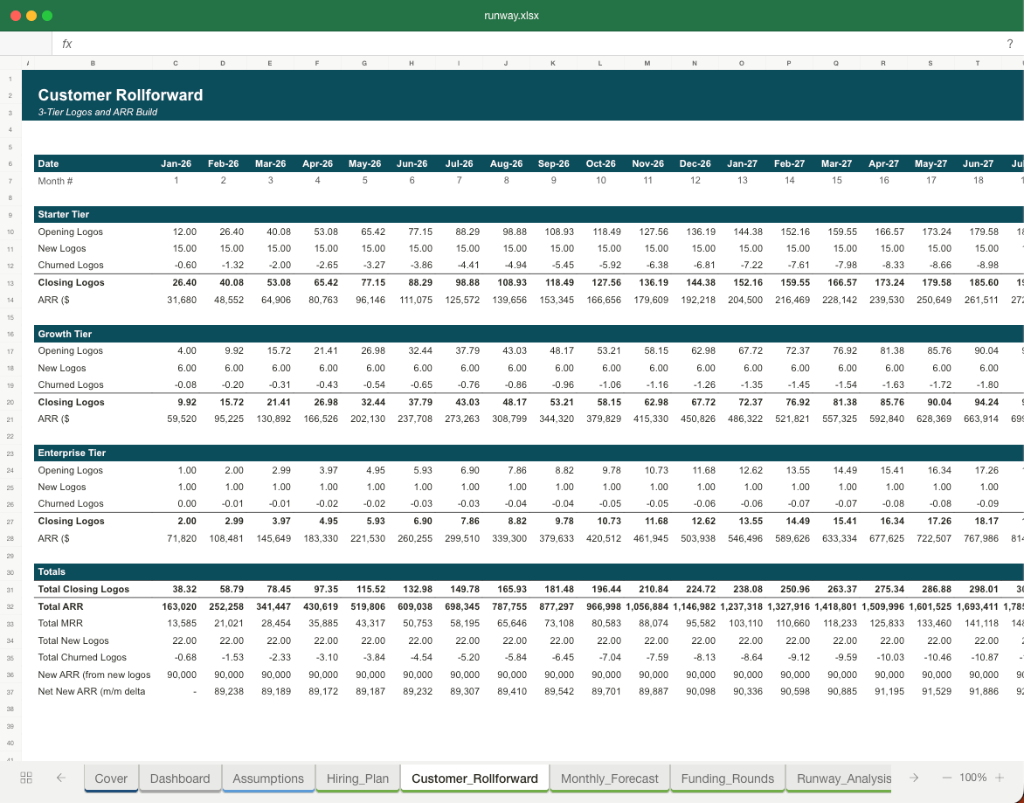
The financial model is a freight-brokerage P&L. Shipment volume, average quoted price, channel mix, and conversion determine revenue, while carrier and service-provider costs create gross margin. Country expansion, sales, operations headcount, and the mix of self-serve versus integrated bookings show how growth translates into cash generation.
A turnkey financial model
Live formulas, no hardcoded values
Outputs are driven by live formulas, so the workbook updates from its assumptions instead of relying on hardcoded results.
All assumptions in one tab
Inputs are clearly marked in the Assumptions tab and separated from calculations, making it clear what to change and what to leave intact.
Statements always balancing
For integrated-statement models, the balance sheet, cash flow, and supporting schedules tie through properly.
Distinct schedules for clarity
Debt, working capital, taxes, and cash flow can get messy quickly. We group calculations in clear schedules, not across disconnected tabs.
No hidden macros or external links
There are no unexplained external workbook links or macros to undermine auditability or portability.
Changes flow through the model
Update a key driver and see the impact carry through the forecast, financing, and return outputs. We never use hardcoded numbers in formulas.
About Convelio
convelio.com
How to build a detailed financial model for Convelio
A complete walkthrough of the business, drivers, and assumptions behind the downloadable Convelio model - distilled from its pitch deck and publicly available information.
Product & value proposition
- Instant online quoting for art/antiques/design shipments via proprietary pricing algorithm (vs. 48–72 hr industry norm).
- Full online experience: quoting, booking, checkout, end-to-end tracking - vs. email/phone-only incumbents.
- One-stop-shop: pick-up, packing, airfreight, customs formalities, insurance.
- Distribution channels: self-serve platform, public API, widget (e-commerce integrations), inventory quoting solution.
- Pricing advantage: claimed -46% vs. incumbents on sample Paris→NYC airfreight for an €82k painting: Convelio €1,796 vs. ARTA €4,077.
- Key client: Sotheby's (Global Head of Operations testimonial; described as a "pivotal digital strategy" integration).
- Platform metric: 1,000+ clients served each week; 1 shipping price displayed per minute to sellers online.
Market
- Total logistics TAM: $7.4 trillion (General Cargo market).
- SAM - Convelio's target segment: Non-palletized, time-critical & high-value goods logistics = $1.6 trillion (18% of total logistics market).
- Fine art market specifically: US = 44% of fine-art market size. No absolute art market size figure shown.
Revenue model
- Revenue = shipping fees charged to clients for each shipment (freight brokerage model: Convelio prices and books shipments end-to-end, taking a margin vs. supplier cost).
- Pricing is per-shipment; instant quotes generated via proprietary algorithm.
- Channels: direct online platform, API/widget integrations (e-commerce platforms, galleries, auction houses).
- No subscription / SaaS fee explicitly mentioned - transactional revenue per shipment implied.
- Insurance appears to be included in service bundle (not broken out as separate revenue line).
- Revenue currency: EUR (HQ France); US and UK operations also active.
Traction & metrics
- Revenue CAGR since inception: 98%.
- Revenue trajectory: Monthly revenue bar chart from Q4 2017 through Q4 2021 shows consistent quarter-on-quarter growth, with COVID-19 dip visible in Q2 2020, recovering strongly through 2021. Q4 2021 bar is the highest shown with a dotted line projecting further upward ("Expected based on current trading"). No absolute revenue figures are legible from the chart axis.
- Clients: 1,000+ clients served each week.
- NPS: 53 (out of survey sent to all clients). Breakdown: 130 promoters (70%), 30 passive (16%), 27 detractors (14%).
- Total headcount: ~160 employees (120 France, 24 UK, 16 USA).
- Funding history: Seed round (raised ~Q4 2018), Series A (raised ~Q4 2019) - visible on revenue chart timeline.
Unit economics
- Gross margin: Described as "high margins" for their segment vs. "low margins" in general cargo. No specific % given.
- Price competitiveness: -46% vs. closest incumbent on a sample shipment, implying meaningful room between market price and supplier cost.
- AOV: Implied high (shipping an €82k painting at €1,796 per shipment - suggesting AOV likely €1,000–€4,000+ range).
Competition / moat
- Direct competitors named: ARTA, Andre Chenue, ESI Transport, Cadogan Tate (all incumbents, offline, email-only, no instant pricing, no end-to-end tracking).
- Adjacent/general freight: Convoy, Zencargo, Flexport, Forto, Sennder (palletized / general cargo segment, not direct).
- Moats claimed:
- Proprietary instant pricing algorithm (80+ country coverage).
- First-mover as tech-native in a low-tech, fragmented vertical.
- API integrations with large platforms (Sotheby's, 1stdibs referenced in customer emails).
- Land & expand playbook with large clients.
- Freight management + dispatch software for internal ops (not just a frontend).
Team & funding ask / use of funds
- Co-founders:
- Edouard Gouin, Co-CEO - former GVD at Rocket Internet; BD, Product & Tech, Corporate Finance.
- Clément Ouizille, Co-CEO - former COO of two startups, investment banking background (Rothschild & Co).
- Key hires: GM Europe (ex-DB Schenker CCO, Bain), GM USA (ex-Houzz VP Sales, ex-Flowspace CRO), GM UK (ex-Strategy&), VP Global Ops (ex-Oliver Wyman), CTO (ex-Tiller/SumUp), Head of Finance (ex-Mazars).
- Funding ask: €35M+ Series B.
- Use of funds:
- Accelerate US growth (US = 44% of fine-art market).
- Consolidate European offering - open local offices.
- Technology - large-scale API integrations, operational automation.
- Enhance offering - additional high-revenue opportunities.
- Prior rounds: Seed (~Q4 2018), Series A (~Q4 2019) - amounts not disclosed in deck.
Recommended financial model
- Archetype + why: Freight brokerage / logistics transactional P&L (GMV / revenue take-rate model), similar to a marketplace. Convelio books and executes shipments, takes a gross margin between client price and supplier cost. Not a pure SaaS model (no subscription revenue stated). A 3-statement model is appropriate given Series B stage, multi-country operations, and capex in tech and headcount.
- Forecast horizon & granularity: 5-year (2022–2026), quarterly for Years 1–2, annual for Years 3–5. Monthly optional for Year 1 cash management.
- Key drivers & assumptions:
| Driver | Value |
|---|---|
| Revenue CAGR (historical) | 98% |
| Forward revenue growth - Y1 | 80% |
| Forward revenue growth - Y2 | 60% |
| Forward revenue growth - Y3–5 | 40% / 30% / 25% |
| Revenue model | Per-shipment fee (transactional) |
| Average shipment value (AOV) to client | €2,000–€3,000 |
| Gross take-rate (gross margin on revenue) | 35–45% |
| Clients served per week (current) | 1,000+ |
| Client growth rate | Tied to revenue growth / AOV change |
| Headcount (current) | ~160 employees |
| Headcount growth Y1 | +40% |
| S&M as % of revenue | 15–20% |
| R&D / Tech as % of revenue | 10–15% |
| G&A as % of revenue | 8–12% |
| Series B raise | €35M+ |
| Cash burn to breakeven | ~24–30 months at current trajectory (model to solve) |
- Scenarios (Base / Bull / Bear - which variables flex):
- Base: 80% → 40% revenue CAGR trajectory; gross margin 38%; headcount scales with revenue.
- Bull: US ramp accelerates (US = 44% of market; fast enterprise wins); 90%+ Y1 growth; gross margin expands to 42% via tech automation.
- Bear: macro/art market slowdown; growth decelerates to 40% Y1; gross margin compresses to 32% (pricing pressure to retain enterprise accounts).
- Flex variables: revenue growth rate, AOV, gross take-rate, S&M spend, headcount ramp pace.
- Required sheets / outputs:
- Assumptions - all drivers in one place, clearly tagged.
- Revenue build - shipments × AOV, split by geography (Europe / USA / RoW) and channel (direct / API).
- P&L (Income Statement) - Revenue, COGS (supplier freight cost), Gross Profit, OpEx by function (S&M, R&D, G&A), EBITDA, EBIT, Net Income.
- Headcount plan - by function and geography, linked to OpEx.
- Cash flow - operating, capex (tech), funding rounds.
- Balance sheet - simplified (cash, AR, AP, equity).
- KPI dashboard - Monthly revenue run-rate, Gross margin %, Shipment volume, Client count, NPS (static), cash runway.
- Scenario toggle - drop-down or data table switching Base / Bull / Bear.
Frequently asked
Is the Convelio financial model free?+
Yes. The Convelio model is a free Excel (.xlsx) download with live formulas. Sign up with your email and the workbook is yours to keep, review, and edit.
What's included in the model?+
A 5-year monthly forecast with P&L, cash flow and runway, valuation (exit multiple plus a DCF cross-check), MOIC/IRR returns, and unit economics, with live formulas throughout.
How was this model built?+
It was built from Convelio's pitch deck and publicly available information, then structured to investment-banking standards as a fully editable Excel model.
Can I change the assumptions?+
Yes. You can change assumptions and the live formulas will recalculate in the downloadable Excel model.
Have more financial modelling questions? Contact us

Created by ex-finance professionals
Hey, I’m Alex and I created Finamodel.
Over my years in the finance industry I kept building the same models over and over again. Same structure, same assumptions, different logo. So I started building frameworks to turn them into clean, reusable templates.
Every model here is one I’d actually use for a client, and I personally vet each one before it goes up.
I’m not an expert in every industry, but I’ve built enough models to know what belongs in one. And when something is completely foreign to me, I reach out to my network for experts to work on our models with us.
Having a template library on hand cuts a first build from hours to minutes.
Need help finding your model? You’ll find me in the Finamodel app!
Other Marketplace Startup Financial Models
Browse another startup in the same category.

Acquco
Amazon brand aggregator - acquires third-party Amazon seller businesses at attractive multiples, then scales them via proprietary growth playbooks and technology.
Arive
Premium q-commerce app delivering lifestyle and branded products in under 30 minutes across German cities.

Audience Town
Vertical data and advertising platform targeting home movers across the entire home journey - pre-move through post-move.

AudioMob
Non-intrusive in-game audio ad platform bridging music/brand advertisers to mobile game publishers.

Authoritive
Two-way messaging platform that turns creator expertise into scalable, push-delivered learning experiences via SMS/WhatsApp.

Avo
Building amenity and office perk platform delivering same-day grocery/pantry/goods to residential and commercial tenants via a white-label marketplace.
beehiiv
Newsletter platform for creators to build, grow, and monetize email audiences - SaaS subscription + native ad network revenue.
Borzo
Global same-day logistics marketplace connecting B2B merchants with crowdsourced couriers for last-mile delivery