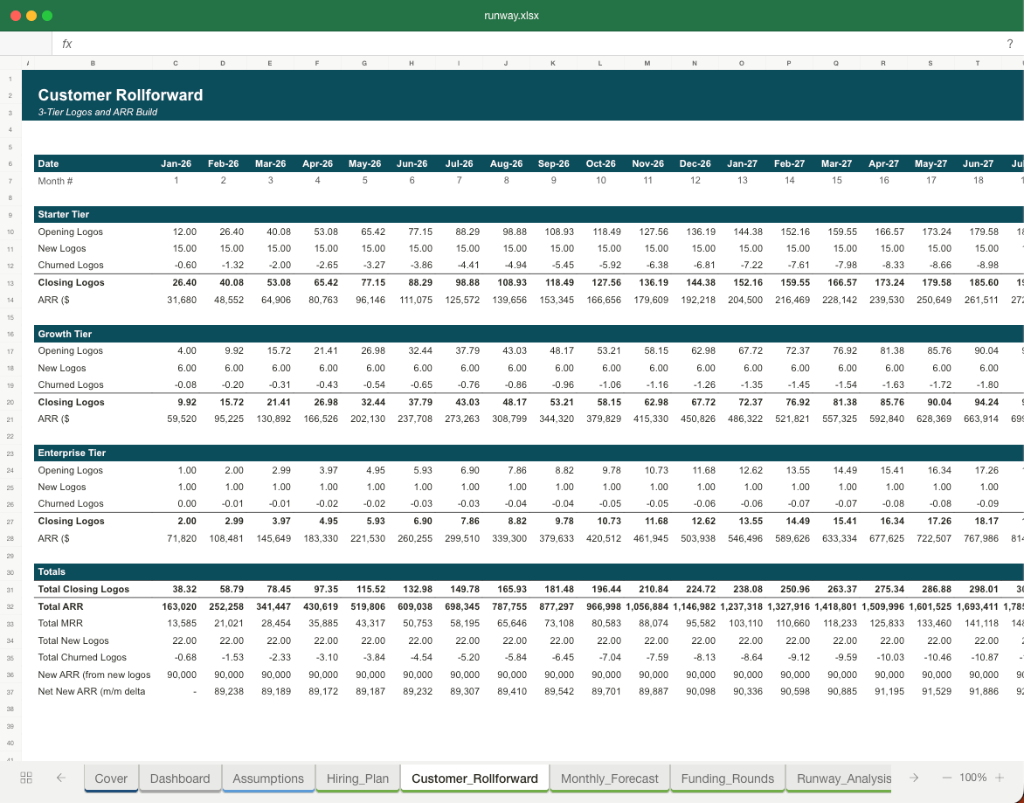
D-Dash (formerly Spektra) - 2018 Financial Model
Crypto/Web3 Startup Financials (Free Excel Download)
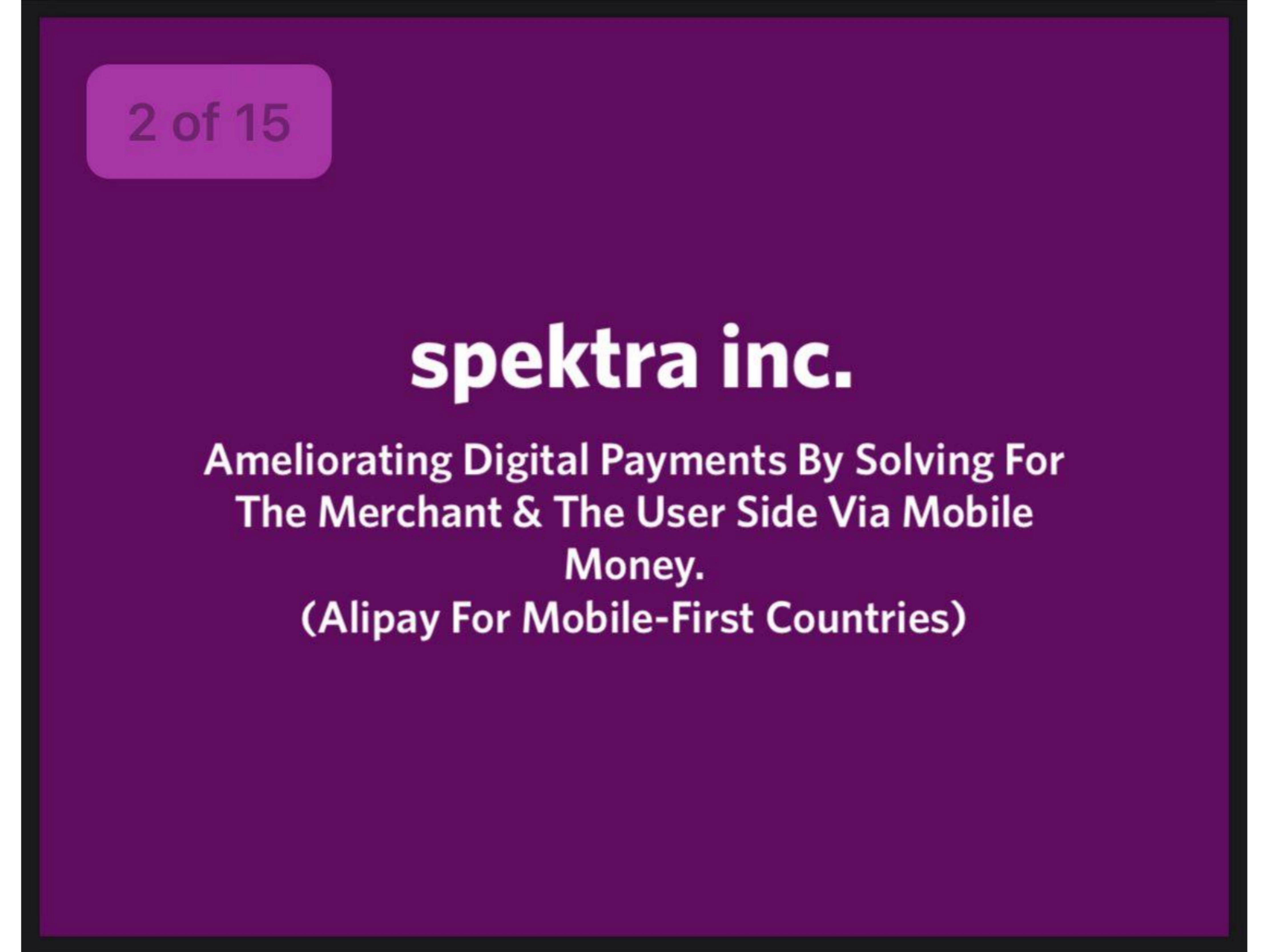
Mobile-money infrastructure layer that simplifies payments for merchants and end-users across mobile-first emerging markets - "Alipay for Mobile-First Countries"



professionals from Deloitte
Used by professionals from






About this model
Dash, formerly Spektra, is an API-based payment gateway and consumer wallet for mobile-money ecosystems. It simplifies peer-to-peer, bill, and merchant payments in emerging markets, positioning itself as an Alipay-like network where conventional banking access is limited.
The 2018 deck describes a pre-seed company raising $100,000, with an addressable region spanning Sub-Saharan Africa, MENA, Latin America, the Caribbean, Southeast Asia, and the Pacific. Initial markets are likely Kenya, Ghana, and Nigeria, where fragmented local payment rails make merchant acceptance and integrations important.
Model Dash as a payments network: onboard users and merchants, project payment volume per active user or merchant, and apply the merchant transaction take rate to derive revenue. Build partner-integration, regulatory, customer-support, and network operations costs beneath revenue. Seed funding and payment-volume ramp should drive cash-runway scenarios, because there is no operating history to support a mature forecast.
A turnkey financial model
Live formulas, no hardcoded values
Outputs are driven by live formulas, so the workbook updates from its assumptions instead of relying on hardcoded results.
All assumptions in one tab
Inputs are clearly marked in the Assumptions tab and separated from calculations, making it clear what to change and what to leave intact.
Statements always balancing
For integrated-statement models, the balance sheet, cash flow, and supporting schedules tie through properly.
Distinct schedules for clarity
Debt, working capital, taxes, and cash flow can get messy quickly. We group calculations in clear schedules, not across disconnected tabs.
No hidden macros or external links
There are no unexplained external workbook links or macros to undermine auditability or portability.
Changes flow through the model
Update a key driver and see the impact carry through the forecast, financing, and return outputs. We never use hardcoded numbers in formulas.
About Dash (formerly Spektra) - 2018
How to build a detailed financial model for Dash (formerly Spektra) - 2018
A complete walkthrough of the business, drivers, and assumptions behind the downloadable Dash (formerly Spektra) - 2018 model - distilled from its pitch deck and publicly available information.
Product & value proposition
Two-sided offering:
Merchant side (Spektra Checkout)
- 1-step seamless checkout vs. 6–10 step USSD flows from incumbents
- Works on web, mobile, in-app
- 10-minute integration (vs. up to 12 months with raw MNO APIs)
- Out-of-the-box: cross-border payments, fraud prevention, recurring payments, refunds, digital receipts, merchant dashboard/ledger
User side (Spektra Wallet)
- Mobile app: 1–2 taps to pay, works online & offline
- Cash-in/cash-out, multi-SIM, interoperability across MNOs
- Refunds, digital receipts, multi-currency, P2P payments, recurring payments
- Rewards/incentives, in-app customer support, third-party super-app services
Core technical moat: single API aggregating 270+ MNOs; removes per-provider integration burden.
Market
- 690 million mobile money users across 90 countries
- $1 billion transacted per day via mobile money
- 440 million smartphone users in mobile-first countries
- Mobile money dominates Sub-Saharan Africa, MENA, Latin America, Caribbean, SE Asia & Pacific
- Source cited: GSMA, 2017
TAM implied: ~$365B/year in mobile money transaction volume. No SAM/SOM breakdown or market-size dollar figure provided in the deck.
Revenue model
Not explicitly stated in the deck. No pricing slide, no fee schedule, no revenue model breakdown. Likely transaction-fee model (take-rate on GMV processed), consistent with comparable payment gateways in the market (Flutterwave, Paystack, Cellulant typically charge 1–2.5% per transaction). Rationale: this is the standard model for the cited competitors and for Alipay (the stated analog). Possible secondary revenue: SaaS/API subscription fees for merchants; premium wallet features or interchange on user side. No evidence in deck.
Traction & metrics
- Founder invested $20,000 to date
- No customers, revenue, GMV, transaction volume, or growth figures shown
- Deck implies pre-revenue / pre-product (raising to get regulatory clearance and serve "initial customers")
Competition / moat
Local competitors: PesaPal (Kenya), Flutterwave (Nigeria), Direct Pay Online/DPO (Kenya), Beyonic (Uganda), Paystack (Nigeria), Cellulant (Kenya), Hubtel (Ghana)
Global competitors: PayPal, Mastercard (MasterPass), Visa (M-Visa), GrabPay, Google Pay
Stated moat / differentiation:
- Single unified API across MNOs (vs. fragmented per-provider integration)
- 1-step checkout experience (vs. 6–10 step USSD flows)
- 10-minute merchant integration (vs. up to 12 months)
- Consumer wallet with interoperability across SIMs/MNOs - none of the local competitors offer both merchant and user sides together
Team & funding ask / use of funds
Team:
- Prince Boakye Boampong - Founder & CEO; 12 years software development experience
- Prior: Standard Bank (Africa's largest bank, consultant); Pioneer Fund (Investor/Venture Partner); OMG Digital Inc. (Y Combinator S16, Founder & CEO)
- No other team members shown
Funding:
- Already invested: $20,000 (founder)
- Raising: $100,000 Pre-Seed
- Use of funds: regulatory clearance, serve initial customers, hit seed-funding milestones
No valuation, equity %, or cap table information disclosed.
Recommended financial model
- Archetype + why: Payments/FinTech GMV take-rate model with 3-statement underpinning. The business is a two-sided payment gateway - the correct P&L driver is GMV processed × take-rate, matching Flutterwave/Paystack comps. A full 3-statement is appropriate given the need to model regulatory capital, operating burn, and seed-round timing.
- Forecast horizon & granularity: 3 years monthly (Month 1–36), switching to quarterly in years 2–3. Pre-revenue through ~Month 6 while regulatory clearance is obtained; revenue ramps in Year 1 thereafter.
- Key drivers & assumptions:
- *Addressable market entry:* launch in 1–2 anchor countries (Kenya, Ghana)
- *Merchant acquisition:* number of active merchants onboarded per month
- *GMV per merchant per month:*
- *Take-rate:*
- *MNO settlement/cost of revenue:*
- *Regulatory timeline:*
- *Headcount:*
- *CAC (merchant):*
- *User wallet adoption:*
- *Pre-seed cash:* $120,000 total ($20k founder + $100k raise)
- Scenarios (Base / Bull / Bear - which variables flex):
- *Bear:* regulatory delay extends 9–12 months; merchant ramp 50% slower; take-rate compressed to 1.0%
- *Base:* regulatory clearance in 6 months; merchants ramp per assumptions above; 1.5% take-rate
- *Bull:* regulatory clearance in 3 months; 2x merchant ramp; 2.0% blended take-rate; wallet user monetization begins Year 2
- Required sheets / outputs:
- Assumptions dashboard (all drivers centralized)
- GMV build (merchants × avg GMV/merchant)
- Revenue P&L (take-rate revenue, COGS/settlement fees, gross profit)
- Operating expense build (headcount, tech/cloud, compliance/regulatory, marketing)
- EBITDA bridge
- Cash flow & runway (critical: pre-revenue burn + pre-seed cash = runway to seed)
- Balance sheet (simplified)
- Scenario toggle (Bear/Base/Bull)
- KPI dashboard: GMV, active merchants, take-rate, gross margin %, cash runway
Frequently asked
Is the Dash (formerly Spektra) - 2018 financial model free?+
Yes. The Dash (formerly Spektra) - 2018 model is a free Excel (.xlsx) download with live formulas. Sign up with your email and the workbook is yours to keep, review, and edit.
What's included in the model?+
A 5-year monthly forecast with P&L, cash flow and runway, valuation (exit multiple plus a DCF cross-check), MOIC/IRR returns, and unit economics, with live formulas throughout.
How was this model built?+
It was built from Dash (formerly Spektra) - 2018's pitch deck and publicly available information, then structured to investment-banking standards as a fully editable Excel model.
Can I change the assumptions?+
Yes. You can change assumptions and the live formulas will recalculate in the downloadable Excel model.
Have more financial modelling questions? Contact us

Created by ex-finance professionals
Hey, I’m Alex and I created Finamodel.
Over my years in the finance industry I kept building the same models over and over again. Same structure, same assumptions, different logo. So I started building frameworks to turn them into clean, reusable templates.
Every model here is one I’d actually use for a client, and I personally vet each one before it goes up.
I’m not an expert in every industry, but I’ve built enough models to know what belongs in one. And when something is completely foreign to me, I reach out to my network for experts to work on our models with us.
Having a template library on hand cuts a first build from hours to minutes.
Need help finding your model? You’ll find me in the Finamodel app!
Other Crypto/Web3 Startup Financial Models
Browse another startup in the same category.

0x Labs
0x Labs builds open exchange infrastructure (protocol, API, consumer app) for on-chain token trading across multiple blockchains.

1inch Network
DeFi aggregation protocol that routes crypto swaps across 100+ liquidity sources to deliver best rates and lowest gas fees.

Aether
Synthetic biology platform that builds searchable protein indexes to engineer novel molecular assemblers for high-value industrial products.
Alto
Self-directed IRA platform enabling retail investors to invest in alternative assets (private equity, debt, real estate, crypto) via tax-advantaged retirement savings.
Auki Labs
Decentralized peer-to-peer spatial positioning SDK for social AR - building the infrastructure layer to replace GPS and enable a persistent AR metaverse.
Awesome People Ventures Fund 2
Awesome People Ventures is a community-driven, decentralized early-stage Web3 VC fund raising Fund II.

Axelar
Cross-chain blockchain overlay network enabling universal transfer of assets, transactions, and state across all blockchain ecosystems.
BRD
BRD is a non-custodial crypto wallet app (consumer) and blockchain infrastructure API platform (enterprise) targeting mass-market crypto adoption.