 Doola Financial Model
Fintech Startup Financials (Free Excel Download)
"Business-in-a-Box" - end-to-end US company formation and financial services stack for non-US founders.



professionals from Deloitte
Used by professionals from






About this model
doola is a business-in-a-box platform for non-US founders forming and operating US companies. It bundles incorporation, banking access, compliance, tax support, registered-agent services, and other administrative tasks that entrepreneurs would otherwise assemble separately.
The initial company-formation workflow is a wedge into an ongoing financial-services relationship. The research identifies annual subscription plans of roughly $2,000 to $3,000, plus add-on services and longer-term banking, card, lending, and API opportunities.
The model should begin with monthly formations, conversion to annual subscriptions, plan mix, service attach rates, and retention. Banking and card products need separate activation, spend, and take-rate schedules, while formation and compliance services should be modelled as one-time or recurring according to the package sold.
A turnkey financial model
Live formulas, no hardcoded values
Outputs are driven by live formulas, so the workbook updates from its assumptions instead of relying on hardcoded results.
All assumptions in one tab
Inputs are clearly marked in the Assumptions tab and separated from calculations, making it clear what to change and what to leave intact.
Statements always balancing
For integrated-statement models, the balance sheet, cash flow, and supporting schedules tie through properly.
Distinct schedules for clarity
Debt, working capital, taxes, and cash flow can get messy quickly. We group calculations in clear schedules, not across disconnected tabs.
No hidden macros or external links
There are no unexplained external workbook links or macros to undermine auditability or portability.
Changes flow through the model
Update a key driver and see the impact carry through the forecast, financing, and return outputs. We never use hardcoded numbers in formulas.
About Doola
doola.com
How to build a detailed financial model for Doola
A complete walkthrough of the business, drivers, and assumptions behind the downloadable Doola model - distilled from its pitch deck and publicly available information.
Product & value proposition
- doola bundles 10 services non-US founders previously had to stitch together: entity formation (LLC, C-Corp, DAO LLC), registered agent, EIN/ITIN, US bank account, payment processor, virtual mailbox, tax filing, state compliance, tax consultations, ongoing support.
- Product is delivered via an online wizard / dashboard (formation software) used as a wedge.
- Integrated banking layer (doola Banking) exposes checking/payments/cards once entity is live.
- Strategic vision: formation is the "trojan horse" into a broader fintech platform - roadmap includes charge cards, credit cards, lending, payroll, accounting/bookkeeping, cap tables, 83Bs, patents/trademarks, fundraising, issuing, insurance.
- B2B API infrastructure positioning: doola frames itself as "2.0" vs Atlas's "1.0" formation service; offers API/syndicate access for partners.
- Third-party integrations for services not built in-house.
Market
- Wedge TAM (non-US founder formation): 5M US companies projected to form in 2022 × 30% non-US founders × $3K doola subscription = $4.5B potential revenue.
- Total fintech opportunity framed via competitor valuations - Intuit $102B, Stripe $95B / Atlas $95B, ADP $85B, Brex $12B, Deel $12B, Gusto $10B, Carta $7.4B, Xero $11.8B, Zenbusiness $1.7B, AngelList $4B, Mercury $1.6B, Pilot $1.2B, Square $35B, Wolters Kluwer $24B, Clerky, CSC, Legalzoom $2.5B - collectively described as "a Billion $ opportunity".
- US Population = 4.25% of world; Rest of World = 95.75% - framing the non-US customer TAM.
- No market growth rate (CAGR) provided in deck.
Revenue model
- Subscription: Business Plan ~$2K/year; full subscription described as ~$3K/year (Business Plan + Banking + Services).
- Embedded banking / fintech monetisation: interchange, card issuance, lending - "monetise like a bank". No specific fee rates disclosed.
- Add-on services: tax filing, tax consultations, state compliance, virtual mailbox, registered agent - likely fee-per-service or bundled tiers. No individual pricing disclosed.
- B2B API / syndicate channel: Partners can call doola's entity-formation API; revenue model for this channel not specified.
- Customer mix: 80% non-US, 20% US.
- Distribution: primarily direct/inbound (online wizard). Partner/API channel implied but not quantified.
Traction & metrics
- No revenue, ARR, customer count, MoM/YoY growth, churn, or retention figures shown in deck.
- No traction slide present.
- The only "live" financial figure visible is a sandbox banking dashboard balance of $2,137.59 - this is a product screenshot, not a traction metric.
- Funding history implies company was ~2 years old at Series A (founded ~2020).
Unit economics
- Implied LTV floor: $3K ACV per customer; banking monetisation would extend LTV over entity lifetime.
- No CAC, payback period, gross margin, or contribution margin disclosed.
Competition / moat
- Direct competitors named: Atlas (Stripe's formation product - framed as "1.0"), Clerky, Gust, ZenBusiness, LegalZoom.
- Positioning matrix axes: Non-US focused vs US focused; entity types (C-Corps, LLCs, DAO LLCs) - doola claims the only player covering all three entity types AND non-US founders.
- Moat claims:
- Only non-US-focused full-stack provider (formation + banking + compliance + services).
- API infrastructure layer (vs point-solution competitors).
- Network: backed by YC, Nexus VP, notable angels (Dharmesh Shah, Jacqueline Reeses, Arjun Sethi, Sahil Bloom, Ankur Nagpal).
- Global team positioned as authentic product-market fit ("we are our customers").
Team & funding ask / use of funds
- Founder & CEO: Arjun Mahadevan - Dropbox, Wharton/UPenn.
- Team: global (15+ nationalities visible from flag grid); in-person HQ NYC.
- Funding raised to date: $11.6M across three rounds.
- Pre-seed: $500K, Sep 2020 - YC, Hustle Fund.
- Seed: $3.1M, Nov 2021 - Nexus Venture Partners, Arjun Sethi, Jacqueline Reeses, Dharmesh Shah + others.
- Series A: $8.0M, Oct 2022 - Nexus Venture Partners, YC Continuity Fund, Sahil Bloom, Ankur Nagpal + others.
Recommended financial model
- Archetype + why: SaaS + fintech revenue model with subscription ARR as primary driver and banking/services attach as secondary revenue layer. doola has a clear subscription ACV ($2–3K/year), high-intent formation funnel (one-time formation event triggering recurring subscription), and a long-term fintech monetisation thesis. This is a subscription-led model with an embedded fintech upsell - closest to a B2B SaaS ARR model with a fintech revenue layer bolted on (not a pure SaaS, not a pure marketplace).
- Forecast horizon & granularity: 5-year model (2023–2027), monthly for Year 1, quarterly for Years 2–3, annual for Years 4–5. Series A stage warrants near-term monthly granularity for burn/runway tracking.
- Key drivers & assumptions:
- New formations per month: start ~200/mo (Year 1), growing 10–15% MoM in early months, decelerating to ~5% MoM by Year 3 - no traction data in deck to anchor; should be updated with actuals.
- Formation conversion rate (visitor → paid): ~20%; typical for guided online legal/compliance wizards.
- Business Plan ACV: $2,000/year.
- Full bundle ACV (Business Plan + Banking + Services): $3,000/year.
- Bundle attach rate (% taking full $3K package): 50% at launch, growing to 70% by Year 3 as banking product matures.
- Annual churn rate: 15–20% - formations are sticky (registered agent is annual renewal), but some entities will dissolve or migrate; no deck data.
- Banking revenue per active account (interchange + fees): $200–400/year per active banking customer; benchmarked against Mercury/Brex neobank economics.
- Banking attach rate (% of formation customers activating banking): 60% Year 1, rising to 80% Year 3.
- Add-on services revenue (tax filing, compliance, consultations): $300–600/customer/year blended; priced as one-time or annual add-ons.
- API/B2B channel revenue: negligible Year 1–2; model as a separate line item activating in Year 3 at 5–10% of total revenue.
- Gross margin (software + services): 60–70% blended - formation/compliance has higher cost-of-service (registered agent, tax prep) than pure SaaS; banking margin depends on interchange economics.
- Headcount: ~15–25 FTE at Series A close; grow to 50–80 by Year 3 based on $8M raise and typical SaaS burn.
- S&M as % of revenue: 40–50% in early years (high CAC for international acquisition), declining to 25–30% as organic/referral scales.
- R&D as % of revenue: 25–30%.
- G&A as % of revenue: 15–20%.
- Scenarios (Base / Bull / Bear - which variables flex):
- Base: 10–12% MoM formation growth, 65% bundle attach, 15% annual churn, banking attach 60%.
- Bull: 15–20% MoM growth (YC/partner channel fires), 75% bundle attach, 10% churn, banking revenue at $400/account - doola reaches $10M ARR by Year 3.
- Bear: 6–8% MoM growth, high churn (20%+) from competitive pressure (Atlas, ZenBusiness pricing), banking regulation delays - slower ramp, higher burn.
- Primary flex variables: new formation volume, churn rate, banking attach rate, ACV (pricing power vs competitors).
- Required sheets / outputs:
- Assumptions - all drivers in one place, colour-coded inputs.
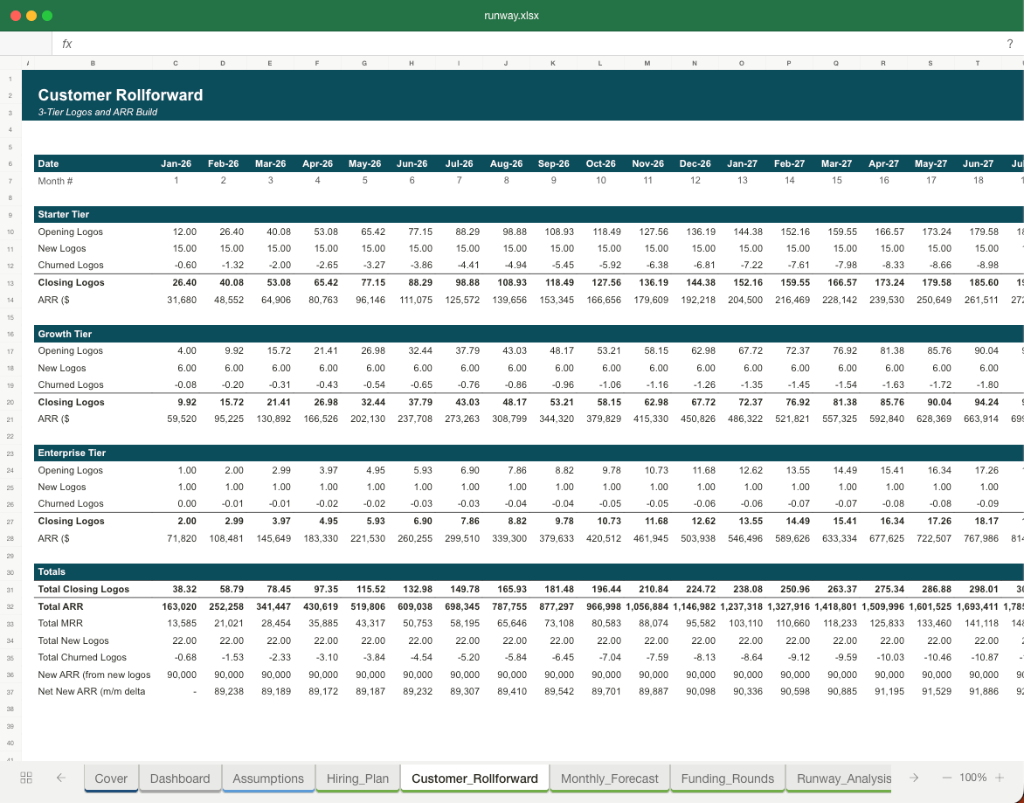
- Cohort model - monthly formation cohorts × retention curve × ACV (subscription + banking + services per cohort).
- Revenue build - subscription ARR, banking revenue, services revenue, API revenue; MRR waterfall (new, expansion, churn).
- P&L - revenue, COGS, gross profit, S&M, R&D, G&A, EBITDA, net income.
- Headcount plan - by department, linked to opex.
- Cash flow & runway - monthly cash burn, cash balance, months of runway vs Series A proceeds.
- KPI dashboard - ARR, MRR, customer count, ARPU, net revenue retention (NRR), CAC, LTV, LTV:CAC, gross margin.
- Scenario toggle - Base / Bull / Bear switcher feeding all outputs.
Frequently asked
Is the Doola financial model free?+
Yes. The Doola model is a free Excel (.xlsx) download with live formulas. Sign up with your email and the workbook is yours to keep, review, and edit.
What's included in the model?+
A 5-year monthly forecast with P&L, cash flow and runway, valuation (exit multiple plus a DCF cross-check), MOIC/IRR returns, and unit economics, with live formulas throughout.
How was this model built?+
It was built from Doola's pitch deck and publicly available information, then structured to investment-banking standards as a fully editable Excel model.
Can I change the assumptions?+
Yes. You can change assumptions and the live formulas will recalculate in the downloadable Excel model.
Have more financial modelling questions? Contact us

Created by ex-finance professionals
Hey, I’m Alex and I created Finamodel.
Over my years in the finance industry I kept building the same models over and over again. Same structure, same assumptions, different logo. So I started building frameworks to turn them into clean, reusable templates.
Every model here is one I’d actually use for a client, and I personally vet each one before it goes up.
I’m not an expert in every industry, but I’ve built enough models to know what belongs in one. And when something is completely foreign to me, I reach out to my network for experts to work on our models with us.
Having a template library on hand cuts a first build from hours to minutes.
Need help finding your model? You’ll find me in the Finamodel app!
Other Fintech Startup Financial Models
Browse another startup in the same category.
Acin
SaaS and data subscription network for operational risk management at Tier 1 financial institutions

Ageras Group
B2B SME ecosystem - marketplace connecting SMEs with accountants + cloud accounting/payroll software + embedded financial services (lending, factoring, banking)

Airbase
Unified non-payroll spend management platform (corporate cards, AP/bill pay, expense reimbursement, approval workflows) for mid-market companies.

Altruist
Vertically integrated all-in-one platform for registered investment advisors (RIAs) - combining custodial, portfolio management, practice management, and client acquisition tools.
Amenitiz
All-in-one hotel management SaaS platform ("Shopify for hotels") for independent hoteliers - PMS, booking engine, channel manager, website builder, payments, and AI-driven revenue management.

Anrok
SaaS sales tax compliance platform - nexus monitoring, calculation, registration, filing, and remittance - built specifically for SaaS companies.
Arrival
Arrival is an EV manufacturer of commercial vans and buses using proprietary Microfactories and vertically integrated components, going public via SPAC merger with CIIG Merger Corp.

AtoB
AtoB is building financial infrastructure for commercial fleets, starting with a no-fee Visa fleet card for fuel and expanding into payroll, BNPL, and international.