 Eleven Labs Financial Model
AI/ML Startup Financials (Free Excel Download)
AI-powered automatic dubbing SaaS that converts audio/video content into any language while preserving the original speaker's voice, emotion, and intonation.


professionals from Deloitte
Used by professionals from






About this model
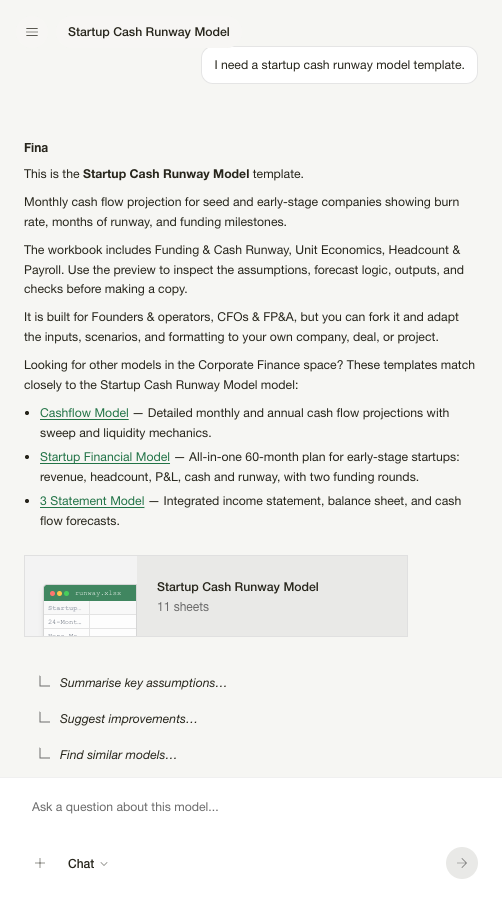
ElevenLabs automates dubbing by converting uploaded audio or video into another language while retaining the speaker's voice, emotion, and intonation. Its Speech-plus-Text approach supports voice cloning and can produce a dubbed ten-minute video in roughly two minutes.
The SaaS product combines a subscription bundle of convertible minutes with per-minute overage pricing, illustrated at about $1 per minute. It targets creators first, with potential API and SDK distribution to editing software and game developers, plus a human-in-the-loop quality option.
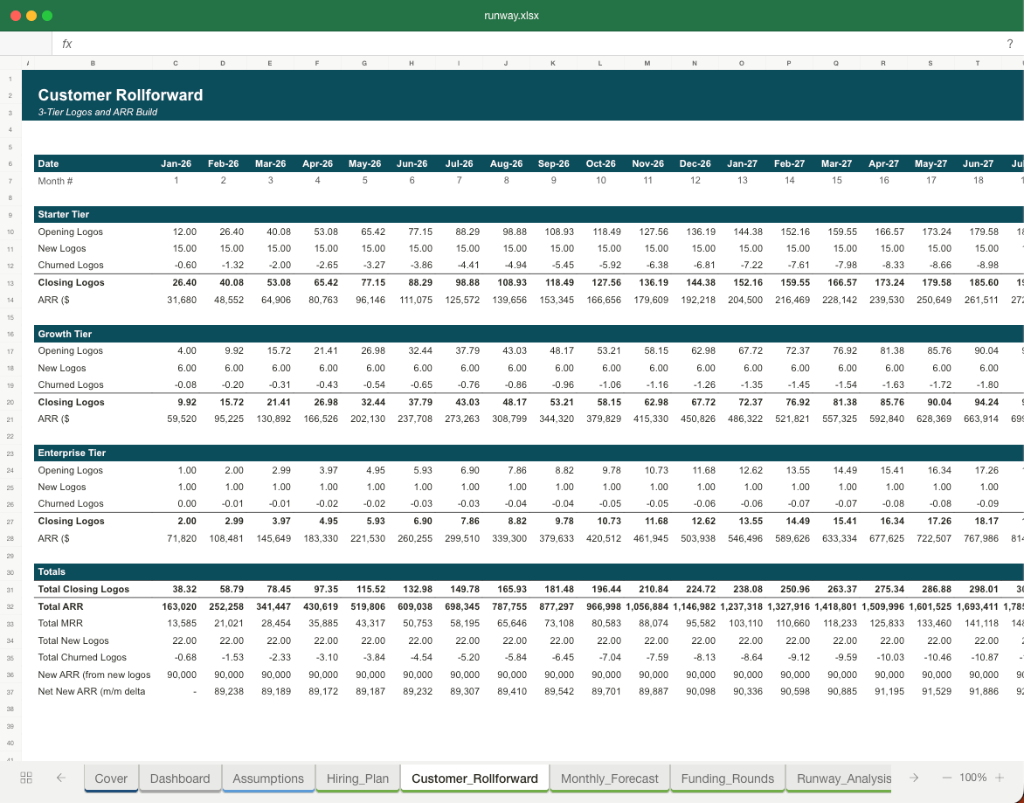
The model cohorts paying subscribers and translates videos, minutes, and languages into subscription and overage revenue. It tests creator acquisition, usage, churn, inference and storage cost, gross margin, API adoption, product and marketing headcount, cash burn, and runway.
A turnkey financial model
Live formulas, no hardcoded values
Outputs are driven by live formulas, so the workbook updates from its assumptions instead of relying on hardcoded results.
All assumptions in one tab
Inputs are clearly marked in the Assumptions tab and separated from calculations, making it clear what to change and what to leave intact.
Statements always balancing
For integrated-statement models, the balance sheet, cash flow, and supporting schedules tie through properly.
Distinct schedules for clarity
Debt, working capital, taxes, and cash flow can get messy quickly. We group calculations in clear schedules, not across disconnected tabs.
No hidden macros or external links
There are no unexplained external workbook links or macros to undermine auditability or portability.
Changes flow through the model
Update a key driver and see the impact carry through the forecast, financing, and return outputs. We never use hardcoded numbers in formulas.
About Eleven Labs
elevenlabs.io
How to build a detailed financial model for Eleven Labs
A complete walkthrough of the business, drivers, and assumptions behind the downloadable Eleven Labs model - distilled from its pitch deck and publicly available information.
Product & value proposition
- Automated dubbing SaaS: upload audio or video, click to dub into another language, download result in ~2 minutes for a 10-minute video.
- Core differentiator: novel speech representation that takes both Speech and Text as inputs (vs. traditional TTS), preserving prosody (per-phoneme, speaker-independent annotations) and speaker voice (separate speaker embeddings).
- Three headline features:
- Human Quality - preserves emotions, intonation, performance via model trained on thousands of hours of professional dubbing.
- Personalised - voice cloning across languages (speaker's own voice maintained).
- Simple & Quick - end-to-end SaaS; human-in-the-loop option for quality uplift.
- Traditional dubbing benchmark: ~$100/min and >2 weeks per 10-minute video.
Market
Three-tier expanding market framing:
- $2B/yr - TAM for all professional content creators (podcasts + videos)
- $4.6B/yr - Current spend on game localization + movie dubbing (existing industry to disrupt)
- $24B/yr - Full localization, translation, interpreting total market
Content creator funnel deep-dive:
- 50M+ content creators worldwide (TAM)
- 2M professional creators (SAM)
- 100K YouTube creators with >500K subscribers (SOM)
- 10K creators that upload captions (Immediate Market)
- Content volume from SOM: 9M minutes/month (3 videos × 10 min × 3 languages × 100K creators)
- Implied revenue at ~$1/min: $110M/year
No market growth rate cited in deck.
Revenue model
- Primary model: subscription with a base bundle of convertible minutes.
- Usage overage: ~$1/min of dubbed audio (company's own illustration of floor price; actual pricing not disclosed).
- Channels: direct SaaS (self-serve), potential API/SDK for audio & video editing software and game developers.
- Adjacent use-cases on roadmap (not yet monetised): real-time dubbing, real-time voice conversion, professional dubbing for film, localization/advertising, offline voice generation (games, audiobooks, podcasts).
Traction & metrics
- Traction & Feedback slide (slide 11): fully redacted - no revenue, customer count, MRR, or growth metrics available.
- MrBeast case study used as proxy demand signal: Spanish dubbed channel (launched 2021) reached 19M subscribers; one dubbed video generates ~$50K for the creator. (This is third-party data, not Eleven's own traction.)
- Prototype exists with stated demo dub time of 2 minutes for a 10-minute video.
Competition / moat
Competitive quadrant (Quality vs. Accessibility & Speed):
- Top-left (high quality, low speed): traditional studios - Logic Union, Simonsays(?), MN Creative - voice actors, post-production.
- Centre (semi-automated, high manual intervention): Deepdub.ai, Papercup.
- Bottom-right (accessible/fast, lower quality): Amazon Polly, IBM Watson, Google Wavenet - pure TTS.
- Top-right (high quality + high speed): Eleven Labs - positioned as sole occupant.
Moat claims:
- Novel Speech+Text input architecture (not pure TTS) - prosody mapping preserves emotional performance across languages.
- Data flywheel: high-volume creator usage improves speech/text datasets.
- Trained on thousands of hours of professional dubbing data.
- Generalizable to new languages quickly.
Team & funding ask / use of funds
Team:
- Mati Staniszewski, CEO - Mathematics, Imperial College London; ex-Palantir (deployment); ex-BlackRock, Opera Software; founded Mathscon (1,000+ students).
- Piotr Dabkowski, CTO - CS, Cambridge & Oxford; ex-Google ML; NeurIPS paper (300+ citations); created Js2Py (250K+ downloads/month).
- Both friends since high school, studied and worked together.
Recommended financial model
Archetype + why: Usage-based SaaS with subscription base + per-minute overage - mirrors the company's own stated model. Build as a bottoms-up consumption model: cohorted subscriber acquisition driving monthly active dubbing minutes, layered with a subscription floor and variable per-minute revenue above the bundle. This is analogous to a cloud-infra usage model (think Twilio/AWS), not a pure seat-based SaaS.
Forecast horizon & granularity: Monthly for Years 1–2, quarterly for Years 3–5. Five-year total horizon is appropriate for a seed-stage AI SaaS.
Key drivers & assumptions:
| Driver | Value | Source |
|---|---|---|
| Content creator TAM | 50M worldwide | - |
| Professional creator SAM | 2M | - |
| SOM (YT >500K subs) | 100K | - |
| Avg videos/creator/month | 3 | - |
| Avg video length | 10 min | - |
| Languages dubbed per video | 3 | - |
| Floor price per minute | ~$1/min audio | - |
| Initial market (caption uploaders) | 10K creators | - |
| Monthly minutes per creator (SOM calc) | 90 min/mo | - |
| Traditional dubbing cost | ~$100/min | - |
| Traditional dubbing lead time | >2 weeks per 10-min video | - |
| Month 1 paying subscribers | 500 | Seed stage; prototype live; redacted traction suggests some early users |
| Monthly subscriber growth rate (Y1) | 15–25% MoM | Typical viral/product-led SaaS at early stage with strong creator word-of-mouth |
| Avg monthly minutes consumed per subscriber | 90 min/mo | Based on deck's own 3 videos × 10 min × 3 languages assumption |
| Subscription ARPU (base plan) | $30–$99/mo incl. bundle | Benchmarked against Descript, Otter.ai, Riverside; deck implies ~$1/min floor |
| Overage rate | $1.00/min above bundle | Deck's stated floor price |
| Bundle minutes included in subscription | 60 min/mo | Encourages overage; typical usage model |
| Gross margin (long-run) | 60–70% | AI inference + storage costs; speech model compute is material at early scale, improves with volume |
| Gross margin (Year 1) | 40–50% | Compute-heavy early; GPU cost per inference is high before scale economies |
| Monthly churn | 4–6% | Creator-segment tools see moderate churn; no retention data in deck |
| CAC | $50–$150 per subscriber | Product-led / self-serve with content creator influencer channel; no data in deck |
| S&M as % of revenue (Year 1) | 30% | Early land-and-expand; low touch |
| R&D as % of revenue (Year 1) | 40% | Two founders, ML-heavy; compute + talent |
| G&A | $20K–$40K/mo | Seed stage, UK entity |
Scenarios (Base / Bull / Bear - which variables flex):
- Bear: Subscriber growth 10% MoM, churn 7%, gross margin stays at 40% (GPU costs don't scale down), ARPU at $30. Competitors close the quality gap faster.
- Base: Subscriber growth 20% MoM, churn 5%, gross margin reaches 65% by Year 3, ARPU $60 blended.
- Bull: Subscriber growth 30% MoM driven by viral creator adoption (MrBeast-style flywheel), churn 3%, expansion into professional film/game studio segment lifts ARPU to $150+, gross margin 70%.
Required sheets / outputs:
- Assumptions - all drivers in one editable block, colour-coded vs.
- Subscriber Model - monthly cohort build: new adds, churn, net adds, ending subscribers by plan tier.
- Revenue Model - subscription revenue (ARPU × subscribers) + overage (minutes above bundle × overage rate).
- P&L (Income Statement) - Revenue → Gross Profit → EBITDA → Net Income; monthly Y1–Y2, quarterly Y3–Y5.
- Headcount Plan - founders + ML engineers + sales/marketing hires; drives OpEx.
- Cash Flow & Runway - burn rate, cash balance, months of runway; critical for seed-stage investors.
- Market Sizing Summary - TAM/SAM/SOM waterfall tied to deck figures.
- Scenario Toggle - dropdown (Bear/Base/Bull) that feeds growth rate, churn, ARPU, and margin assumptions.
- Dashboard - KPI summary: MRR, subscribers, minutes dubbed, gross margin %, cash runway.
Frequently asked
Is the Eleven Labs financial model free?+
Yes. The Eleven Labs model is a free Excel (.xlsx) download with live formulas. Sign up with your email and the workbook is yours to keep, review, and edit.
What's included in the model?+
A 5-year monthly forecast with P&L, cash flow and runway, valuation (exit multiple plus a DCF cross-check), MOIC/IRR returns, and unit economics, with live formulas throughout.
How was this model built?+
It was built from Eleven Labs's pitch deck and publicly available information, then structured to investment-banking standards as a fully editable Excel model.
Can I change the assumptions?+
Yes. You can change assumptions and the live formulas will recalculate in the downloadable Excel model.
Have more financial modelling questions? Contact us

Created by ex-finance professionals
Hey, I’m Alex and I created Finamodel.
Over my years in the finance industry I kept building the same models over and over again. Same structure, same assumptions, different logo. So I started building frameworks to turn them into clean, reusable templates.
Every model here is one I’d actually use for a client, and I personally vet each one before it goes up.
I’m not an expert in every industry, but I’ve built enough models to know what belongs in one. And when something is completely foreign to me, I reach out to my network for experts to work on our models with us.
Having a template library on hand cuts a first build from hours to minutes.
Need help finding your model? You’ll find me in the Finamodel app!
Other AI/ML Startup Financial Models
Browse another startup in the same category.

AI Rudder
AI Rudder provides multi-lingual conversational AI for B2C customer engagement - automating outbound and inbound voice/chat interactions at scale.

Aisera
AI Service Experience platform that automates IT, HR, and customer service workflows via conversational AI and automation.

Amberscript
AI + human hybrid transcription and subtitling platform targeting B2B customers in Europe

Apheris
Privacy-preserving federated ML platform enabling enterprises to train AI on distributed data without sharing raw data.

Arcane
AI copilot for marketing teams that automates data analysis, reporting, and repeatable tasks via a chat interface and scheduled workflows.

Artisan
AI-powered "digital workers" (branded Artisans) that autonomously perform role-specific tasks - starting with outbound sales - and are delivered as SaaS subscriptions.

Artisan Series A
AI-native B2B SaaS platform consolidating the enterprise software stack with human-like "Artisan" AI employees that automate role-specific workflows

Bigblue
Tech-enabled e-commerce fulfillment platform for European D2C brands - "Amazon-standard" delivery without Amazon.