 Forethought (Series B) Financial Model
AI/ML Startup Financials (Free Excel Download)
AI-powered customer support assistant ("Agatha") that helps support agents solve, triage, assist, and discover answers faster.



professionals from Deloitte
Used by professionals from






About this model
Forethought's Series B case centers on its enterprise customer-support automation platform: Solve, Triage, Assist, and Discover. The product learns from historical conversations to deflect requests, route tickets, help agents with knowledge, and identify gaps in the support operation.
The land-and-expand motion begins with one support workflow and adds modules, agents, and channels. Its customer set includes Instacart, Marriott, Gusto, Carta, Asana, and Upwork, while its platform carries ISO 27001 and SOC 2 certifications for enterprise deployment.
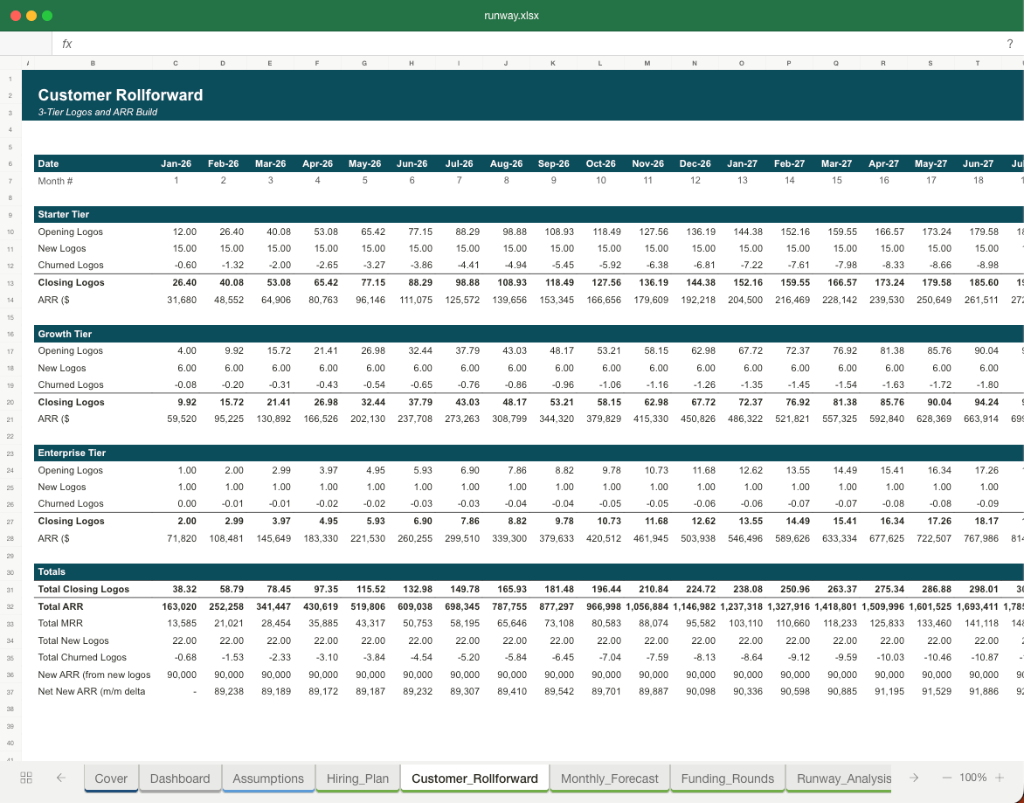
The model uses an ARR bridge that separates new contracts, module expansion, and churn. It forecasts support-team adoption, AI inference and integration cost, gross margin, sales productivity, customer-success and R&D headcount, cash burn, and runway, with resolution and deflection rates as operating drivers.
A turnkey financial model
Live formulas, no hardcoded values
Outputs are driven by live formulas, so the workbook updates from its assumptions instead of relying on hardcoded results.
All assumptions in one tab
Inputs are clearly marked in the Assumptions tab and separated from calculations, making it clear what to change and what to leave intact.
Statements always balancing
For integrated-statement models, the balance sheet, cash flow, and supporting schedules tie through properly.
Distinct schedules for clarity
Debt, working capital, taxes, and cash flow can get messy quickly. We group calculations in clear schedules, not across disconnected tabs.
No hidden macros or external links
There are no unexplained external workbook links or macros to undermine auditability or portability.
Changes flow through the model
Update a key driver and see the impact carry through the forecast, financing, and return outputs. We never use hardcoded numbers in formulas.
About Forethought (Series B)
forethought.ai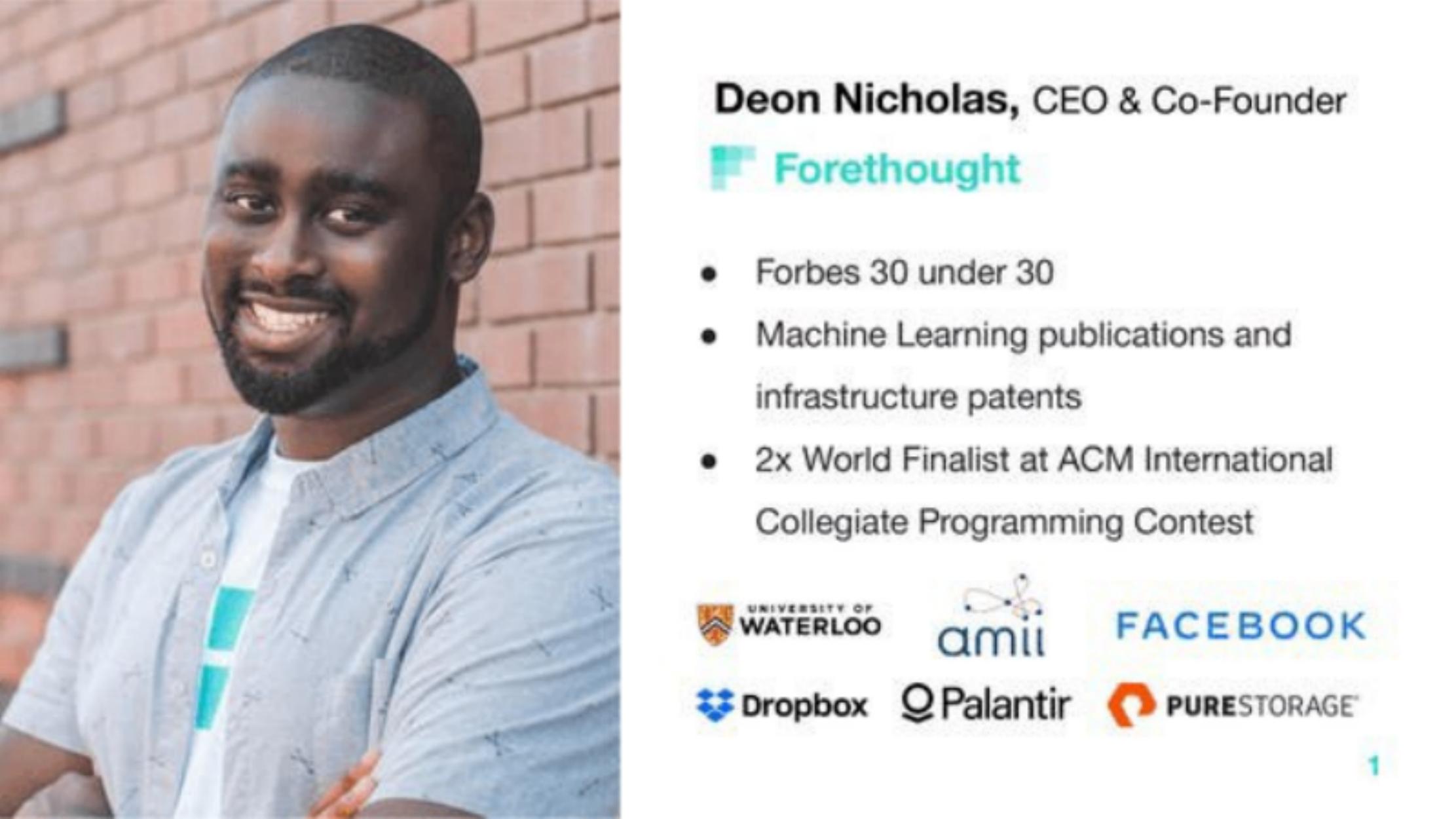
How to build a detailed financial model for Forethought (Series B)
A complete walkthrough of the business, drivers, and assumptions behind the downloadable Forethought (Series B) model - distilled from its pitch deck and publicly available information.
Product & value proposition
- Product: "Agatha" - an AI assistant embedded in customer support workflows. Four stated capabilities:
- Solve - auto-resolves incoming tickets.
- Triage - classifies and routes tickets.
- Assist - surfaces relevant knowledge-base articles to live agents.
- Discover - surfaces knowledge gaps / patterns from ticket data.
- Core positioning: Forethought vs. Google Search (slide 8) - proprietary enterprise knowledge search that returns contextually ranked internal articles (HelpCenter, Support Articles, Internal KB) rather than generic web results. Search results include recency stamps (e.g., "2 weeks", "2 months", "3 months").
- Mission: "Make everyone a genius at their job."
Market
- TAM stated as $100B Opportunity. No methodology, SAM, or SOM breakdown provided.
- Narrative framing: AI as the "4th Industrial Revolution" (following steam, electricity, computing). Used as market-size justification, not a quantified addressable market.
- No CAGR, analyst source, or segmentation in deck.
Revenue model
- Not explicitly stated in deck. Inferred from B2B SaaS context and enterprise customer list:
- Per-seat or platform subscription sold to customer support teams; annual contract value likely scales with number of support agents or ticket volume. Rationale: standard for AI support tooling (Zendesk, Intercom comps).
- Direct sales motion targeting COO / VP of Customer Support at mid-to-large companies.
- No pricing tiers, ACV, or contract structure disclosed.
Traction & metrics
- TC Disrupt SF Battlefield winner - prize check of $100,000. Confirms early-stage.
- Named customers (6 logos): Carta, Instacart, MasterClass, Thumbtack, Gusto, Typeform.
- Target prospects named: ESPN, TicketMaster.
- No ARR, MRR, revenue growth rate, ticket deflection rate, agent CSAT lift, or customer count disclosed.
- No retention, NRR, or churn figures in deck.
Competition / moat
- Slide 8 positions Forethought's search directly against Google Search - implying the moat is enterprise-specific, context-aware NLP that understands internal knowledge bases vs. public web search.
- No explicit competitive landscape slide or named competitors (Zendesk AI, Intercom Fin, Salesforce Einstein, etc.).
- Moat claims implicit: ML publications and infrastructure patents held by CEO Deon Nicholas; team pedigree from LinkedIn, Google, Facebook, Dropbox, Qualtrics, MIT, Harvard, Berkeley, Waterloo.
Team & funding ask / use of funds
- CEO & Co-Founder: Deon Nicholas - Forbes 30 Under 30; ML publications and infrastructure patents; 2x ACM ICPC World Finalist; alumni of Facebook, Dropbox, Palantir, Pure Storage; University of Waterloo.
- Broader team: LinkedIn, Google, Facebook, Dropbox, Qualtrics; academic pedigree MIT, Harvard, Berkeley, Waterloo.
- Use of funds implied by "What's Next": build brand, execute GTM, hire commercial relationships (COO / VP Customer Support buyers), target ESPN and TicketMaster as enterprise anchors.
Recommended financial model
- Archetype + why: B2B SaaS ARR model. Revenue is subscription-based, sold to enterprise customer support teams. Seats or platform fee scales with customer size. Standard SaaS ARR waterfall (new ARR, expansion ARR, churn, net ARR) is the right frame.
- Forecast horizon & granularity: 5 years (Year 1–5); monthly for Year 1–2, annual for Years 3–5. Monthly needed to model early customer ramp and cash burn.
- Key drivers & assumptions:
- New logos per month: 1–2/month in Y1 ramping to 5–8/month by Y3. Rationale: 6 named customers at deck time; GTM being built.
- Average ACV: $30K–$80K/year depending on company size. Rationale: mid-market SaaS AI tool; below Salesforce enterprise, above SMB point tools.
- Net Revenue Retention (NRR): 110%–120%. Rationale: seat expansion as support teams grow; AI tools with proven deflection tend to expand.
- Gross margin: 70%–75%. Rationale: SaaS with AI inference costs; below pure software but above 60%.
- Sales cycle: 60–90 days for mid-market, 120–180 days for enterprise (ESPN/TicketMaster-type).
- CAC (blended): $15K–$40K per customer. Rationale: direct sales to VP/COO; assume 1 AE closes 10–15 logos/year at $120K–$150K OTE.
- Payback period: 18–24 months. Rationale: typical for mid-market SaaS.
- Headcount: Sales + CS hiring paced to logo growth; Engineering flat in Y1 then +2–3 engineers/year.
- Churn: 8%–12% gross annual logo churn. Rationale: early-stage with limited brand; improves as product matures.
- Scenarios (Base / Bull / Bear):
- Base: GTM execution on track; 40–50 logos by end Y2; ACV $45K; NRR 115%.
- Bull: ESPN/TicketMaster-type enterprise anchors land in Y1; ACV lifts to $80K+; NRR 125%; accelerated word-of-mouth in tech customer support segment.
- Bear: Long sales cycles and brand-building delays; logo count misses by 30%; churn elevated at 15% as product-market fit narrows.
- Flex variables: ACV, new logos/month, NRR, gross margin (if inference costs rise), headcount timing.
- Required sheets / outputs:
- Assumptions dashboard (all drivers, toggle Base/Bull/Bear)
- ARR waterfall (new, expansion, churn, net new ARR by month)
- P&L (Revenue, COGS, Gross Profit, S&M, R&D, G&A, EBITDA)
- Headcount plan (by function, linked to opex)
- Cash flow & runway (burn rate, months of runway)
- Unit economics summary (CAC, LTV, LTV/CAC, payback)
- Customer cohort table (logo count by cohort, expansion/churn by year)
- KPI dashboard (ARR, MRR, logo count, NRR, gross margin, burn)
Frequently asked
Is the Forethought (Series B) financial model free?+
Yes. The Forethought (Series B) model is a free Excel (.xlsx) download with live formulas. Sign up with your email and the workbook is yours to keep, review, and edit.
What's included in the model?+
A 5-year monthly forecast with P&L, cash flow and runway, valuation (exit multiple plus a DCF cross-check), MOIC/IRR returns, and unit economics, with live formulas throughout.
How was this model built?+
It was built from Forethought (Series B)'s pitch deck and publicly available information, then structured to investment-banking standards as a fully editable Excel model.
Can I change the assumptions?+
Yes. You can change assumptions and the live formulas will recalculate in the downloadable Excel model.
Have more financial modelling questions? Contact us

Created by ex-finance professionals
Hey, I’m Alex and I created Finamodel.
Over my years in the finance industry I kept building the same models over and over again. Same structure, same assumptions, different logo. So I started building frameworks to turn them into clean, reusable templates.
Every model here is one I’d actually use for a client, and I personally vet each one before it goes up.
I’m not an expert in every industry, but I’ve built enough models to know what belongs in one. And when something is completely foreign to me, I reach out to my network for experts to work on our models with us.
Having a template library on hand cuts a first build from hours to minutes.
Need help finding your model? You’ll find me in the Finamodel app!
Other AI/ML Startup Financial Models
Browse another startup in the same category.

AI Rudder
AI Rudder provides multi-lingual conversational AI for B2C customer engagement - automating outbound and inbound voice/chat interactions at scale.

Aisera
AI Service Experience platform that automates IT, HR, and customer service workflows via conversational AI and automation.

Amberscript
AI + human hybrid transcription and subtitling platform targeting B2B customers in Europe

Apheris
Privacy-preserving federated ML platform enabling enterprises to train AI on distributed data without sharing raw data.

Arcane
AI copilot for marketing teams that automates data analysis, reporting, and repeatable tasks via a chat interface and scheduled workflows.

Artisan
AI-powered "digital workers" (branded Artisans) that autonomously perform role-specific tasks - starting with outbound sales - and are delivered as SaaS subscriptions.

Artisan Series A
AI-native B2B SaaS platform consolidating the enterprise software stack with human-like "Artisan" AI employees that automate role-specific workflows

Bigblue
Tech-enabled e-commerce fulfillment platform for European D2C brands - "Amazon-standard" delivery without Amazon.