FOForgeRock Financial Model
Hardware/Deep-tech Startup Financials (Free Excel Download)
Enterprise digital identity platform managing workforce, consumer, and IoT identities across hybrid and multi-cloud environments.



professionals from Deloitte
Used by professionals from






About this model
ForgeRock is an enterprise digital-identity platform for workforce, consumer, and IoT identities. It manages identity across hybrid and multicloud environments, helping large organisations authenticate users, govern access, and operate identity services across complex technology estates.
Identity is mission-critical infrastructure, so enterprise customers can begin with a major implementation and expand as they add applications, identities, geographies, or use cases. The model should therefore capture contracted ARR alongside deployment and professional-services activity, rather than treating all revenue as a simple seat-based subscription.
Model enterprise contracts, identities managed, platform ARR, implementation, modules, expansion, renewals, and churn. Include solution engineering, customer success, cloud hosting, security research, and sales costs. New-logo wins, deployment scale, identities per customer, module attach, pricing, gross margin, and net retention should determine scenarios.
A turnkey financial model
Live formulas, no hardcoded values
Outputs are driven by live formulas, so the workbook updates from its assumptions instead of relying on hardcoded results.
All assumptions in one tab
Inputs are clearly marked in the Assumptions tab and separated from calculations, making it clear what to change and what to leave intact.
Statements always balancing
For integrated-statement models, the balance sheet, cash flow, and supporting schedules tie through properly.
Distinct schedules for clarity
Debt, working capital, taxes, and cash flow can get messy quickly. We group calculations in clear schedules, not across disconnected tabs.
No hidden macros or external links
There are no unexplained external workbook links or macros to undermine auditability or portability.
Changes flow through the model
Update a key driver and see the impact carry through the forecast, financing, and return outputs. We never use hardcoded numbers in formulas.
About ForgeRock
forgerock.com
How to build a detailed financial model for ForgeRock
A complete walkthrough of the business, drivers, and assumptions behind the downloadable ForgeRock model - distilled from its pitch deck and publicly available information.
Product & value proposition
- Most comprehensive digital identity platform for workforce, consumers, and things (IoT).
- Deployment options: on-premises, public cloud (AWS, Google Cloud, Azure), hybrid/multi-cloud, and dedicated private cloud via ForgeRock Identity Cloud (PaaS).
- Key product lines: ForgeRock Identity Platform (self-managed), ForgeRock Identity Cloud (SaaS/PaaS).
- New capabilities announced: NextGen AI-driven Autonomous Identity, Identity Governance module (IGA expansion), ZeroTouch SDKs.
- Trust Network: 80+ pre-integrated partner technologies (biometrics, risk management, strong authentication, identity proofing).
- Core value drivers: connectivity/access, personalized experiences, security against cyber threats, data privacy (GDPR, PSD2 compliance).
Market
- Total Addressable Market: $15.6B digital identity market.
- Overall market CAGR: 18.4% through 2021.
- Segment breakdown (all figures from slide 5 image, confirmed visually):
- Access Management: $4.8B - 13.3% CAGR through 2021
- Advanced/Strong Authentication: $3.3B - 20.7% CAGR through 2021
- Identity Governance & Administration (IGA): $3.2B - 19.7% CAGR through 2021
- Consumer IAM: $2.8B - 7.4% CAGR through 2021
- IoT-Driven IAM: $1.5B - 98.3% CAGR through 2021
- Addressable universe: 3.8B connected consumers globally; 1.4B in existing geographies. 3.5B workers globally; 1.0B in existing geographies.
- Market penetration: <1% of addressable market penetrated today.
- Source cited: Jeffries research report; internet user data from M. Meeker.
Revenue model
- ARR-based subscription model (confirmed by deck's use of ARR terminology).
- Multi-deployment pricing implies tiered SKUs: on-prem perpetual/subscription, hybrid cloud subscription, SaaS/Identity Cloud subscription.
- Customers: 1,100+ enterprise customers.
- Identities managed: 2.0 billion.
- Channels: direct enterprise sales (inferred from executive team including CRO) plus partner/technology ecosystem.
- No explicit pricing tiers, per-identity pricing, or ASP data disclosed in deck.
Traction & metrics
- Ending 2019 ARR: >$100M
- New ARR growth: +75% in '19 vs '18
- Enterprise customers: 1,100+
- Identities managed: 2.0 billion
- Implied 2018 ARR: ~$57M
Competition / moat
- Moat framing: positioned as the only vendor able to solve both IAM and IGA in a single platform.
- Wave framing: legacy IAM (Wave 1, 1995–2010) and SSO point solutions (Wave 2, 2010–2020) being displaced by Wave 3 - ForgeRock targets full replacement of legacy and point solutions.
- Trust Network of 80+ integrated partner technologies creates switching costs and platform extensibility.
- Named competitors: not listed in deck. Implied incumbents: Oracle, IBM, Microsoft (legacy); Okta, Ping Identity, SailPoint (modern).
Team & funding ask / use of funds
- CEO: Fran Rosch (ex-Symantec, Verisign)
- CFO & EVP Global Operations: John Fernandez (ex-Siebel, UBS)
- CRO: Pete Angstadt (ex-Oracle, Sun)
- CPO: Peter Barker (ex-Oracle, Good)
- CMO: Atri Chatterjee (ex-Zscaler, Symantec)
- Other leaders: Chief People Officer, EVP Customer Success, Chief Legal Officer, VP Product Management, SVP Corp Dev
- Note: majority of executive team joined in last 2 years as of deck date
- Existing investors: Accel, KKR, Foundation Capital, Meritech
Recommended financial model
- Archetype + why: SaaS ARR model with multi-product/multi-deployment layer. ForgeRock is a mature ARR business (~$100M+) heading toward IPO. The core model should be an ARR waterfall (beginning ARR + new bookings + expansion − churn = ending ARR) feeding into a P&L with GAAP revenue recognition. A separate line should track SaaS/Cloud ARR vs. on-prem/hybrid ARR given the deployment mix transition.
- Forecast horizon & granularity: 5-year annual (2020–2024) with Year 1 quarterly detail. Enough to show the IPO-readiness trajectory (path to profitability, Rule of 40).
- Key drivers & assumptions:
- Beginning ARR 2020: >$100M; model as $100M floor
- New ARR growth rate 2019A: +75% YoY; assumed moderation to 50% → 35% → 25% → 20% over 2020–2024
- Customer count: 1,100+; growth rate
- Scenarios (Base / Bull / Bear - which variables flex):
- Bull: NRR 125%+, new ARR growth stays ≥50% through 2021 driven by IGA expansion and Identity Cloud acceleration; gross margin expands faster toward 80%.
- Base: NRR 115%, new ARR decelerates as modeled above; blended gross margin 72%.
- Bear: Macro or competitive headwinds slow net new logos; NRR compresses to 105%; SaaS transition delayed; path to profitability pushed out 12–18 months.
- Required sheets / outputs:
- Assumptions - all drivers, tagged or
- ARR Waterfall - beginning ARR, new ARR, expansion, churn, ending ARR by year/quarter
- Revenue Bridge - ARR to GAAP revenue (deferred revenue mechanics if needed)
- P&L - Revenue, Gross Profit, S&M, R&D, G&A, EBITDA, Net Income
- Headcount Schedule - by department, feeding into OpEx
- SaaS vs. On-Prem Mix - separate ARR tracks to model margin and multiple implications
- Unit Economics Summary - implied CAC, LTV, payback at portfolio level (even if estimated)
- Rule of 40 tracker - ARR growth rate + FCF margin, by year
- IPO Readiness / Valuation - ARR multiple comps (Okta, Ping, SailPoint), implied valuation range at IPO
Frequently asked
Is the ForgeRock financial model free?+
Yes. The ForgeRock model is a free Excel (.xlsx) download with live formulas. Sign up with your email and the workbook is yours to keep, review, and edit.
What's included in the model?+
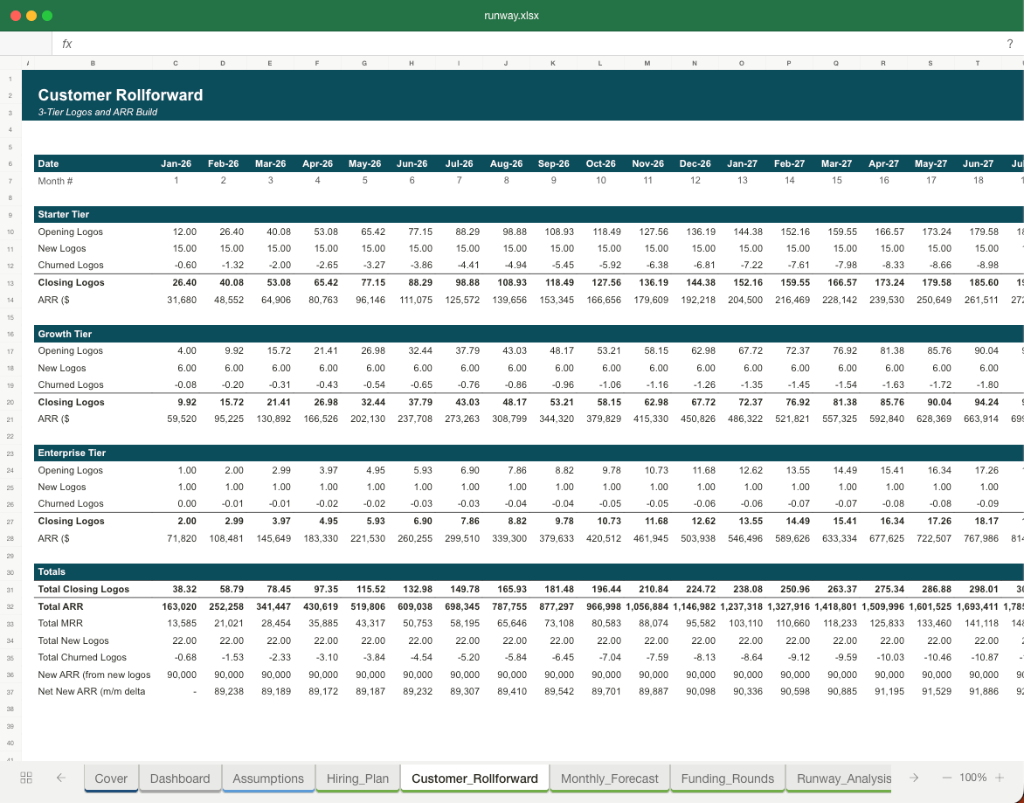
A 5-year monthly forecast with P&L, cash flow and runway, valuation (exit multiple plus a DCF cross-check), MOIC/IRR returns, and unit economics, with live formulas throughout.
How was this model built?+
It was built from ForgeRock's pitch deck and publicly available information, then structured to investment-banking standards as a fully editable Excel model.
Can I change the assumptions?+
Yes. You can change assumptions and the live formulas will recalculate in the downloadable Excel model.
Have more financial modelling questions? Contact us

Created by ex-finance professionals
Hey, I’m Alex and I created Finamodel.
Over my years in the finance industry I kept building the same models over and over again. Same structure, same assumptions, different logo. So I started building frameworks to turn them into clean, reusable templates.
Every model here is one I’d actually use for a client, and I personally vet each one before it goes up.
I’m not an expert in every industry, but I’ve built enough models to know what belongs in one. And when something is completely foreign to me, I reach out to my network for experts to work on our models with us.
Having a template library on hand cuts a first build from hours to minutes.
Need help finding your model? You’ll find me in the Finamodel app!
Other Hardware/Deep-tech Startup Financial Models
Browse another startup in the same category.

ANYbotics
ANYbotics builds and sells autonomous legged inspection robots (ANYmal) for industrial facilities, targeting oil & gas, chemicals, power, offshore, mining, and manufacturing sectors.
Awake Security
Awake Security - AI-driven Network Detection & Response (NDR) platform for the hybrid cloud, positioning as the "intent detection" layer of the SOC visibility triad.

Beem
AR communications platform that overlays full-body "hologram" video of a person into the recipient's physical space via smartphone or web.

Blue White Robotics
Autonomous robotics platform converting existing farm equipment to self-driving tractors for permanent-crop growers, sold as Robots-as-a-Service.

Cambridge GaN Devices
Fabless semiconductor startup commercialising self-protected GaN power transistors (HiGaN) that replace silicon and standard GaN with higher efficiency and no external protection circuitry.

Canix
Cannabis-focused ERP (inventory tracking, compliance automation, sales management, yield forecasting) sold as SaaS to cannabis cultivators, manufacturers, and distributors.
Chobani
Chobani is the US market leader in Greek yogurt; TPG invested $671M in April 2014 for a 35% stake via a structured second lien + equity deal
Cipher Skin
Wearable sensor mesh platform that collects dense multi-modal data from human bodies and industrial objects to predict structural and functional failure before it occurs.