 GoStudent Financial Model
Marketplace Startup Financials (Free Excel Download)
Online live 1:1 tutoring platform connecting students aged 6–19 with vetted tutors via subscription memberships.



professionals from Deloitte
Used by professionals from






About this model
GoStudent is an online tutoring platform matching school-age students with vetted tutors for live one-to-one sessions. Families buy multi-month memberships, while the platform uses a collaborative virtual classroom, study plans, and matching technology to support regular learning.
The business operates across numerous markets and had completed more than 50,000 tutor-student matches. Parents purchase six-, 12-, or 24-month contracts with different monthly session allowances, and tutors are selected through a highly competitive process.
The model combines consumer subscription cohorts with delivered-session economics. New memberships, contract value, renewal, and churn build recognized revenue, while sessions per student and tutor payout produce gross margin. Sales conversion, tutor supply, session utilization, and customer retention are the main drivers of cash payback and scale.
A turnkey financial model
Live formulas, no hardcoded values
Outputs are driven by live formulas, so the workbook updates from its assumptions instead of relying on hardcoded results.
All assumptions in one tab
Inputs are clearly marked in the Assumptions tab and separated from calculations, making it clear what to change and what to leave intact.
Statements always balancing
For integrated-statement models, the balance sheet, cash flow, and supporting schedules tie through properly.
Distinct schedules for clarity
Debt, working capital, taxes, and cash flow can get messy quickly. We group calculations in clear schedules, not across disconnected tabs.
No hidden macros or external links
There are no unexplained external workbook links or macros to undermine auditability or portability.
Changes flow through the model
Update a key driver and see the impact carry through the forecast, financing, and return outputs. We never use hardcoded numbers in formulas.
About GoStudent
gostudent.org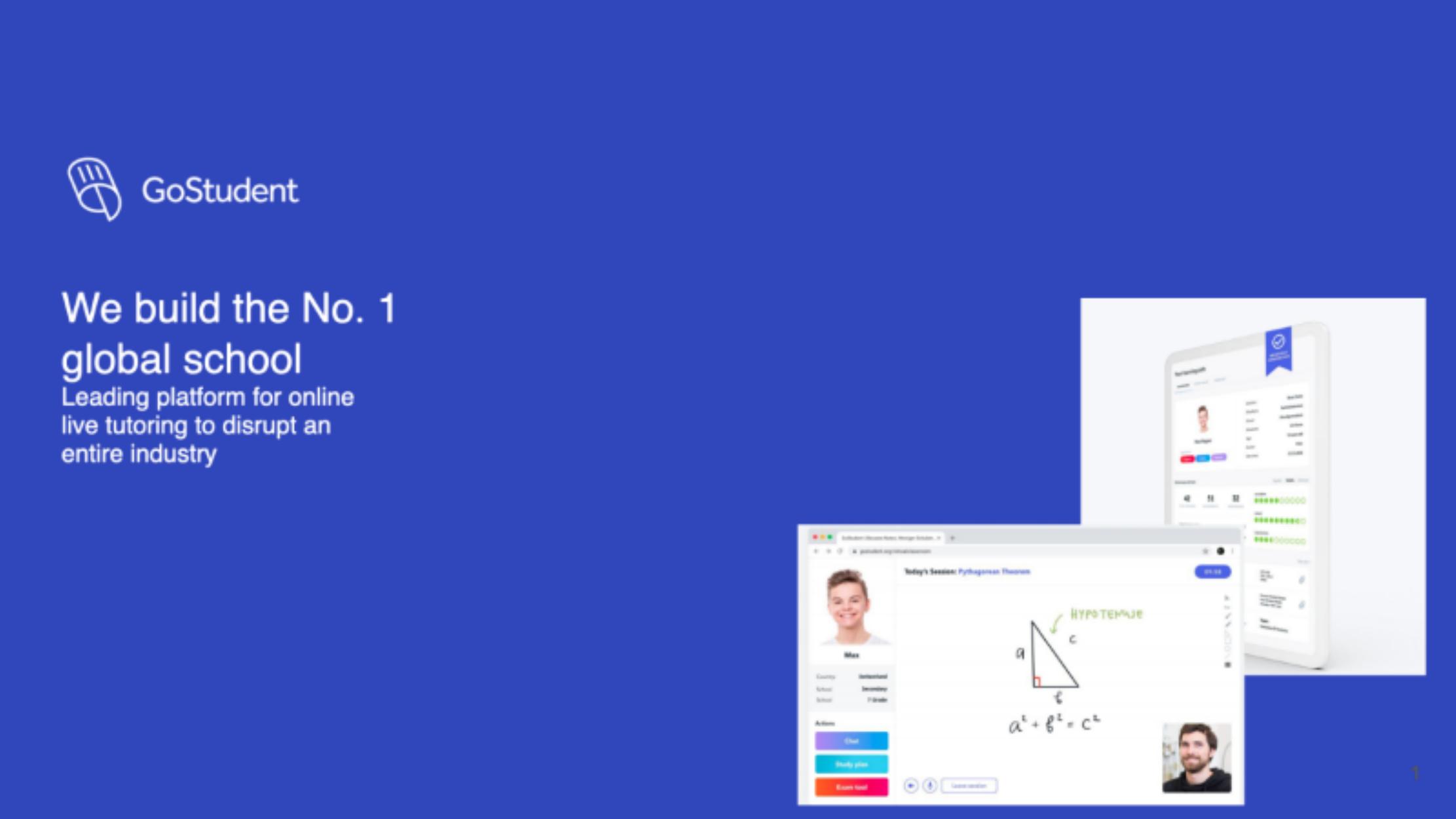
How to build a detailed financial model for GoStudent
A complete walkthrough of the business, drivers, and assumptions behind the downloadable GoStudent model - distilled from its pitch deck and publicly available information.
Product & value proposition
- Core product: Video-based 1:1 live tutoring sessions via proprietary web app with collaborative whiteboard, subject-specific tools, study plan, notes/recordings, and integrated feedback.
- Customers: Parents of school-age children (6–19); inbound via tele-sales consultative model.
- Tutors: Highly selective (~5% pass-rate); matched to students via AI algorithm using 25+ attributes.
- Session subjects: ~50% math, ~30% languages, ~20% side-subjects (Latin, Physics, etc.).
- Membership packages: 6, 12, or 24-month contracts with 4/8/12/16 sessions per month.
- Tech differentiators: AI-powered tutor-student matching; AI emotion-tracking (32 facial expressions, 8 emotions) from pilot study Q1 2021 (N>3,000 sessions, Affectiva algorithm).
Market
- European private tutoring TAM 2021: USD 32bn
- European private tutoring TAM 2027: USD 49bn
- Market CAGR 2021–2027: ~8% (range: 6% pre-school to 8.8% high school)
- Online mix shift: 2021 - 47.1% online / 52.9% blended; 2027 - 64.4% online / 35.6% blended
- China private tutoring market 2021: USD 34bn (comparable to Europe)
- GoStudent addressable market: 90% of EU TAM by covering 15+ countries end 2021
- EU total education spend: >EUR 850bn/year (4% GDP); >20% from private households
- Demand signal: Up to 50% of children need private tutoring
- COVID tailwind: pre-COVID 30% couldn't imagine online tutoring; post-COVID only 3% can't
Revenue model
- Revenue type: Membership subscription; parents pay upfront for 6/12/24-month contracts.
- Sessions per contract: 4, 8, 12, or 16 sessions/month depending on tier.
- Pricing: "Relatively affordable" vs. competitors; deck positions GoStudent at >18–25 EUR per 1:1 session (inferred from competitor pricing legend showing GoStudent as affordable and legacy offline centers as expensive at >35 EUR).
- Channel: In-house tele-sales force using consultative selling ("trust-building sales engine").
- Tutor payout: Not specified. GoStudent takes a platform cut from session fees (implied by platform model).
- No ad revenue, marketplace listing fees, or freemium tier mentioned.
Traction & metrics
- Tutor-student matches: >50,000
- Tutor pass-rate (selectivity): ~5%
- Trustpilot rating: 4.7/5 (n=1,114 reviews)
- Team size: ~160 employees at time of deck (grew from ~40)
- Geographic traction: Presence in DACH, France, Spain, Italy, UK, Ireland, Greece, Netherlands, Turkey, Russia, Mexico, Canada
- Membership model launched: Multi-month contracts 6–24M in place
- Session frequency example (illustrative, not aggregate KPI): 2 sessions/week per student referenced in product walkthrough
Unit economics
- Deck claims "very attractive unit economics" but provides no figures.
- Tutor income reference (anecdotal): One tutor profile mentions ~15 sessions/month; another ~40 sessions/month. - not a unit economics KPI.
Competition / moat
- Competitive set: Legacy offline learning centers (Studienkreis, Acadomia - expensive, >35 EUR 1:1, no location-independent access); traditional marketplaces (Superprof, CleverMate - no customer support, variable quality); shadow market (informal tutors).
- GoStudent positioning: Affordable (18–25 EUR range implied), online, quality-controlled, fully supported.
- Market fragmentation: "Extremely fragmented, only smaller local players, below 1% market share"
- Claimed moats: AI matching (25+ attributes), high tutor selectivity (~5% pass-rate), proprietary study portal, emotion AI, in-house tele-sales with above-industry CVRs, internationalization playbook, loyal customer/tutor base, data flywheel.
Team & funding ask / use of funds
- Founders: Felix Ohswald (CEO), Gregor Müller (COO).
- C-suite: Laura Warner (Chief Growth Officer), Dr. Alfons Priessner (Chief of Staff), Nikolaus Menches (VP Sales, 20+ yrs), Hesham Elnkahlawy (VP Product, 15+ yrs), Paul Cumiskey (VP Marketing, 20+ yrs), Ivo Kolev (CTO, 20+ yrs).
- Advisory board: Dennis Yung (former CEO Udemy), Thomas W. Griesel (founder HelloFresh), Nicolas Brusson (founder BlaBlaCar), David Joo (founder KnowRe).
- Investors: Coatue (Daniel Senft), Left Lane Capital (Harley Miller, Vinny Pujji), DN Capital (Nenad Marovac), Speedinvest (Oliver Holle).
- Use of funds: Implied - 5–6x FTE growth in 2021, international expansion to +15 EU countries plus beyond-EU prep, brand building (marketing team in Berlin).
Recommended financial model
- Archetype + why: Subscription/membership GMV + unit-economics P&L model. GoStudent is a B2C subscription EdTech platform with recurring monthly sessions - closest archetype is a consumer subscription (not pure SaaS, since revenue recognition follows session delivery) layered on a two-sided marketplace. The right model tracks: new subscriber additions, average contract value (ACV), cohort retention/churn, sessions delivered, tutor payout per session, and blended gross margin. Given the declared "very attractive unit economics" claim with zero supporting data, the model must stress-test CAC payback vs. contract length.
- Forecast horizon & granularity:
- 3 years monthly (2021–2023); roll up to annual summary.
- Monthly is required to capture contract start timing, cohort revenue recognition, and tele-sales hiring ramp.
- Key drivers & assumptions:
Demand / subscriber funnel
- New subscribers added per month - ramp from a base implied by >50k matches (not revenue-equivalent); start at ~3,000–5,000 new subs/month given 160-person team and multi-country ops, growing 10–15%/month. Rationale: 5–6x FTE target implies rapid scale.
- Tele-sales conversion rate (CVR) - "above industry standard" per deck slide 16; assume 15–20% lead-to-sale for consultative EdTech inside sales.
- Leads per sales rep per month - 80–120, consistent with inside-sales benchmarks.
Pricing / contract mix
- Session price per hour: ~EUR 20–22 net to GoStudent (midpoint of >18–25 EUR range shown on slide 15).
- Contract mix: 40% 6-month / 40% 12-month / 20% 24-month; longer contracts improve LTV but require higher upfront cash.
- Sessions per month per contract: 4/8/12/16 tiers; average ~8 sessions/month.
- Average Contract Value (ACV): ~EUR 1,440–1,920 for a 12-month / 8 sessions per month contract at EUR 20/session.
Revenue recognition
- Revenue recognized per session delivered (not upfront), unless GoStudent books upfront and defers - session-delivery basis for model conservatism.
Tutor economics / COGS
- Tutor payout per session: EUR 10–12 (50–55% of session price), consistent with gig-economy platform splits.
- Gross margin: ~45–50% after tutor payout; higher at scale if platform costs are relatively fixed.
Churn / retention
- Monthly churn post-contract term: 10–15%; long-term contracts (6–24M) suppress early churn - a key model sensitivity.
- Contract renewal rate: 40–50% at end of 6-month / 60–70% at 12-month - no data in deck.
CAC / sales cost
- Blended CAC (fully-loaded tele-sales): EUR 200–350/subscriber; tele-sales is expensive vs. inbound, but deck implies this is intentional for trust.
- LTV/CAC: target >3x at 12-month payback - needs validation.
Market expansion
- Countries active: ramp to +15 EU countries by end 2021.
- Country-level revenue contribution: DACH contributes ~50% initially, declining to ~35% as EU expands.
Headcount
- FTE growth: 5–6x in 2021 per deck; from ~160 to ~850–960 by year-end 2021.
- Sales/CS/tutor-supply as % of FTE: ~60–70% given tele-sales model.
- Scenarios (Base / Bull / Bear - which variables flex):
- Base: 12% MoM new subscriber growth, EUR 20/session, 45% gross margin, 12% monthly post-contract churn.
- Bull: 18% MoM growth, higher 12/24-month contract mix, EUR 22/session, 50% gross margin, 8% churn, 65% renewal.
- Bear: 6% MoM growth, heavy 6-month contract mix, EUR 18/session, 38% gross margin (higher tutor costs in new markets), 20% churn, 35% renewal.
- Required sheets / outputs:
- Assumptions - all drivers in one editable table; seeded values flagged.
- Subscriber cohort model - monthly new subs, active subs by cohort, contract expirations, renewals.
- Revenue build - sessions delivered × price; deferred revenue schedule if upfront billing.
- Tutor COGS - sessions × tutor payout; gross profit waterfall.
- P&L - gross profit → sales/marketing (CAC × new subs), R&D, G&A → EBITDA.
- Headcount plan - tele-sales ramp tied to new-sub target; cost per FTE.
- Unit economics summary - CAC, LTV, LTV/CAC, payback period by cohort year.
- Scenarios - toggle Base/Bull/Bear; key output table (subscribers, GMV, gross margin %, EBITDA margin).
- Dashboard - KPI summary: active subscribers, GMV, gross margin, burn/runway, LTV/CAC.
Frequently asked
Is the GoStudent financial model free?+
Yes. The GoStudent model is a free Excel (.xlsx) download with live formulas. Sign up with your email and the workbook is yours to keep, review, and edit.
What's included in the model?+
A 5-year monthly forecast with P&L, cash flow and runway, valuation (exit multiple plus a DCF cross-check), MOIC/IRR returns, and unit economics, with live formulas throughout.
How was this model built?+
It was built from GoStudent's pitch deck and publicly available information, then structured to investment-banking standards as a fully editable Excel model.
Can I change the assumptions?+
Yes. You can change assumptions and the live formulas will recalculate in the downloadable Excel model.
Have more financial modelling questions? Contact us

Created by ex-finance professionals
Hey, I’m Alex and I created Finamodel.
Over my years in the finance industry I kept building the same models over and over again. Same structure, same assumptions, different logo. So I started building frameworks to turn them into clean, reusable templates.
Every model here is one I’d actually use for a client, and I personally vet each one before it goes up.
I’m not an expert in every industry, but I’ve built enough models to know what belongs in one. And when something is completely foreign to me, I reach out to my network for experts to work on our models with us.
Having a template library on hand cuts a first build from hours to minutes.
Need help finding your model? You’ll find me in the Finamodel app!
Other Marketplace Startup Financial Models
Browse another startup in the same category.

Acquco
Amazon brand aggregator - acquires third-party Amazon seller businesses at attractive multiples, then scales them via proprietary growth playbooks and technology.
Arive
Premium q-commerce app delivering lifestyle and branded products in under 30 minutes across German cities.

Audience Town
Vertical data and advertising platform targeting home movers across the entire home journey - pre-move through post-move.

AudioMob
Non-intrusive in-game audio ad platform bridging music/brand advertisers to mobile game publishers.

Authoritive
Two-way messaging platform that turns creator expertise into scalable, push-delivered learning experiences via SMS/WhatsApp.

Avo
Building amenity and office perk platform delivering same-day grocery/pantry/goods to residential and commercial tenants via a white-label marketplace.
beehiiv
Newsletter platform for creators to build, grow, and monetize email audiences - SaaS subscription + native ad network revenue.
Borzo
Global same-day logistics marketplace connecting B2B merchants with crowdsourced couriers for last-mile delivery