 Hadean Financial Model
Media/Gaming Startup Financials (Free Excel Download)
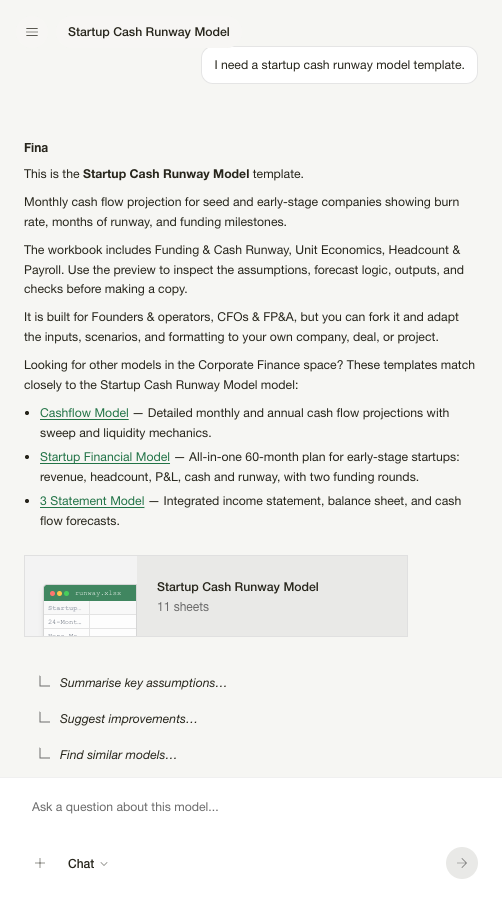
Distributed computing platform ("metaverse infrastructure") enabling massively scalable virtual worlds, simulations, and synthetic environments for gaming, enterprise, and defence.



professionals from Deloitte
Used by professionals from






About this model
Hadean provides a Rust-based distributed cloud platform for massive virtual worlds, simulations, and synthetic environments. It sits between applications and hardware, supports public, private, on-premise, and air-gapped deployments, and integrates with game engines, APIs, AI libraries, and blockchain tooling.
Its product suite includes Metaverse Hub, Simulate, Connect, Orchestrate, Authenticate, and Studio. Revenue is inferred to combine recurring platform licences, multi-year delivery and co-development contracts, bespoke Studio services, and grants; the deck does not disclose a pricing unit, ARR, or customer count.
The company had raised $37 million and cites 14,274 concurrent players in EVE Aether Wars. Other references include a three-year CAE agreement simulating more than two million entities and 300-plus users. The model should distinguish licence, services, and grant revenue from cloud infrastructure, engineering, and sales costs.
A turnkey financial model
Live formulas, no hardcoded values
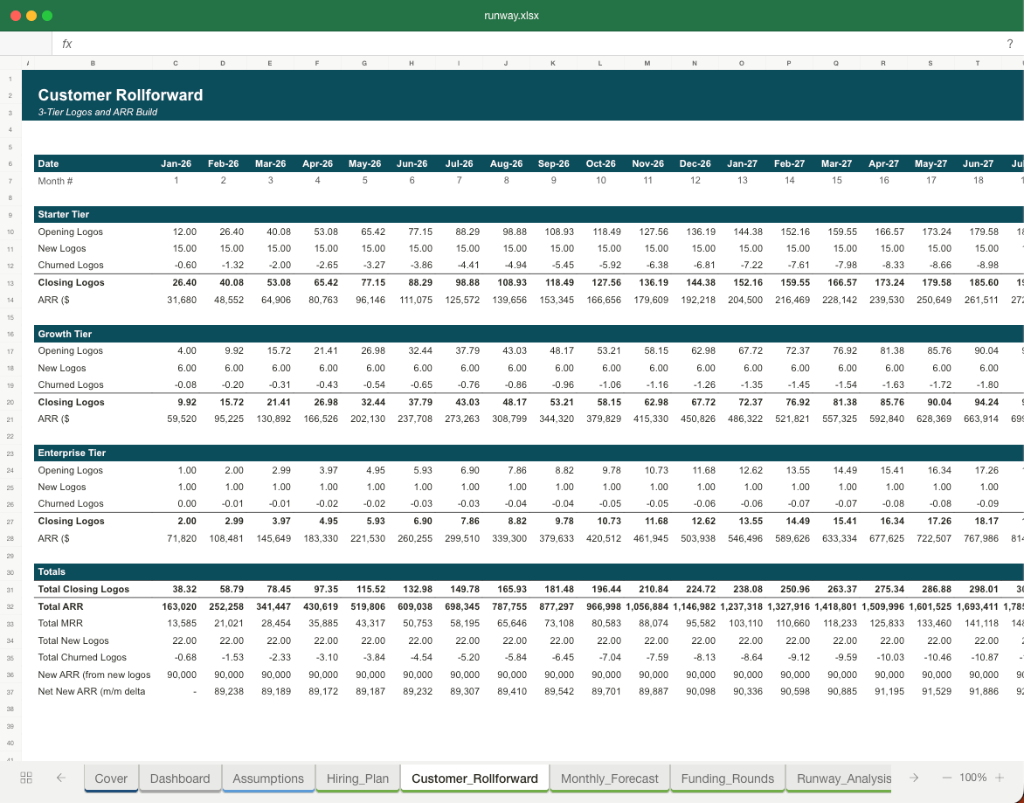
Outputs are driven by live formulas, so the workbook updates from its assumptions instead of relying on hardcoded results.
All assumptions in one tab
Inputs are clearly marked in the Assumptions tab and separated from calculations, making it clear what to change and what to leave intact.
Statements always balancing
For integrated-statement models, the balance sheet, cash flow, and supporting schedules tie through properly.
Distinct schedules for clarity
Debt, working capital, taxes, and cash flow can get messy quickly. We group calculations in clear schedules, not across disconnected tabs.
No hidden macros or external links
There are no unexplained external workbook links or macros to undermine auditability or portability.
Changes flow through the model
Update a key driver and see the impact carry through the forecast, financing, and return outputs. We never use hardcoded numbers in formulas.
About Hadean
hadean.com
How to build a detailed financial model for Hadean
A complete walkthrough of the business, drivers, and assumptions behind the downloadable Hadean model - distilled from its pitch deck and publicly available information.
Product & value proposition
Hadean's core product is the Hadean Distributed Cloud Platform - a high-performance Rust-based distributed computing layer that replaces legacy cloud middleware. It sits between application and hardware, eliminating the need for bespoke microservice stacks, manual DevOps, and bespoke auto-scaling. Key differentiators vs. legacy stack:
- "Bare metal" performance at cloud scale
- Dynamic scalability without manual operations
- Interoperable via C++ / Python APIs, game engines (Unity, Unreal, O3DE, VBS), AI/ML libs, and blockchain
- Cloud-native: public cloud (Azure, AWS, Oracle), on-prem, air-gapped, private cloud
Built on top of the platform, Hadean sells six products:
- Hadean Metaverse Hub - interoperability, social graphing, tokenised economy
- Hadean Simulate - high-fidelity large-scale world simulation
- Hadean Connect - global connectivity, bandwidth reduction, low latency
- Hadean Orchestrate - parallelised simulation and data modelling
- Hadean Authenticate - traffic verification, no shared/stored data
- Hadean Studio - appears as a delivery/professional services arm for bespoke builds (mentioned in GamesCoin and Pixelynx case studies)
The core value proposition: enable customers to run massive-scale concurrent virtual environments (10K–14K+ CCU) that are structurally impossible on existing cloud infrastructure.
Market
- Total metaverse economy (TAM): $8–13 trillion by 2030
- Commercial segment (gaming, virtual concerts, entertainment): $200bn
- Enterprise segment (digital twins, virtual workspaces, autonomous systems): $70bn
- Government segment (synthetic environments, training, decision support): $20bn
No SAM or SOM breakdown provided. No CAGR cited for segment-level growth. The deck positions the $290bn addressable sub-market ($200bn + $70bn + $20bn) as Hadean's near-term target.
Revenue model
Not explicitly stated in deck. Revenue model must be inferred from case studies and product positioning:
- Platform licensing / SaaS: Implied by "distributed cloud platform" model. Enterprise and government clients likely pay recurring platform access fees.
- Multi-year contracts: CAE deal is explicitly described as a "deal over 3 years comprising multi-project delivery and co-development" - suggests milestone-based or annual contract revenue.
- Professional services / Studio: Hadean Studio delivers bespoke builds (GamesCoin metaverse, Pixelynx musicverse, Sony SIMS). May carry a services/implementation revenue line alongside platform licensing.
- Grants: Epic MegaGrant received for Unreal Engine integration; DASA (UK Defence and Security Accelerator) programme mentioned. These are non-dilutive grant revenues.
Pricing unit is not disclosed. No per-CCU, per-seat, per-compute-hour, or ACV/ARR figures appear in the deck.
Traction & metrics
No revenue or ARR figures disclosed. Traction presented through partnerships and technical benchmarks:
- Funding raised to date: $37m
- Record concurrency (gaming): 14,274 CCU in a single PvP battle (EVE Aether Wars, 2019) - claimed as world record; vs. Improbable/ScavLab 10K CCU (2021) and Epic Games/Fortnite 100 CCU (present) per bar chart on slide 04
- Minecraft: 10x increase on player capacity; backend/networking upgrade delivered in 50% of planned time; 1 developer scaled lobbies from 100 to 1K+ players in 3 days
- CAE deal: 3-year multi-project + co-development agreement; simulation of 2M+ entities, 300+ concurrent users
- UK MoD: Pathfinder agreement for Defence Synthetic Environment Platform (DSEP) and CTTP
- Microsoft (USMC tender): Selected as core simulation engine for multi-level global conflict simulation
- BAE Systems: Partnership for multi-domain synthetic training (air, land, sea, space, cyber)
- COVID-19 simulations: Francis Crick Institute (2-year contract); Imperial College London national-scale contact tracing model
- CCP (EVE Online): 5x bandwidth reduction, 3x cost efficiency
- Xsolla: 10K+ connected users per room, virtual conference capability
- British Army DASA: 9–12 month analytic process reduced to <1 day
No customer count, logo count, revenue, churn, or NRR metrics disclosed.
Competition / moat
Competitive positioning shown via CCU benchmark chart:
- Hadean: 14K CCU (2019)
- Improbable (SpatialOS): 10K CCU (2021)
- Epic Games (Fortnite): 100 CCU (present)
Competitive moat claimed:
- Technical: High-performance Rust core; "secure by design"; bare-metal performance without legacy middleware layers
- First-mover records: World's first 14K CCU single-shard PvP event
- Enterprise lock-in: Multi-year co-development deals (CAE) create switching costs; platform becomes embedded in customer simulation architecture
- Government clearance / relationships: MoD Pathfinder, DASA, USMC via Microsoft - high-barrier relationships that take years to build
- Ecosystem integrations: Epic MegaGrant, Unity, Unreal, O3DE, Azure, AWS, Oracle - broad integration surface
Primary named competitor is Improbable (SpatialOS). AWS, Azure native solutions, and bespoke game studio netcode are implicit alternatives.
Team & funding ask / use of funds
Team:
- Craig Beddis, Co-Founder & CEO - 25 yrs enterprise tech; Automic Software (50% YoY growth, $600m exit); raised $37m for Hadean
- Aidan Hobson-Sayers, Co-Founder & CTO - distributed compute expert; co-authored 2 books on Docker; Rust core contributor; Cambridge CS
- Mimi Keshani, Co-Founder & COO - Cambridge Masters; leads Life Science R&D and partnerships
- Shany Elkarat, Chief Product Officer - 25 yrs product/marketing in tech/telecoms
- Ralf Paschen, Chief Marketing Officer - enterprise tech marketing (CA, Automic)
- Lars Koschin, Chief Gaming Officer - 25+ yrs MMO veteran; launched 25 MMO titles incl. Runes of Magic
Advisors / investors: John Taysom (18+ IPOs, 82 investments, co-founder Privitar); Robert Sansom (Cambridge Angels, FORE Systems £2.8bn exit); Phil Osborn CBE (former Chief of Defence Intelligence); Marcus Willett OBE (GCHQ); Prof. David May (XMOS, invented first parallel microprocessor); Prof. Paul Kelly (Imperial College); Jerome Joaug (Ader Capital, DeepTech); David Gardner OBE (co-founder LVP, 30 yrs games)
Recommended financial model
- Archetype + why: B2B platform SaaS + professional services / contract revenue model (multi-segment). Hadean has two distinct revenue streams - (1) recurring platform licensing across commercial (gaming, entertainment) and enterprise customers and (2) large government/defence contracts (multi-year, milestone-based). The correct model is a segmented revenue build: recurring ARR/TCV for commercial/enterprise, plus a backlog/contract-revenue waterfall for government. A simple 3-statement model should sit underneath.
- Forecast horizon & granularity: 5 years (2023–2027), quarterly for years 1–2, annual thereafter. Government contracts require a contract-backlog schedule. Quarterly granularity needed to model milestone payments and cash timing.
- Key drivers & assumptions:
- *Commercial segment*
- Number of new gaming/entertainment clients per year
- Average ACV per commercial customer
- Net revenue retention / expansion rate
- Professional services attach rate and average project size
- *Enterprise segment*
- Number of enterprise digital twin / virtual workspace customers
- ACV
- *Government / defence segment*
- Active contracts: CAE (3-year, size undisclosed), MoD Pathfinder, USMC via Microsoft, BAE, DASA (Cervus)
- Average government contract TCV
- Win rate on future tenders
- *Grant revenue*
- Recognised as received; lumpy, non-recurring
- *Cost structure*
- R&D headcount as % of total opex
- Gross margin on platform
- Gross margin on professional services
- Blended gross margin
- Total headcount and cost base
- *Market sizing seed*
- $290bn combined near-term addressable sub-market; Hadean captures <0.1% in early years
- Scenarios (Base / Bull / Bear - which variables flex):
- *Bear*: Government tender wins delayed; commercial gaming adoption slow post-metaverse hype cycle; 2–3 commercial wins/year, ACV at low end, gross margin compressed by cloud pass-through costs
- *Base*: CAE-style 3-year deals with 2–3 new government clients/year; 5–8 commercial wins/year; platform gross margin 65%
- *Bull*: Microsoft/USMC deal scales into multi-contract US DoD relationship; gaming platform becomes standard for major studios; 15+ commercial clients/year; high NRR expansion; potential Minecraft/Mojang enterprise contract converts to large platform deal
- Required sheets / outputs:
- Assumptions dashboard (all drivers, scenario toggle)
- Commercial revenue waterfall (gaming + entertainment clients - cohort model, ACV × logo count)
- Enterprise revenue waterfall (digital twins + workspace clients)
- Government contract backlog schedule (contract by contract: TCV, start date, milestone schedule, recognised revenue per quarter)
- Professional services revenue (attach rate × project size)
- Grant revenue schedule
- Headcount plan and opex build
- P&L (blended gross margin, EBITDA)
- Cash flow statement (critical: government contracts have long cash conversion cycles)
- Balance sheet (light version; key: cash runway)
- KPI summary: ARR, logo count by segment, backlog TCV, gross margin %, burn rate, runway months
Frequently asked
Is the Hadean financial model free?+
Yes. The Hadean model is a free Excel (.xlsx) download with live formulas. Sign up with your email and the workbook is yours to keep, review, and edit.
What's included in the model?+
A 5-year monthly forecast with P&L, cash flow and runway, valuation (exit multiple plus a DCF cross-check), MOIC/IRR returns, and unit economics, with live formulas throughout.
How was this model built?+
It was built from Hadean's pitch deck and publicly available information, then structured to investment-banking standards as a fully editable Excel model.
Can I change the assumptions?+
Yes. You can change assumptions and the live formulas will recalculate in the downloadable Excel model.
Have more financial modelling questions? Contact us

Created by ex-finance professionals
Hey, I’m Alex and I created Finamodel.
Over my years in the finance industry I kept building the same models over and over again. Same structure, same assumptions, different logo. So I started building frameworks to turn them into clean, reusable templates.
Every model here is one I’d actually use for a client, and I personally vet each one before it goes up.
I’m not an expert in every industry, but I’ve built enough models to know what belongs in one. And when something is completely foreign to me, I reach out to my network for experts to work on our models with us.
Having a template library on hand cuts a first build from hours to minutes.
Need help finding your model? You’ll find me in the Finamodel app!
Other Media/Gaming Startup Financial Models
Browse another startup in the same category.

Almost Friday
Almost Friday is a multi-platform comedy/lifestyle media brand built around the "Friday Beers" universe, monetising through apparel, brand partnerships, events, podcasts, and music.

Amagi
Cloud-native SaaS platform for TV/OTT channel creation, distribution, and ad monetization (FAST-focused)

Audoo
IoT + SaaS platform that captures real-time public music performance data and reports it to Performing Rights Organisations (PROs) to enable accurate royalty distribution.
Backbone
Backbone makes a mobile gaming controller (hardware) + unified software platform (Backbone app) that aggregates all game streaming services in one place.
Beacon Pines
Beacon Pines is a cute-and-creepy narrative adventure game set inside a magical storybook, developed by indie studio Hiding Spot Games.
Bear and Breakfast
A management/adventure video game where you play as a bear running a B&B cabin in the woods.
Bioshock
BioShock is a first-person action horror game pitched to a publisher for development funding - a game-development studio deal, not an operating startup.

Button City 2018
Indie narrative adventure game about cute animal kids saving their local arcade, targeting console and PC.