 HomeCooks Financial Model
Marketplace Startup Financials (Free Excel Download)
Two-sided marketplace connecting home/micro food creators with consumers for pre-prepped, frozen-then-delivered meals - "the Etsy of food."



professionals from Deloitte
Used by professionals from






About this model
HomeCooks is a marketplace for home and micro food creators to sell prepared meals to consumers. Creators batch-cook dishes, while the platform manages pickup, frozen storage, and delivery so customers can reheat a wide selection of meals quickly.
The company reported more than 6,000 customers, 100 active chefs, 50,000 meals ordered, and 24% average monthly revenue growth. With typical meals priced at £5–£8 and average baskets of £40, the platform combines creator discovery with a meaningful cold-chain fulfillment layer.
The model uses active chefs, menu availability, orders per dish, and average meal price to build transaction value. A blended take rate converts GMV into revenue, while logistics and fulfillment costs create the contribution-margin bridge. Customer repeat orders, chef activation, basket size, and delivery density are the primary sensitivities.
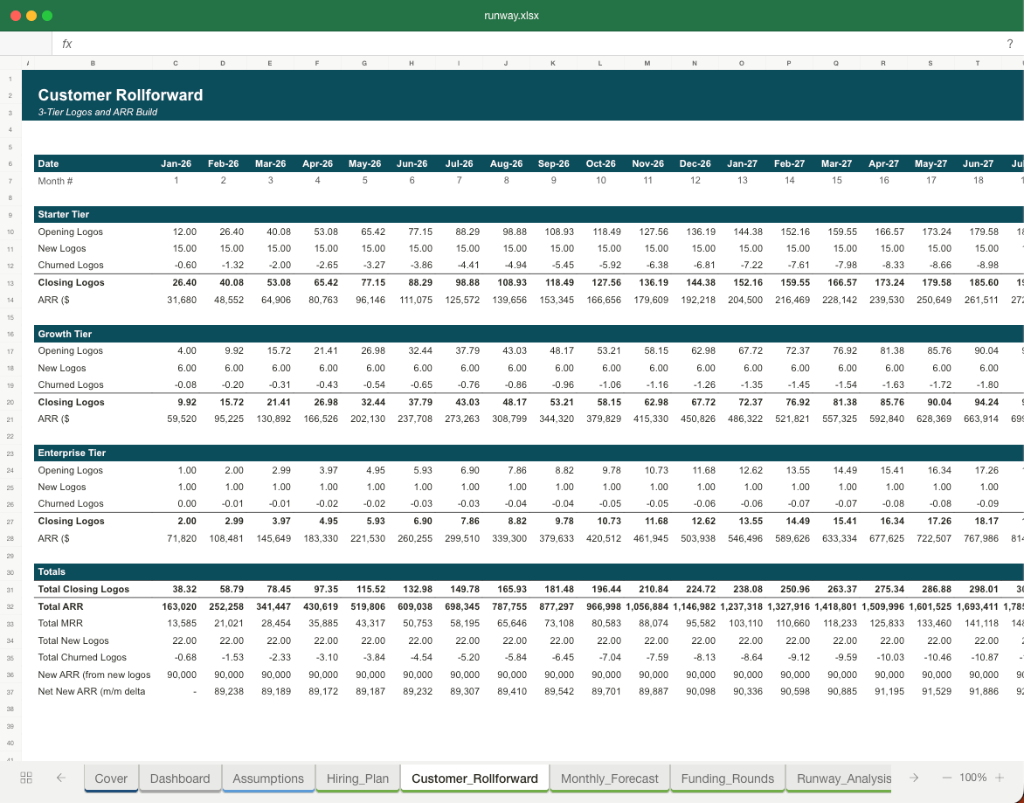
A turnkey financial model
Live formulas, no hardcoded values
Outputs are driven by live formulas, so the workbook updates from its assumptions instead of relying on hardcoded results.
All assumptions in one tab
Inputs are clearly marked in the Assumptions tab and separated from calculations, making it clear what to change and what to leave intact.
Statements always balancing
For integrated-statement models, the balance sheet, cash flow, and supporting schedules tie through properly.
Distinct schedules for clarity
Debt, working capital, taxes, and cash flow can get messy quickly. We group calculations in clear schedules, not across disconnected tabs.
No hidden macros or external links
There are no unexplained external workbook links or macros to undermine auditability or portability.
Changes flow through the model
Update a key driver and see the impact carry through the forecast, financing, and return outputs. We never use hardcoded numbers in formulas.
About HomeCooks
home-cooks.co.uk
How to build a detailed financial model for HomeCooks
A complete walkthrough of the business, drivers, and assumptions behind the downloadable HomeCooks model - distilled from its pitch deck and publicly available information.
Product & value proposition
- Platform connects three types of food creators (Amateurs/Hobbyists, Professional Chefs, Micro Brands) with consumers ("Eaters").
- Creators batch-cook meals; HomeCooks handles cold-chain logistics (pickup, frozen storage, dispatch).
- Eaters receive ambient or frozen pre-prepped meals, reheatable in 5–10 minutes.
- Creator onboarding costs ~£0 CapEx; company scales chefs up slowly, ordering only what it knows will sell.
- Social layer in development: chef profiles, community messaging, social feed - intended to increase engagement and virality.
- Average meal price on HomeCooks: £5–£8 vs. Deliveroo £9–£15.
- Prep time: 5–10 minutes vs. Gousto 10–45 minutes, HelloFresh 20–45 minutes.
Market
- UK TAM (home food service): £10bn in 2015 → £18bn in 2021
- Breakdown 2021: Takeaway Delivery £11bn, Ready Meals £4bn, Meal Kits £2bn
- Global Eat at Home Market: £250bn
- UK food creator supply pool: ~500,000 creators (amateurs, professional chefs, micro brands)
- Market validation comps (US food creator marketplaces): Shef $20m Series A (a16z), Cook Unity $47m Series B, Goldbelly $100m Series B
Revenue model
- Marketplace take-rate on GMV (transaction value). Revenue is explicitly separated from "Transaction Value" in the 2024–2028 forecast, implying a take-rate.
- Implied take-rate 2024: Revenue £682k / Transaction Value £1.8m = ~38%
- Implied take-rate 2025: Revenue £5.6m / Transaction Value £14.2m = ~39%
- Implied take-rate 2026: Revenue £36m / Transaction Value £87m = ~41%
- Note: take-rate appears remarkably high for a marketplace; it likely encompasses logistics/fulfilment revenue bundled in, not pure commission. The deck does not disaggregate commission from logistics fees.
- Consumer-facing: pre-prepped meal orders; average basket value £40
- Average meal price per dish: £5–£8; implying ~5–8 items per basket
- Creator-side: no listing fees stated; revenue model for creators is purely from sales (no take explicitly called out for creator side)
- 2 orders per customer per month
Traction & metrics
Quarterly revenue (slide 06):
- Q3 2022: £10k
- Q4 2022: £36k
- Q1 2023: £67k
- Q2 2023: £81k
- Q3 2023: £105k
- Q4 2023 (run rate): £158k*
Other KPIs as of deck date (~Q3/Q4 2023):
- Customers: 6,000+
- Meals ordered (cumulative): 50,000+
- Average Basket Value: £40
- Average Monthly Revenue Growth: 24%
- Active Chefs: 100+
- Available Meals: 200+
- Orders per customer per month: 2
Active food creator growth:
- Q3 2022: 28
- Q4 2022: 45
- Q1 2023: 56
- Q2 2023: 85
- Q3 2023: 129
Supply pipeline: 900+ food brands on waiting list
Near-term target: £150k monthly revenue by Q2 2024; 500 active meals by Q4 2024
Unit economics
- No explicit CAC figure stated in deck.
- No explicit LTV figure stated.
- No gross margin or contribution margin stated.
- Deck claims "quick user payback" vs. meal kit competitors, attributed to subsidised CPA through creator referrals.
- Acquisition channel mix (slide 19): Eater Referral 33.3%, Paid Online 19%, Influencer 14.3%, Creator Referral 14.3%, Social 11.4%, Offline Direct 7.6%.
- Creator revenue benchmarks (slide 15): Amateurs £0.6k–£0.8k/month; Professional Chefs £3k–£4.8k/month; Micro Brands £6.5k–£8.5k/month.
- Current mix of active creators (slide 15): Micro Brands 39%, Professional Chefs 29%, Amateurs 23%, Other 9%.
Competition / moat
- Primary delivery competitors: Deliveroo, Uber Eats, Just Eat - HomeCooks positioned higher quality / lower price, UK-wide coverage.
- Meal kit competitors: Gousto, HelloFresh - HomeCooks faster to cook (5–10 min) and more variety (200+ vs 50–75 dishes).
- Moat claims: network effects (more creators → more dishes → more orders → more creators); supply-side lock-in (low churn; chefs invested in brand on platform); community/social features building switching cost; UK-wide cold-chain logistics as operational barrier.
- Key differentiators: £0 creator CapEx; national UK delivery; frozen format enabling non-metropolitan reach where Deliveroo/Uber are absent.
Team & funding ask / use of funds
Team:
- Josh Magidson - Founder & CEO; previously founded Eatstudent (acquired by Just Eat) and Zing Zing (largest Chinese food delivery chain in UK).
- Alex Waddington - Partner Growth (ex Abel & Cole)
- Nick Collins - Operations Lead (ex Yo Sushi)
- Selin Erkut - Community
- Charlotte Litman - Product
- Dusan Koutny - CTO (Non-Exec)
- Miao Chen - Head of Growth
Investors / Advisors:
- SpeedInvest, Love Ventures
- Daniel Murray-Serter (Founder, Heights)
- Laurens Groeneveld (Founder, Just Eat)
- Leonard Picardo (Founding Team, Deliveroo)
- Islington Council
Funding ask: Not explicitly stated in deck. No raise amount, valuation, or use-of-funds breakdown shown.
12-month priorities (use of implied raise):
- UK Growth: £150k monthly revenue by Q2 2024; 500 active meals by Q4 2024
- Tech: App release Q2 2024; Social Feed Q3 2024
- Team: 5x key hires in growth, tech, and product
Recommended financial model
Archetype + why: Marketplace GMV / take-rate P&L with supply-side (creator) and demand-side (eater) driver trees. HomeCooks earns a blended take-rate on GMV (commission + logistics); both sides need separate driver trees. This is not a SaaS or subscription model - it is a transaction-volume-driven marketplace, so revenue is best modelled as: `Active Chefs × Avg Dishes per Chef × Dish Orders per Month × Avg Dish Price × Take Rate`. A 3-statement model is warranted only at Series A; for this seed deck a GMV waterfall + contribution-margin bridge is more appropriate.
Forecast horizon & granularity:
- Monthly for 2024–2025 (near-term operational visibility); annual summaries for 2026–2028.
- Deck provides annual milestones through 2028; near-term target is £150k MRR by Q2 2024.
Key drivers & assumptions:
Supply side (creator tree):
- Active food creators, Q3 2023: 129
- Active creator monthly growth rate: ~17% QoQ historically → implies ~5% MoM
- Creator mix: 39% Micro Brands, 29% Professional Chefs, 23% Amateurs, 9% Other
- Avg dishes per creator type: Micro Brand 1,000+, Professional Chef 500, Amateur 100
- Creator churn rate: low (management-driven, not voluntary);
- Supply target 2024: 400 active chefs; 500 active meals (distinct from chefs) by Q4 2024
Demand side (eater tree):
- Active customers (cumulative): 6,000+
- Orders per customer per month: 2
- Average basket value: £40
- Average monthly customer growth: 24% -
- Eater acquisition: 33% via eater referral, 14% creator referral, 19% paid online, 14% influencer, 11% social, 8% offline
Revenue / take-rate:
- Blended take-rate on GMV: ~38–41% implied from deck forecast
- This likely includes logistics/fulfilment pass-through; actual commission rate unknown separately
- Avg meal price to end consumer: £5–£8 per dish; avg basket £40 → ~5–8 items per order
Unit economics (to be built bottom-up):
- LTV proxy: 2 orders/month × £40 basket × estimated gross margin % × estimated retention months
Company-provided revenue forecast:
- 2024: Revenue £682k, Chefs 400, Orders 59k, GMV £1.8m
- 2025: Revenue £5.6m, Chefs 1.3k, Orders 459k, GMV £14.2m
- 2026: Revenue £36m, Chefs 2.4k, Orders 2.7m, GMV £87m
- 2027: Revenue £161m, Chefs 23k, Orders 11.8m, GMV £388m
- 2028: Revenue £556m, Chefs 57k, Orders 40m, GMV £1.35bn
Scenarios (Base / Bull / Bear - which variables flex):
- Base: Monthly creator growth ~5% MoM; take-rate ~38%; basket value stable at £40; UK-only through 2025; European launch 2026 on plan
- Bull: Creator growth accelerates with social features (app launch); basket value grows as Micro Brand mix increases; European launch ahead of schedule
- Bear: Creator growth stalls at 150–200 (quality control churn); logistics costs spike; paid acquisition required as referral loop matures; European launch delayed
Key flex variables: active creator count, orders per creator, blended take-rate, logistics cost per order, customer acquisition mix (organic vs. paid), geographic expansion timing.
Required sheets / outputs:
- Assumptions - all inputs, tagged vs.
- Creator Model - active creator build (adds, churn, mix by tier), dishes per creator, GMV per creator
- Eater Model - active customer build, orders/month, basket value, total orders, total GMV
- Revenue Bridge - GMV × take-rate → revenue; split by commission vs. logistics if data available
- Cost Structure - logistics (per order), platform ops, marketing (CPA × new customers), headcount (5 hires), tech/product
- Contribution Margin - revenue minus variable costs (logistics, creator payouts if applicable)
- P&L - through to EBITDA; net income likely not needed at seed stage
- Cash & Runway - simplified cash flow; burn rate vs. raise proceeds (when raise amount known)
- KPI Dashboard - MRR, active chefs, active customers, orders, GMV, take-rate, CAC, payback
- Scenario Toggle - Base / Bull / Bear with single-input switches
Frequently asked
Is the HomeCooks financial model free?+
Yes. The HomeCooks model is a free Excel (.xlsx) download with live formulas. Sign up with your email and the workbook is yours to keep, review, and edit.
What's included in the model?+
A 5-year monthly forecast with P&L, cash flow and runway, valuation (exit multiple plus a DCF cross-check), MOIC/IRR returns, and unit economics, with live formulas throughout.
How was this model built?+
It was built from HomeCooks's pitch deck and publicly available information, then structured to investment-banking standards as a fully editable Excel model.
Can I change the assumptions?+
Yes. You can change assumptions and the live formulas will recalculate in the downloadable Excel model.
Have more financial modelling questions? Contact us

Created by ex-finance professionals
Hey, I’m Alex and I created Finamodel.
Over my years in the finance industry I kept building the same models over and over again. Same structure, same assumptions, different logo. So I started building frameworks to turn them into clean, reusable templates.
Every model here is one I’d actually use for a client, and I personally vet each one before it goes up.
I’m not an expert in every industry, but I’ve built enough models to know what belongs in one. And when something is completely foreign to me, I reach out to my network for experts to work on our models with us.
Having a template library on hand cuts a first build from hours to minutes.
Need help finding your model? You’ll find me in the Finamodel app!
Other Marketplace Startup Financial Models
Browse another startup in the same category.

Acquco
Amazon brand aggregator - acquires third-party Amazon seller businesses at attractive multiples, then scales them via proprietary growth playbooks and technology.
Arive
Premium q-commerce app delivering lifestyle and branded products in under 30 minutes across German cities.

Audience Town
Vertical data and advertising platform targeting home movers across the entire home journey - pre-move through post-move.

AudioMob
Non-intrusive in-game audio ad platform bridging music/brand advertisers to mobile game publishers.

Authoritive
Two-way messaging platform that turns creator expertise into scalable, push-delivered learning experiences via SMS/WhatsApp.

Avo
Building amenity and office perk platform delivering same-day grocery/pantry/goods to residential and commercial tenants via a white-label marketplace.
beehiiv
Newsletter platform for creators to build, grow, and monetize email audiences - SaaS subscription + native ad network revenue.
Borzo
Global same-day logistics marketplace connecting B2B merchants with crowdsourced couriers for last-mile delivery