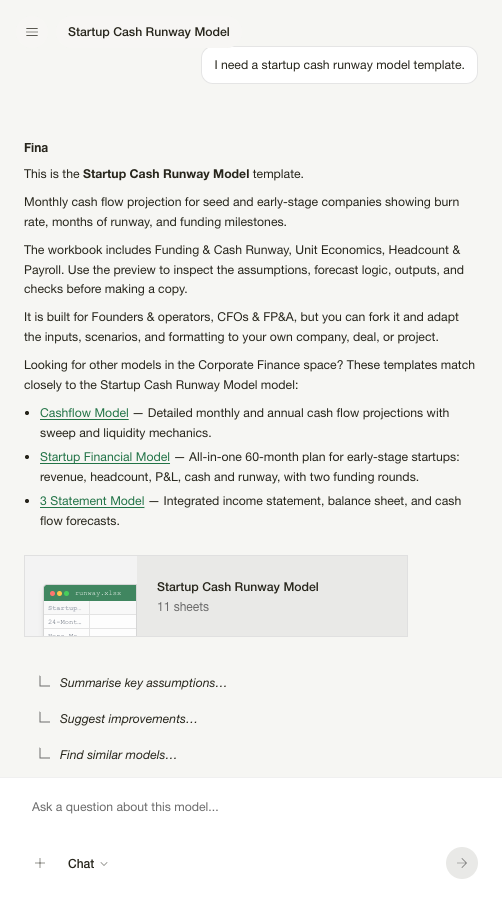
 HTEC Financial Model
Logistics/Mobility Startup Financials (Free Excel Download)
Technology services and product engineering firm providing outsourced R&D, product development, and engineering delivery to corporates, scaleups, and global enterprises.



professionals from Deloitte
Used by professionals from






About this model
HTEC provides outsourced R&D, product engineering, and technology-delivery services to corporates and scaleups. Its revenue depends on engineering capacity and long-term client programmes rather than software licences alone.
The model should start with billable engineers, utilisation, and blended rates, then reconcile those drivers to project backlog. Client concentration matters because a small group of programmes can shape growth and risk.
Forecast payroll and delivery costs against revenue to derive delivery margin. This makes the link between staffing, client demand, and profitability explicit for an engineering-services business. The plan should identify how long-term programmes use capacity differently from shorter technology-delivery assignments.
A turnkey financial model
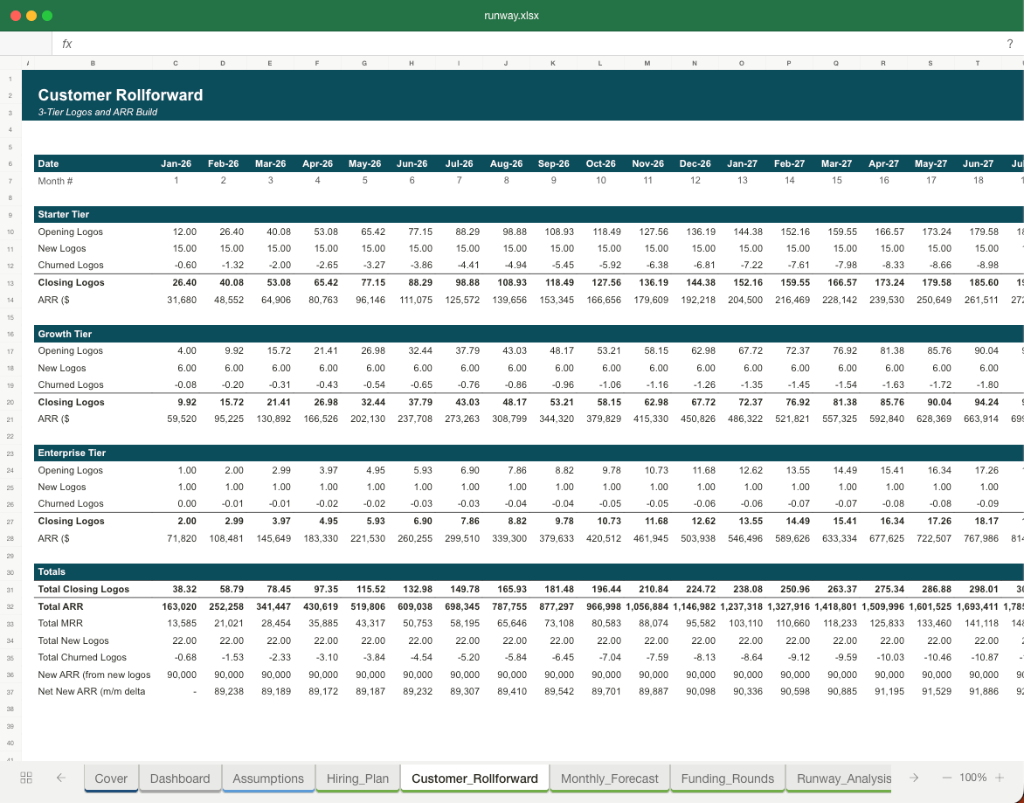
Live formulas, no hardcoded values
Outputs are driven by live formulas, so the workbook updates from its assumptions instead of relying on hardcoded results.
All assumptions in one tab
Inputs are clearly marked in the Assumptions tab and separated from calculations, making it clear what to change and what to leave intact.
Statements always balancing
For integrated-statement models, the balance sheet, cash flow, and supporting schedules tie through properly.
Distinct schedules for clarity
Debt, working capital, taxes, and cash flow can get messy quickly. We group calculations in clear schedules, not across disconnected tabs.
No hidden macros or external links
There are no unexplained external workbook links or macros to undermine auditability or portability.
Changes flow through the model
Update a key driver and see the impact carry through the forecast, financing, and return outputs. We never use hardcoded numbers in formulas.
About HTEC
htecgroup.com
How to build a detailed financial model for HTEC
A complete walkthrough of the business, drivers, and assumptions behind the downloadable HTEC model - distilled from its pitch deck and publicly available information.
Product & value proposition
Three engagement models:
- Product Ownership - HTEC owns full end-to-end product delivery; takes vision → roadmap → engineering.
- Integrated Delivery - HTEC owns delivery for defined features/subsystems, integrating with client internal and third-party systems.
- Scale-Up - Staff augmentation; HTEC professionals join client cross-functional teams as embedded regular members.
Deep tech capability stack: ML/AI, Big Data / Data Engineering & Science, Large Cloud Infrastructures, Embedded SW & Firmware, Custom Devices & Electronics, IoT, Robotics, Platform Design, Software Applications (Web/Mobile).
Internal delivery structure: TEO (Tech Excellence Office - senior engineers / architects), PIO (Product Innovation Office - product managers and designers), PMO (Project Management Office).
Acquired "momentum" design agency (globally rated #1 UX Design Agency 2017–2021 on Clutch.co).
Revenue model
Not explicitly stated in deck. Implied model based on engagement framework:
- Primary revenue driver: billable headcount × blended billing rate (time-and-materials). Three tiers correspond to increasing scope / margin: Scale-Up (lowest complexity) → Integrated Delivery → Product Ownership (highest value-add / margin potential).
- Unit of sale: engineers/consultants placed or teams assembled per client engagement.
- No pricing, day rates, or contract structures disclosed in deck.
- Client segments: large tech corporates, VC-backed startups/scaleups, global enterprises.
Traction & metrics
From slide 5 (momentum acquisition announcement):
- 19 years of Digital Product UX experience (since 2002)
- 650+ Projects Designed & Developed
- 53%+ Customer Acquisitions (likely repeat / referral rate - label reads "Customer Acquisitions")
- $41B+ Value Created (for clients)
- 7% of clients are in the Fortune 500
From slide 9 (development centers):
- 1,200+ professionals (total headcount)
- Current monthly hires: 80
- Goal: 200 monthly hires by EOY 2022
- ~20 development center locations across South East Europe (mix of existing + opening)
No revenue figures, ARR, revenue growth rate, utilization rate, or billing rates disclosed in deck.
Competition / moat
Positioning: positioned between "Consulting firms" (high-end, strategy-heavy) and "Support and staff augmentation vendors" (commodity), occupying a "momentum" zone of product-led delivery with engineering depth.
Moats claimed:
- 10+ years of complex engineering project experience
- Proprietary domain expertise across ML/AI, IoT, embedded, robotics, FinTech, Edge Computing
- Dominant position in South East Europe talent pool, enabling rapid scale at lower cost than Western European/US onshore rates
- Clutch.co #1 UX Design Agency 2017–2021 (via momentum acquisition)
No specific competitor names cited.
Team & funding ask / use of funds
- No founding team slide, named executives, or bios in deck.
- No funding ask, round size, valuation, or use-of-funds breakdown disclosed.
- Contact: 535 Mission St, 14th floor, San Francisco; +1 415 490 8175; office-sf@htecgroup.com.
Recommended financial model
- Archetype + why: Professional Services / Engineering Headcount P&L model. Revenue is driven by billable headcount × utilization × blended billing rate. This is a capacity-scaling business: costs are predominantly people (salaries in SEE + Western sales/management overhead), and growth levers are hiring velocity and billing rate by engagement tier. A 3-statement model with a headcount build is appropriate; not a SaaS ARR model (no subscription), not a marketplace (no GMV), not an M&A deck.
- Forecast horizon & granularity: 3–5 years annual (monthly in Year 1 to capture hiring ramp). EOY 2022 hiring target suggests deck is from 2021–2022.
- Key drivers & assumptions:
- Headcount (billable): 1,200+ as of deck date; current monthly hires = 80; target 200/month by EOY 2022.
- Monthly hiring ramp rate: Linear ramp 80 → 200 monthly hires over ~12 months.
- Attrition rate: ~15–20% annual - typical for SEE engineering firms competing for talent.
- Utilization rate: 75–85% - standard for professional services; not disclosed.
- Blended billing rate ($/engineer/month): ~$8,000–$15,000/month depending on engagement tier (Scale-Up < Integrated Delivery < Product Ownership); SEE-based firms typically bill at a discount to US/UK onshore.
- Blended salary cost (SEE engineers): ~$2,500–$5,000/month fully loaded - SEE labor arbitrage is the core margin engine.
- Gross margin: 35–55% - typical for nearshore engineering services at scale.
- Revenue per engineer (annual): ~$96K–$180K depending on rate tier and utilization.
- Sales overhead: ~10–15% of revenue - Western-facing BD team (NY, London, Stockholm, etc.) is the cost center.
- G&A / management overhead: ~8–12% of revenue.
- Client concentration: moderate risk - 7% Fortune 500 clients suggests large anchor clients; no customer count or revenue split disclosed.
- Engagement mix shift: gradual shift toward higher-margin Product Ownership and Integrated Delivery as firm scales, improving blended margin.
- Scenarios (Base / Bull / Bear - which variables flex):
- Base: Hiring ramp reaches 200/month by EOY 2022; utilization 80%; blended rate held flat; attrition 17%.
- Bull: Hiring ramp overshoots (250/month EOY 2022); engagement mix shifts to higher-tier models; billing rates rise 5–8% annually as reputation scales.
- Bear: Hiring slows (100/month due to SEE talent competition); utilization drops to 70%; clients churn faster post-acquisition integration.
- Required sheets / outputs:
- Headcount Build - monthly hires, attrition, net billable headcount by engagement tier.
- Revenue Bridge - headcount × utilization × blended rate by tier.
- P&L - revenue, gross profit, S&M, G&A, EBITDA.
- Cash Flow - working capital (receivables lag for professional services), capex (offices).
- Balance Sheet (simplified).
- Scenario toggle (Base / Bull / Bear on hiring ramp and utilization).
- KPI dashboard - headcount, utilization %, revenue/head, gross margin %, monthly burn/profitability.
Frequently asked
Is the HTEC financial model free?+
Yes. The HTEC model is a free Excel (.xlsx) download with live formulas. Sign up with your email and the workbook is yours to keep, review, and edit.
What's included in the model?+
A 5-year monthly forecast with P&L, cash flow and runway, valuation (exit multiple plus a DCF cross-check), MOIC/IRR returns, and unit economics, with live formulas throughout.
How was this model built?+
It was built from HTEC's pitch deck and publicly available information, then structured to investment-banking standards as a fully editable Excel model.
Can I change the assumptions?+
Yes. You can change assumptions and the live formulas will recalculate in the downloadable Excel model.
Have more financial modelling questions? Contact us

Created by ex-finance professionals
Hey, I’m Alex and I created Finamodel.
Over my years in the finance industry I kept building the same models over and over again. Same structure, same assumptions, different logo. So I started building frameworks to turn them into clean, reusable templates.
Every model here is one I’d actually use for a client, and I personally vet each one before it goes up.
I’m not an expert in every industry, but I’ve built enough models to know what belongs in one. And when something is completely foreign to me, I reach out to my network for experts to work on our models with us.
Having a template library on hand cuts a first build from hours to minutes.
Need help finding your model? You’ll find me in the Finamodel app!
Other Logistics/Mobility Startup Financial Models
Browse another startup in the same category.

BusRight
SaaS platform for K-12 school district transportation management - routing, real-time tracking, driver tablets, parent notifications.
Clean Kitchen Club
UK plant-based QSR brand operating eat-in, grab-and-go, and delivery formats across London, with plans for nationwide expansion.

Cloudsmith
Cloud-native software supply chain management platform - secure, managed package distribution for engineering teams.
Enron
Enron Communications ("ePower") is a wholly owned subsidiary of Enron Corp. pitching an application delivery platform built on a national Pure IP fiber optic network.
Hangry
Indonesia's first multi-brand virtual restaurant operator ("House of Winning Brands") running delivery-only F&B brands out of shared kitchen infrastructure.

Hologram
IoT cellular connectivity platform that abstracts SIM management, carrier selection, and device fleet operations into a single software layer.
Liefergrün
Sustainable, customer-oriented last-mile delivery solution for e-commerce, using cargo bikes and e-vans with microhub infrastructure.
Little Spoon
Direct-to-consumer fresh organic baby and kids' food subscription, expanding into vitamins/supplements and a parenting content platform.