LILiefergrün Financial Model
Logistics/Mobility Startup Financials (Free Excel Download)
Sustainable, customer-oriented last-mile delivery solution for e-commerce, using cargo bikes and e-vans with microhub infrastructure.



professionals from Deloitte
Used by professionals from






About this model
Liefergrün is a sustainable last-mile delivery business using cargo bikes, e-vans, and microhubs for e-commerce. Its proposition combines lower-emission delivery with customer-oriented service.
The operating model should translate parcels and revenue per parcel into delivery revenue, then allocate volume across microhubs and fleet types. Route density is a key driver of fleet and labour efficiency.
Forecast fleet cost, driver labour, and contribution margin as parcel volumes grow. The model should show whether denser routes can support the service proposition while improving last-mile unit economics. Retain separate assumptions for cargo bikes, e-vans, and the microhubs that support e-commerce deliveries for each operating route.
A turnkey financial model
Live formulas, no hardcoded values
Outputs are driven by live formulas, so the workbook updates from its assumptions instead of relying on hardcoded results.
All assumptions in one tab
Inputs are clearly marked in the Assumptions tab and separated from calculations, making it clear what to change and what to leave intact.
Statements always balancing
For integrated-statement models, the balance sheet, cash flow, and supporting schedules tie through properly.
Distinct schedules for clarity
Debt, working capital, taxes, and cash flow can get messy quickly. We group calculations in clear schedules, not across disconnected tabs.
No hidden macros or external links
There are no unexplained external workbook links or macros to undermine auditability or portability.
Changes flow through the model
Update a key driver and see the impact carry through the forecast, financing, and return outputs. We never use hardcoded numbers in formulas.
About Liefergrün
How to build a detailed financial model for Liefergrün
A complete walkthrough of the business, drivers, and assumptions behind the downloadable Liefergrün model - distilled from its pitch deck and publicly available information.
Product & value proposition
- Sustainable last-mile delivery via cargo bikes and e-vans - avoids 420g CO2 per parcel (not offset, avoided).
- Microhub distributed city infrastructure for route efficiency.
- 1-hour delivery time window with real-time ETAs communicated to end consumer.
- Scheduled pickup returns (door-to-door, no parcel shop drop-off).
- Customer support / live tracking mobile experience.
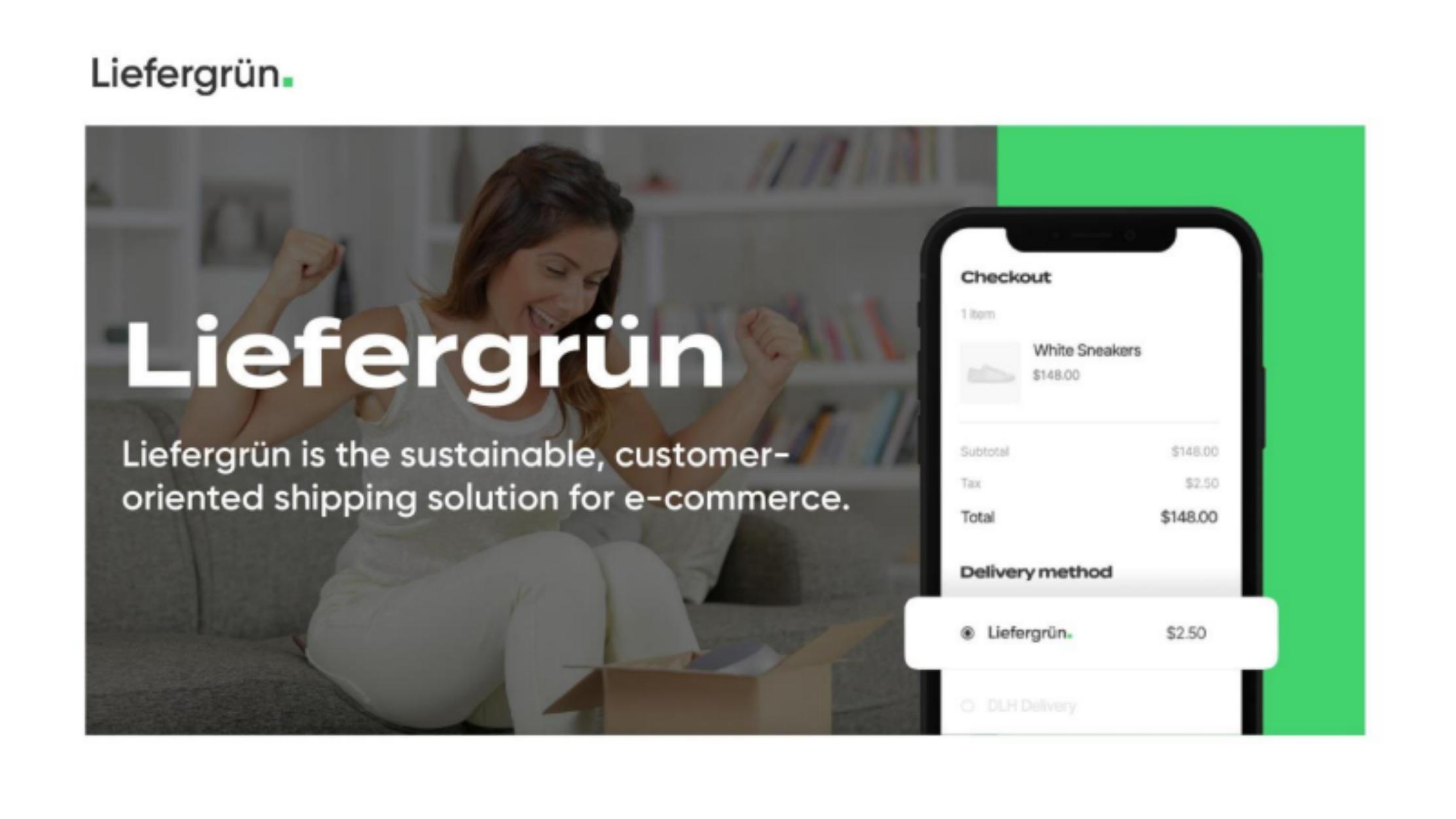
- Positioned as a checkout option alongside incumbents (e.g. DLH shown as alternative) at $2.50 delivery fee.
- Vertical segments: Electronics, Pharma, Fashion, Food boxes.
- Brand aspiration: "Klarna of deliveries" - own the B2C delivery brand layer on top of e-commerce.
Revenue model
- Primary: Per-parcel delivery fee charged to e-commerce merchants. Checkout UI shows $2.50 fee - likely illustrative but indicates price point order of magnitude.
- Secondary: Returns pickup fee (price not stated).
- Channel: B2B sales to e-commerce merchants; Liefergrün appears as a delivery option at merchant checkout.
- No subscription, SaaS, or take-rate model mentioned. Pure transactional per-parcel pricing implied.
- No pricing tiers, volume discounts, or contract terms disclosed.
Traction & metrics
- Geographic coverage: 11 metropolitan/major city regions across Germany.
- CO2 avoidance: 420g per delivered parcel.
- Delivery fee reference: $2.50 per parcel (illustrative checkout UI).
- No revenue figures, parcel volumes, GMV, merchant count, delivery count, growth rates, or retention metrics in deck.
Competition / moat
- Incumbent shown at checkout: "DLH Delivery" (likely DHL) as a slower, diesel-vehicle alternative.
- Differentiation on: sustainability (zero-emission vs. diesel sprinters), speed (1-hour window vs. "3–5 working days, 10am–4pm slot"), customer experience (real-time ETA, live tracking, door-to-door returns).
- Moat sources stated: brand (B2C-facing "Klarna" analogy), microhub infrastructure, authentic sustainability (avoid, not offset).
- No IP, exclusivity, data network effects, or switching cost data mentioned.
Team & funding ask / use of funds
Recommended financial model
- Archetype + why: B2B last-mile delivery operations model - volume-driven P&L with per-parcel economics. Closest archetype is a logistics/courier operating model (revenue = parcels delivered x delivery fee per parcel; cost = driver/rider wages, microhub opex, vehicle/fleet costs, tech). Not SaaS, not marketplace GMV - Liefergrün takes revenue on each parcel, not a take-rate from a marketplace.
- Forecast horizon & granularity: 3 years monthly (Year 1 build-out, Years 2–3 city expansion + internationalization). Monthly granularity needed to model city-by-city ramp, microhub capex timing, and rider headcount.
- Key drivers & assumptions:
| Driver | Value |
|---|---|
| Delivery fee per parcel | $2.50 |
| Returns fee per parcel | ~$3–4 |
| Active cities at launch | 11 (Germany) |
| Parcels/city/day at ramp | 200–500 |
| CO2 avoidance per parcel | 420g |
| City expansion pace | +3–5 cities/year (international Y3) |
- Scenarios (Base / Bull / Bear - which variables flex):
- Bear: Parcel volume ramps slowly (merchant onboarding lag), delivery fee pressure from DHL, rider cost inflation - city-level EBITDA breakeven pushed to month 18+.
- Base: 11 German cities reach ~300 parcels/city/day by month 12; modest international entry Y3; 25% gross margin per parcel.
- Bull: Rapid merchant onboarding (Klarna-style checkout plugin adoption), returns revenue boosts per-parcel economics, ESG regulation tailwinds push merchants to switch from diesel - breakeven Y2.
- Flex variables: Parcels/city/day ramp rate, delivery fee (B2B pricing power), rider cost/parcel, returns attach rate, city count.
- Required sheets / outputs:
- Assumptions - all drivers in one place, color-coded inputs.
- Volume Build - city x month parcel volume model (deliveries + returns separately).
- Revenue - delivery revenue + returns revenue; blended fee per parcel.
- Opex Build - rider/driver costs (variable), microhub costs (semi-fixed per city), fleet/capex, central G&A, tech.
- P&L - monthly IS: revenue → gross profit → EBITDA → EBIT.
- Headcount - riders (variable to volume), ops/city managers (fixed per city), central team.
- Cash Flow / Runway - capex for microhubs + fleet; working capital; burn rate vs. funding.
- KPI Dashboard - parcels delivered, revenue/parcel, cost/parcel, gross margin %, EBITDA/city, CO2 avoided (sustainability reporting).
- Scenario toggle - Bear / Base / Bull switcher feeding into P&L and runway.
Frequently asked
Is the Liefergrün financial model free?+
Yes. The Liefergrün model is a free Excel (.xlsx) download with live formulas. Sign up with your email and the workbook is yours to keep, review, and edit.
What's included in the model?+
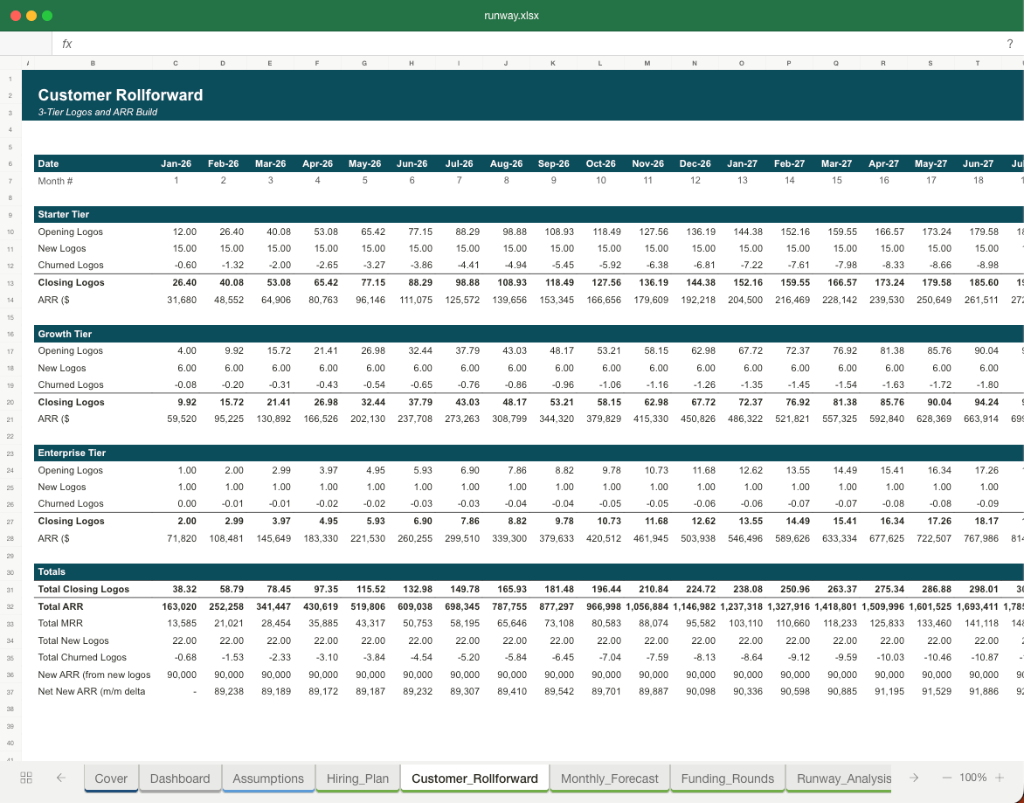
A 5-year monthly forecast with P&L, cash flow and runway, valuation (exit multiple plus a DCF cross-check), MOIC/IRR returns, and unit economics, with live formulas throughout.
How was this model built?+
It was built from Liefergrün's pitch deck and publicly available information, then structured to investment-banking standards as a fully editable Excel model.
Can I change the assumptions?+
Yes. You can change assumptions and the live formulas will recalculate in the downloadable Excel model.
Have more financial modelling questions? Contact us

Created by ex-finance professionals
Hey, I’m Alex and I created Finamodel.
Over my years in the finance industry I kept building the same models over and over again. Same structure, same assumptions, different logo. So I started building frameworks to turn them into clean, reusable templates.
Every model here is one I’d actually use for a client, and I personally vet each one before it goes up.
I’m not an expert in every industry, but I’ve built enough models to know what belongs in one. And when something is completely foreign to me, I reach out to my network for experts to work on our models with us.
Having a template library on hand cuts a first build from hours to minutes.
Need help finding your model? You’ll find me in the Finamodel app!
Other Logistics/Mobility Startup Financial Models
Browse another startup in the same category.

BusRight
SaaS platform for K-12 school district transportation management - routing, real-time tracking, driver tablets, parent notifications.
Clean Kitchen Club
UK plant-based QSR brand operating eat-in, grab-and-go, and delivery formats across London, with plans for nationwide expansion.

Cloudsmith
Cloud-native software supply chain management platform - secure, managed package distribution for engineering teams.
Enron
Enron Communications ("ePower") is a wholly owned subsidiary of Enron Corp. pitching an application delivery platform built on a national Pure IP fiber optic network.
Hangry
Indonesia's first multi-brand virtual restaurant operator ("House of Winning Brands") running delivery-only F&B brands out of shared kitchen infrastructure.

Hologram
IoT cellular connectivity platform that abstracts SIM management, carrier selection, and device fleet operations into a single software layer.

HTEC
Technology services and product engineering firm providing outsourced R&D, product development, and engineering delivery to corporates, scaleups, and global enterprises.
Little Spoon
Direct-to-consumer fresh organic baby and kids' food subscription, expanding into vitamins/supplements and a parenting content platform.