INInclude Financial Model
Climate/Energy Startup Financials (Free Excel Download)
Croatian hardware company designing and selling smart street benches with integrated solar charging, Wi-Fi, and IoT sensors for public spaces globally.



professionals from Deloitte
Used by professionals from






About this model
Include sells Steora solar-powered smart benches and related public-space products. The benches combine photovoltaic power, batteries, charging, Wi-Fi, environmental sensors, lighting, and optional CCTV or digital displays for municipalities, telecoms, and developers.
Revenue is primarily hardware sales through direct municipal contracts and distributors, including Deutsche Telekom and T-Systems. By early 2019 it had sold more than 1,000 units across 260 cities, generated €1.2 million of 2018 revenue from 445 benches, and reached a modest €27,000 net profit.
The model should build revenue from units and ASP by SKU, capturing the mix shift toward higher-priced Urban+ and Monna products. Link hardware COGS, inventory and working capital, distribution expansion, operating expenses, and cash flow; thin historical margins make volume, component cost, and procurement timing central sensitivities.
A turnkey financial model
Live formulas, no hardcoded values
Outputs are driven by live formulas, so the workbook updates from its assumptions instead of relying on hardcoded results.
All assumptions in one tab
Inputs are clearly marked in the Assumptions tab and separated from calculations, making it clear what to change and what to leave intact.
Statements always balancing
For integrated-statement models, the balance sheet, cash flow, and supporting schedules tie through properly.
Distinct schedules for clarity
Debt, working capital, taxes, and cash flow can get messy quickly. We group calculations in clear schedules, not across disconnected tabs.
No hidden macros or external links
There are no unexplained external workbook links or macros to undermine auditability or portability.
Changes flow through the model
Update a key driver and see the impact carry through the forecast, financing, and return outputs. We never use hardcoded numbers in formulas.
About Include
http:include.ai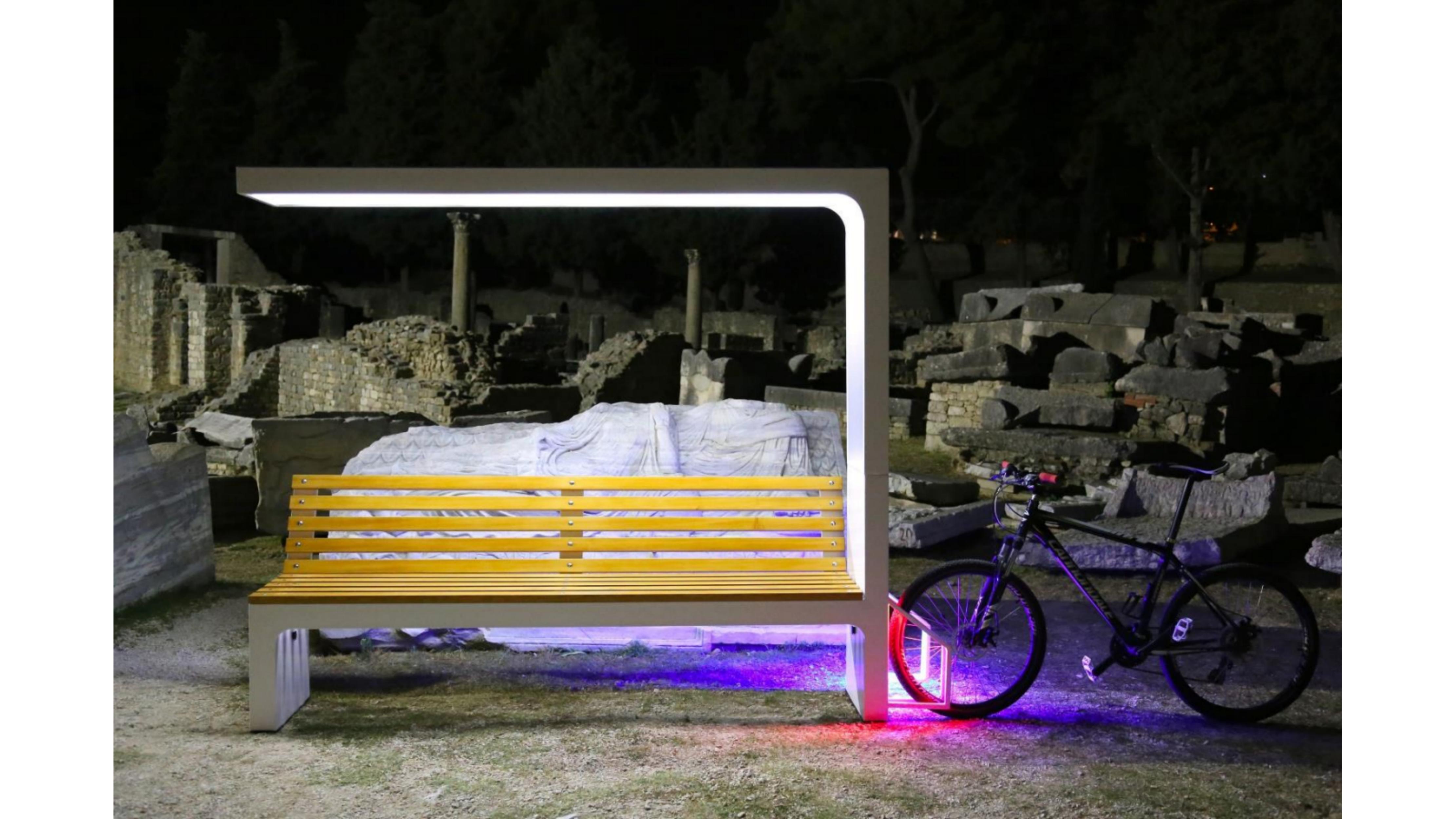
How to build a detailed financial model for Include
A complete walkthrough of the business, drivers, and assumptions behind the downloadable Include model - distilled from its pitch deck and publicly available information.
Product & value proposition
- Core product: Steora - smart street bench with photovoltaic modules, battery pack, USB charging, wireless charging, Wi-Fi hotspot, environmental sensors, ambient lighting, optional CCTV and digital display.
- Product line (11 products as of 2019): Steora Standard, Steora Hybrid, Steora Urban, Steora Urban+, Steora CCTV, Steora E, plus Monna (cycle bench, launched Nov 2018).
- Value prop: Enables cities to deploy interactive smart-city infrastructure without grid dependency (solar-powered). Revenue model for municipalities can include advertising via displays and data from IoT sensors.
- Customer segments: Municipalities, city councils, telecom infrastructure companies (Deutsche Telekom, T-Systems cited), real-estate and public-space developers.
Revenue model
- Primary: Hardware product sales - direct to municipalities and via distribution partners.
- Average selling price in 2018: €2,420 per bench.
- Mix shift noted toward higher-priced models (Steora Urban+ and Monna) driving revenue growth beyond unit volume growth.
- Channel: 15 distribution contracts signed as of early 2019 (Deutsche Telekom, T-Systems, others unnamed).
- No SaaS / recurring software revenue, maintenance contracts, or data monetisation mentioned in deck.
Traction & metrics
- Units sold (cumulative by Feb 2019): 1,000+
- Milestone timeline: 100th (Sep 2016), 500th (Jan 2018), 600th (Apr 2018), 700th (Jun 2018), 800th (Aug 2018), 900th (Dec 2018), 1,000th (Feb 2019)
- 2018 annual units sold: 445 benches
- 2018 revenues: €1.2M
- 2018 net profit: €27k
- Profitability achieved 16 months after first investment round; company also cash-flow positive
- Global markets: 42 in 36 months
- Global cities: 260
- Distribution contracts signed: 15
- Product usage (cumulative, as of early 2019):
- Energy produced: 25,946 kWh
- Energy consumed: 25,994 kWh
- USB charging sessions: 173,732
- Wireless charging sessions: 201,507
- Wi-Fi users: 1,782,386
- Data used: 10,288 GB
- Revenue trend from chart (approximate, bars + line):
- 2015: ~€30–50k (few units)
- 2016: ~€150–200k (~150 units)
- 2017: ~€600–700k (~350 units)
- 2018: €1.2M (445 units)
Unit economics
- Average selling price (2018): €2,420
- Net profit margin (2018): ~2.3% (€27k / €1.2M)
- No COGS, gross margin, or CAC/LTV data presented.
- Implied COGS + OpEx ≈ €1.173M in 2018.
Competition / moat
- No competitive slide in deck.
- Moats implied: 1,000+ units installed globally as social proof; multiple EU/international awards (European Parliament EU Top 50, Deloitte Fast 50, Forbes 30 under 30); 15 distribution contracts with major telecoms; 4-year head-start in a nascent category.
Team & funding ask / use of funds
- Founder: Ivan Mrvos (founded 2014; Forbes 30 Under 30 Europe 2019).
- Team size: 30+ employees across R&D, sales, marketing, finance, production, procurement.
- Prior funding: €465k seed round, April 2017.
Recommended financial model
- Archetype + why: Hardware revenue P&L with unit economics driver tree. Include is a product-sales business - revenue = units sold × ASP by SKU. Gross margin is driven by hardware COGS (BOM + manufacturing). This is not a SaaS or marketplace; a 3-statement operating model anchored on unit volume and product mix is the right build.
- Forecast horizon & granularity: Annual, 2019–2023 (extend past the deck's stated 2021 horizon to show a full 5-year view). Monthly granularity for 2019 would be ideal for cash flow management given thin margins, but annual is sufficient for a VC model at this stage.
- Key drivers & assumptions:
| Driver | Value | Source |
|---|---|---|
| 2018 units sold | 445 | - |
| 2018 revenue | €1,200,000 | - |
| 2018 ASP (blended) | €2,420 | - |
| 2018 net profit | €27,000 | - |
| 2019–2021 target installations | 3,400+ cumulative | - |
| 2020–2021 cumulative net profit | €1,710,000 | - |
| Target markets by 2021 | 50 | - |
| Target distributors by 2021 | 30 | - |
| Revenue 2021 projection (from chart) | ~€6–7M | - |
| Expense 2021 projection (from chart) | ~€5–5.5M | - |
| Unit volume growth rate 2019–2021 | ~55–65% CAGR | - |
| ASP uplift from mix shift | +5–10% per year | - |
| Gross margin | 35–45% | - |
| OpEx growth | ~30–40% CAGR | - |
| 2019 revenues (implied from chart) | ~€2.0–2.5M | - |
| Seed round raised | €465,000 | - |
- Scenarios (Base / Bull / Bear - which variables flex):
- Base: Unit volume grows ~55% CAGR; ASP rises ~7%/yr from mix shift; gross margin holds ~40%; OpEx scales with headcount.
- Bull: Distributor deals (Deutsche Telekom scale) drive volume outperformance; Urban+ / Monna mix pushes ASP to €3,500+; gross margin expands to 45%+ on volume leverage.
- Bear: Municipal procurement cycles slow; ASP compression from competitive entry; gross margin squeezed below 35% on component costs; path to €1.71M net profit by 2021 delayed by 1–2 years.
- Required sheets / outputs:
- `Assumptions` - all drivers (unit volume, ASP by SKU, GM%, OpEx line items, headcount, distributor count)
- `Revenue Build` - units by product line (Steora Standard, Hybrid, Urban, Urban+, CCTV, E, Monna) × ASP × blended revenue
- `Income Statement` - Revenue, COGS, Gross Profit, OpEx (R&D, Sales & Marketing, G&A), EBIT, Net Profit
- `Cash Flow` - simplified: Net Profit + D&A – CapEx – Working Capital (inventory build is key for hardware)
- `KPI Dashboard` - units sold, cumulative installs, ASP, gross margin %, net margin %, markets, distributors
- `Scenario Toggle` - Base / Bull / Bear switch
Frequently asked
Is the Include financial model free?+
Yes. The Include model is a free Excel (.xlsx) download with live formulas. Sign up with your email and the workbook is yours to keep, review, and edit.
What's included in the model?+
A 5-year monthly forecast with P&L, cash flow and runway, valuation (exit multiple plus a DCF cross-check), MOIC/IRR returns, and unit economics, with live formulas throughout.
How was this model built?+
It was built from Include's pitch deck and publicly available information, then structured to investment-banking standards as a fully editable Excel model.
Can I change the assumptions?+
Yes. You can change assumptions and the live formulas will recalculate in the downloadable Excel model.
Have more financial modelling questions? Contact us

Created by ex-finance professionals
Hey, I’m Alex and I created Finamodel.
Over my years in the finance industry I kept building the same models over and over again. Same structure, same assumptions, different logo. So I started building frameworks to turn them into clean, reusable templates.
Every model here is one I’d actually use for a client, and I personally vet each one before it goes up.
I’m not an expert in every industry, but I’ve built enough models to know what belongs in one. And when something is completely foreign to me, I reach out to my network for experts to work on our models with us.
Having a template library on hand cuts a first build from hours to minutes.
Need help finding your model? You’ll find me in the Finamodel app!
Other Climate/Energy Startup Financial Models
Browse another startup in the same category.

Abatable
Robo-advisor platform for sourcing and managing high-quality carbon removal offsets, targeting asset managers.
Bower
Mobile app that rewards consumers for scanning and recycling consumer packaging at existing bins, monetised by CPG brand subscriptions and consumer data.
Bramble Energy
UK deep-tech company commercialising a PCB-based hydrogen fuel cell stack (PCBFC™) for portable power and mobility applications.

Cervest
AI-powered Climate Intelligence platform that quantifies physical climate risk at the asset level, delivered as a freemium SaaS product.

Clockworks Analytics
B2B SaaS platform providing automated fault-detection and diagnostics (FDD) analytics for commercial and institutional building portfolios.

Dandelion Energy
Dandelion Energy installs residential geothermal heat pump systems (ground-source HVAC) with in-house financing, targeting US homeowners on fossil-fuel heating.

Emitwise
B2B SaaS platform automating corporate carbon footprint tracking, reporting, and reduction using machine learning.
Fisker
Fisker is an asset-light, design-led EV company merging with Spartan Energy Acquisition Corp. in a SPAC transaction to fund the launch of the Fisker Ocean SUV.


