 Kili Technology Financial Model
AI/ML Startup Financials (Free Excel Download)
Training data management platform that helps enterprises label, manage, and improve data quality for AI/ML models.



professionals from Deloitte
Used by professionals from






About this model
Kili Technology provides a data-labelling platform for machine-learning teams. Customers use it to organise training-data workflows, manage annotation quality, and coordinate the people and processes required to build reliable datasets for AI development.
The enterprise product can be sold as recurring platform access and expand as customers add users, projects, data volume, and model-development teams. Its economics must recognise that annotation and quality-control delivery can carry variable costs beyond conventional software hosting.
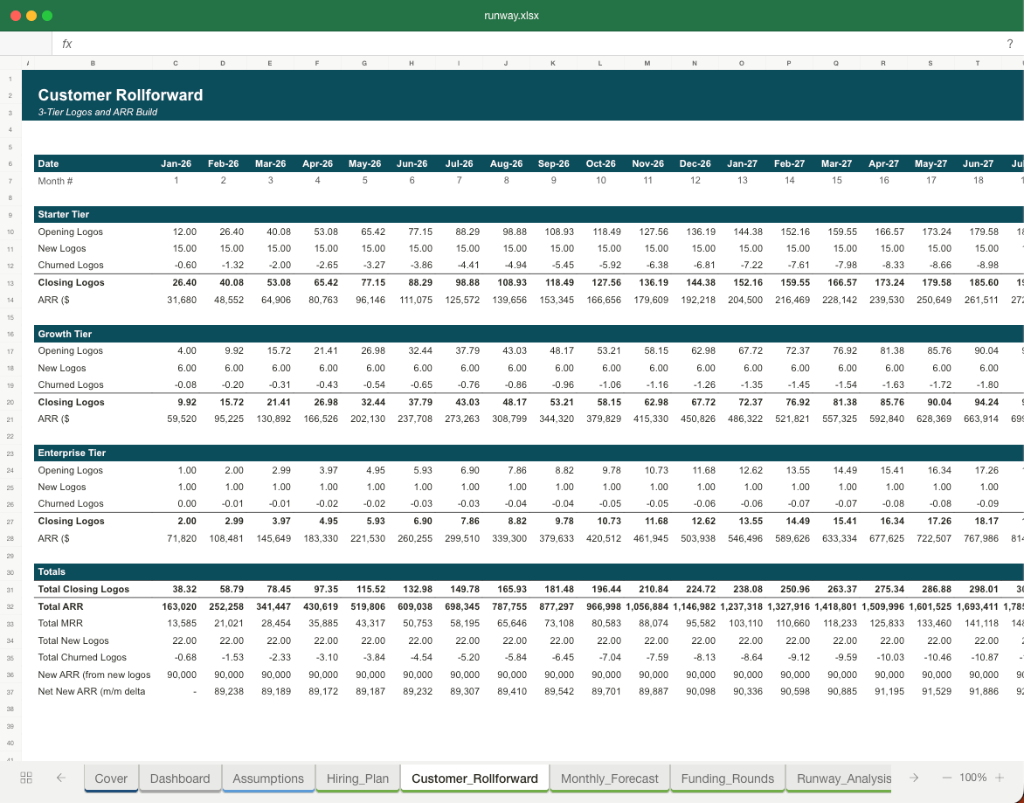
The model starts with enterprise contracts and a cohort-based ARR bridge for new logos, expansion, and churn. It layers users and labelled-data volume onto revenue and COGS, then tracks gross margin, delivery capacity, sales and R&D headcount, operating cash flow, and runway.
A turnkey financial model
Live formulas, no hardcoded values
Outputs are driven by live formulas, so the workbook updates from its assumptions instead of relying on hardcoded results.
All assumptions in one tab
Inputs are clearly marked in the Assumptions tab and separated from calculations, making it clear what to change and what to leave intact.
Statements always balancing
For integrated-statement models, the balance sheet, cash flow, and supporting schedules tie through properly.
Distinct schedules for clarity
Debt, working capital, taxes, and cash flow can get messy quickly. We group calculations in clear schedules, not across disconnected tabs.
No hidden macros or external links
There are no unexplained external workbook links or macros to undermine auditability or portability.
Changes flow through the model
Update a key driver and see the impact carry through the forecast, financing, and return outputs. We never use hardcoded numbers in formulas.
About Kili Technology
kili-technology.com
How to build a detailed financial model for Kili Technology
A complete walkthrough of the business, drivers, and assumptions behind the downloadable Kili Technology model - distilled from its pitch deck and publicly available information.
Product & value proposition
- Platform for managing training data end-to-end: labeling, collaboration, quality monitoring, and labeling automation.
- Supports all asset types (image, text, audio, video implied).
- Human-in-the-loop workflow: combines ML predictions with human annotation to accelerate labeling.
- Data pipeline integration and ML application output monitoring.
- Core promise: turn raw, unstructured data into "ground truth" at industrial scale.
Market
- 80% of unstructured data by 2025 - $733bn market size (sourced from Markets & Markets, Grandview Research, GM Insights).
- 80% of enterprises investing in AI.
- 80% of AI projects not deployed in production.
- No SAM or SOM breakdown provided.
- No explicit data-labeling-software market size cited (the $733bn appears to reference the broader unstructured data / AI market, not the labeling tooling TAM specifically).
Competition / moat
- Competitive context referenced indirectly: Google (annotation since 2013, "Bighead Architecture"), Facebook (user-scale annotation), Apple, Lyft, Amazon, Uber - all built proprietary annotation platforms.
- Positioning: Kili makes available to enterprises what tech giants built internally.
- No direct competitor names (Scale AI, Labelbox, Snorkel, etc.) mentioned.
- Moat claims: data quality impact quantified - 10% reduction in label accuracy typically results in 2–5% model performance decrease; up to 10% errors found in most-used open-source datasets.
Recommended financial model
- Archetype + why: B2B SaaS ARR model. Kili sells a platform (seat- or usage-based license) to enterprise data/ML teams. The natural model is ARR-driven with expansion revenue as customers label more data types and add annotators. No transaction/marketplace element is described.
- Forecast horizon & granularity: 3 years monthly (M1–M36), collapsing to quarterly from Y2 for readability. Early-stage deck warrants monthly granularity to track cash burn and ARR ramp.
- Key drivers & assumptions:
- New logos / month: ramp from 2 → 8 new customers/month over 3 years; no customer count in deck
- ACV (Annual Contract Value): $60k–$120k enterprise ACV; comparable to Labelbox/Scale AI mid-market; not in deck
- Revenue per customer: seat-based or data-volume-based; modelled as flat ACV with net revenue retention
- Net Revenue Retention (NRR): 115–125% for B2B SaaS AI tooling with expansion from more seats/data types
- Gross margin: 70–80%; platform software with some cloud compute cost; no COGS disclosed
- CAC: $30k–$50k enterprise sales motion; no sales data in deck
- Payback period: 12–18 months given assumed ACV and gross margin
- Headcount: sales + CS hiring tied to new logo targets; no team data in deck
- R&D spend: 40–50% of revenue at this stage (early SaaS)
- Churn: 5–10% gross annual logo churn; platform stickiness from data lock-in supports low churn assumption
- Market size: $733bn addressable market cited; data-labeling software sub-segment is meaningfully smaller - ~$3–5bn by 2025 for software tooling specifically
- Scenarios (Base / Bull / Bear - which variables flex):
- Base: 4 new logos/month at $80k ACV, 120% NRR, 75% gross margin
- Bull: 7 new logos/month, $100k ACV, 130% NRR (platform becomes standard for large enterprise ML teams)
- Bear: 2 new logos/month, $60k ACV, 110% NRR, 68% gross margin (longer sales cycles, pricing pressure from Scale AI / open-source)
- Key flex variables: new logo velocity, ACV, NRR, gross margin
- Required sheets / outputs:
- Assumptions (all drivers, clearly flagged vs)
- ARR Bridge (new ARR, expansion, churn, net new ARR)
- P&L (Revenue, COGS, Gross Profit, OpEx by function: R&D, S&M, G&A, EBITDA)
- Headcount plan (by department, tied to revenue drivers)
- Cash & runway (burn rate, months of runway, fundraising trigger)
- Scenario toggle (Base / Bull / Bear)
- KPI dashboard (ARR, MRR, logos, NRR, CAC, LTV, gross margin, burn multiple)
Frequently asked
Is the Kili Technology financial model free?+
Yes. The Kili Technology model is a free Excel (.xlsx) download with live formulas. Sign up with your email and the workbook is yours to keep, review, and edit.
What's included in the model?+
A 5-year monthly forecast with P&L, cash flow and runway, valuation (exit multiple plus a DCF cross-check), MOIC/IRR returns, and unit economics, with live formulas throughout.
How was this model built?+
It was built from Kili Technology's pitch deck and publicly available information, then structured to investment-banking standards as a fully editable Excel model.
Can I change the assumptions?+
Yes. You can change assumptions and the live formulas will recalculate in the downloadable Excel model.
Have more financial modelling questions? Contact us

Created by ex-finance professionals
Hey, I’m Alex and I created Finamodel.
Over my years in the finance industry I kept building the same models over and over again. Same structure, same assumptions, different logo. So I started building frameworks to turn them into clean, reusable templates.
Every model here is one I’d actually use for a client, and I personally vet each one before it goes up.
I’m not an expert in every industry, but I’ve built enough models to know what belongs in one. And when something is completely foreign to me, I reach out to my network for experts to work on our models with us.
Having a template library on hand cuts a first build from hours to minutes.
Need help finding your model? You’ll find me in the Finamodel app!
Other AI/ML Startup Financial Models
Browse another startup in the same category.

AI Rudder
AI Rudder provides multi-lingual conversational AI for B2C customer engagement - automating outbound and inbound voice/chat interactions at scale.

Aisera
AI Service Experience platform that automates IT, HR, and customer service workflows via conversational AI and automation.

Amberscript
AI + human hybrid transcription and subtitling platform targeting B2B customers in Europe

Apheris
Privacy-preserving federated ML platform enabling enterprises to train AI on distributed data without sharing raw data.

Arcane
AI copilot for marketing teams that automates data analysis, reporting, and repeatable tasks via a chat interface and scheduled workflows.

Artisan
AI-powered "digital workers" (branded Artisans) that autonomously perform role-specific tasks - starting with outbound sales - and are delivered as SaaS subscriptions.

Artisan Series A
AI-native B2B SaaS platform consolidating the enterprise software stack with human-like "Artisan" AI employees that automate role-specific workflows

Bigblue
Tech-enabled e-commerce fulfillment platform for European D2C brands - "Amazon-standard" delivery without Amazon.