Krew Financial Model
Marketplace Startup Financials (Free Excel Download)
Live fitness platform connecting consumers with fitness professionals via hardware-free, gamified group classes, powered by proprietary P2P/edge-computing technology.



professionals from Deloitte
Used by professionals from






About this model
Krew is a live, gamified fitness platform that connects consumers with fitness professionals through browser-based group classes. Motion-tracking AI provides real-time scoring and leaderboards, while professionals receive tools for classes, packages, subscriptions, client management, and feedback.
The company positions its technology as a hardware-free alternative to more expensive connected-fitness experiences. Its business model was redacted, but the product indicates a take rate on professional earnings, with possible subscription economics layered on top of per-class and recurring consumer payments.
The model should build gross bookings from active professionals, classes, attendance, and average consumer spend, then apply a flexible take rate. Subscription or professional-tier revenue remains separate. Professional activation, consumer frequency, retention, streaming costs, and creator payout determine whether the marketplace can scale with attractive contribution margin.
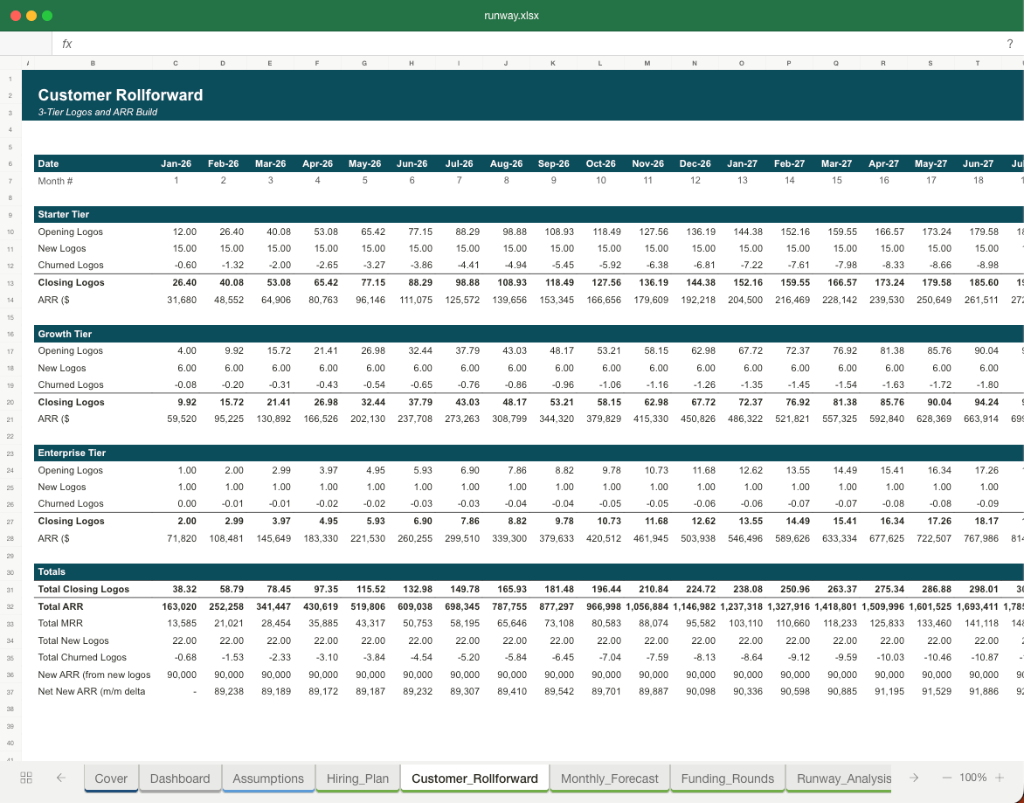
A turnkey financial model
Live formulas, no hardcoded values
Outputs are driven by live formulas, so the workbook updates from its assumptions instead of relying on hardcoded results.
All assumptions in one tab
Inputs are clearly marked in the Assumptions tab and separated from calculations, making it clear what to change and what to leave intact.
Statements always balancing
For integrated-statement models, the balance sheet, cash flow, and supporting schedules tie through properly.
Distinct schedules for clarity
Debt, working capital, taxes, and cash flow can get messy quickly. We group calculations in clear schedules, not across disconnected tabs.
No hidden macros or external links
There are no unexplained external workbook links or macros to undermine auditability or portability.
Changes flow through the model
Update a key driver and see the impact carry through the forecast, financing, and return outputs. We never use hardcoded numbers in formulas.
About Krew
krew.io
How to build a detailed financial model for Krew
A complete walkthrough of the business, drivers, and assumptions behind the downloadable Krew model - distilled from its pitch deck and publicly available information.
Product & value proposition
- Live, gamified fitness classes streamed browser-based, no hardware or download required ("Peloton without the $3k bike") slide 02.
- Real-time motion-tracking AI scores participants and drives leaderboards visible to all during class slide 04.
- Pros get monetisation tools: per-class, packages, subscriptions, on-demand pay-per-view slide 04.
- Pro-facing features: individualized feedback, pose correction with annotation, CRM, automated reminders, notes per client, in-person class management slides 04, 16, 17.
- Proprietary P2P + edge computing architecture makes unit cost of delivering livestreaming + AI ~1/100th of cloud/CPaaS competitors (Krew TURN/signaling: $1,200/month vs. AWS Chime $90k+ for equivalent sessions) slide 12.
Market
- Global remote health & wellness market: $11.0bn (2020) → $60.9bn (2026), 33% CAGR slide 06.
- Global fitness app market: $3.6bn (2020) → $12.0bn (2026), 22.3% CAGR slides 03, 06.
- 87% of gym-goers cancelling membership or adding online option post-COVID slide 03 (image).
- People working from home (UK): 5% before lockdown → 49% during lockdown; 80% "would like to" slide 03 (image).
- People working out daily (UK): 31m before lockdown → 31m during lockdown, +6m increase attributed despite no gyms slide 03 (image).
- Under-employed fitness professionals: 740,000 US / 57,000 UK slide 03.
- SOM framing: "Krew customers needed for $100m ARR" - figure redacted slide 06; addressable base is 35.4m Americans who watched more online exercise videos due to social distancing, out of 221.6m Americans who engage in physical activity slide 06.
Revenue model
- Business model is redacted in the deck slide 07.
- Revenue mechanism implied by context: transaction/take-rate on pro earnings (consistent with "we only make money when pros make money" statement slide 04).
- Monetisation tools for pros include: per-class payments, packages, subscriptions, on-demand pay-per-view slides 04, 08.
- Average consumer spend per month: redacted slide 06. Competitive benchmarks shown: ClassPass $80–$160/month, Peloton $150/month, Orangetheory $279/month slide 06.
- US gym-goers price distribution: 46% pay $0–$30/month, 32% pay $30–$50/month, 11% pay $50–$70/month slide 06 (image). Krew positioning is in the value tier relative to Peloton/Orangetheory.
- No monthly fee charged to pros slide 04.
Traction & metrics
All traction metrics are redacted in both the JSON text and the slide image slide 08:
- Number of pros on waitlist/directory: redacted
- Number of pros onboarded: redacted
- WoW customer retention %: redacted
- % of customers using Krew 1+ times/week: redacted
- % of customers using Krew 2+ times/week: redacted
- WAU targets at 6/12/18-month milestones: all redacted
- ARR targets at 12/18-month milestones: redacted
Note: deck is an investor deck from 2021 (cover slide 01); redactions appear to be investor-version redactions for public distribution.
Unit economics
- COGS advantage is a central thesis: Krew's P2P + edge approach delivers livestreaming at ~$1,200/month (TURN + signaling server) vs. ~$90k–$216k/month for CPaaS alternatives at equivalent scale (~30k sessions/month, 30 pax/session) slide 12.
- Gross margin: "incredible gross margins" claimed because no monthly pro fees and cost structure is dominated by very low video infrastructure cost slide 04. No specific gross margin % disclosed.
- AI delivery cost at scale: proprietary vs. AWS Studio Notebooks (ml.g4dn.2xlarge, Europe): $1,050,600–$2,112,000/month for equivalent AI; Krew cost: $0 (edge-computed) slide 12.
Competition / moat
Competitive set (slide 07 - entrepreneur-enabler category):
- Playbook (similar: Sudor.fit): transaction fee 20%; 150 creators, "several thousand" waitlist slide 13.
- Exer.ai / Exerstudio.com: freemium; pre-launch at time of deck slide 13.
- Moxie.xyz: transaction fee 8–12%; 600 classes/week slide 13.
- TrueCoach (acquired): subscription B2B $19/$49/$99/month; 15,000 coaches slides 07, 13.
Broader category view (slide 15):
- ClassPass: credits-based subscription, offline managed marketplace.
- Peloton: hardware + subscription; live gamification only via $3k bike.
- Aaptiv: subscription, AI-led on-demand.
- Glofox: B2B supply-side infrastructure.
Moat claims:
- ~4 years of proprietary P2P/edge-computing R&D ahead of the market slide 05.
- Hardware-less real-time gamification is academically hard (P2P scalability requires PhD-level expertise); legacy players face inertia from cloud-first architectures slide 14.
- CTO (Dr. Yousef Amar): PhD distributed networks, Nokia Bell Labs, Imperial/Cambridge/Oxford slide 09.
Team & funding ask / use of funds
Team slide 09:
- CEO: Jose Martin Quesada - McKinsey, Google, Avanade; London Business School / ESCP; consumer ML and digital growth.
- CTO: Dr. Yousef Amar - PhD distributed networks/edge computing; Nokia Bell Labs; Imperial/Cambridge/Oxford; patent in load balancing.
- Chief Research Officer: Dr. Marco Marchesi - Apple, Cambridge; AI in creative industries.
- Growth & product: Nuan Zhang (consultant + certified PT), London Business School.
- 3 developers (current).
- Planned hires at seed: Commercial Officer (ex-MD major in-person competition), Digital Marketing (ex-startup, 2m audience), additional developers.
Funding:
- Pre-seed raised: £0.08m slide 13.
- Raising: seed round, amount redacted; separately a "larger seed" scenario shown on roadmap slide 08.
- Use of funds: Not explicitly in deck. Implied uses: product stability (99%), AI v2, additional monetisation tools, CRM, referral tooling, headcount (commercial + digital marketing + developers) slide 08.
Recommended financial model
- Archetype + why: Two-sided marketplace / creator-economy SaaS hybrid. Revenue flows from a take-rate on gross booking value (pros earn → Krew takes %) and/or a platform subscription. This is structurally similar to a marketplace GMV model (gross bookings × take rate = revenue) with a SaaS-style pro-tier subscription layered on top. Given the early stage and fact that take-rate % is redacted, the model must flex on both the take-rate and average session/subscription price.
- Forecast horizon & granularity: Monthly for Years 1–2 (match roadmap milestones: today → 6m → 12m → 18m), quarterly for Years 3–5. Horizon: 5 years.
- Key drivers & assumptions:
Supply side (pros):
- Starting pro count: redacted; model with placeholder, e.g. low tens to low hundreds.
- Pro growth rate (MoM): 10–15% MoM early, tapering to 3–5% at scale; rationale: marketplace cold-start supply-first.
- Sessions per pro per month: 8–12 sessions/month; rationale: fitness instructors typically teach 2–3x/week.
- Average class size (participants): 10–20 pax; rationale: deck shows leaderboards with ~20 participants in product images.
Demand side (consumers):
- Conversion rate (consumer → paying after free class): 15–25%; rationale: freemium-to-paid benchmarks for fitness apps.
- Average consumer monthly spend: redacted; $15–$30/month (below ClassPass $80 floor; Krew positioned as accessible/value tier per slide 06 gym-fee distribution showing 78% pay <$50/month).
- Consumer retention (monthly): redacted; 70–80% monthly; rationale: fitness apps typically 60–80% monthly, Krew flagged "increasing retention" as KPI.
Revenue:
- Take rate on gross booking value: redacted; 15–25%; rationale: midpoint of comparable (Moxie 8–12%, Playbook 20%).
- Pro subscription (planned): $0 at launch (deck states no monthly fee), small B2B tier introduced in Year 2 for premium CRM/management tools.
Costs:
- Infrastructure COGS: ~$1,200/month for TURN/signaling server at current scale; scales roughly linearly with concurrent sessions.
- AI COGS: $0 at Krew (edge-computed); modest cloud cost for batch jobs.
- Staff: CEO, CTO, CRO, 3 devs now; seed hires add ~4–5 FTEs implied.
- S&M: heavy on content marketing / organic social (pro-led audience growth), paid CAC modest at seed.
- Gross margin target: 70–80% long-run; high because COGS are near-zero (edge-computing moat claim slide 04).
- Scenarios (Base / Bull / Bear - which variables flex):
- Base: take rate 20%, avg consumer spend $20/month, pro MoM growth 10%, consumer monthly retention 75%.
- Bull: take rate 25%, avg consumer spend $25/month, faster pro growth 15% MoM, retention 82%.
- Bear: take rate 15%, avg consumer spend $15/month, pro growth 7% MoM, retention 65%, delayed AI monetisation.
- Key flex variable: avg consumer spend (most sensitive, entirely redacted); secondary: take rate and pro supply growth.
- Required sheets / outputs:
- Assumptions - all drivers with/ tags, scenario toggles.
- Pro Supply Build - pro cohort model (adds per month, churn, active pro count).
- Consumer Demand Build - sessions per pro × avg class size × conversion rate → paying consumers; cohort retention waterfall.
- Gross Bookings & Revenue - GBV = sessions × avg ticket; Revenue = GBV × take rate + subscription revenue.
- P&L - Revenue → Gross Profit (infra + AI COGS) → EBITDA (headcount, S&M, G&A).
- Headcount plan - current team + seed hires + scaling.
- Cash / Runway - seed raise proceeds vs. monthly burn; months of runway.
- KPI Dashboard - WAU, paying consumers, active pros, GMV, ARR, gross margin %, burn rate.
- Scenario comparison - Base / Bull / Bear on ARR and runway.
Frequently asked
Is the Krew financial model free?+
Yes. The Krew model is a free Excel (.xlsx) download with live formulas. Sign up with your email and the workbook is yours to keep, review, and edit.
What's included in the model?+
A 5-year monthly forecast with P&L, cash flow and runway, valuation (exit multiple plus a DCF cross-check), MOIC/IRR returns, and unit economics, with live formulas throughout.
How was this model built?+
It was built from Krew's pitch deck and publicly available information, then structured to investment-banking standards as a fully editable Excel model.
Can I change the assumptions?+
Yes. You can change assumptions and the live formulas will recalculate in the downloadable Excel model.
Have more financial modelling questions? Contact us

Created by ex-finance professionals
Hey, I’m Alex and I created Finamodel.
Over my years in the finance industry I kept building the same models over and over again. Same structure, same assumptions, different logo. So I started building frameworks to turn them into clean, reusable templates.
Every model here is one I’d actually use for a client, and I personally vet each one before it goes up.
I’m not an expert in every industry, but I’ve built enough models to know what belongs in one. And when something is completely foreign to me, I reach out to my network for experts to work on our models with us.
Having a template library on hand cuts a first build from hours to minutes.
Need help finding your model? You’ll find me in the Finamodel app!
Other Marketplace Startup Financial Models
Browse another startup in the same category.

Acquco
Amazon brand aggregator - acquires third-party Amazon seller businesses at attractive multiples, then scales them via proprietary growth playbooks and technology.
Arive
Premium q-commerce app delivering lifestyle and branded products in under 30 minutes across German cities.

Audience Town
Vertical data and advertising platform targeting home movers across the entire home journey - pre-move through post-move.

AudioMob
Non-intrusive in-game audio ad platform bridging music/brand advertisers to mobile game publishers.

Authoritive
Two-way messaging platform that turns creator expertise into scalable, push-delivered learning experiences via SMS/WhatsApp.

Avo
Building amenity and office perk platform delivering same-day grocery/pantry/goods to residential and commercial tenants via a white-label marketplace.
beehiiv
Newsletter platform for creators to build, grow, and monetize email audiences - SaaS subscription + native ad network revenue.
Borzo
Global same-day logistics marketplace connecting B2B merchants with crowdsourced couriers for last-mile delivery