 Lance Financial Model
Fintech Startup Financials (Free Excel Download)
Smart business banking app for self-employed / freelancers - combines a bank account with automated tax, savings, and expense allocation



professionals from Deloitte
Used by professionals from






About this model
Lance is a smart business-banking app for self-employed people and freelancers. It combines an account with automated tax, savings, and expense allocation so independent workers can manage cash flow without maintaining a separate finance stack.
A monthly accounting subscription is the primary disclosed revenue stream, supplemented by banking economics and partner services such as tax filing or incorporation. The product’s value grows as more of a freelancer’s activity and financial administration moves into the app.
The model should forecast subscribed users, monthly ARPU, retention, bank-account activation, debit spend, and service attachment. Subscription ARR should remain distinct from interchange, deposit-spread, and referral revenue, allowing cohort-level expansion and the economics of each product to be tested clearly.
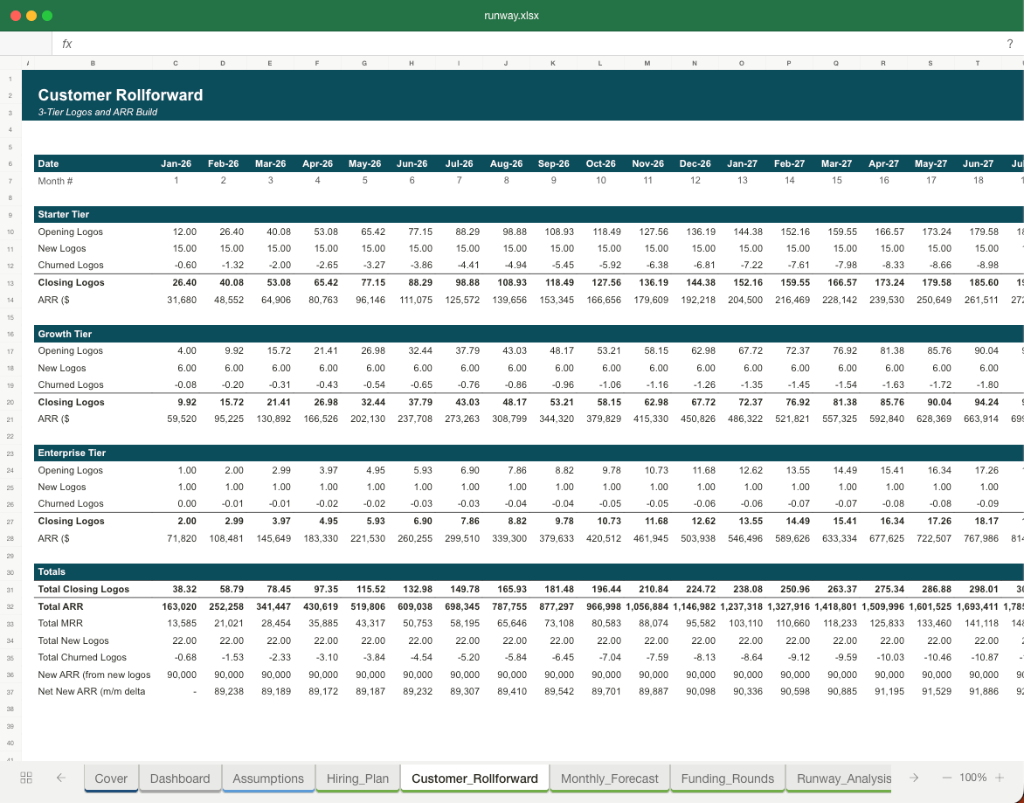
A turnkey financial model
Live formulas, no hardcoded values
Outputs are driven by live formulas, so the workbook updates from its assumptions instead of relying on hardcoded results.
All assumptions in one tab
Inputs are clearly marked in the Assumptions tab and separated from calculations, making it clear what to change and what to leave intact.
Statements always balancing
For integrated-statement models, the balance sheet, cash flow, and supporting schedules tie through properly.
Distinct schedules for clarity
Debt, working capital, taxes, and cash flow can get messy quickly. We group calculations in clear schedules, not across disconnected tabs.
No hidden macros or external links
There are no unexplained external workbook links or macros to undermine auditability or portability.
Changes flow through the model
Update a key driver and see the impact carry through the forecast, financing, and return outputs. We never use hardcoded numbers in formulas.
About Lance
lance.com
How to build a detailed financial model for Lance
A complete walkthrough of the business, drivers, and assumptions behind the downloadable Lance model - distilled from its pitch deck and publicly available information.
Product & value proposition
Lance is a mobile-first bank account built for the self-employed. Core differentiator is a proprietary "Financial Framework" that automatically splits incoming revenue into four buckets - Salary, Taxes, Expenses, and Savings - inside a "Stacks" system.
Product modules per the deck:
- Modern online banking (debit VISA, $0 fees, 24/7 support, card controls)
- Automated allocations via Stacks (Salary, Tax, Savings, Expenses sub-accounts)
- Expense tracking and profit/loss insights
- Tax management (automated withholding, filing support)
Positioned as "First to Market" for integrated business banking + accounting for freelancers.
Market
- TAM proxy: Over 60M Americans are self-employed
- 73% of today's students will start working as freelancers
- 97% of freelancers consider it a long-term career choice
- Average freelancer salary: $60K across America
- Problem quantification: self-employed lose $6,500 annually in missed deductions
- No explicit TAM/SAM/SOM dollar figures provided in deck
Revenue model
Two revenue streams shown:
SaaS Revenue (primary)
- Monthly accounting subscription fee
- Exact price per month not stated in deck
Add'l Revenue (ancillary)
- Banking: typical APY spread and interchange rates on debit card transactions
- Services: tax filing, incorporation, and other partner/referral revenue
No explicit subscription price per user disclosed in deck.
Traction & metrics
Revenue projections from area chart:
- 2021: ~$1M (approximate, read from chart axis)
- 2022: ~$4M (approximate, read from chart axis)
- 2023: ~$10M (approximate, read from chart axis)
Note: these appear to be forward projections shown in the deck, not confirmed actuals. No customers, MRR, churn, or retention figures disclosed.
App UI mockup shows illustrative user "Marcus" with balance $34,682.55, +10% from last month; Stacks allocation: Salary $3,500, Savings $220, Tax $114.50, Expenses $560 - these are demo-account figures, not company metrics.
Competition / moat
Competitive advantages stated:
- First to market for integrated business banking + accounting
- Proprietary Financial Framework (structured allocation path across industries)
- Ease of use: accounting, filing, and revenue allocation automated
- Set It + Forget It: one-time setup, then fully automated
No competitive landscape slide or incumbent comparison shown.
Team & funding ask / use of funds
Team:
- Oona Rokyta - CEO (prev. Microsoft, Aleph)
- Gilad Uziely - COO (prev. Flex)
- Oren Reuveni - CTO (prev. Taboola, Riskified)
- Tom Reuveni - CPO (prev. Taboola, Juno)
Recommended financial model
- Archetype + why: SaaS ARR + banking ancillary revenue model. Lance has a clearly stated monthly subscription fee (SaaS) as the primary driver, plus two secondary streams tied to user banking activity (interchange and APY spread) and partner services revenue. This is a classic fintech neobank with a SaaS overlay - model the subscription cohort-by-cohort and layer interchange/APY/services revenue as a per-user rate on top.
- Forecast horizon & granularity: Monthly for Years 1–2; quarterly for Year 3. Matches the 2021–2023 chart horizon in the deck.
- Key drivers & assumptions:
| Driver | Value | Source |
|---|---|---|
| TAM - US self-employed | 60M Americans | - |
| Avg freelancer annual income | $60K | - |
| Monthly SaaS subscription price | ~$10–$20/mo - typical neobank/fintech subscription tier; exact price not in deck | |
| Monthly gross user adds (Y1) | ~500–1,000 - implied by ~$1M 2021 revenue at ~$15/mo = ~5,500 paying users by year-end | |
| Monthly churn rate | ~3–5% - typical early-stage fintech; no deck data | |
| Interchange revenue per user per month | ~$1–2/mo - typical debit interchange ~1.5% on ~$500–1,500 monthly spend | |
| APY spread per user | ~0.5–1.0% net on avg deposit; typical neobank economics | |
| Partner/services revenue per user | ~$2–5/mo blended (tax filing, incorporation referrals) | |
| Gross margin (SaaS) | ~70–75% - software-heavy; banking/services cost drag brings blended margin lower | |
| CAC | ~$50–100 - digital-first freelancer acquisition; no deck data | |
| Target paying users by end 2023 | ~55,000–60,000 - implied by ~$10M revenue at ~$15/mo avg revenue per user |
- Scenarios (Base / Bull / Bear - which variables flex):
- Base: Subscription price ~$15/mo; churn ~4%; user adds ramp linearly; reaches ~$10M revenue by 2023 per deck chart
- Bull: Subscription price $20/mo + higher ancillary ARPU from banking/services attach; churn 2–3%; viral/word-of-mouth growth among freelancer communities
- Bear: Churn 6–8%; subscription price compression to $10/mo; slower user acquisition; ancillary revenue minimal in early years
- Required sheets / outputs:
- Assumptions - all drivers with / tags, toggle for scenarios
- User Cohort Model - monthly new users, active users, churned users; cumulative paying base
- Revenue Build - SaaS MRR (users × price), banking revenue (users × interchange + APY), services revenue (users × attach rate); total ARR
- Income Statement - revenue by stream, COGS (banking cost of funds, support, infrastructure), gross profit, opex (S&M, R&D, G&A), EBITDA
- Cash Flow & Runway - given no funding ask shown, track burn vs. revenue ramp
- KPI Dashboard - MAU, paying users, MRR, ARR, ARPU, churn %, gross margin, LTV/CAC (once CAC assumed)
- Scenario Toggle - Base / Bull / Bear switcher on assumptions tab
Frequently asked
Is the Lance financial model free?+
Yes. The Lance model is a free Excel (.xlsx) download with live formulas. Sign up with your email and the workbook is yours to keep, review, and edit.
What's included in the model?+
A 5-year monthly forecast with P&L, cash flow and runway, valuation (exit multiple plus a DCF cross-check), MOIC/IRR returns, and unit economics, with live formulas throughout.
How was this model built?+
It was built from Lance's pitch deck and publicly available information, then structured to investment-banking standards as a fully editable Excel model.
Can I change the assumptions?+
Yes. You can change assumptions and the live formulas will recalculate in the downloadable Excel model.
Have more financial modelling questions? Contact us

Created by ex-finance professionals
Hey, I’m Alex and I created Finamodel.
Over my years in the finance industry I kept building the same models over and over again. Same structure, same assumptions, different logo. So I started building frameworks to turn them into clean, reusable templates.
Every model here is one I’d actually use for a client, and I personally vet each one before it goes up.
I’m not an expert in every industry, but I’ve built enough models to know what belongs in one. And when something is completely foreign to me, I reach out to my network for experts to work on our models with us.
Having a template library on hand cuts a first build from hours to minutes.
Need help finding your model? You’ll find me in the Finamodel app!
Other Fintech Startup Financial Models
Browse another startup in the same category.
Acin
SaaS and data subscription network for operational risk management at Tier 1 financial institutions

Ageras Group
B2B SME ecosystem - marketplace connecting SMEs with accountants + cloud accounting/payroll software + embedded financial services (lending, factoring, banking)

Airbase
Unified non-payroll spend management platform (corporate cards, AP/bill pay, expense reimbursement, approval workflows) for mid-market companies.

Altruist
Vertically integrated all-in-one platform for registered investment advisors (RIAs) - combining custodial, portfolio management, practice management, and client acquisition tools.
Amenitiz
All-in-one hotel management SaaS platform ("Shopify for hotels") for independent hoteliers - PMS, booking engine, channel manager, website builder, payments, and AI-driven revenue management.

Anrok
SaaS sales tax compliance platform - nexus monitoring, calculation, registration, filing, and remittance - built specifically for SaaS companies.
Arrival
Arrival is an EV manufacturer of commercial vans and buses using proprietary Microfactories and vertically integrated components, going public via SPAC merger with CIIG Merger Corp.

AtoB
AtoB is building financial infrastructure for commercial fleets, starting with a no-fee Visa fleet card for fuel and expanding into payroll, BNPL, and international.