 Laoshi Financial Model
Marketplace Startup Financials (Free Excel Download)
Mobile app providing vocabulary and teaching tools for Mandarin Chinese learners and tutors



professionals from Deloitte
Used by professionals from






About this model
Laoshi is a mobile learning platform for Mandarin students and tutors. It offers vocabulary tools and teaching workflows today, with a roadmap toward tutor analytics, exercises, and a live lesson marketplace that connects learners and teachers directly.
The app had 13,000 monthly active users, more than 290 registered teachers, 3,700-plus students learning Mandarin, and more than 200 paying subscribers. The initial commercial model is a student subscription introduced by tutors, while lesson commission is planned as a later revenue layer.
The model uses tutor acquisition as the top of the funnel. Tutors bring students into annual subscriptions, so tutor cohorts, students per tutor, conversion, price, and teacher retention build ARR. Once live lessons launch, lesson GMV and commission are layered in, with tutor acquisition cost and student retention as the key sensitivities.
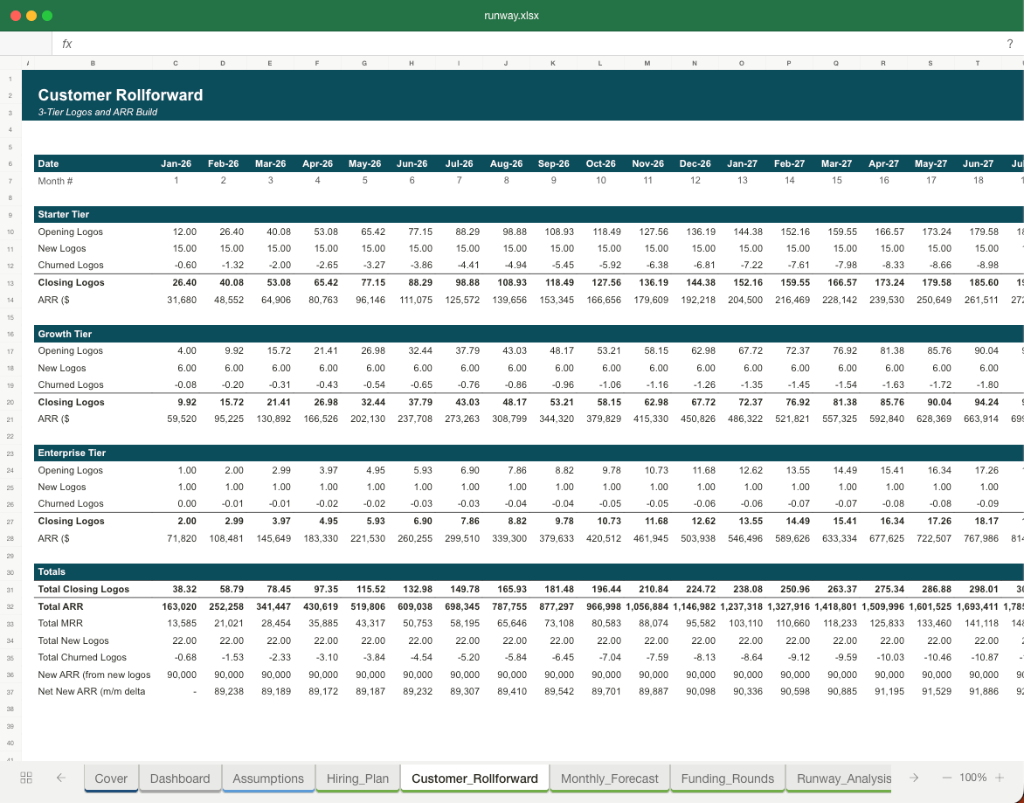
A turnkey financial model
Live formulas, no hardcoded values
Outputs are driven by live formulas, so the workbook updates from its assumptions instead of relying on hardcoded results.
All assumptions in one tab
Inputs are clearly marked in the Assumptions tab and separated from calculations, making it clear what to change and what to leave intact.
Statements always balancing
For integrated-statement models, the balance sheet, cash flow, and supporting schedules tie through properly.
Distinct schedules for clarity
Debt, working capital, taxes, and cash flow can get messy quickly. We group calculations in clear schedules, not across disconnected tabs.
No hidden macros or external links
There are no unexplained external workbook links or macros to undermine auditability or portability.
Changes flow through the model
Update a key driver and see the impact carry through the forecast, financing, and return outputs. We never use hardcoded numbers in formulas.
About Laoshi
laoshi.io
How to build a detailed financial model for Laoshi
A complete walkthrough of the business, drivers, and assumptions behind the downloadable Laoshi model - distilled from its pitch deck and publicly available information.
Product & value proposition
Two-sided platform connecting Mandarin Chinese teachers/tutors with students:
- For tutors: lesson preparation tools, vocabulary/flashcard builder, exercise builder, analytics, student acquisition channel
- For students: vocabulary learning (SRS-style word tools), tutor matching, reduced prep time
- Roadmap phases:
- 2021: Tools for learning words (current)
- 2022: Community, grammar wiki, beginner course
- 2023: Analytics for tutors, exercise builder
- 2024: Live teaching marketplace (commission revenue layer)
- App available on iOS App Store and Google Play
- Prior venture: sold 4,000+ copies of a Mandarin Chinese study book directly to consumers; ran 8 offline schools across multiple cities with 2,000+ students
Market
- 40 million people studying Chinese as a second language globally
- 60,000+ Mandarin Chinese language teachers worldwide
- Tutors handle 5–10 students; classroom teachers handle 30–200 students
- Comparable deal: LingoAce raised $176M from Owl Ventures, Sequoia Capital, Tiger Global (online live classes, ages 4–15)
- No explicit TAM/SAM/SOM breakdown or dollar market-size figure in deck
Revenue model
Two revenue layers:
- Student subscriptions via tutors: 1-year subscription at >$40/student; tutors each bring at least 5 students → ≥$200 ARR per tutor
- Live lessons and courses (commission): future marketplace layer targeted for 2024 roadmap phase
Target: 10,000 tutors → >$2M ARR from subscriptions alone; live lessons/courses commission to lift total to ≥$10M ARR
Tutor acquisition cost: $50
Traction & metrics
All from summary slide unless noted:
- 1,200 DAU, 13K MAU - organic, word of mouth
- 13K total users, 6.3K new users (October snapshot)
- 3,700+ students learning Mandarin Chinese with Laoshi
- 290+ teachers registered
- Teacher count growth: ~40 (Oct '21) → ~110 (Apr '22) → ~250 (Sep '22), sharp acceleration Aug–Sep '22
- Teacher retention at 5 months: >40%
- Teacher retention curve: 100% Month 0 → ~50% Month 1 → ~40% Month 2–4 (flattening - presented as PMF signal)
- 200+ paying subscribers
- Active user engagement: all users - 5 days/week; paying users - 6.5 days/week
- Average time in app for active users: 6 hours/week
- New user daily spikes: 150–375 new users/day in October (organic)
- Growth is fully organic / word-of-mouth (no paid acquisition stated)
Unit economics
- Tutor CAC: $50
- Revenue per tutor (Year 1): ≥$200 (5 students × $40 annual subscription)
- Payback on tutor CAC: implied <1 year at the stated subscription rate
- Student subscription price: >$40/year
Competition / moat
Competitors shown in feature matrix: Duolingo, Skritter, Quizlet, LingoAce
Feature dimensions compared: words, handwriting, SRS, textbooks, community, tools for tutors, focus on Chinese
Laoshi's claimed advantages: only platform combining Mandarin-specific focus + SRS vocabulary + tutor-facing tools + community. Competitors either lack tutor tools (Duolingo, Quizlet) or lack broader student-facing learning features (LingoAce = live classes only).
Moat: tutor network effects (tutors bring students); proprietary Mandarin-specific content/tooling; prior community from 8 offline schools and book sales.
Team & funding ask / use of funds
Team:
- Sergei Kondrashov - CEO; Mandarin Chinese domain expert, teacher, author, school network
- Danil Khasanshin - BDM; business development, team building, fundraising, prior exit
- Natalia Sinitsyna - Content Director; content creation, tutoring, school management
- Kostya Zakharenko - Product Designer; design system, visual style
- Zaur Sundukov - CTO; AI/ML, patents, articles, Code Jam, Science Olympiad background
Funding ask: $600k Goal: release stable version, become profitable, be ready to grow
Use of funds:
- Product Development: 60% ($360k)
- Marketing and Sales: 20% ($120k)
- Localizations: 10% ($60k)
- SaaS and other: 10% ($60k)
Recommended financial model
- Archetype + why: Two-sided marketplace SaaS with a tutor-led GTM funnel. Primary metric is tutor count driving student subscriptions (ARR). Secondary layer is live-lesson marketplace GMV/commission (2024+). Best modelled as a SaaS ARR model with a tutor-cohort acquisition funnel in Phase 1, transitioning to a marketplace GMV + take-rate layer in Phase 2. Not a 3-statement model - the deck does not disclose cost structure beyond use-of-funds allocation; a full P&L would be largely fabricated.
- Forecast horizon & granularity: Monthly for Year 1–2 (seed deployment + path to profitability is the stated goal); quarterly for Year 3–4 (marketplace ramp). 4-year horizon covers the full product roadmap through live marketplace launch.
- Key drivers & assumptions:
*Tutor acquisition*
- Starting tutor base: 290
- Monthly new tutor adds: ~25–30/month
- Tutor CAC: $50
- Monthly tutor churn: ~10%
*Student monetisation*
- Students per active tutor: 5
- Annual subscription price per student: $40
- Student attach rate (% of tutor's students who subscribe):
- ARR per active tutor: $200
*Marketplace (Phase 2, 2024+)*
- Commission rate on live lessons:
- Average lesson price:
- Lessons per tutor per month:
*Cost structure*
- $600k raised; burn allocation: 60% product ($360k), 20% marketing ($120k), 10% localisation ($60k), 10% SaaS/other ($60k)
- Monthly burn rate:
- Headcount: 5 co-founders identified; additional hires assumed with product development budget
*Target milestones (stated)*
- 10,000 tutors → $2M ARR from subscriptions
- Live lessons/courses → $10M ARR total
- Scenarios (Base / Bull / Bear):
- Bear: Tutor growth stalls at current organic rate (~20/month); student attach rate stays low (5–10%); marketplace delayed to 2025
- Base: Marketing spend accelerates tutor adds to 100–150/month post-raise; attach rate improves to 30–40%; marketplace launches on 2024 schedule
- Bull: Viral teacher network effect (slide 13 organic spikes become norm); tutor adds 300+/month; marketplace take-rate monetises premium content
- Required sheets / outputs:
- Assumptions dashboard (all toggleable inputs)
- Tutor cohort model (monthly adds, retention curve, active tutor count)
- Student & subscriber model (students per tutor, attach rate, ARR waterfall)
- Marketplace GMV model (Phase 2, 2024+)
- Burn & runway model (use-of-funds budget vs revenue ramp)
- Summary P&L (revenue, gross profit at assumed margin, EBITDA)
- KPI summary: MAU, DAU, tutor count, paying subscribers, ARR, CAC, LTV, payback period
Frequently asked
Is the Laoshi financial model free?+
Yes. The Laoshi model is a free Excel (.xlsx) download with live formulas. Sign up with your email and the workbook is yours to keep, review, and edit.
What's included in the model?+
A 5-year monthly forecast with P&L, cash flow and runway, valuation (exit multiple plus a DCF cross-check), MOIC/IRR returns, and unit economics, with live formulas throughout.
How was this model built?+
It was built from Laoshi's pitch deck and publicly available information, then structured to investment-banking standards as a fully editable Excel model.
Can I change the assumptions?+
Yes. You can change assumptions and the live formulas will recalculate in the downloadable Excel model.
Have more financial modelling questions? Contact us

Created by ex-finance professionals
Hey, I’m Alex and I created Finamodel.
Over my years in the finance industry I kept building the same models over and over again. Same structure, same assumptions, different logo. So I started building frameworks to turn them into clean, reusable templates.
Every model here is one I’d actually use for a client, and I personally vet each one before it goes up.
I’m not an expert in every industry, but I’ve built enough models to know what belongs in one. And when something is completely foreign to me, I reach out to my network for experts to work on our models with us.
Having a template library on hand cuts a first build from hours to minutes.
Need help finding your model? You’ll find me in the Finamodel app!
Other Marketplace Startup Financial Models
Browse another startup in the same category.

Acquco
Amazon brand aggregator - acquires third-party Amazon seller businesses at attractive multiples, then scales them via proprietary growth playbooks and technology.
Arive
Premium q-commerce app delivering lifestyle and branded products in under 30 minutes across German cities.

Audience Town
Vertical data and advertising platform targeting home movers across the entire home journey - pre-move through post-move.

AudioMob
Non-intrusive in-game audio ad platform bridging music/brand advertisers to mobile game publishers.

Authoritive
Two-way messaging platform that turns creator expertise into scalable, push-delivered learning experiences via SMS/WhatsApp.

Avo
Building amenity and office perk platform delivering same-day grocery/pantry/goods to residential and commercial tenants via a white-label marketplace.
beehiiv
Newsletter platform for creators to build, grow, and monetize email audiences - SaaS subscription + native ad network revenue.
Borzo
Global same-day logistics marketplace connecting B2B merchants with crowdsourced couriers for last-mile delivery