 Legal.io Financial Model
Marketplace Startup Financials (Free Excel Download)
Enterprise marketplace combining legal talent staffing/recruitment, vendor discovery, and job listings for corporate legal departments.



professionals from Deloitte
Used by professionals from






About this model
Legal.io is a marketplace and professional network for corporate legal teams, legal talent, and legal-technology vendors. It combines flex counsel staffing, recruitment and job listings, vendor discovery, market data, and verified professional profiles in one specialized platform.
The company reported 4.5 times year-over-year growth and a $1.2 million gross-profit run rate, with customers including Medallia, Nextdoor, and Zoom. Revenue comes from staffing take rates, recruitment listing fees, and advertising or premium profiles, each with different margins.
The model uses a three-stream GMV waterfall. Staffing billings and take rate drive flex counsel revenue, job postings and pricing drive recruitment revenue, and sponsored profiles build advertising income. Legal-talent supply, enterprise accounts, placement fill rate, revenue mix, and segment-level gross margin determine operating leverage.
A turnkey financial model
Live formulas, no hardcoded values
Outputs are driven by live formulas, so the workbook updates from its assumptions instead of relying on hardcoded results.
All assumptions in one tab
Inputs are clearly marked in the Assumptions tab and separated from calculations, making it clear what to change and what to leave intact.
Statements always balancing
For integrated-statement models, the balance sheet, cash flow, and supporting schedules tie through properly.
Distinct schedules for clarity
Debt, working capital, taxes, and cash flow can get messy quickly. We group calculations in clear schedules, not across disconnected tabs.
No hidden macros or external links
There are no unexplained external workbook links or macros to undermine auditability or portability.
Changes flow through the model
Update a key driver and see the impact carry through the forecast, financing, and return outputs. We never use hardcoded numbers in formulas.
About Legal.io
legal.io
How to build a detailed financial model for Legal.io
A complete walkthrough of the business, drivers, and assumptions behind the downloadable Legal.io model - distilled from its pitch deck and publicly available information.
Product & value proposition
Three interlocking platform pillars:
- Marketplace / Jobs / Recruitment - enterprises hire verified legal talent (attorneys, legal ops, trust & safety, compliance) for temporary (flex counsel) and permanent roles.
- Network / Identity / Community - professional network for legal buyers and sellers; verified profiles; combined network budget claimed at +$10B.
- Tools / Software / Market data - vendor discovery (G2-style profiles for legal tech vendors), salary and technology data, lead-gen for legal tech software.
Positioning: "LinkedIn + Hired.com + G2 for legal". Structured data (practice areas, legal software stack, languages) that LinkedIn does not surface.
Differentiation vs. traditional staffing: transparent pricing, data-driven candidate matching, D&I benchmarking.
Market
- TAM: $10.2B, composed of:
- $3B US Legal Staffing + Recruitment (15% staffing / 85% recruitment); digital players account for only 3% of spend.
- $100B enterprise legal spend in the US; $5B immediately addressable.
- $250M marketing spend by legal tech vendors.
- $2B enterprise marketing spend by AmLaw 100 firms.
- SAM: $5B (immediately addressable enterprise legal spend) + $3B staffing/recruitment = ~$8B, but Legal.io's near-term SAM is best read as the $3B staffing/recruitment market given current product.
Revenue model
Three monetization lines:
| Stream | Product | Buyer | Pricing model |
|---|---|---|---|
| Flex Counsel (Marketplace) | Temporary legal talent placement | Corporate legal departments | take-rate on GMV - typical staffing marketplaces charge 15–30% of billings |
| Recruitment (Job Listing) | Full-time job postings | HR / legal departments | per-posting fee or subscription; standard for legal job boards |
| Advertising / Premium Profile | Sponsored profiles, vendor marketing | Law firms, legal tech vendors, individual attorneys | CPM / flat sponsorship fee; analogous to G2 premium listings |
Key financial metric shown: GMV and Gross Profit (combo chart, slide 14). Gross Profit Run Rate = $1.2M. The gap between GMV bars and gross profit line implies a take-rate / margin well below 100% - consistent with a staffing/marketplace model where talent billings flow through.
Traction & metrics
- YoY Growth: 4.5x
- Gross Profit Run Rate: $1.2M
- GMV and Gross Profit growing across 24 months (Jan Y1 → Dec Y2), with GMV bars accelerating materially in H2 Y2. No Y-axis labels visible on the chart - absolute GMV figure not readable.
- Enterprise customers include Medallia, Nextdoor, Zoom
- 200k+ legal jobs posted annually cited as market context; platform indexes from Legal.io and third-party sources
- Community budget on the network: +$10B combined buy + sell side
- D&I placements: 42% minority, 52% women - outperforming NALP (16.9% minority, 35.4% women) and ABA benchmarks
Unit economics
- No explicit CAC, LTV, or payback period disclosed.
- Gross Profit Run Rate of $1.2M with 4.5x YoY growth implies prior-year run rate ~$267K.
- No headcount or opex data provided.
Competition / moat
Competitive matrix positions Legal.io in the "Digital / Marketplace + Enterprise" quadrant - the only player there.
Named competitors:
- Consumer / SMB digital: Upcounsel, Rocket Lawyer, LegalZoom, Avvo, Lawyers.com, HG.org
- Horizontal professional networks: LinkedIn, Hired
- Reviews/software discovery: G2
- Healthcare analog: Doximity
- Traditional enterprise legal staffing: Axiom, Atrium, Elevate, Robert Half Legal
- Job boards: Lawcrossing
Moat claims:
- Vertical-specific structured data (practice areas, software stack, languages) not available on LinkedIn.
- Network effects: legal buyers and sellers verified and connected on one platform.
- D&I differentiation as a procurement consideration for enterprise legal.
- Thesis backed by a16z "unbundling of LinkedIn" argument and Harry Stebbings tweet (20+ $5B+ companies).
Team & funding ask / use of funds
Team:
- Pieter Gunst - Founder & CEO. Stanford Law, DLA Piper (Brussels), SurveyMonkey in-house. Forbes 30 Under 30, CodeX.
- Hannah Konitshek - Founder & COO. UC Hastings Law, LivingSocial, Polymath Capital Partners.
- Daniel Lo - Founder & CTO. RottenTomatoes, SlideShare, Ampush.
- Van Dang - Board Member & Investor. Former VP & Deputy GC at Cisco.
- Tony Lai - Board Member & Founder. Stanford Law, Herbert Smith Freehills, StartX, CodeX.
Funding:
- Raised to date: $3.4M Seed (March 2018)
- Current ask: $8M Series A
Recommended financial model
Archetype + why: Three-stream marketplace P&L with GMV waterfall. The business has three distinct revenue lines (flex counsel staffing, recruitment/job listings, advertising) with very different gross margin profiles. A marketplace GMV model is the right archetype: track GMV → take-rate → revenue → gross profit by segment. This mirrors how the company reports internally (the deck shows GMV + Gross Profit as the two primary metrics). Not a pure SaaS ARR model - no subscription revenue mentioned.
Forecast horizon & granularity:
- Monthly for Year 1–2 (matches the 24-month chart already shown).
- Quarterly for Years 3–5.
- 5-year total horizon appropriate for a Series A.
Key drivers & assumptions:
*Flex Counsel (Staffing/Marketplace):*
- Monthly GMV: seed from chart shape + $1.2M GP run rate; peak monthly GMV ~$500K–$800K implied by GP run rate at ~20–25% take-rate.
- GMV growth rate: 3.0x YoY (below trailing 4.5x, assuming deceleration post-Series A scale-up).
- Take-rate: 22% on flex counsel GMV (mid-range for legal staffing marketplaces).
*Recruitment (Job Listings):*
- Average job posting fee: $500–$1,000/post based on comparable legal job boards.
- Monthly active listings: derived from 200k+ annual market context; Legal.io captures a small but growing share.
- Gross margin: ~85% (hosting + sales cost).
*Advertising / Premium Profiles:*
- Target pool: $250M legal tech vendor marketing spend; $2B AmLaw 100 marketing spend.
- Average contract size: $10K–$50K/year per vendor/firm.
- Gross margin: ~90%.
*Network / Community:*
- Acts as customer acquisition funnel for all three revenue streams; no direct monetization disclosed. Model as cost center (content, community management).
*Operating expenses:*
- Headcount: post-Series A hiring plan not disclosed; model sensitivity on S&M and engineering headcount ramp.
- OpEx ramp tied to Series A deployment over 18–24 months.
Scenarios (Base / Bull / Bear - which variables flex):
- Base: GMV 3x YoY, take-rate 22%, ad contracts growing 20% annually.
- Bull: GMV 4.5x YoY (maintains trailing growth), take-rate expands to 25% as brand/verification commands premium, advertising revenue inflects with vendor directory scale.
- Bear: GMV 1.5x YoY (macro slowdown in enterprise legal hiring), take-rate compresses to 18% (competition from Axiom/Elevate), advertising revenue flat.
Required sheets / outputs:
- Assumptions - all drivers, toggleable by scenario.
- Revenue Build - GMV by segment → take-rate → net revenue → gross profit.
- P&L (Income Statement) - Revenue, COGS, Gross Profit, OpEx (S&M, R&D, G&A), EBITDA.
- Headcount Plan - by function, tied to Series A deployment.
- Cash & Runway - starting cash ($8M Series A + $3.4M – prior burn), monthly burn, months of runway.
- KPI Dashboard - GMV, gross profit, take-rate, job listings, active customers, GP margin.
- Valuation Bridge (optional) - revenue multiple benchmarked to Doximity, Axiom, G2.
Frequently asked
Is the Legal.io financial model free?+
Yes. The Legal.io model is a free Excel (.xlsx) download with live formulas. Sign up with your email and the workbook is yours to keep, review, and edit.
What's included in the model?+
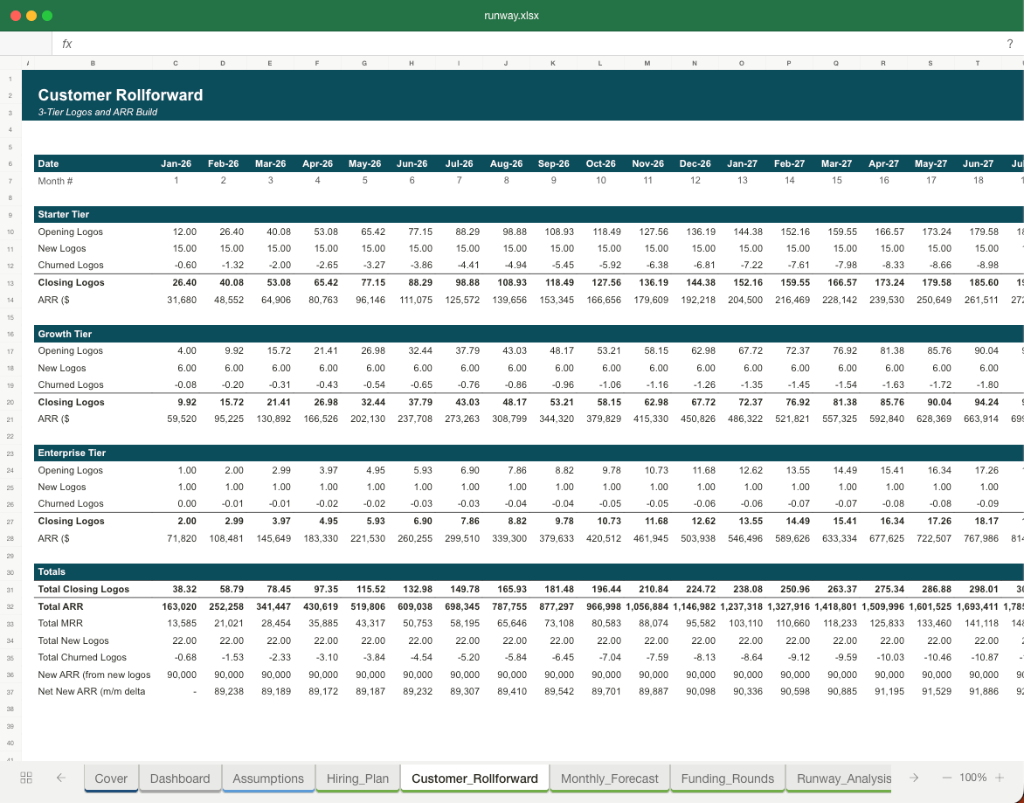
A 5-year monthly forecast with P&L, cash flow and runway, valuation (exit multiple plus a DCF cross-check), MOIC/IRR returns, and unit economics, with live formulas throughout.
How was this model built?+
It was built from Legal.io's pitch deck and publicly available information, then structured to investment-banking standards as a fully editable Excel model.
Can I change the assumptions?+
Yes. You can change assumptions and the live formulas will recalculate in the downloadable Excel model.
Have more financial modelling questions? Contact us

Created by ex-finance professionals
Hey, I’m Alex and I created Finamodel.
Over my years in the finance industry I kept building the same models over and over again. Same structure, same assumptions, different logo. So I started building frameworks to turn them into clean, reusable templates.
Every model here is one I’d actually use for a client, and I personally vet each one before it goes up.
I’m not an expert in every industry, but I’ve built enough models to know what belongs in one. And when something is completely foreign to me, I reach out to my network for experts to work on our models with us.
Having a template library on hand cuts a first build from hours to minutes.
Need help finding your model? You’ll find me in the Finamodel app!
Other Marketplace Startup Financial Models
Browse another startup in the same category.

Acquco
Amazon brand aggregator - acquires third-party Amazon seller businesses at attractive multiples, then scales them via proprietary growth playbooks and technology.
Arive
Premium q-commerce app delivering lifestyle and branded products in under 30 minutes across German cities.

Audience Town
Vertical data and advertising platform targeting home movers across the entire home journey - pre-move through post-move.

AudioMob
Non-intrusive in-game audio ad platform bridging music/brand advertisers to mobile game publishers.

Authoritive
Two-way messaging platform that turns creator expertise into scalable, push-delivered learning experiences via SMS/WhatsApp.

Avo
Building amenity and office perk platform delivering same-day grocery/pantry/goods to residential and commercial tenants via a white-label marketplace.
beehiiv
Newsletter platform for creators to build, grow, and monetize email audiences - SaaS subscription + native ad network revenue.
Borzo
Global same-day logistics marketplace connecting B2B merchants with crowdsourced couriers for last-mile delivery