 Legion M Financial Model
Media/Gaming Startup Financials (Free Excel Download)
Fan-owned entertainment company that co-invests in, produces, and markets independent films and media projects - using its shareholder/community base as a built-in promotional and predictive asset.



professionals from Deloitte
Used by professionals from





About this model
Legion M is a fan-owned entertainment company whose shareholders can also act as investors, audience, promoters, focus testers, and film scouts. Its community of more than 150,000 members supports project discovery and marketing through tools including Film Scout, MeetupMaker, and M Pulse.
The company earns from co-financing, production and live events, distribution and release participation, merchandise and licensing, and development fees. This structure ties fan ownership to individual film and media projects rather than relying on a single advertising or subscription revenue line.
Legion M had raised more than $16 million from over 35,000 investors and reported roughly $1.05 million of 2021 revenue across a portfolio of 20-plus projects. The model should forecast project-level capital deployment and proceeds, then consolidate event, merchandise, and operating costs alongside the community-growth and cash requirements.
A turnkey financial model
Live formulas, no hardcoded values
Outputs are driven by live formulas, so the workbook updates from its assumptions instead of relying on hardcoded results.
All assumptions in one tab
Inputs are clearly marked in the Assumptions tab and separated from calculations, making it clear what to change and what to leave intact.
Statements always balancing
For integrated-statement models, the balance sheet, cash flow, and supporting schedules tie through properly.
Distinct schedules for clarity
Debt, working capital, taxes, and cash flow can get messy quickly. We group calculations in clear schedules, not across disconnected tabs.
No hidden macros or external links
There are no unexplained external workbook links or macros to undermine auditability or portability.
Changes flow through the model
Update a key driver and see the impact carry through the forecast, financing, and return outputs. We never use hardcoded numbers in formulas.
About Legion M
legionm.com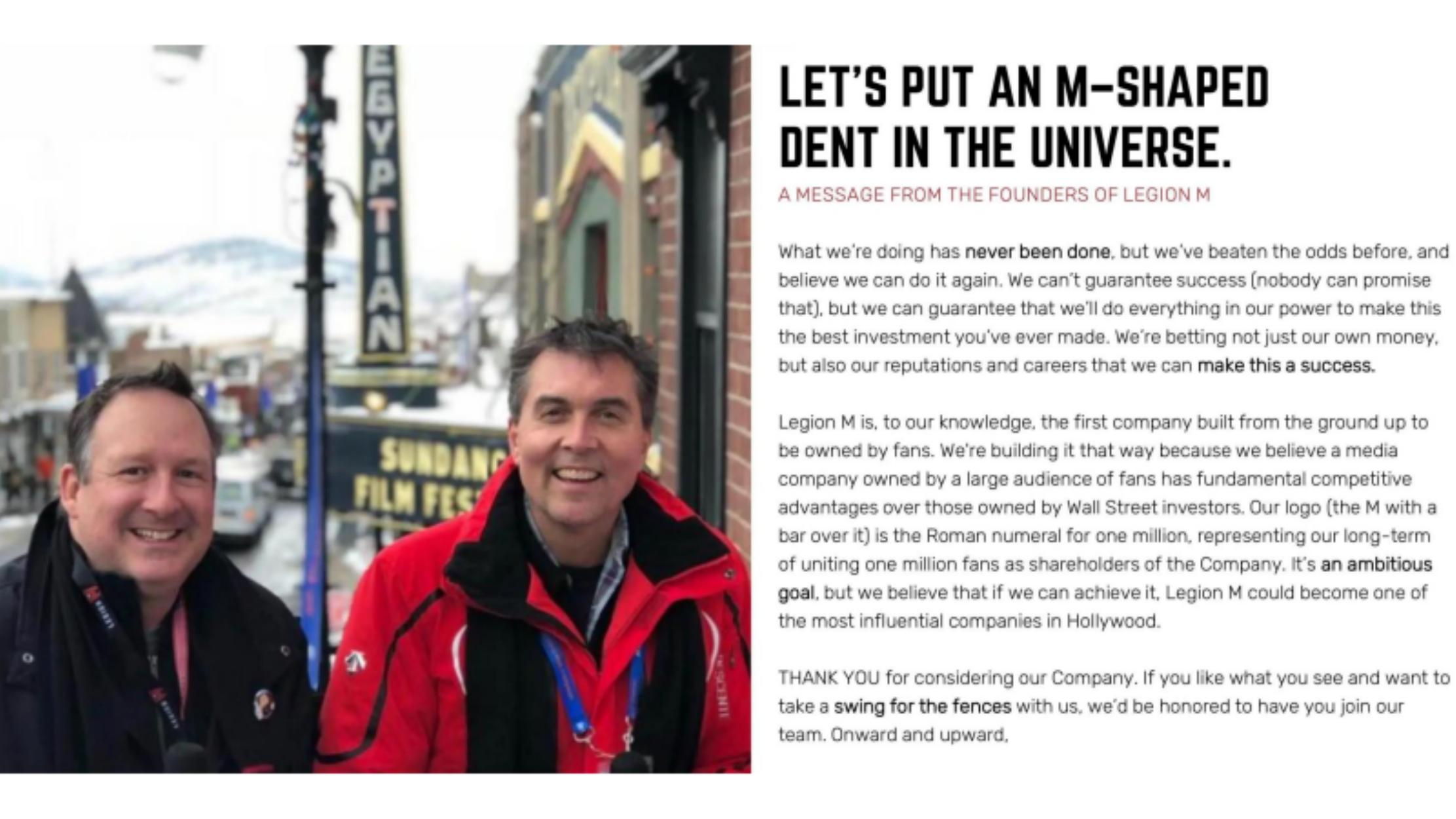
How to build a detailed financial model for Legion M
A complete walkthrough of the business, drivers, and assumptions behind the downloadable Legion M model - distilled from its pitch deck and publicly available information.
Product & value proposition
Legion M is structured as a fan-owned entertainment company - shareholders are simultaneously investors, audience members, promoters, focus-testers, and film scouts. The core value proposition has two sides:
- To fans/investors: equity ownership in a media company with mission alignment (fan-powered Hollywood); community events, merchandise, and exclusive experiences.
- To Hollywood: a built-in grassroots audience (currently 150K+ community members) that reduces marketing spend, validates projects early (M Pulse, Film Scout tools), and generates social impressions at scale.
Long-term goal: 1 million fan-shareholders - the "M" logo is the Roman numeral for 1,000,000.
Proprietary tools: Film Scout (festival analytics), MeetupMaker (fan events), M Pulse (real-time project feedback).
Market
- Deck describes entertainment as a "multi-trillion-dollar global industry" but provides no precise TAM/SAM/SOM figures.
- Hypothetical consumption power: "1 million investors would consume nearly $6.7 billion of media each year" - a projected figure, not current revenue.
- Hypothetical promotional reach: "1 million investors have a combined social reach of 1.7 billion impressions" - aspirational, not current.
Revenue model
Five revenue streams explicitly shown as "2022 Revenue Streams":
- Financing - co-investing in independent films/projects; return via back-end participation (revenue share, profit points, equity in projects).
- Production & Live Events - producing original content and fan events (Stan Lee tributes, Comic Con activations, premiere events, themed parties).
- Distribution & Release - theatrical and ancillary release participation; revenue from distribution deals on released titles.
- Merchandise & Licensing - branded and project-specific merchandise (Mandy Funko Pop, Red Miller plush, Cheddar Goblin Mac N' Cheese) and licensing revenue.
- Development - option fees and development revenue on projects in pipeline.
No per-unit pricing, deal sizes, or margin data disclosed in the deck.
Traction & metrics
- Total capital raised: Over $16M from more than 35,000 investors
- Community size: Over 150,000 members
- Annual revenue (from line chart, slide 12):
- 2016: ~$50K
- 2017: ~$400K
- 2018: ~$175K
- 2019: ~$700K
- 2020: ~$875K
- 2021: ~$1,050,000
- Project portfolio (2016–2022): 20+ projects across financing, production, distribution, merchandise, and development
- Notable title: Mandy (2018) - described as theatrical surprise success; Business Insider cited; ongoing licensing revenue still generating in 2022
- Y-axis gridlines on revenue chart: $0, $175K, $350K, $525K, $700K, $875K, $1,050K, $1,225K
Competition / moat
Moat claimed (not quantified):
- First-mover: Self-described as "world's first fan-owned entertainment company"
- Community network effect: Each shareholder is a promoter, focus-tester, and scout - value compounds as community grows
- Structural alignment: Shareholders financially and emotionally invested in success of every project
- Celebrity validation: Stan Lee endorsed the concept; testimonials from Dean Devlin and Michael Uslan (billion-dollar franchise producers)
- Press coverage: Fast Company, Forbes, Variety, Hollywood Reporter, Deadline, etc.
Traditional competitors (studios, streamers, other indie financiers) not named or benchmarked.
Team & funding ask / use of funds
Co-founders:
- Paul Scanlan - Co-founder & CEO
- Jeff Annison - Co-founder & President
Key team members (slide 15):
- Terri Lubaroff - CDO / Head of Content
- David Baxter - VP of Development
- Michelle P. Carter - Creative Executive
- Prophetess Branchcomb - Director of Finance
- Taylor Gledhill - Creative Director
- Terri Pinon - Community Manager
- Clare Bateman-King - Worldwide Events & BD
- Mandy Baroisbanian - Merch & Licensing Consultant
- Chris Cooper & Tyler Harmon - Growth Hackers
Funding ask / use of funds: Not explicitly stated in deck. Deck is an equity crowdfunding overview; the $16M+ already raised implies this is an ongoing or follow-on crowdfunding campaign. No specific raise target or use-of-proceeds breakdown shown.
Recommended financial model
Archetype + why: Project-portfolio entertainment company P&L with community growth flywheel overlay. Best modeled as a multi-stream independent studio / project-finance model - similar in structure to an indie film slate model but with recurring community/merchandise revenue layered on top. Not a pure SaaS or DTC model. The equity crowdfunding capital raise is an input/funding mechanism, not a revenue line.
Forecast horizon & granularity:
- Historical: 2016–2021 (6 years actuals from chart - annual granularity only, no quarterly data in deck)
- Forecast: 2022–2026 (4–5 years forward); annual granularity appropriate given project-cycle lumpy revenue
- Monthly granularity only if cash flow / runway modeling is needed (no indication of burn rate in deck)
Key drivers & assumptions:
*Community / investor growth*
- Current shareholders: 35,000
- Current community (non-investing members): 150,000
- Annual investor growth rate: ~30–40% YoY given momentum narrative; no CAGR stated
- Long-term target: 1,000,000 shareholders
*Project pipeline & slate*
- Number of projects financed per year: ~4–6 based on 20+ projects over ~6 years from deck
- Revenue per released project (back-end): Highly variable; Mandy shown as multi-year tail; most projects appear small/mid-range
- Project revenue lag: 12–24 months from financing to first release revenue typical for indie film
*Revenue stream mix (2022 blended - inferred from slides 10–11)*
- Financing (back-end participation): largest segment by project count
- Distribution & Release: recurring on released titles; growing tail as catalog grows
- Merchandise & Licensing: project-specific; Mandy is the lead case; growing with catalog depth
- Production & Live Events: episodic; depends on headline talent (Stan Lee events historically significant)
- Development: smallest near-term revenue; long lead times
*Revenue growth*
- 2021 baseline revenue: ~$1,050,000
- 2022–2026 growth rate: 20–35% YoY as catalog accumulates and community scales; deck thesis is "accumulating revenue" from growing back-catalog
*Margins*
- Gross margin: Variable by stream - merchandise/licensing likely 40–60%; back-end participation on financing is capital-light; production is capital-intensive; blended gross margin unknown
- Operating cost structure: Small team (~15 people per slide 15); estimated $2–3M annual opex; company likely operates at breakeven or slight loss pre-crowdfunding capital
Scenarios (Base / Bull / Bear - which variables flex):
- Base: Community grows 25% YoY to ~200K by 2026; 5 projects/year slate; revenue grows ~25% YoY from $1.05M (2021) base
- Bull: Community hits 500K+ shareholders; one breakout Mandy-scale hit per year; merchandise licensing compounds; revenue 2x–3x base by 2025
- Bear: Community growth stalls; no major hit releases; live events disrupted; revenue flat/declining from 2021 base
Required sheets / outputs:
- Community & Investor Growth Model - shareholders and members by year; crowdfunding capital raised
- Project Slate & Pipeline - project tracker with investment date, release date, revenue category, expected tail
- Revenue Build by Stream - financing back-end, distribution, merchandise/licensing, production/live events, development; annual by stream
- P&L - revenue, COGS (production costs, merch COGS), gross profit, opex (team, G&A, marketing), EBITDA
- Cash Flow / Funding - crowdfunding raises as funding inflows; project investment as capex/investment outflows; operating cash flow
- KPI Dashboard - community size, shareholders, projects in pipeline, projects released, catalog revenue tail
Frequently asked
Is the Legion M financial model free?+
Yes. The Legion M model is a free Excel (.xlsx) download with live formulas. Sign up with your email and the workbook is yours to keep, review, and edit.
What's included in the model?+
A 5-year monthly forecast with P&L, cash flow and runway, valuation (exit multiple plus a DCF cross-check), MOIC/IRR returns, and unit economics, with live formulas throughout.
How was this model built?+
It was built from Legion M's pitch deck and publicly available information, then structured to investment-banking standards as a fully editable Excel model.
Can I change the assumptions?+
Yes. You can change assumptions and the live formulas will recalculate in the downloadable Excel model.
Have more financial modelling questions? Contact us

Created by ex-finance professionals
Hey, I’m Alex and I created Finamodel.
Over my years in the finance industry I kept building the same models over and over again. Same structure, same assumptions, different logo. So I started building frameworks to turn them into clean, reusable templates.
Every model here is one I’d actually use for a client, and I personally vet each one before it goes up.
I’m not an expert in every industry, but I’ve built enough models to know what belongs in one. And when something is completely foreign to me, I reach out to my network for experts to work on our models with us.
Having a template library on hand cuts a first build from hours to minutes.
Need help finding your model? You’ll find me in the Finamodel app!
Other Media/Gaming Startup Financial Models
Browse another startup in the same category.

Almost Friday
Almost Friday is a multi-platform comedy/lifestyle media brand built around the "Friday Beers" universe, monetising through apparel, brand partnerships, events, podcasts, and music.

Amagi
Cloud-native SaaS platform for TV/OTT channel creation, distribution, and ad monetization (FAST-focused)

Audoo
IoT + SaaS platform that captures real-time public music performance data and reports it to Performing Rights Organisations (PROs) to enable accurate royalty distribution.
Backbone
Backbone makes a mobile gaming controller (hardware) + unified software platform (Backbone app) that aggregates all game streaming services in one place.
Beacon Pines
Beacon Pines is a cute-and-creepy narrative adventure game set inside a magical storybook, developed by indie studio Hiding Spot Games.
Bear and Breakfast
A management/adventure video game where you play as a bear running a B&B cabin in the woods.
Bioshock
BioShock is a first-person action horror game pitched to a publisher for development funding - a game-development studio deal, not an operating startup.

Button City 2018
Indie narrative adventure game about cute animal kids saving their local arcade, targeting console and PC.


