M3M30 Financial Model
Marketplace Startup Financials (Free Excel Download)
API aggregation platform ("next generation cloud") that lets developers discover, consume, and pay for 60+ public APIs through a single account and unified client framework.



professionals from Deloitte
Used by professionals from






About this model
M30 is an API aggregation platform that lets developers discover, consume, and pay for public APIs through one account and unified client framework. Its marketplace simplifies documentation, billing, and access across more than 60 APIs.
The product uses a freemium, usage-led model: Pro costs $25 per month, Team costs $45 per user per month, and overages begin after included API-call limits. It had 6,500 signups and one million monthly API calls at the time of the deck.
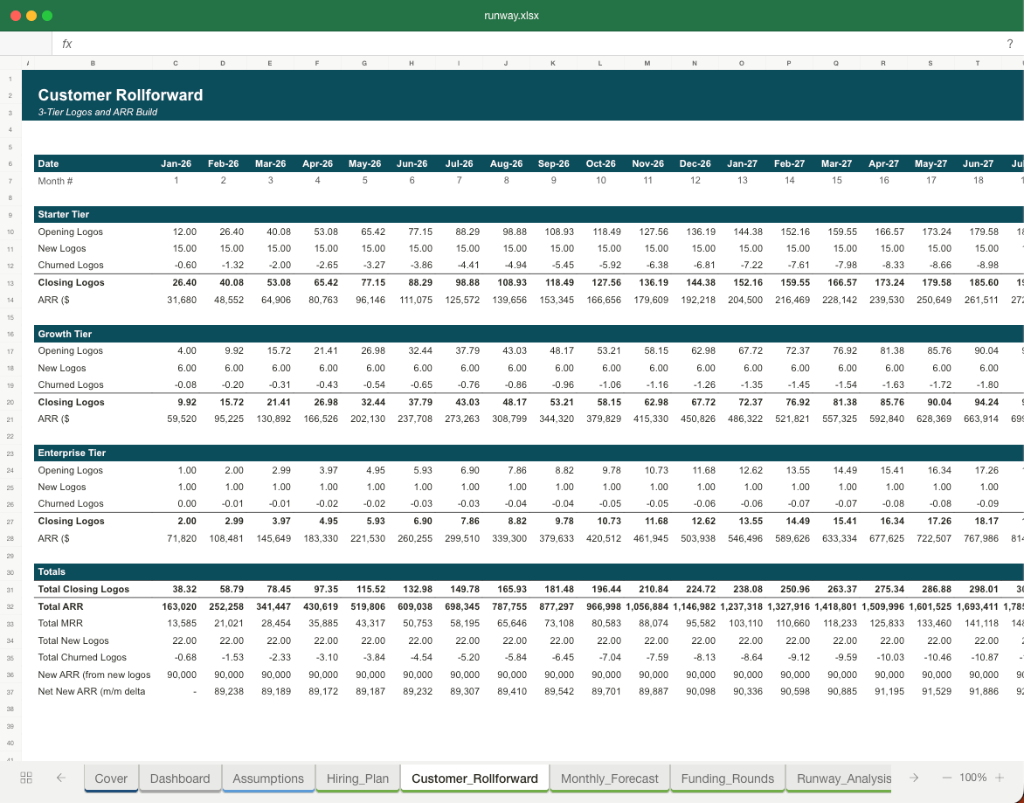
The model is a PLG usage-SaaS build. Free signups, paid conversion, seats, API consumption, premium-service attach, and overage rates create MRR. Retention, usage expansion, infrastructure cost per request, and developer acquisition efficiency determine gross margin and the route to scale.
A turnkey financial model
Live formulas, no hardcoded values
Outputs are driven by live formulas, so the workbook updates from its assumptions instead of relying on hardcoded results.
All assumptions in one tab
Inputs are clearly marked in the Assumptions tab and separated from calculations, making it clear what to change and what to leave intact.
Statements always balancing
For integrated-statement models, the balance sheet, cash flow, and supporting schedules tie through properly.
Distinct schedules for clarity
Debt, working capital, taxes, and cash flow can get messy quickly. We group calculations in clear schedules, not across disconnected tabs.
No hidden macros or external links
There are no unexplained external workbook links or macros to undermine auditability or portability.
Changes flow through the model
Update a key driver and see the impact carry through the forecast, financing, and return outputs. We never use hardcoded numbers in formulas.
About M30
How to build a detailed financial model for M30
A complete walkthrough of the business, drivers, and assumptions behind the downloadable M30 model - distilled from its pitch deck and publicly available information.
Product & value proposition
- Single platform to explore, discover, and consume public APIs.
- One consolidated billing account with consumption-based pricing.
- Unified client framework: one set of docs, client libraries, and examples.
- Built as a serverless cloud abstraction over public cloud infrastructure.
- Powered by open-source "Micro" framework (micro/micro on GitHub).
- Product screens show: API marketplace catalog, per-API docs/sandbox, and a billing dashboard showing balance ($28.43 visible in UI) and usage chart.
Market
- Context provided via the problem slide: the "Third-Party API Economy" is fragmented across 30+ named vendors across Payments, Payroll, E-Commerce, Messaging, Health, Search, CMS, Insurtech, Security, Identity, Logistics, Forms, Verification, Data Mgmt, Video, Automation, Location categories.
Revenue model
Three-layer model:
| Tier | Price | Included requests |
|---|---|---|
| Solo (Free) | $0 | 1M requests/month |
| Pro | $25/month | 20M requests/month |
| Team | $45/mo per user | 100M requests/month |
- Pay-as-you-grow overage: $1 per million API calls after free tier.
- Premium paid services on top (SMS, email, geocoding, news, etc.) - priced per-call above the base tier.
- Future recurring subscriptions (Pro/Team/Business starting at $20/month mentioned as forward-looking).
- Channel: self-serve / PLG (developer-led, free-to-start). No enterprise/sales channel mentioned.
Traction & metrics
From slide 5 (confirmed via image):
- 6,500 signups since launch
- 1 million API calls per month (current run-rate)
- 60 APIs on the platform
- 5 minutes to first API call (time-to-value)
From slide 5 chart image: Total API Requests line chart Jul–Feb; scale tops ~3.5M cumulative; curve inflects sharply Nov–Feb, reaching ~3.5M cumulative by Feb 1.
From slide 6 (Usage Data dashboard image):
- Signups chart (Jul–Feb): rises from ~0 to ~5,000 total, steeper inflection Oct–Nov.
- API Requests chart (Jul–Feb): multi-API stacked lines; top API (db) reaches ~1,500K cumulative by Feb; weather and cache also material.
- Users by API bar chart: top APIs by user count include db, weather, id, email, helloworld, currency - db is clearly #1, weather #2.
From slide 7 (Open Source):
- Underlying Micro framework: ~10,500 GitHub stars as of 2021 (chart reads ~10k+ by late 2021, from ~700 in 2017).
- Micro processes 1 billion requests per day.
No revenue figures disclosed.
Unit economics
- No CAC, LTV, or payback figures in deck.
- Implied gross margin is high (API pass-through with serverless infra); no cost data disclosed.
- Overage pricing: $1/M calls above free tier. At 1M calls/month run-rate, current monetizable volume is near zero (all on free tier).
Competition / moat
- Problem framing: no current aggregator with standardised consumption model exists.
- Moat stated: open-source Micro framework with 10k+ GitHub stars and 1B requests/day scale provides credibility and OSS developer distribution.
- No explicit competitive comparison slide.
- Case study: OpenBooking (CEO Louis Brauer) migrated from Twilio SMS → M3O SMS, Sendgrid/Postmark → M3O Email, AWS S3 → M3O Space, citing ease of use, single billing, reduced complexity.
Team & funding ask / use of funds
Team:
- Asim Aslam - CEO; background in Micro (OSS)
- Dominic Wong - CTO; ex-Monzo
- Martin Virando - Dev UX; ex-Cisco
Existing investors:
- Blossom Capital
- Lightspeed Venture Partners
- Angels: Ross Mason, Luke Kanies, Spencer Kimball
Ask: Raising $5M
Use of funds:
- Accelerate growth and adoption
- Hire engineers and developer evangelists
- Build API integrations and client libraries
Milestones post-raise:
- Grow team to 10
- Catalog of 100 public APIs
- 100,000 users on the platform
Recommended financial model
- Archetype + why: Usage-based SaaS with freemium funnel. Revenue has two streams: (1) subscription MRR (Pro @ $25/mo, Team @ $45/user/mo) and (2) consumption overage ($1/M calls). Classic PLG funnel: free signups → paid conversion → expansion via seat/usage growth. 3-statement not warranted at this stage; a driver-based ARR/MRR model with unit-level cohort tracking is appropriate.
- Forecast horizon & granularity: Monthly, 36 months (3 years). Year 1 = actuals/near-term, Years 2–3 = projection.
- Key drivers & assumptions:
- Monthly new signups: ~500–700/mo implied by 6,500 over ~10 months → model as growing 5–10% MoM post-raise as hiring/evangelism kicks in
- Free-to-paid conversion rate: 3–5% of active users convert to Pro/Team (typical PLG benchmark); not in deck
- Paid tier mix: 80% Pro, 20% Team (no data; Team requires collab which implies teams, less common at early stage)
- Average team size (Team tier): 3 users/team
- Monthly churn on paid: 3–5%/month (early-stage developer tools benchmark)
- API calls per paid user/month: 5–20M (Pro includes 20M; most users likely sub-20M early)
- Overage revenue: negligible in Year 1 (most usage on free/within-plan); models as % of paid cohort exceeding plan limits, starting ~10% by Year 2
- Premium API attach rate (SMS, email, geocoding): 15% of paid users purchase at least one premium API service; average $10/mo
- Gross margin: 70–80% (API pass-through costs are infra + third-party API costs; no data)
- Headcount: starts at 3, grows to 10 post-raise; mostly engineering + 2 dev evangelists
- Avg engineer salary: $120K/yr (UK/US blend given Monzo/Blossom pedigree)
- Infra cost per million API calls: $0.10–0.20 (serverless cloud; needs sensitivity)
- Scenarios (Base / Bull / Bear - which variables flex):
- Base: 5% MoM signup growth, 3% free-to-paid conversion, 3% monthly churn
- Bull: 10% MoM signup growth, 5% conversion, 2% churn - inflects to profitability in ~30 months
- Bear: 3% MoM signup growth, 2% conversion, 6% churn - extends runway, requires bridge
- Required sheets / outputs:
- `Assumptions` - all drivers in one place, flagged vs
- `Funnel` - monthly signups → MAU → paid users (cohort-based)
- `Revenue` - MRR breakdown: Pro sub, Team sub, overage, premium APIs
- `P&L` - gross profit, opex (headcount, infra, S&M), EBITDA, net burn
- `Headcount` - role-by-role hiring plan tied to raise milestones
- `Cash` - cash balance, monthly burn, runway from $5M raise
- `Dashboard` - KPI summary: MRR, ARR, paid users, total signups, API call volume, burn, runway
Frequently asked
Is the M30 financial model free?+
Yes. The M30 model is a free Excel (.xlsx) download with live formulas. Sign up with your email and the workbook is yours to keep, review, and edit.
What's included in the model?+
A 5-year monthly forecast with P&L, cash flow and runway, valuation (exit multiple plus a DCF cross-check), MOIC/IRR returns, and unit economics, with live formulas throughout.
How was this model built?+
It was built from M30's pitch deck and publicly available information, then structured to investment-banking standards as a fully editable Excel model.
Can I change the assumptions?+
Yes. You can change assumptions and the live formulas will recalculate in the downloadable Excel model.
Have more financial modelling questions? Contact us

Created by ex-finance professionals
Hey, I’m Alex and I created Finamodel.
Over my years in the finance industry I kept building the same models over and over again. Same structure, same assumptions, different logo. So I started building frameworks to turn them into clean, reusable templates.
Every model here is one I’d actually use for a client, and I personally vet each one before it goes up.
I’m not an expert in every industry, but I’ve built enough models to know what belongs in one. And when something is completely foreign to me, I reach out to my network for experts to work on our models with us.
Having a template library on hand cuts a first build from hours to minutes.
Need help finding your model? You’ll find me in the Finamodel app!
Other Marketplace Startup Financial Models
Browse another startup in the same category.

Acquco
Amazon brand aggregator - acquires third-party Amazon seller businesses at attractive multiples, then scales them via proprietary growth playbooks and technology.
Arive
Premium q-commerce app delivering lifestyle and branded products in under 30 minutes across German cities.

Audience Town
Vertical data and advertising platform targeting home movers across the entire home journey - pre-move through post-move.

AudioMob
Non-intrusive in-game audio ad platform bridging music/brand advertisers to mobile game publishers.

Authoritive
Two-way messaging platform that turns creator expertise into scalable, push-delivered learning experiences via SMS/WhatsApp.

Avo
Building amenity and office perk platform delivering same-day grocery/pantry/goods to residential and commercial tenants via a white-label marketplace.
beehiiv
Newsletter platform for creators to build, grow, and monetize email audiences - SaaS subscription + native ad network revenue.
Borzo
Global same-day logistics marketplace connecting B2B merchants with crowdsourced couriers for last-mile delivery