 MiO Marketplace Financial Model
Marketplace Startup Financials (Free Excel Download)
B2B SaaS marketplace and sales intelligence platform connecting media buyers and sellers across all ad formats (traditional, non-traditional, non-programmatic digital).



professionals from Deloitte
Used by professionals from






About this model
MiO is a B2B media marketplace and sales-intelligence platform for buyers and sellers of advertising inventory across traditional and digital formats. Buyers can browse, negotiate, and coordinate campaigns, while sellers manage packages, analytics, and sales workflows.
At the current stage, revenue comes from media-seller subscriptions rather than transaction commission. Local plans begin at $995 per month and national plans exceed $15,000 per month; buyers and transactions are free as the company builds marketplace liquidity.
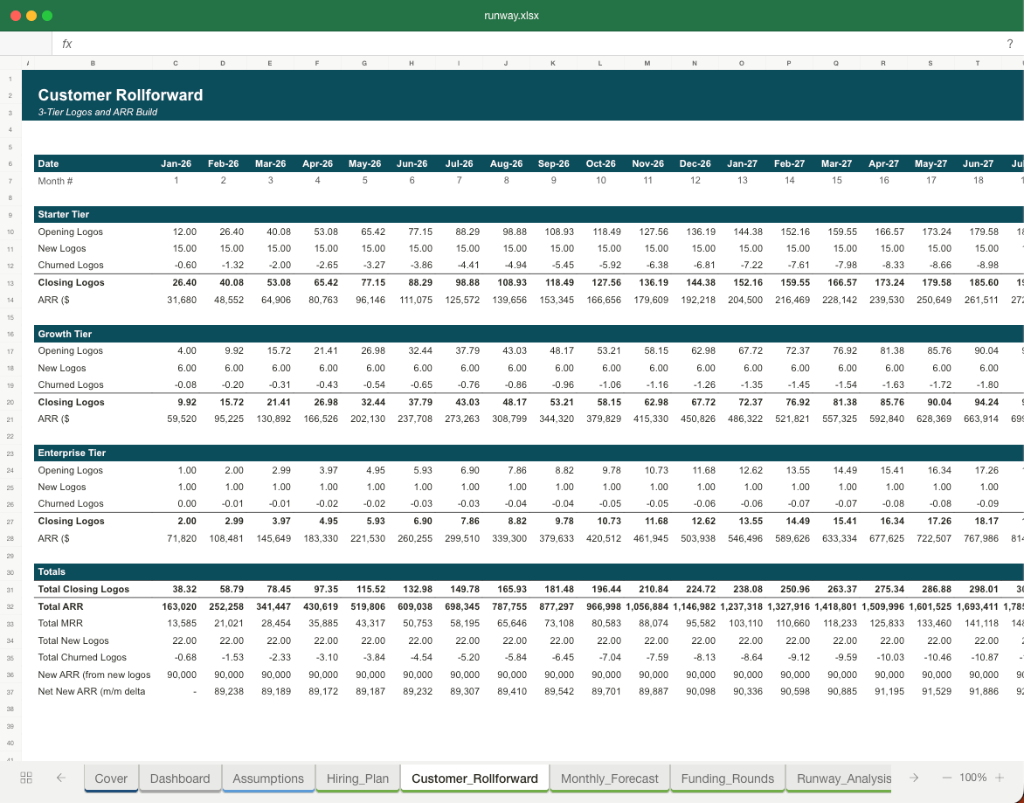
The model is a B2B SaaS ARR forecast with a marketplace funnel overlay. Paying sellers, tier mix, monthly price, churn, and sales conversion build MRR, while buyer adoption is tracked as a leading indicator. Seller acquisition, account expansion, product delivery, and timing of a future transaction take rate are central sensitivities.
A turnkey financial model
Live formulas, no hardcoded values
Outputs are driven by live formulas, so the workbook updates from its assumptions instead of relying on hardcoded results.
All assumptions in one tab
Inputs are clearly marked in the Assumptions tab and separated from calculations, making it clear what to change and what to leave intact.
Statements always balancing
For integrated-statement models, the balance sheet, cash flow, and supporting schedules tie through properly.
Distinct schedules for clarity
Debt, working capital, taxes, and cash flow can get messy quickly. We group calculations in clear schedules, not across disconnected tabs.
No hidden macros or external links
There are no unexplained external workbook links or macros to undermine auditability or portability.
Changes flow through the model
Update a key driver and see the impact carry through the forecast, financing, and return outputs. We never use hardcoded numbers in formulas.
About MiO Marketplace
miomarketplace.com
How to build a detailed financial model for MiO Marketplace
A complete walkthrough of the business, drivers, and assumptions behind the downloadable MiO Marketplace model - distilled from its pitch deck and publicly available information.
Product & value proposition
- MiO (Marketplace, Intelligence, Optimization) is a single platform where media buyers and sellers can browse, bid, negotiate, and transact advertising across every media type.
- Seller-side: publisher dashboard with analytics, package management, DocuSign integration, heatmaps, machine learning campaign visibility optimization, CRM integration roadmap.
- Buyer-side: MiO Mailbox (integrated chat), like/dislike signals, "Fetch" AI concierge search, saved vendor/package tracking via hashtag technology.
- Core value proposition: replaces the "dozen B2B SaaS systems" currently needed to consummate a media sale (LinkedIn + email + Slack + CRM + DocuSign + RFP tools etc.).
Market
- TAM: $600+ billion total US ad spend across MiO's target media categories.
- Serviceable market (implicit): 600,000+ media, brand, and ad agency account execs trading ads; 25+ million annual ad transactions; $10 billion annual wages of ad sellers at media companies.
- Media industry described as "nearly $1 Trillion annually" globally.
- 60% of media spend falls outside DSPs, search, and social (i.e., MiO's direct addressable slice). Sources cited: eMarketer Oct 2021, WARC Media May 2020, MarketingCharts.com, PWC Global Media Outlook 2021.
- No SOM figure given explicitly; company uses penetration-rate table as proxy (see §9).
Revenue model
- Primary: B2B SaaS subscriptions charged to media sellers.
- Entry-level: $995/month (local market).
- National tier: $15,000+/month.
- TAM table uses $1,500/month as the modelling assumption.
- Buyers: join free (for now).
- Transactions: free (for now) - no take-rate on GMV at this stage.
- Go-to-market: demand-gen to attract buyers first; buyer presence then attracts sellers (classic marketplace liquidity flywheel); agency network-effect strategy (top 5 agencies control $20B).
Traction & metrics
- Media partners signed (sample logos): iHeart Media, Pandora, SiriusXM, Amobee, Tribune, Advance Local, Lamar, Scripps.
- Agency partners signed (sample logos): Noble People, Mindstream Media Group.
- Described as "traction" but no subscriber count, MRR/ARR, or GMV figures disclosed for current state.
- Dashboard screenshot (live product, Dec 2022–Jan 2023): Total Revenue $32,400; All Packages 34; Sold Packages 12; Total Offers 23; Visitors 354; Total Likes 123 - these appear to be a single publisher's stats for one month, not company-level revenue.
- Founder bootstrapped 2021–2022; angel investment $550K in 2022.
- No ARR, MRR, churn, or customer count disclosed at company level.
Unit economics
- Implied LTV floor: $995/month × 12 = ~$11,940/year at entry-level; $15,000+/month × 12 = $180,000+/year at national tier.
Competition / moat
- Competitive positioning (quadrant - Broad/Narrow media range × 1-sided vs. 2-way marketplace):
- Upper-left (broad media, 1-sided): Salesforce, Mediaocean, DealHub, FreeWheel.
- Lower-left (narrow media, 1-sided): Briefbid, Productive.
- Lower-right (narrow media, 2-way): OpenX, MilkMoney, Google Ad Manager, The Trade Desk.
- Upper-right (broad media, 2-way marketplace): MiO - claims to be the only player in this quadrant.
- Moat claims: network effects from agency concentration (top 5 agencies control $20B); buyer-first strategy creates supply-side lock-in; proprietary sales intelligence / buyer intent data over time.
Team & funding ask / use of funds
- Founder & CEO: Sean Halter - two decades in media/marketing; built and exited multiple multi-million-dollar businesses on both buy- and sell-side; host of "The CMO Suite" podcast.
- Board of Directors: Sri Rajagopalan (CCO, General Mills); Todd Schnitt (Media Personality / Tech Investor); Paul Willett (CFO, Connectivity Holdings); Matt Brown (SaaS Advisor, Thumbstopper).
- Funding to date: founder bootstrapped 2021–2022; $550K angel in 2022.
- Current raise: $150K (Spring 2023).
- Valuation: $3.8M; cap structure: 80% owner / 20% investor.
- Use of funds: Software Engineers, UX/UI Designers, v2 Website Development, AI Integrations, Direct API Connections, Account Executives (BizDev), Senior Exec (COO), Marketing / Brand Awareness.
Recommended financial model
- Archetype + why: B2B SaaS ARR model with marketplace subscriber funnel. Revenue is 100% subscription at this stage (no take-rate). The core driver is number of paying media seller accounts × tier mix × monthly price. Marketplace GMV and transaction revenue are a future-state option to layer in once MiO switches on transaction fees, but should not be the primary model now.
- Forecast horizon & granularity: Monthly for Years 1–2 (2023–2024); quarterly summary for Year 3 (2025). Matches the ARR chart in the deck (2022–2025).
- Key drivers & assumptions:
- Total addressable sellers: 600,000 account execs; subset who are publisher/seller-side is estimated ~50% = 300,000.
- New seller subscriber additions per month: start at ~5–10/month in 2023, scaling to ~50–80/month by 2025.
- Tier mix: 80% entry-level ($995/mo), 20% national ($15,000+/mo modelled at $15,000).
- Blended ARPU: ~$3,795/mo blended; use $1,500/mo as deck's own stated assumption for base case.
- Monthly churn: 2.0% (annual ~22%).
- Buyers: free, so no revenue contribution modelled; track as engagement metric.
- Transaction take-rate: 0% in base case; model as upside scenario toggle.
- Gross margin: ~80%.
- Headcount: ramp per use-of-funds list - eng, design, BizDev AEs, COO.
- CAC:.
- ARR milestones (from deck chart, read off bars): 2022 ~$0 (pre-revenue / bootstrapped); 2023 ~$1M; 2024 ~$4–5M; 2025 ~$13–14M.
- Scenarios (Base / Bull / Bear - which variables flex):
- Base: $1,500/mo ARPU, 2% churn, steady AE hiring ramp per use-of-funds.
- Bull: agency network-effect triggers - one top-5 agency adoption adds hundreds of seller accounts; blended ARPU lifts toward $3,000/mo as national tier mix grows; transaction fee (1–2% take-rate) switched on in 2024.
- Bear: slow buyer-side adoption delays seller conversion; ARPU stays at $995 entry-level; churn 4%+; ARR at ~$2M by 2025.
- Required sheets / outputs:
- Assumptions - all inputs, clearly labelled.
- Subscriber build - monthly new adds, churn, net active sellers by tier.
- Revenue - MRR → ARR by tier; blended ARPU; net revenue retention.
- P&L - revenue, COGS (hosting/infra), gross profit, S&M (AE headcount + marketing), R&D (eng + design), G&A, EBITDA.
- Headcount plan - roles per use-of-funds, hire dates, fully-loaded cost.
- Cash & runway - opening balance ($550K angel + $150K new raise = ~$700K), monthly burn, months of runway.
- TAM penetration table - replicate deck's 0.5%–10% scenario table at $1,500/mo as sensitivity output.
- Valuation bridge - implied EV at 8x ARR per penetration scenario (deck already shows this; model should reproduce it dynamically).
Frequently asked
Is the MiO Marketplace financial model free?+
Yes. The MiO Marketplace model is a free Excel (.xlsx) download with live formulas. Sign up with your email and the workbook is yours to keep, review, and edit.
What's included in the model?+
A 5-year monthly forecast with P&L, cash flow and runway, valuation (exit multiple plus a DCF cross-check), MOIC/IRR returns, and unit economics, with live formulas throughout.
How was this model built?+
It was built from MiO Marketplace's pitch deck and publicly available information, then structured to investment-banking standards as a fully editable Excel model.
Can I change the assumptions?+
Yes. You can change assumptions and the live formulas will recalculate in the downloadable Excel model.
Have more financial modelling questions? Contact us

Created by ex-finance professionals
Hey, I’m Alex and I created Finamodel.
Over my years in the finance industry I kept building the same models over and over again. Same structure, same assumptions, different logo. So I started building frameworks to turn them into clean, reusable templates.
Every model here is one I’d actually use for a client, and I personally vet each one before it goes up.
I’m not an expert in every industry, but I’ve built enough models to know what belongs in one. And when something is completely foreign to me, I reach out to my network for experts to work on our models with us.
Having a template library on hand cuts a first build from hours to minutes.
Need help finding your model? You’ll find me in the Finamodel app!
Other Marketplace Startup Financial Models
Browse another startup in the same category.

Acquco
Amazon brand aggregator - acquires third-party Amazon seller businesses at attractive multiples, then scales them via proprietary growth playbooks and technology.
Arive
Premium q-commerce app delivering lifestyle and branded products in under 30 minutes across German cities.

Audience Town
Vertical data and advertising platform targeting home movers across the entire home journey - pre-move through post-move.

AudioMob
Non-intrusive in-game audio ad platform bridging music/brand advertisers to mobile game publishers.

Authoritive
Two-way messaging platform that turns creator expertise into scalable, push-delivered learning experiences via SMS/WhatsApp.

Avo
Building amenity and office perk platform delivering same-day grocery/pantry/goods to residential and commercial tenants via a white-label marketplace.
beehiiv
Newsletter platform for creators to build, grow, and monetize email audiences - SaaS subscription + native ad network revenue.
Borzo
Global same-day logistics marketplace connecting B2B merchants with crowdsourced couriers for last-mile delivery