MLMysten Labs Financial Model
Crypto/Web3 Startup Financials (Free Excel Download)
Mysten Labs builds foundational web3 infrastructure (smart contract language, consensus, SDK) and monetizes via token stakes in partner networks.



professionals from Deloitte
Used by professionals from






About this model
Mysten Labs develops foundational Web3 components, including the Move smart-contract language, Narwhal consensus technology, and a future Polaris developer platform. Rather than beginning with a single new chain, it planned to launch open networks or co-develop with existing L1 and L2 ecosystems.
Its economic model is token-based: partner networks grant token stakes in exchange for integration work, while Mysten can retain tokens from networks it launches. The deck records co-development agreements with Celo and Sommelier and targets additional partners, but provides no recurring SaaS revenue or disclosed token values.
Model partner agreements, token-stake percentages, grant values, vesting schedules, and token liquidation for operating cash. Keep mark-to-market treasury value distinct from cash realised, then layer R&D headcount and infrastructure burn beneath it. Partner count, vesting, token-price scenarios, launch timing, and liquidation rates determine runway far more than conventional ARR metrics.
A turnkey financial model
Live formulas, no hardcoded values
Outputs are driven by live formulas, so the workbook updates from its assumptions instead of relying on hardcoded results.
All assumptions in one tab
Inputs are clearly marked in the Assumptions tab and separated from calculations, making it clear what to change and what to leave intact.
Statements always balancing
For integrated-statement models, the balance sheet, cash flow, and supporting schedules tie through properly.
Distinct schedules for clarity
Debt, working capital, taxes, and cash flow can get messy quickly. We group calculations in clear schedules, not across disconnected tabs.
No hidden macros or external links
There are no unexplained external workbook links or macros to undermine auditability or portability.
Changes flow through the model
Update a key driver and see the impact carry through the forecast, financing, and return outputs. We never use hardcoded numbers in formulas.
About Mysten Labs
mystenlabs.com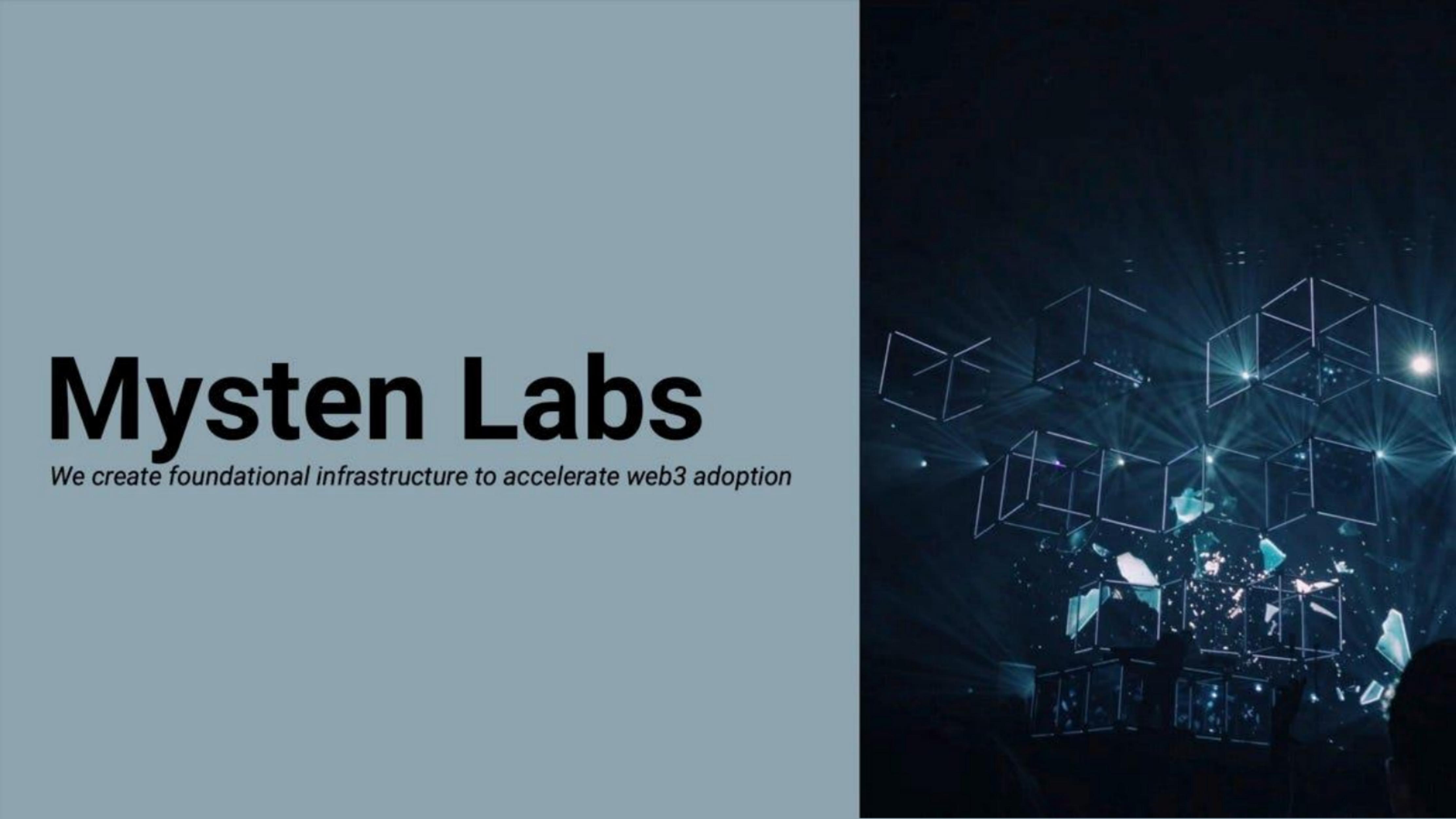
How to build a detailed financial model for Mysten Labs
A complete walkthrough of the business, drivers, and assumptions behind the downloadable Mysten Labs model - distilled from its pitch deck and publicly available information.
Product & value proposition
- Polaris web3 platform: abstraction layer over L1/L2 complexity; lets developers build, deploy, and manage web3 products without dealing with underlying chain differences.
- Core open-source components (the actual IP):
- Move: modern, safe smart contract language (from Diem/Facebook).
- Narwhal: mempool/DAG-based consensus providing order-of-magnitude throughput uplift for PoS chains.
- KELP / Tusk: mentioned in roadmap alongside Move and Narwhal; details redacted.
- Polaris SDK: rich developer frameworks targeting 2024 release.
- GTM strategy: launch each component as a standalone open network (tokenized) or co-develop into existing L1s/L2s in exchange for token stakes - not a bottom-up "build a new L1" play (though Polaris L1 is a future phase).
Revenue model
Two streams, both token-economics-based:
- Token launch / network ownership: Launch open network projects with tokenization models; Mysten retains founding/protocol tokens.
- Co-development token stakes: Partner L1/L2 networks grant Mysten Labs a stake (in partner network tokens) in exchange for integrating Narwhal, Move, KELP, or Tusk. Specific stake percentages/values are fully redacted.
- 2021/22: stake in CELO and Sommelier networks for co-dev signed agreements.
- 2023: targeting 3 additional networks.
- 2024: targeting 4 additional networks.
No cash/SaaS/subscription revenue described. Revenue realization depends on token price at time of vesting/sale.
Traction & metrics
- Co-dev agreements signed: Celo and Sommelier.finance.
- Narwhal: engineering complete Q4 2021; integration with major L1 targeted Q4 2021.
- Core protocol R&D complete on first project; testnet within 6 months.
- Token stake agreements reached in two partner networks (amounts redacted).
- No revenue, user, or transaction-volume figures disclosed.
Competition / moat
Not explicitly addressed in deck. Implied moats:
- Pedigree: former Facebook/Novi Research leads; created Move language and Narwhal protocol.
- IP: proprietary protocol components (Move, Narwhal, KELP, Tusk) already in production R&D.
- First-mover lock-in: "first mover advantage" language used for L1 partner token grants.
- Academic depth: Chief Scientist George Danezis, 100+ papers, co-founder of Chainspace (acquired by Facebook).
Team & funding ask / use of funds
Team:
- Evan Cheng - CEO; former Sr. Director R&D, Novi Research (Facebook); previously Apple; ACM Award 2012.
- Sam Blackshear - CTO; Principal Engineer Novi Research; tech lead of Move language; Facebook Fellowship 2014.
- Adeniyi Abiodun - COO; former Sr. Staff PM Novi Research; Oracle/VMWare blockchain product lead; founded bitcoin mining company 2012.
- George Danezis - Chief Scientist; Professor UCL; former Novi Research Principal; Chainspace co-founder (acquired by Facebook 2019); 100+ papers.
Funding ask / use of funds: Fully redacted - round size, valuation, and use of proceeds are not visible in deck.
Recommended financial model
- Archetype + why: Token-economics treasury / protocol revenue model - not a standard SaaS or operating P&L. Revenue is driven by (a) token grants from partners (mark-to-market holdings) and (b) own-network token launch proceeds. The closest analog is a crypto protocol treasury model combined with a venture-style portfolio of token positions. No recurring cash subscription exists.
- Forecast horizon & granularity: 2021–2025 annual (matching roadmap milestones); quarterly for 2022 near-term to track partner integrations against plan.
- Key drivers & assumptions:
| Driver | Value / Assumption | | -- | -- | | Co-dev partners signed per year | 2 in 2021/22, 3 in 2023, 4 in 2024 | | Avg token stake per co-dev partner (% of partner network) | Unknown - redacted | | Dollar value of token stakes at grant | Unknown - must be modelled with sensitivity to partner token price | | Vesting schedule on partner token grants | 2–4 year linear vest, typical for protocol partnerships; confirm with company | | Own-network (Polaris L1) token supply / Mysten reserve % | Unknown; 20–30% founder/protocol reserve, standard for L1s | | Polaris L1 token launch date | 2024 | | Token price appreciation | model flat (at grant price) as base; flex in scenarios | | Treasury management / token liquidation rate | 10–20%/yr liquidation of vested tokens for operating cash |
- Scenarios (Base / Bull / Bear - which variables flex):
- Base: Partner count per roadmap; flat token prices at grant; standard vesting.
- Bull: 2× partner count; token prices 3× at vest; Polaris L1 token valued at top-quartile L1 comparable at launch.
- Bear: 1 partner per year (slow adoption); token prices -70% from grant (crypto bear market); Polaris L1 delayed to 2025.
- Required sheets / outputs:
- Partnership pipeline: year-by-year partner count, token stake %, token grant $ value at grant date.
- Token treasury: holdings by partner/own-network, vesting schedule, mark-to-market, liquidation plan.
- P&L / cash burn: headcount, R&D opex, G&A; cash from token liquidations vs. equity raises.
- Runway: months of cash given burn rate and liquidation schedule.
- Sensitivity table: portfolio value vs. token price × number of partners.
- Scenario toggle: Base / Bull / Bear on a single assumptions sheet.
Frequently asked
Is the Mysten Labs financial model free?+
Yes. The Mysten Labs model is a free Excel (.xlsx) download with live formulas. Sign up with your email and the workbook is yours to keep, review, and edit.
What's included in the model?+
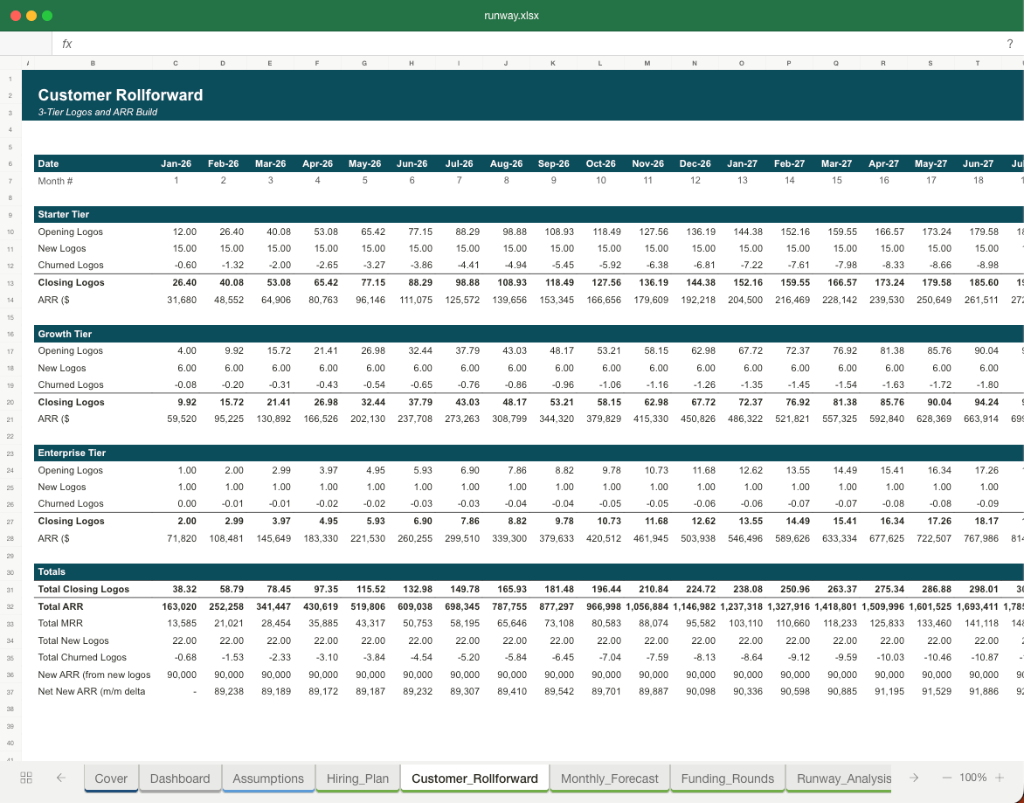
A 5-year monthly forecast with P&L, cash flow and runway, valuation (exit multiple plus a DCF cross-check), MOIC/IRR returns, and unit economics, with live formulas throughout.
How was this model built?+
It was built from Mysten Labs's pitch deck and publicly available information, then structured to investment-banking standards as a fully editable Excel model.
Can I change the assumptions?+
Yes. You can change assumptions and the live formulas will recalculate in the downloadable Excel model.
Have more financial modelling questions? Contact us

Created by ex-finance professionals
Hey, I’m Alex and I created Finamodel.
Over my years in the finance industry I kept building the same models over and over again. Same structure, same assumptions, different logo. So I started building frameworks to turn them into clean, reusable templates.
Every model here is one I’d actually use for a client, and I personally vet each one before it goes up.
I’m not an expert in every industry, but I’ve built enough models to know what belongs in one. And when something is completely foreign to me, I reach out to my network for experts to work on our models with us.
Having a template library on hand cuts a first build from hours to minutes.
Need help finding your model? You’ll find me in the Finamodel app!
Other Crypto/Web3 Startup Financial Models
Browse another startup in the same category.
0x Labs
0x Labs builds open exchange infrastructure (protocol, API, consumer app) for on-chain token trading across multiple blockchains.

1inch Network
DeFi aggregation protocol that routes crypto swaps across 100+ liquidity sources to deliver best rates and lowest gas fees.

Aether
Synthetic biology platform that builds searchable protein indexes to engineer novel molecular assemblers for high-value industrial products.
Alto
Self-directed IRA platform enabling retail investors to invest in alternative assets (private equity, debt, real estate, crypto) via tax-advantaged retirement savings.
Auki Labs
Decentralized peer-to-peer spatial positioning SDK for social AR - building the infrastructure layer to replace GPS and enable a persistent AR metaverse.
Awesome People Ventures Fund 2
Awesome People Ventures is a community-driven, decentralized early-stage Web3 VC fund raising Fund II.

Axelar
Cross-chain blockchain overlay network enabling universal transfer of assets, transactions, and state across all blockchain ecosystems.
BRD
BRD is a non-custodial crypto wallet app (consumer) and blockchain infrastructure API platform (enterprise) targeting mass-market crypto adoption.