 Noto Financial Model
Fintech Startup Financials (Free Excel Download)
AI-native operating system for lesson-based businesses (tutoring, music/dance schools, private coaching), replacing fragmented legacy software with an integrated SaaS + payments platform.



professionals from Deloitte
Used by professionals from






About this model
Noto is an AI-native operating system for lesson-based businesses such as tutoring providers, music and dance schools, and private coaches. It replaces fragmented legacy tools with a unified workflow for customer management, operations, and payments.
The company sells vertical SaaS with an implied annual contract value that rises when customers adopt AI capabilities and add-on CRM modules. Embedded ACH payments provide a second monetisation route as lesson businesses process more activity through the platform.
The model should forecast customer businesses, ACV by product tier, CRM adoption, implementation, retention, and expansion. Payment revenue should be calculated from active businesses, lesson-payment volume, and net ACH take rate, with sales productivity and support costs tested by customer segment.
A turnkey financial model
Live formulas, no hardcoded values
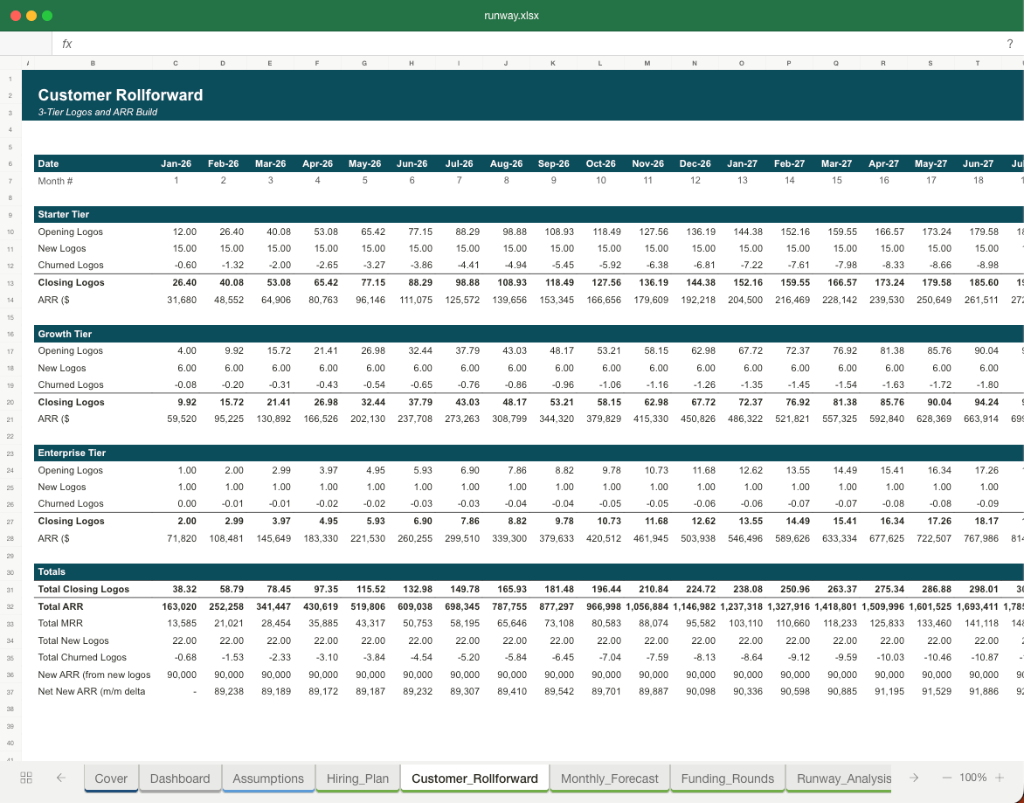
Outputs are driven by live formulas, so the workbook updates from its assumptions instead of relying on hardcoded results.
All assumptions in one tab
Inputs are clearly marked in the Assumptions tab and separated from calculations, making it clear what to change and what to leave intact.
Statements always balancing
For integrated-statement models, the balance sheet, cash flow, and supporting schedules tie through properly.
Distinct schedules for clarity
Debt, working capital, taxes, and cash flow can get messy quickly. We group calculations in clear schedules, not across disconnected tabs.
No hidden macros or external links
There are no unexplained external workbook links or macros to undermine auditability or portability.
Changes flow through the model
Update a key driver and see the impact carry through the forecast, financing, and return outputs. We never use hardcoded numbers in formulas.
About Noto
noto.nyc
How to build a detailed financial model for Noto
A complete walkthrough of the business, drivers, and assumptions behind the downloadable Noto model - distilled from its pitch deck and publicly available information.
Product & value proposition
- All-in-one operating system: scheduling/calendar, CRM/lead pipeline, billing/invoicing, payroll/pay rates, attendance, automations, and analytics - replacing 5–6 point solutions (Mailchimp, Acuity, Stripe, HubSpot/Monday)
- Embedded API partners (Check for payroll, Reach, Pocketflows) enable premium features at lower cost than standalone tools
- ACH payments as trojan horse: saves customers $1,000+/month vs. card fees; parents trust education businesses with bank details
- AI layer: LLM agents for onboarding/data migration, rescheduling assistant (beta), communication automation (reducing 1+ full-time admin)
- Target customer: SMB lesson-based businesses with 1–5 admins, 10–50 instructors, 100–500 parent/student accounts
Market
- TAM: $125B
- Also stated as $150B (4× yoga/pilates market) in slide 6 text - likely includes adjacent/global scope; $125B shown in chart is the more precise figure used for modeling
- Market breakdown - lesson-based businesses total ~150,000:
- Tutoring: 75,000 businesses (online + in-person)
- Extracurricular enrichment: ~85,000 (15K music schools + 20K dance + 30K long tail + 20K athletics)
- Private coaching: 10,000 businesses
- Noto's addressable market: 75K businesses × $25K ACV = $1.88B ARR
- Comparator - Mindbody (yoga/pilates): 25K businesses, $12K ACV, $300M ARR
- SMB vertical comps: Toast ($24B on 1M businesses, $2.5B rev), ServiceTitan ($24B, 1M, $2.5B), Procore ($10B, 550K, $1.2B), Mindbody ($3B, 48K, $500M), Slice ($2B, 75K, $300M)
- Projected Noto at scale (slide 3): 150,000 businesses, $1.1B revenue, $11B company - note this is an aspirational comp projection, not a forecast
Revenue model
- Primary: SaaS subscription per business
- Base ACV: $25K implied in market slide; AI-enhanced ACV: $35K mentioned with LOIs
- CRM module add-on: $100/month ($1,200/year) shown on product screenshot
- Secondary: Payment processing take rate on ACH transactions (explicitly monetized; contrasted with legacy competitors who do not monetize payments)
- Channels: Outbound (email, calls, ads) ~25%; word-of-mouth via curriculum networks (Suzuki, Kaplan, Yamaha); PE group partnerships (Rocket Youth, Ensemble Music)
- Pricing ceiling for AI tier: $35K ACV (vs. base $25K)
Traction & metrics
- Customer usage: 6+ hours of active usage per working day per customer
- Customer profile: 1–5 admins, 10–50 instructors, 100–500 parents per business
- Design partner: at least 1 confirmed (music school, "The Practice Room" referenced in slides 9 and 34)
- Conference traction: outperformed 12-year incumbent TutorBird at tutoring conference
Unit economics
- ACV: $25K (base), $35K (AI tier)
- CAC bottleneck: onboarding takes 2–3 weeks + 1 full engineering day for data migration; AI agents intended to reduce this
Competition / moat
- Competitive landscape:
- 55% of market on spreadsheets/sticky notes
- 45% on legacy PE-owned software (10–12+ year old platforms, e.g. TutorBird, Pike13)
- Legacies do not monetize payments
- Moat sources:
- System-of-record stickiness (all scheduling, billing, CRM in one place)
- Embedded payment take rate - structurally unavailable to non-payment-native incumbents
- AI layer on top of proprietary operational data (rescheduling, communication, migration)
- Curriculum/PE network distribution (Suzuki, Yamaha, Rocket Youth, Ensemble Music)
- Modern UX vs. visibly outdated incumbents (Pike13 screenshot shown)
Team & funding ask / use of funds
- AJ Ding, CEO & co-founder: second-time technical founder; prior AI recruiting company - $2M ARR, $6.5M seed raised; ML/data roles at Quora, Lyft, Meta; stats at Yale; family SMB background
- Steve Wang, CTO: led engineering at Nitra (vertical SaaS for doctors, $65M raised, a16z-backed); SWE at Lyft; applied math at Harvard
- Use of funds:
- 2 full-stack engineers to automate migration via AI agents
- 1 bizops generalist for lead gen and support
Recommended financial model
- Archetype + why: Vertical SaaS ARR model with embedded payments revenue layer. Noto is a classic vertical SaaS business - the primary driver is customer count × ACV, with a secondary payment processing revenue stream that scales with GMV flowing through the platform. This matches Toast/Mindbody comp set the deck explicitly uses.
- Forecast horizon & granularity: 5 years (Year 1–5), monthly in Year 1, quarterly in Years 2–5. Seed-stage business so monthly near-term granularity matters for cash runway.
- Key drivers & assumptions:
| Driver | Value |
|---|---|
| Addressable businesses (TAM units) | 150,000 |
| Initial target segment | 75,000 |
| Base ACV (SaaS subscription) | $25,000 |
| AI-tier ACV | $35,000 |
| CRM add-on price | $1,200/year ($100/mo) |
| Payment processing take rate | 0.5%–1.0% of GMV |
| Average GMV per business per year | $250,000–$500,000 |
| New customers per month (Y1) | 5–10 |
| Onboarding cost per customer (pre-AI) | 1 engineering-day equivalent |
| Onboarding duration | 2–3 weeks |
| Monthly churn | 1.0%–1.5% |
| Gross margin (SaaS) | 70%–75% |
| Gross margin (payments) | 30%–40% |
| S&M as % of revenue (early stage) | 35%–45% |
| R&D as % of revenue | 30%–35% |
| AI-tier adoption (% of new customers) | 20% Y1 → 50% Y3 |
- Scenarios (Base / Bull / Bear - which variables flex):
- Base: 10 new customers/month Y1, 50% base / 50% AI-tier mix by Y3, 1.0% monthly churn, payments take rate 0.75%
- Bull: 20 new customers/month Y1 via network partnerships, 70% AI-tier by Y3 at $35K ACV, churn 0.7%, take rate 1.0%
- Bear: 5 new customers/month (onboarding bottleneck persists), 20% AI-tier, churn 1.5%, payments slow to adopt (ACH resistance)
- Required sheets / outputs:
- Assumptions dashboard (all drivers in one place, color-coded vs.)
- Customer cohort model (monthly new customers, churn waterfall, cumulative ARR by cohort)
- Revenue build (SaaS ARR + payments GMV × take rate + add-on modules)
- P&L (gross profit by revenue line, OpEx by department: S&M, R&D, G&A)
- Headcount plan (eng, bizops, customer success - keyed to onboarding capacity)
- Cash flow & runway (critical: seed stage with defined bottleneck)
- Market penetration curve (customers as % of 75K TAM units)
- Scenario toggle (Base / Bull / Bear on single input sheet)
Frequently asked
Is the Noto financial model free?+
Yes. The Noto model is a free Excel (.xlsx) download with live formulas. Sign up with your email and the workbook is yours to keep, review, and edit.
What's included in the model?+
A 5-year monthly forecast with P&L, cash flow and runway, valuation (exit multiple plus a DCF cross-check), MOIC/IRR returns, and unit economics, with live formulas throughout.
How was this model built?+
It was built from Noto's pitch deck and publicly available information, then structured to investment-banking standards as a fully editable Excel model.
Can I change the assumptions?+
Yes. You can change assumptions and the live formulas will recalculate in the downloadable Excel model.
Have more financial modelling questions? Contact us

Created by ex-finance professionals
Hey, I’m Alex and I created Finamodel.
Over my years in the finance industry I kept building the same models over and over again. Same structure, same assumptions, different logo. So I started building frameworks to turn them into clean, reusable templates.
Every model here is one I’d actually use for a client, and I personally vet each one before it goes up.
I’m not an expert in every industry, but I’ve built enough models to know what belongs in one. And when something is completely foreign to me, I reach out to my network for experts to work on our models with us.
Having a template library on hand cuts a first build from hours to minutes.
Need help finding your model? You’ll find me in the Finamodel app!
Other Fintech Startup Financial Models
Browse another startup in the same category.
Acin
SaaS and data subscription network for operational risk management at Tier 1 financial institutions

Ageras Group
B2B SME ecosystem - marketplace connecting SMEs with accountants + cloud accounting/payroll software + embedded financial services (lending, factoring, banking)

Airbase
Unified non-payroll spend management platform (corporate cards, AP/bill pay, expense reimbursement, approval workflows) for mid-market companies.

Altruist
Vertically integrated all-in-one platform for registered investment advisors (RIAs) - combining custodial, portfolio management, practice management, and client acquisition tools.
Amenitiz
All-in-one hotel management SaaS platform ("Shopify for hotels") for independent hoteliers - PMS, booking engine, channel manager, website builder, payments, and AI-driven revenue management.

Anrok
SaaS sales tax compliance platform - nexus monitoring, calculation, registration, filing, and remittance - built specifically for SaaS companies.
Arrival
Arrival is an EV manufacturer of commercial vans and buses using proprietary Microfactories and vertically integrated components, going public via SPAC merger with CIIG Merger Corp.

AtoB
AtoB is building financial infrastructure for commercial fleets, starting with a no-fee Visa fleet card for fuel and expanding into payroll, BNPL, and international.