 Oloid Financial Model
Hardware/Deep-tech Startup Financials (Free Excel Download)
Cloud-based physical access control SaaS that retrofits existing door hardware with a software overlay, replacing legacy badge readers with mobile/facial authentication.



professionals from Deloitte
Used by professionals from






About this model
Oloid is cloud physical-access-control SaaS that retrofits existing doors with mobile and facial authentication. It replaces legacy badge-reader workflows with a software overlay, allowing organisations to modernise access without wholly replacing installed physical-security infrastructure.
The enterprise model is driven by sites, doors, and identities rather than conventional user seats alone. Customers must integrate hardware and enrol users, then can expand across facilities as the software proves reliable, secure, and easier to operate than legacy credential workflows.
Model enterprise customers, sites, doors, identities, subscription ARPU, installation, hardware integration, expansion, renewals, and churn. Include solution engineering, partner hardware, cloud delivery, security, support, and sales costs. Rollout pace, doors per site, pricing, installation margin, expansion, and retention should drive scenarios.
A turnkey financial model
Live formulas, no hardcoded values
Outputs are driven by live formulas, so the workbook updates from its assumptions instead of relying on hardcoded results.
All assumptions in one tab
Inputs are clearly marked in the Assumptions tab and separated from calculations, making it clear what to change and what to leave intact.
Statements always balancing
For integrated-statement models, the balance sheet, cash flow, and supporting schedules tie through properly.
Distinct schedules for clarity
Debt, working capital, taxes, and cash flow can get messy quickly. We group calculations in clear schedules, not across disconnected tabs.
No hidden macros or external links
There are no unexplained external workbook links or macros to undermine auditability or portability.
Changes flow through the model
Update a key driver and see the impact carry through the forecast, financing, and return outputs. We never use hardcoded numbers in formulas.
About Oloid
oloid.ai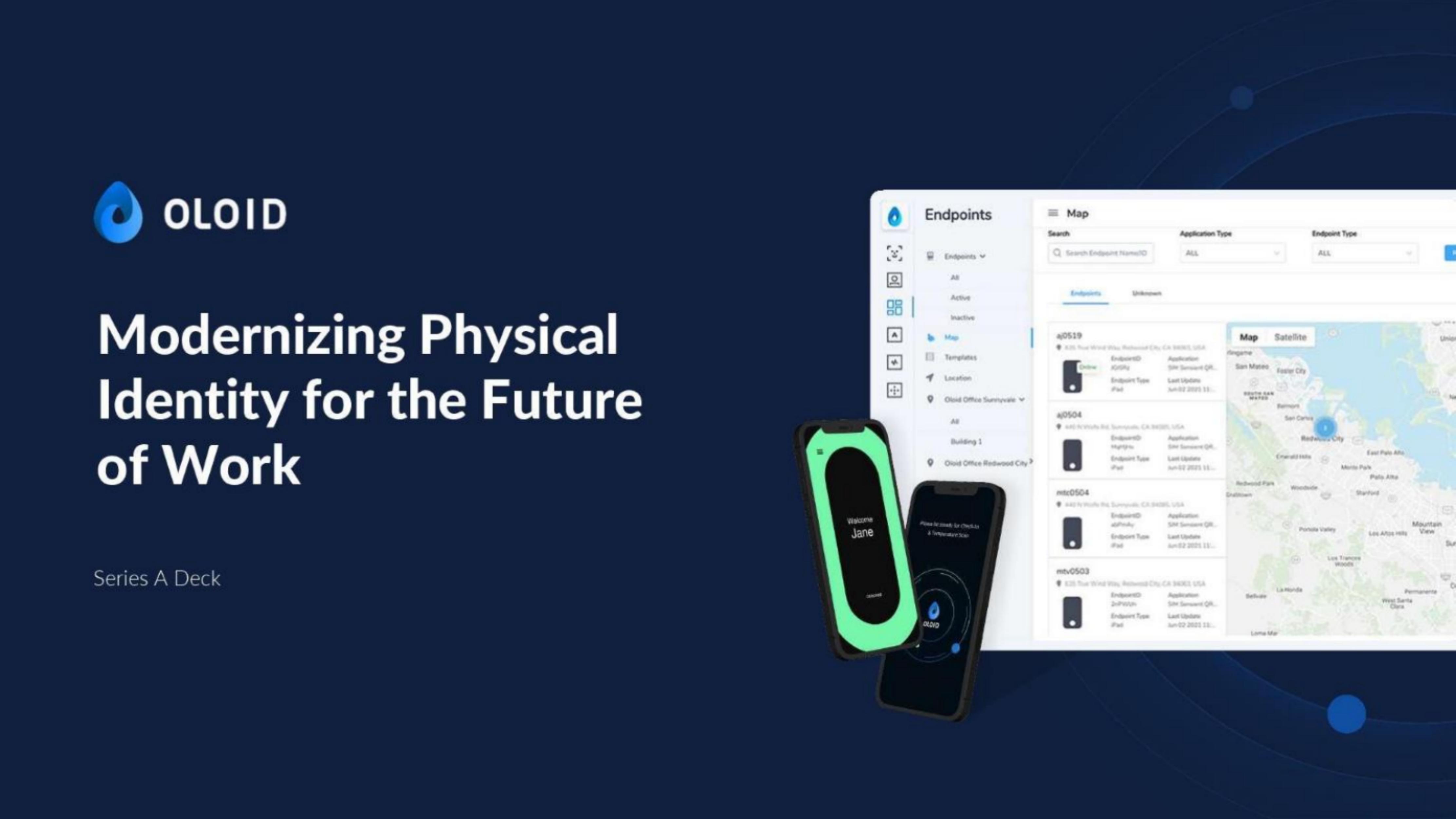
How to build a detailed financial model for Oloid
A complete walkthrough of the business, drivers, and assumptions behind the downloadable Oloid model - distilled from its pitch deck and publicly available information.
Product & value proposition
- Software overlay that moves PACS intelligence from on-premise closet hardware to the cloud and mobile edge
- Multimodal authentication: BLE, facial recognition, QR, NFC - runs on off-the-shelf tablets/smartphones
- No rip-and-replace: integrates with existing PACS readers and closet hardware
- Self-installable in under 1 hour via app store download
- Cost per door upgrade: <$100 with Oloid vs. $1,500–2,000 for competitors (hardware + installation)
- Use cases beyond access control: time & attendance, desk reservation, safety/wellness, vaccination management, space analytics, occupancy/density, tailgating detection, video intercom
- Data analytics layer: space utilization, operational data, anomaly detection, compliance analytics, credential management
- Positioning: "SSO for physical identity" - analogous to Okta for cyber identity
Market
- Global TAM for PACS: $70B (US, Canada, LatAm, Europe & ROW excl. China)
- Access Control SaaS: $42B
- SAM - Access Control SaaS for Commercial Real Estate: $21B / 158M doors
- Near-term beachhead (wired commercial enterprise doors): $8.4B
- ICP initial target (Current GTM, Enterprise): $1B / 1M doors
- Source cited: Group 337 research
- Market tailwind: global fingerprint biometric revenues fell 22% ($1.8B) in 2020 due to COVID; total biometrics market forecast ~$40B by 2025 (ABI Research)
Revenue model
- Model implied: SaaS subscription per door/endpoint
- Pricing unit is per door
- Channels:
- Current (pre-Series A): Direct sales to large employers; remote/assisted installs; channel partners (leveraging partner customer relationships); technology partnerships (integrations with workplace apps)
- New post-Series A: Self sign-up + self-installation; inbound marketing + automated funnel conversion
- SDK in development for embedding into tenant management apps (landlord/investor/real estate managed buildings)
- ICP: Occupier-managed buildings; mixed workforce (desk + deskless workers); looking for retrofit option
Unit economics
- Cost per door upgrade (hardware + installation, one-time): <$100 with Oloid vs. $1,500–2,000 competitors
- Self-installation time: <1 hour
Competition / moat
Competitors named (slide 9): Alcatraz, Proxy, Verkada, Openpath, Kisi, Brivo - all require rip-and-replace of door readers
Moat claims:
- Only self-installable enterprise PACS solution (no reader replacement needed)
- Patented BLE-based identification protocols; BLE SDK with 4M downloads (CTO background)
- AI/ML + computer vision + BLE/NFC/camera hardware-software IP - "hard-to-replicate"
- Software overlay approach: integrates with existing PACS vs. replacing it
- Integration ecosystem: Workday, ADP, Kronos, Okta, Active Directory, ServiceNow, Envoy, Genetec, Honeywell, Johnson Controls, HID, Lenel, and others
Team & funding ask / use of funds
Team:
- Mohit Garg, Co-founder & CEO: 2x SaaS founder; previously co-founder & CRO at Mindtickle (valued at $1.2B, raised $280M); grew Mindtickle ARR 1,000%+ in 3 years; early product roles at Aruba Networks, Iospan Wireless; Stanford / ISB / Kellogg
- Madhu Madhusudhanan, Co-founder & CTO: Identity management at IBM; voice-AI authentication at IBM Watson; creator of patented BLE identification protocols; BLE SDK with 4M downloads; innovation awards - HTNEXT, Phocuswright, Next Big Thing; Leavey School of Business
Recommended financial model
- Archetype + why: SaaS ARR model with a door-unit (endpoint) driver. Revenue is subscription-based, priced per door/endpoint per period. The natural KPI pyramid is: doors under management → ARR per door → gross/net revenue retention → ARR. This is structurally identical to a seat-based SaaS model but the unit is a door rather than a user.
- Forecast horizon & granularity: 5 years (Year 1–5), monthly for Year 1–2 (to capture ramp and cash burn), annual thereafter. Series A context warrants a monthly cash view in Year 1.
- Key drivers & assumptions:
| Driver | Value | Source |
|---|---|---|
| Initial addressable doors (ICP beachhead) | 1M doors | - |
| Cost per door upgrade to customer (Oloid) | <$100 one-time | - |
| Competitor cost per door (for value prop framing) | $1,500–2,000 | - |
| ACV per door per year (subscription) | ~$120–$240/door/year (~$10–$20/door/month); common PACS SaaS range; no deck data | |
| Blended door adds per quarter, Year 1 | 500–2,000 doors/quarter; early-stage enterprise ramp | |
| Door adds growth rate (QoQ) | 20–40% QoQ as self-install channel activates post-Series A | |
| Gross margin | 70–80%; pure SaaS with minimal hardware COGS | |
| Net revenue retention (NRR) | 110–120%; expansion via additional use cases per site (analytics, attendance, wellness modules) | |
| Sales cycle (enterprise) | 3–6 months for direct/channel; <1 week for self-serve | |
| Churn (gross) | 5–10% annual; enterprise physical access tends to be sticky | |
| Headcount ramp (S&M, R&D, G&A) | Aggressive post-Series A; no specific plan disclosed | |
| CAC (blended) | $500–$2,000 per door for direct/channel; significantly lower for self-serve inbound |
- Scenarios (Base / Bull / Bear - which variables flex):
- Bear: Self-install GTM takes longer to convert; door adds remain enterprise-direct at 500/quarter; ACV at low end ($120/door/year); NRR 105%
- Base: Self-install begins contributing in Year 2; blended door adds accelerate to ~3,000–5,000/quarter by Year 3; ACV $180/door/year; NRR 115%
- Bull: Self-install scales rapidly post-Series A; channel/SDK partnerships multiply door reach; ACV with upsell modules reaches $240/door/year; NRR 125%; inbound CAC collapses
- Required sheets / outputs:
- Assumptions tab (all drivers, clearly tagged)
- Door cohort model (quarterly cohort adds, churn, cumulative doors under management)
- ARR bridge (new ARR, expansion ARR, churned ARR, net new ARR)
- P&L (Revenue, COGS, Gross Profit, S&M, R&D, G&A, EBITDA, Net Income)
- Cash flow & runway (especially important for Series A burn management)
- Headcount plan (by department)
- GTM channel mix (direct vs. self-serve vs. channel - track separately as unit economics differ)
- Sensitivity table (ACV × door growth rate vs. ARR at Year 3/5)
- Summary KPI dashboard (ARR, doors, ACV, gross margin, NRR, runway)
Frequently asked
Is the Oloid financial model free?+
Yes. The Oloid model is a free Excel (.xlsx) download with live formulas. Sign up with your email and the workbook is yours to keep, review, and edit.
What's included in the model?+
A 5-year monthly forecast with P&L, cash flow and runway, valuation (exit multiple plus a DCF cross-check), MOIC/IRR returns, and unit economics, with live formulas throughout.
How was this model built?+
It was built from Oloid's pitch deck and publicly available information, then structured to investment-banking standards as a fully editable Excel model.
Can I change the assumptions?+
Yes. You can change assumptions and the live formulas will recalculate in the downloadable Excel model.
Have more financial modelling questions? Contact us

Created by ex-finance professionals
Hey, I’m Alex and I created Finamodel.
Over my years in the finance industry I kept building the same models over and over again. Same structure, same assumptions, different logo. So I started building frameworks to turn them into clean, reusable templates.
Every model here is one I’d actually use for a client, and I personally vet each one before it goes up.
I’m not an expert in every industry, but I’ve built enough models to know what belongs in one. And when something is completely foreign to me, I reach out to my network for experts to work on our models with us.
Having a template library on hand cuts a first build from hours to minutes.
Need help finding your model? You’ll find me in the Finamodel app!
Other Hardware/Deep-tech Startup Financial Models
Browse another startup in the same category.

ANYbotics
ANYbotics builds and sells autonomous legged inspection robots (ANYmal) for industrial facilities, targeting oil & gas, chemicals, power, offshore, mining, and manufacturing sectors.
Awake Security
Awake Security - AI-driven Network Detection & Response (NDR) platform for the hybrid cloud, positioning as the "intent detection" layer of the SOC visibility triad.

Beem
AR communications platform that overlays full-body "hologram" video of a person into the recipient's physical space via smartphone or web.

Blue White Robotics
Autonomous robotics platform converting existing farm equipment to self-driving tractors for permanent-crop growers, sold as Robots-as-a-Service.

Cambridge GaN Devices
Fabless semiconductor startup commercialising self-protected GaN power transistors (HiGaN) that replace silicon and standard GaN with higher efficiency and no external protection circuitry.

Canix
Cannabis-focused ERP (inventory tracking, compliance automation, sales management, yield forecasting) sold as SaaS to cannabis cultivators, manufacturers, and distributors.
Chobani
Chobani is the US market leader in Greek yogurt; TPG invested $671M in April 2014 for a 35% stake via a structured second lien + equity deal
Cipher Skin
Wearable sensor mesh platform that collects dense multi-modal data from human bodies and industrial objects to predict structural and functional failure before it occurs.


