 Palau Project Financial Model
Marketplace Startup Financials (Free Excel Download)
Mobile app that scans food barcodes, scores their ecological and nutritional impact, and sells tailored sustainable food baskets via a marketplace.



professionals from Deloitte
Used by professionals from






About this model
Palau Project is a consumer app that scans food barcodes to show ecological and nutritional impact, then directs users to tailored sustainable food baskets. It combines product scores, diet-footprint calculations, and a marketplace intended to make lower-impact choices easier.
The early product had organic downloads, 10,000 total scans, and 700 weekly active users in Portugal, but no disclosed revenue. Its proposed commercial model is a 3–5% commission on products sold through the marketplace, without a stated subscription layer.
The model starts with user growth: downloads, activation, repeat scans, and the conversion from informed users to basket purchasers. Average basket value and commission rate produce revenue, while retailer supply, fulfillment partnerships, content, and customer acquisition determine contribution margin. Engagement and basket conversion are the largest uncertainties.
A turnkey financial model
Live formulas, no hardcoded values
Outputs are driven by live formulas, so the workbook updates from its assumptions instead of relying on hardcoded results.
All assumptions in one tab
Inputs are clearly marked in the Assumptions tab and separated from calculations, making it clear what to change and what to leave intact.
Statements always balancing
For integrated-statement models, the balance sheet, cash flow, and supporting schedules tie through properly.
Distinct schedules for clarity
Debt, working capital, taxes, and cash flow can get messy quickly. We group calculations in clear schedules, not across disconnected tabs.
No hidden macros or external links
There are no unexplained external workbook links or macros to undermine auditability or portability.
Changes flow through the model
Update a key driver and see the impact carry through the forecast, financing, and return outputs. We never use hardcoded numbers in formulas.
About Palau Project
palauproject.com
How to build a detailed financial model for Palau Project
A complete walkthrough of the business, drivers, and assumptions behind the downloadable Palau Project model - distilled from its pitch deck and publicly available information.
Product & value proposition
Three-part mobile app:
- Barcode scanner - scans food products, returns an ecological score (e.g. 87/100), CO2 emissions vs. category average, packaging rating, palm-oil flag, and regional alternatives.
- Diet footprint calculator - user inputs diet type and consumption frequency; app returns annual water usage and carbon footprint vs. average.
- Tailored food basket / marketplace - weekly/monthly curated basket of high-scoring products; users can switch to recommended alternatives.
Supporting features: community, gamification ("climate journey"), recipes with CO2 and calorie data, academy content.
Tagline: "Buy Well. Live Better." - promise of up to 70% reduction in consumer environmental impact.
Market
- TAM proxy: 57M European consumers identified as the addressable population.
- Competitor-held: ~17.5M users across existing competitor apps.
- Remaining opportunity: 67% of the 57M = ~38M users; note the deck presents this as "remaining market share to capture" - not a revenue TAM figure.
- Demand signals: 37% of European consumers deeply care about sustainability; 13% post-COVID shifted to buying more eco-friendly food brands (source: McKinsey & Company).
- No € revenue TAM/SAM/SOM breakdown in deck. No CAGR or market growth rate cited.
Revenue model
- Primary: marketplace commission - 3–5% on every product sold through the app.
- The deck references an EU regulatory angle ("European Union" on slide 10) suggesting potential future B2G or compliance-driven revenue, but this is not elaborated.
- No subscription fee, freemium tier pricing, or B2B data revenue mentioned in deck.
- No GMV projections, average basket size, or order frequency shown.
Traction & metrics
All figures from slides 13–15; no revenue numbers are disclosed.
App metrics:
- 25–30 organic downloads per day
- 10,000 total scans to date
- 1h 45min average engagement time (likely per session or per week - not specified)
- 0 → 700 WAU (weekly active users) in Portugal in one month
Social:
- TikTok video: 430K views
User geography:
- Portugal: 832 users
- Belgium: 685
- Spain: 252
- United States: 242
- Germany: 144
- United Kingdom: 89
- Italy: 86
- (Additional countries exist - "View countries" link on slide)
Recognition & non-dilutive funding:
- Top 10 finalist out of 3,000 startups at Food 4 Future (Bilbao)
- Top 8 startups at BNEW E-commerce Hub (Barcelona)
- €50K subsidy from Flanders Agency for Innovation & Entrepreneurship (Vlaanderen is Ondernemen)
Pipeline / momentum:
- Partnership with Noise Studios
- Wefunder expanding into Europe; Palau selected among first 10 startups for crowdfunding campaign
- Invited to pitch at Web Summit
Competition / moat
Direct competitors (efficient tech tools):
- Yuka, Open Food Facts, myrealfood, Eugène, ScanUp
Adjacent / emotional sustainability players:
- Sea Shepherd, Earth Hero, Greenpeace, Klima, 4ocean
Positioning: Palau claims to be the only product sitting at the intersection of "efficient tech tool" (transparency/scanning) AND "emotional satisfaction" (ocean/planet narrative) - a Venn diagram positioning with no current overlap competitor identified.
Stated moat drivers: community, gamification, convenience, impact measurement. Proprietary ecological scoring algorithm implied but not detailed.
Team & funding ask / use of funds
Founding team:
- Jerome - CEO/Hustler: EAE Business School; marketing background; content creator; world champion (discipline not stated); 2 documentaries on Amazon Prime.
- Simon - CTO/Hacker: School 19; fullstack dev internship at DPG-Media (VTM.be).
Extended team:
- Holly - Environmental journalist / content writer
- Jade - COO & Advisor; Senior McKinsey consultant
- Emilio - Marketing; Head of Content at Moonroi
- Toby - Product Manager; Technical Account Manager at Qualtrics
- Nina - User Research intern; content creation at DuoTone
Funding ask:
- Seed round: €500K
- Use of funds allocation:
- Team (key hires: growth, data architecture, front/back-end, R&D): 47% = ~€235K
- Marketing (growth campaigns, paid performance, climate influencers): 23% = ~€115K
- Platform (infra scaling, analytics, dev outsourcing): 20% = ~€100K
- Operations (office, equipment, team): 10% = ~€50K
Equity note: "Equity for thrifters" - implies crowdfunding / retail equity round (consistent with Wefunder mention).
Recommended financial model
- Archetype + why: Consumer marketplace / app monetisation model - specifically a two-sided marketplace GMV + commission P&L, layered with a user-growth funnel (downloads → MAU → transacting users). The business is pre-revenue; the model must bridge from app user counts to basket GMV to net revenue. A lightweight 3-statement is appropriate at seed but the core driver is the conversion funnel and GMV build.
- Forecast horizon & granularity: 3 years (Year 1–3), monthly in Year 1, quarterly in Years 2–3. Seed capital depleted model to show runway.
- Key drivers & assumptions:
| Driver | Seed value |
|---|---|
| Daily organic downloads | 25–30/day |
| WAU as % of MAU | ~700 WAU vs. ~2,300 total users implies ~30% |
| Take rate / commission | 3–5% |
| Seed burn split | Team 47%, Marketing 23%, Platform 20%, Operations 10% |
| Seed raise | €500K |
| Non-dilutive grant received | €50K |
| Headcount at seed close | ~7 (founding + extended team) |
- Scenarios (Base / Bull / Bear - which variables flex):
- Bear: Transacting user conversion stays at 3%; basket frequency 1.5x/month; take rate 3%; marketing spend underperforms.
- Base: 7% conversion by Year 2; basket 2x/month; 4% take rate; 15% MoM download growth off seed marketing.
- Bull: 15% conversion by Year 2 driven by community/gamification flywheel; 3x/month basket; partnerships (Noise Studios, Wefunder) accelerate user acquisition at lower CAC.
- Required sheets / outputs:
- Assumptions - all drivers in one tab, colour-coded inputs.
- User funnel - Downloads → Installs → MAU → WAU → Transacting users (monthly, Year 1).
- GMV & Revenue - Basket GMV × take rate = net revenue.
- P&L - Net revenue, gross profit, OpEx by category (team, marketing, platform, operations), EBITDA, net loss.
- Cash & Runway - Seed €500K + €50K grant vs. monthly burn; months-to-zero, next raise trigger.
- Headcount plan - role-by-role hire schedule tied to seed use-of-funds.
- Scenario toggle - Bear / Base / Bull switch feeding into funnel and P&L.
- KPI dashboard - MAU, WAU, GMV, net revenue, burn rate, runway (months).
Frequently asked
Is the Palau Project financial model free?+
Yes. The Palau Project model is a free Excel (.xlsx) download with live formulas. Sign up with your email and the workbook is yours to keep, review, and edit.
What's included in the model?+
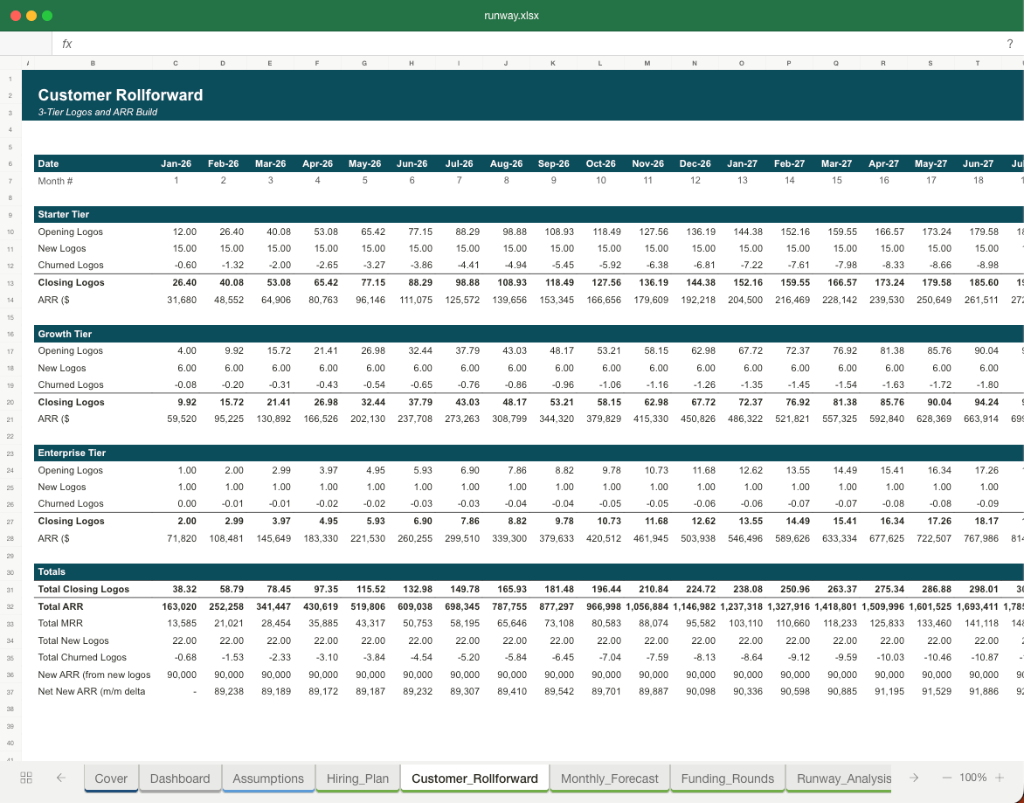
A 5-year monthly forecast with P&L, cash flow and runway, valuation (exit multiple plus a DCF cross-check), MOIC/IRR returns, and unit economics, with live formulas throughout.
How was this model built?+
It was built from Palau Project's pitch deck and publicly available information, then structured to investment-banking standards as a fully editable Excel model.
Can I change the assumptions?+
Yes. You can change assumptions and the live formulas will recalculate in the downloadable Excel model.
Have more financial modelling questions? Contact us

Created by ex-finance professionals
Hey, I’m Alex and I created Finamodel.
Over my years in the finance industry I kept building the same models over and over again. Same structure, same assumptions, different logo. So I started building frameworks to turn them into clean, reusable templates.
Every model here is one I’d actually use for a client, and I personally vet each one before it goes up.
I’m not an expert in every industry, but I’ve built enough models to know what belongs in one. And when something is completely foreign to me, I reach out to my network for experts to work on our models with us.
Having a template library on hand cuts a first build from hours to minutes.
Need help finding your model? You’ll find me in the Finamodel app!
Other Marketplace Startup Financial Models
Browse another startup in the same category.

Acquco
Amazon brand aggregator - acquires third-party Amazon seller businesses at attractive multiples, then scales them via proprietary growth playbooks and technology.
Arive
Premium q-commerce app delivering lifestyle and branded products in under 30 minutes across German cities.

Audience Town
Vertical data and advertising platform targeting home movers across the entire home journey - pre-move through post-move.

AudioMob
Non-intrusive in-game audio ad platform bridging music/brand advertisers to mobile game publishers.

Authoritive
Two-way messaging platform that turns creator expertise into scalable, push-delivered learning experiences via SMS/WhatsApp.

Avo
Building amenity and office perk platform delivering same-day grocery/pantry/goods to residential and commercial tenants via a white-label marketplace.
beehiiv
Newsletter platform for creators to build, grow, and monetize email audiences - SaaS subscription + native ad network revenue.
Borzo
Global same-day logistics marketplace connecting B2B merchants with crowdsourced couriers for last-mile delivery