 Pecan.ai Financial Model
AI/ML Startup Financials (Free Excel Download)
No-code predictive analytics platform that lets business analysts build and deploy AI models without data scientists.



professionals from Deloitte
Used by professionals from






About this model
Pecan is a no-code predictive-analytics platform that lets business analysts build and deploy AI models without data scientists. It automates ingestion, ETL, feature engineering, training, evaluation, deployment, monitoring, and retraining for churn, LTV, forecasting, conversion, and next-best-action use cases.
Customers subscribe by use case and entity count, creating clear expansion through more models, users, and data. Case studies cite a 37% revenue-per-user uplift and 91% increase in purchases for a mobile app, alongside a 35% conversion-rate improvement for a retailer.
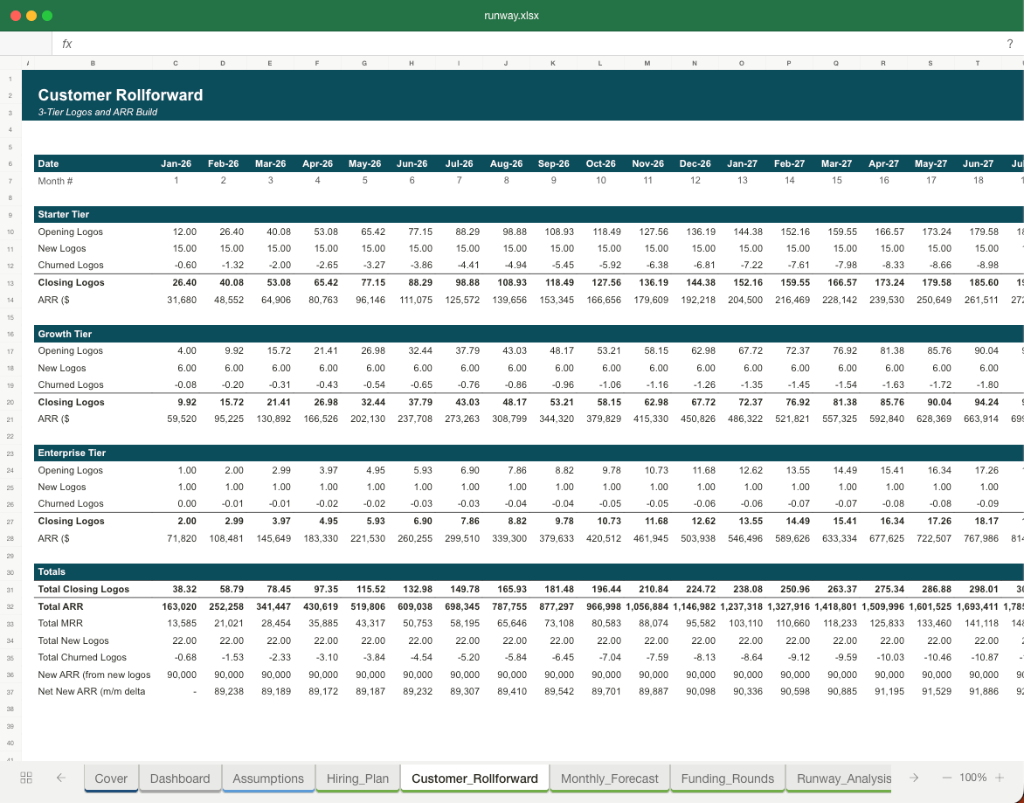
The model builds ARR by customer, use case, and entities, separating new business, expansion, and churn. It links data-processing and delivery costs, implementation, sales and R&D hiring, gross margin, cash burn, and runway to adoption, retention, and performance outcomes. Pecan had raised $16.5 million by the deck date.
A turnkey financial model
Live formulas, no hardcoded values
Outputs are driven by live formulas, so the workbook updates from its assumptions instead of relying on hardcoded results.
All assumptions in one tab
Inputs are clearly marked in the Assumptions tab and separated from calculations, making it clear what to change and what to leave intact.
Statements always balancing
For integrated-statement models, the balance sheet, cash flow, and supporting schedules tie through properly.
Distinct schedules for clarity
Debt, working capital, taxes, and cash flow can get messy quickly. We group calculations in clear schedules, not across disconnected tabs.
No hidden macros or external links
There are no unexplained external workbook links or macros to undermine auditability or portability.
Changes flow through the model
Update a key driver and see the impact carry through the forecast, financing, and return outputs. We never use hardcoded numbers in formulas.
About Pecan.ai
pecan.ai
How to build a detailed financial model for Pecan.ai
A complete walkthrough of the business, drivers, and assumptions behind the downloadable Pecan.ai model - distilled from its pitch deck and publicly available information.
Product & value proposition
Pecan is a low/no-code "AI bridge" between business owners (who define KPIs) and BI/data analysts (who build models).
The platform automates the entire AI value chain end-to-end - data ingestion, ETL, feature engineering, model training, evaluation, deployment, and monitoring - in hours, without requiring data scientists.
Key use-case outputs supported: churn prediction, LTV modeling, next-best-offer/action, upsell/cross-sell propensity, demand/sales forecasting, conversion prediction.
Three stated tech moats:
- Drag-and-drop-to-AI (in-platform ETL, SQL-based model building) - US patent pending.
- Automated data preparation and feature engineering (harmonization, cleansing, encoding, external enrichment, feature selection).
- Automated deployment and monitoring (continuous DB resampling, model monitoring, retraining - no code or engineering required).
Revenue model
- Subscription per use case + per entities (i.e., seats or data volume).
- Upsell vector: customer growth, increased usage, and additional use cases purchased.
- No specific pricing tiers, ACV, or ARPU numbers disclosed in deck.
- Go-to-market channel not explicitly stated; implied land-and-expand within enterprise/mid-market accounts given case-study profile of customers (retailer, mobile app company).
Traction & metrics
- Total funding raised to date: $16.5M; investors: S-Capital, Dell Capital, MindSet Ventures.
- Company founded: April 2018.
- No ARR, customer count, growth rate, NRR, or revenue figures disclosed in the deck.
- Case study 1 (mobile app company): 37% uplift in revenue/user; 91% increase in purchases - delivered in 10 days.
- Case study 2 (retailer): 35% increase in conversion rate; 20% improvement in sales rep productivity.
- Product UI metrics visible (Churn model example, slide 13): 80% estimated precision rate; 79% estimated detection rate; 38,332 (11%) correctly detected churners; 8,900 (2%) false detected; 8,881 (2%) unpredicted churns.
- LTV model (slide 14): 81% explained variance (R²); 25% median absolute % error. Sample per-device predicted vs. actual LTV - iPhone 11 Pro $4.45 predicted / $5.23 actual; HTC Dream $1.25 / $1.95; Asus ZenFone $3.22 / $2.43.
Competition / moat
Competitive positioning not explicitly shown as a comp matrix. Moat framed as three technology differentiators (see §2). Implicit competitive landscape: DataRobot (VP of Success hire came from there), traditional data science tooling, bespoke BI teams. No direct comps named.
Team & funding ask / use of funds
Team:
- Zohar Bronfman - CEO & co-founder; PhD in AI, PhD in Philosophy; formerly Unit 8200.
- Noam Brezis - CTO & co-founder; PhD in AI, data expert; formerly Unit 8200.
- Limor Segev - VP Product; formerly VP Product at WeWork and eBay.
- Eran Yorkovsky - VP Digital Solutions; formerly client partner at Facebook.
- Yehonathan Barnea - VP of Success; formerly AI Success Director at DataRobot.
- Tomer Meron - VP R&D; formerly Google and eBay.
Funding raised: $16.5M to date.
Recommended financial model
- Archetype + why: B2B SaaS ARR model with land-and-expand mechanics. Revenue is subscription-based (per use case + per entities), with explicit upsell motion from expanding use cases and entity counts within accounts. Classic SaaS metrics apply: ARR, NRR, logo retention, expansion ARR.
- Forecast horizon & granularity: 5 years (Year 1 monthly, Years 2–5 annual). Monthly granularity in Year 1 to capture sales ramp and early customer cohort dynamics.
- Key drivers & assumptions:
| Driver | Value |
|---|---|
| Starting ARR | Unknown |
| Founded date | April 2018 |
| Total raised | $16.5M |
- Scenarios (Base / Bull / Bear - which variables flex):
- Base: Steady logo adds (5/month), 115% NRR, 75% gross margin, ACV grows modestly.
- Bull: Faster logo adds (8–10/month), 125%+ NRR driven by multi-use-case upsell, enterprise ACV expansion.
- Bear: Slow sales cycle (2–3 new logos/month), higher churn (12%), NRR at 100%, elongated payback period.
- Required sheets / outputs:
- Assumptions - all inputs on one editable sheet.
- Revenue build - cohort-based ARR bridge (new ARR, expansion ARR, churned ARR, net new ARR).
- P&L (Income Statement) - revenue, COGS, gross profit, opex by function, EBITDA, net income.
- Headcount plan - by department, linked to opex.
- Cash flow & runway - operating cash flow, capex, ending cash, months of runway.
- SaaS KPI dashboard - ARR, MRR, NRR, logo count, ACV, LTV/CAC (once data available), magic number.
- Scenario toggle - Base / Bull / Bear switchable via a single cell.
Frequently asked
Is the Pecan.ai financial model free?+
Yes. The Pecan.ai model is a free Excel (.xlsx) download with live formulas. Sign up with your email and the workbook is yours to keep, review, and edit.
What's included in the model?+
A 5-year monthly forecast with P&L, cash flow and runway, valuation (exit multiple plus a DCF cross-check), MOIC/IRR returns, and unit economics, with live formulas throughout.
How was this model built?+
It was built from Pecan.ai's pitch deck and publicly available information, then structured to investment-banking standards as a fully editable Excel model.
Can I change the assumptions?+
Yes. You can change assumptions and the live formulas will recalculate in the downloadable Excel model.
Have more financial modelling questions? Contact us

Created by ex-finance professionals
Hey, I’m Alex and I created Finamodel.
Over my years in the finance industry I kept building the same models over and over again. Same structure, same assumptions, different logo. So I started building frameworks to turn them into clean, reusable templates.
Every model here is one I’d actually use for a client, and I personally vet each one before it goes up.
I’m not an expert in every industry, but I’ve built enough models to know what belongs in one. And when something is completely foreign to me, I reach out to my network for experts to work on our models with us.
Having a template library on hand cuts a first build from hours to minutes.
Need help finding your model? You’ll find me in the Finamodel app!
Other AI/ML Startup Financial Models
Browse another startup in the same category.

AI Rudder
AI Rudder provides multi-lingual conversational AI for B2C customer engagement - automating outbound and inbound voice/chat interactions at scale.

Aisera
AI Service Experience platform that automates IT, HR, and customer service workflows via conversational AI and automation.

Amberscript
AI + human hybrid transcription and subtitling platform targeting B2B customers in Europe

Apheris
Privacy-preserving federated ML platform enabling enterprises to train AI on distributed data without sharing raw data.

Arcane
AI copilot for marketing teams that automates data analysis, reporting, and repeatable tasks via a chat interface and scheduled workflows.

Artisan
AI-powered "digital workers" (branded Artisans) that autonomously perform role-specific tasks - starting with outbound sales - and are delivered as SaaS subscriptions.

Artisan Series A
AI-native B2B SaaS platform consolidating the enterprise software stack with human-like "Artisan" AI employees that automate role-specific workflows

Bigblue
Tech-enabled e-commerce fulfillment platform for European D2C brands - "Amazon-standard" delivery without Amazon.