 Persefoni Financial Model
Climate/Energy Startup Financials (Free Excel Download)
SaaS carbon accounting platform that converts operational, financial, and supply-chain activity data into CO2e footprint calculations and climate disclosures.



professionals from Deloitte
Used by professionals from






About this model
Persefoni is enterprise carbon-accounting software that combines operational, financial, and supply-chain data in a CO2e Activity Ledger. It applies GHG Protocol and PCAF calculations to produce footprint measurement, warming trajectories, reduction targets, and climate-disclosure outputs.
The commercial proposition is a compliance-grade accounting layer for corporates and financial institutions rather than qualitative ESG reporting. The deck does not provide pricing or traction metrics, but its data structure and annual disclosure use cases indicate enterprise contracts with longer sales cycles and sticky renewals.
The model should use annual or quarterly enterprise cohorts: new logos, ACV, implementation timing, churn, and net revenue retention from expanded reporting and data use. Link the ARR waterfall to gross margin, customer success, sales capacity, R&D, and cash burn, flexing regulatory pull and contract value in scenarios.
A turnkey financial model
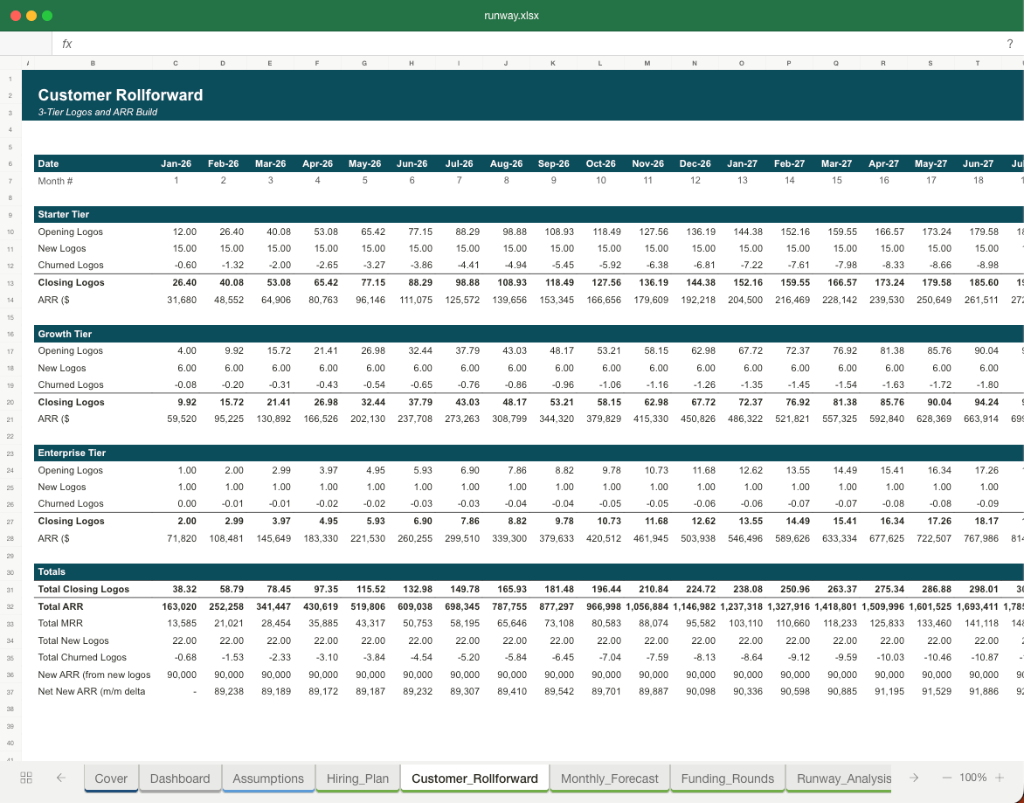
Live formulas, no hardcoded values
Outputs are driven by live formulas, so the workbook updates from its assumptions instead of relying on hardcoded results.
All assumptions in one tab
Inputs are clearly marked in the Assumptions tab and separated from calculations, making it clear what to change and what to leave intact.
Statements always balancing
For integrated-statement models, the balance sheet, cash flow, and supporting schedules tie through properly.
Distinct schedules for clarity
Debt, working capital, taxes, and cash flow can get messy quickly. We group calculations in clear schedules, not across disconnected tabs.
No hidden macros or external links
There are no unexplained external workbook links or macros to undermine auditability or portability.
Changes flow through the model
Update a key driver and see the impact carry through the forecast, financing, and return outputs. We never use hardcoded numbers in formulas.
About Persefoni
persefoni.com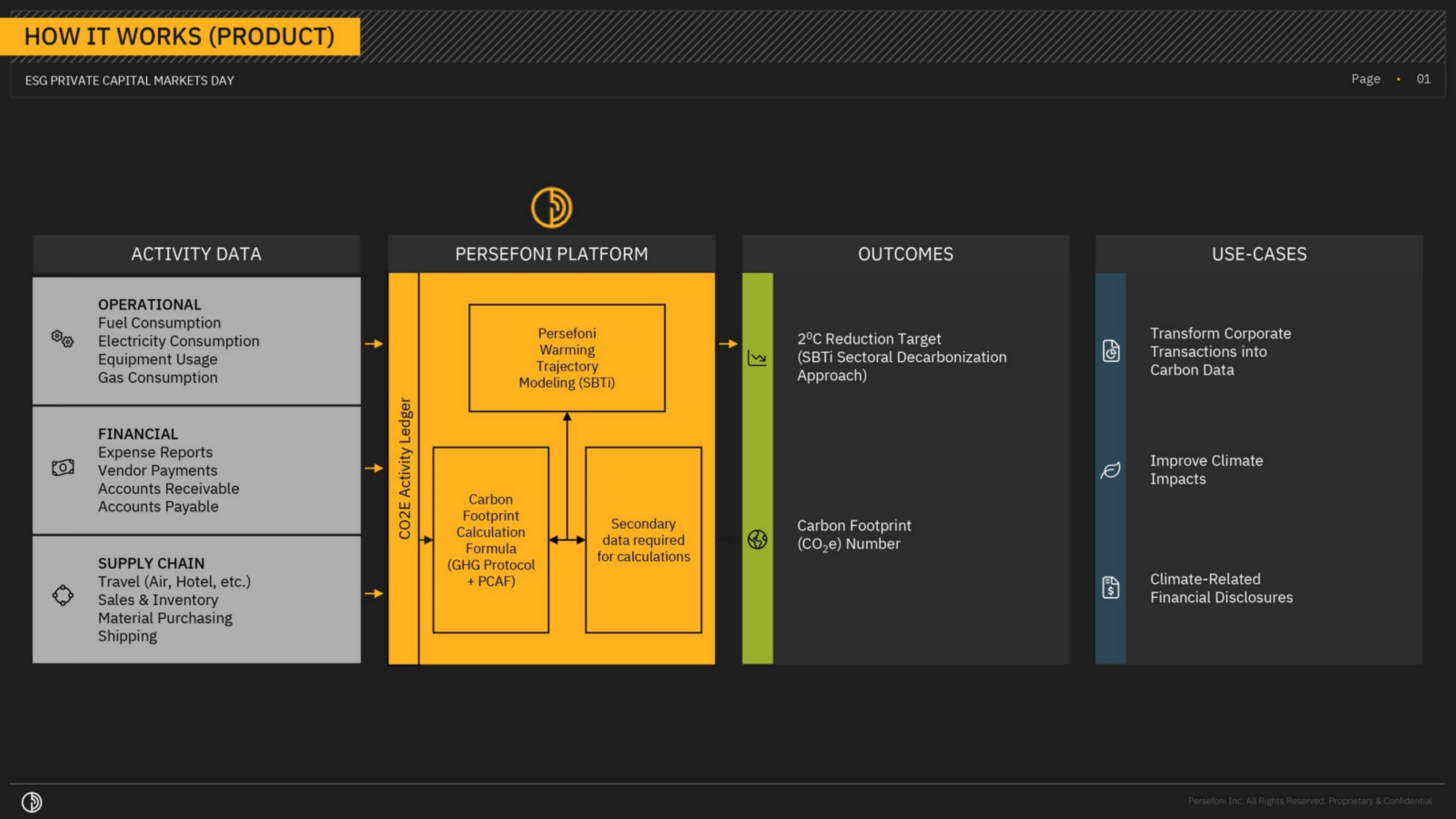
How to build a detailed financial model for Persefoni
A complete walkthrough of the business, drivers, and assumptions behind the downloadable Persefoni model - distilled from its pitch deck and publicly available information.
Product & value proposition
Carbon accounting platform (the "Persefoni Platform") that ingests three categories of activity data:
- Operational: fuel consumption, electricity, equipment usage, gas consumption.
- Financial: expense reports, vendor payments, accounts receivable/payable.
- Supply chain: travel (air, hotel), sales & inventory, material purchasing, shipping.
The platform runs these through a "CO2e Activity Ledger" using GHG Protocol + PCAF formulas (260+ calculations, 1,000s of data types) to produce:
- Carbon footprint (CO2e number)
- Warming trajectory modeling (SBTi Sectoral Decarbonization Approach)
- 2°C reduction target alignment
Use cases: corporate carbon transformation, improving climate impacts, climate-related financial disclosures (TCFD).
Positioning: carbon accounting is to ESG what GAAP accounting is to financial reporting - a structured, formula-driven compliance layer, not just qualitative reporting.
Market
Context implied: the addressable market sits within the "E" (Environmental) pillar of ESG reporting, specifically at the intersection of Carbon Accounting (CDP, PCAF/GHGP), Sustainability Reporting (TCFD/GRI/SASB), and Environmental Compliance (EPA/country-specific regulations). The "S" (Social) and "G" (Governance) pillars are shown but are explicitly out of scope for the platform.
Revenue model
Inferred: enterprise SaaS subscription model, likely sold to corporates and financial institutions (the "financial" data input category and PCAF framework reference suggests financial-services clients are a primary target). Likely annual contracts given compliance-driven purchasing.
Competition / moat
Not explicitly stated. Implied moat elements:
- Advisory board with regulatory/standards insiders: SASB founding chairman (Robert Eccles), TCFD founding secretariat member (Curtis Ravenel), former GRI CEO (Tim Mohin). These are the people who wrote the standards the platform implements.
- Complexity moat: carbon accounting requires 260+ calculations vs. 12 for financial GAAP, across 1,000s of data types - high switching cost once a company's ledger is built.
- Regulatory tailwind: both SEC/US regulatory and international frameworks apply to carbon accounting, creating compliance pull.
Team & funding ask / use of funds
Advisory board (slide 3 - note this is an advisory board slide, core founding team not shown):
- Tim Mohin - Chief Sustainability Officer; former CEO of GRI, sustainability lead at Intel/Apple/AMD, EPA/Senate policy.
- Rakhi Kumar - SAB Member; SVP at Liberty Mutual, former State Street ESG lead, Moody's/Booz Allen.
- Robert Eccles - Co-Chair; founding chairman of SASB, Visiting Professor Oxford Said Business School, BCG Senior Advisor.
- Curtis Ravenel - Co-Chair; founding secretariat member of TCFD, advisor to Mark Carney (UN Special Envoy for Climate Finance), Bloomberg LP.
Recommended financial model
- Archetype + why: Enterprise SaaS ARR model. Persefoni is a B2B software platform with recurring subscription revenue, sold into compliance-driven enterprise buyers (corporates + financial institutions). Standard SaaS ARR build is the correct archetype. A 3-statement model can be layered on top once revenue projections are established.
- Forecast horizon & granularity: 5-year annual model (Year 1–5), with Year 1 broken into quarterly detail. Compliance SaaS tends to have longer sales cycles and sticky annual contracts, making quarterly granularity sufficient for near term.
- Key drivers & assumptions:
- New logo additions per year
- Average contract value (ACV) per customer
- Net revenue retention / expansion rate
- Gross margin
- Sales & marketing as % of revenue
- R&D as % of revenue
- Churn rate
- Headcount ramp (AE quota, CS ratio)
- Scenarios (Base / Bull / Bear - which variables flex):
- Bear: slow regulatory pull; ACV compressed as buyers demand cheap solutions; NRR ~105%; logo growth low end.
- Base: moderate regulatory tailwind (SEC climate disclosure rules pass); ACV mid-range; NRR ~115%; logo growth mid-case.
- Bull: mandatory carbon accounting regulation accelerates (SEC + EU CSRD spillover for US companies); strong PCAF adoption in financial services; NRR ~120%+; ACV expands via financial-institution segment.
- Required sheets / outputs:
- Assumptions dashboard (toggle scenarios)
- ARR waterfall (new ARR, expansion ARR, churned ARR, net new ARR)
- Revenue build (logo count × ACV × NRR)
- P&L (gross margin, S&M, R&D, G&A, EBITDA)
- Headcount plan
- Cash bridge / runway (if funding ask data becomes available)
- KPI summary (ARR, logo count, NRR, CAC payback, LTV/CAC)
Frequently asked
Is the Persefoni financial model free?+
Yes. The Persefoni model is a free Excel (.xlsx) download with live formulas. Sign up with your email and the workbook is yours to keep, review, and edit.
What's included in the model?+
A 5-year monthly forecast with P&L, cash flow and runway, valuation (exit multiple plus a DCF cross-check), MOIC/IRR returns, and unit economics, with live formulas throughout.
How was this model built?+
It was built from Persefoni's pitch deck and publicly available information, then structured to investment-banking standards as a fully editable Excel model.
Can I change the assumptions?+
Yes. You can change assumptions and the live formulas will recalculate in the downloadable Excel model.
Have more financial modelling questions? Contact us

Created by ex-finance professionals
Hey, I’m Alex and I created Finamodel.
Over my years in the finance industry I kept building the same models over and over again. Same structure, same assumptions, different logo. So I started building frameworks to turn them into clean, reusable templates.
Every model here is one I’d actually use for a client, and I personally vet each one before it goes up.
I’m not an expert in every industry, but I’ve built enough models to know what belongs in one. And when something is completely foreign to me, I reach out to my network for experts to work on our models with us.
Having a template library on hand cuts a first build from hours to minutes.
Need help finding your model? You’ll find me in the Finamodel app!
Other Climate/Energy Startup Financial Models
Browse another startup in the same category.

Abatable
Robo-advisor platform for sourcing and managing high-quality carbon removal offsets, targeting asset managers.
Bower
Mobile app that rewards consumers for scanning and recycling consumer packaging at existing bins, monetised by CPG brand subscriptions and consumer data.
Bramble Energy
UK deep-tech company commercialising a PCB-based hydrogen fuel cell stack (PCBFC™) for portable power and mobility applications.

Cervest
AI-powered Climate Intelligence platform that quantifies physical climate risk at the asset level, delivered as a freemium SaaS product.

Clockworks Analytics
B2B SaaS platform providing automated fault-detection and diagnostics (FDD) analytics for commercial and institutional building portfolios.

Dandelion Energy
Dandelion Energy installs residential geothermal heat pump systems (ground-source HVAC) with in-house financing, targeting US homeowners on fossil-fuel heating.

Emitwise
B2B SaaS platform automating corporate carbon footprint tracking, reporting, and reduction using machine learning.
Fisker
Fisker is an asset-light, design-led EV company merging with Spartan Energy Acquisition Corp. in a SPAC transaction to fund the launch of the Fisker Ocean SUV.