PRProfound Financial Model
AI/ML Startup Financials (Free Excel Download)
B2B SaaS platform that monitors and optimizes brand visibility in AI-generated search answers (answer engines / LLMs).



professionals from Deloitte
Used by professionals from






About this model
Profound is an AI Optimization platform for monitoring and improving a brand's visibility in answer engines. Its dashboard tracks visibility scores, competitor rankings, citations, topics, models, and regions, then provides recommendations to improve inclusion in generated responses.
The Series A company sells recurring analytics and optimisation software to enterprise marketing teams, with direct sales capacity including account executives and a BDR. It says Fortune 500 brands rely on the product, but discloses no customer count, ARR, pricing, churn, or NPS.
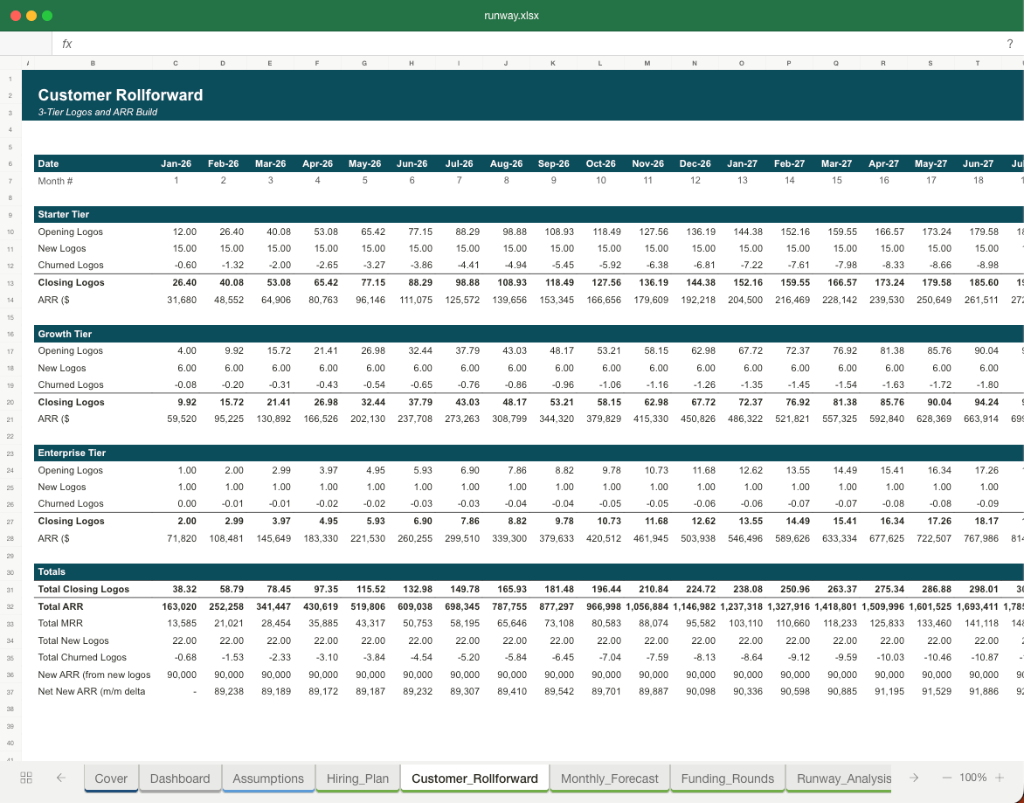
The model builds ARR from enterprise logos and ACV, separating new contracts, expansion, and churn. It includes LLM-query and data-pipeline costs, sales productivity, customer success, product and R&D hiring, gross margin, operating burn, and runway under adoption scenarios.
A turnkey financial model
Live formulas, no hardcoded values
Outputs are driven by live formulas, so the workbook updates from its assumptions instead of relying on hardcoded results.
All assumptions in one tab
Inputs are clearly marked in the Assumptions tab and separated from calculations, making it clear what to change and what to leave intact.
Statements always balancing
For integrated-statement models, the balance sheet, cash flow, and supporting schedules tie through properly.
Distinct schedules for clarity
Debt, working capital, taxes, and cash flow can get messy quickly. We group calculations in clear schedules, not across disconnected tabs.
No hidden macros or external links
There are no unexplained external workbook links or macros to undermine auditability or portability.
Changes flow through the model
Update a key driver and see the impact carry through the forecast, financing, and return outputs. We never use hardcoded numbers in formulas.
About Profound
tryprofound.com
How to build a detailed financial model for Profound
A complete walkthrough of the business, drivers, and assumptions behind the downloadable Profound model - distilled from its pitch deck and publicly available information.
Product & value proposition
- Profound is an "AI Optimization" platform - the GEO (Generative Engine Optimization) equivalent of traditional SEO tools.
- Core offering: dashboard that tracks brand visibility scores (% of AI answers in a given topic/industry that mention the brand), industry rankings vs. competitors, and actionable recommendations to improve inclusion in LLM-generated answers.
- Dashboard modules shown: Home (visibility score + trend line), Search, Inbox, Metrics (Industry, Topic, Model, Citation), Improve.
- Product allows filtering by model, region, and time range (24h / 7d / 30d / custom).
- Sample metric shown: Ramp visibility score 89.8%, up 1% vs last week; ranked #2 in Banking behind Chase (92%).
- Vision: expand into Generative UI, Shopability, Memory & personalization, Custom indexing, Voice interface, Agentic browsing, Generative advertising, Consumer hardware.
Market
- Total marketing software spend: $150B+ in 2025.
- Projected to exceed $215B by 2027.
- Marketing software = 14.9% of all enterprise software spend (~15.6% by 2027).
- Framing: Profound positions itself as the defining MarTech brand of the "Generative" platform shift (analogous to companies built on Dot-com / Mobile / Social waves).
- AI search adoption: 10% of US internet users now use answer engines first for search.
- No explicit SAM or SOM breakout; no Profound-specific market share figures in deck.
Revenue model
- Inferred from product: SaaS subscription, likely seat-based or brand/domain-based, sold to enterprise/mid-market marketing and SEO teams. Rationale: dashboard product serving Fortune 500 brands; comparable to Semrush, Moz, Conductor pricing structures.
- Sales motion: direct (AEs + BDRs named in team slide - 2 AEs, 1 BDR).
Traction & metrics
- Customer base: "Fortune 500 brands rely on Profound for AI Optimization" - no specific customer count or named logos shown in the visible portion of the slide (right panel was a grey placeholder/redacted box in the image).
- No ARR, MRR, growth rate, churn, or NPS figures in deck.
- Social proof: viral tweet referencing a $10B+ market cap company losing top-of-funnel due to AI search shift; Profound's account replied.
Competition / moat
- Competitive positioning implicit: first-mover in "AI Optimization" category creation.
- No explicit competitor slide.
- Moat claim: "most advanced AI Optimization technology in the world".
- Structural moat factors implied: proprietary indexing of LLM outputs across multiple models (filter by model visible in dashboard), real-time brand ranking data, network effects from aggregating cross-brand visibility data.
Team & funding ask / use of funds
- Co-founders:
- James Cadwallader - CEO; previously co-founded MarTech company Kyra.
- Dylan Babbs - CTO; previously Software Engineer & Product Designer at Uber (geospatial and data products).
- Full team (12 people total): Charles Zhou (Founding SWE), Mikael Sargsyan (SWE), Praneeth Alla (SWE), Benjamin Groose (SDR), Charlie Demuth (AE), Matthew Brown (AE), Eliot Lee (BD), Joseph Turtel (Chief of Staff), Joshua Blyskal (Customer Success), Stephanie Kramer (Business Operations).
- Funding ask: Series A - amount not stated in deck.
Recommended financial model
- Archetype + why: B2B SaaS ARR model. Profound sells a recurring subscription analytics/optimization product to enterprise brands. Revenue scales by logo count × ACV; margin structure is high-gross-margin SaaS (data pipeline + LLM query costs as COGS). This is the correct archetype - not marketplace, not usage-based (no evidence of consumption pricing), not transactional.
- Forecast horizon & granularity: 3 years (Year 1–3), monthly for Year 1, quarterly for Years 2–3. Series A investors expect a credible path to $10M+ ARR; monthly granularity in Year 1 captures the ramp.
- Key drivers & assumptions:
| Driver | Value | Source |
|---|---|---|
| Starting logo count (Month 1) | 10–20 Fortune 500 / enterprise customers. Rationale: "Fortune 500 brands rely on Profound" but no count disclosed; team has 2 AEs + 1 BDR suggesting early commercial stage. | |
| New logos per month | 3–8 net new logos/month in Year 1, scaling with sales headcount. Rationale: small direct sales team, enterprise sales cycles 60–90 days. | |
| ACV (Annual Contract Value) | $30K–$80K/year per brand. Rationale: enterprise MarTech SaaS comps (Semrush enterprise: ~$30K+; Conductor: $60K–$120K); Fortune 500 buyer, not SMB. | |
| Gross revenue churn (annual) | 10–15%. Rationale: new category = some churn risk; offset by strong top-of-funnel demand narrative. | |
| Gross margin | 70–80%. Rationale: SaaS analytics platform; main COGS = LLM API query costs + data infrastructure. | |
| S&M as % of revenue | 50–70% in Year 1, declining to 35–45% by Year 3. Rationale: enterprise land-and-expand motion, early stage. | |
| R&D as % of revenue | 25–35%. Rationale: heavy ML/data engineering team. | |
| G&A as % of revenue | 10–15%. | |
| Marketing software TAM (2025) | $150B+ | |
| Marketing software TAM (2027) | $215B+ | |
| AI search adoption (US) | 10% of internet users | |
| Headcount growth | 1–2 new AEs per quarter in Year 1–2; engineer hiring paced to product roadmap. |
- Scenarios (Base / Bull / Bear - which variables flex):
- Base: 3–5 new logos/month at $40K ACV, 12% annual churn, 75% gross margin.
- Bull: 6–8 new logos/month (category takes off, inbound demand spikes), $60K ACV (upsell to multi-brand / enterprise), 8% churn.
- Bear: 1–3 new logos/month (long sales cycles, budget scrutiny), $25K ACV, 18% churn (category education drag, customers pause to evaluate ROI).
- Primary flex variables: new logos/month, ACV, churn. Secondary: gross margin (LLM API cost trajectory).
- Required sheets / outputs:
- Assumptions - all drivers in one tab, clearly labeled vs.
- Revenue build - cohort-based ARR waterfall (new ARR, expansion, churned ARR, net new ARR, ending ARR) by month/quarter.
- P&L (Income Statement) - Revenue → Gross Profit → EBITDA → Net Income.
- Headcount plan - by function (Sales, Eng, G&A), feeds S&M / R&D / G&A opex.
- Cash & runway - cash burn by month, Series A proceeds → runway endpoint.
- KPI dashboard - ARR, logo count, ACV, NRR (net revenue retention), CAC payback, LTV:CAC, burn multiple.
- Scenarios - toggle Base / Bull / Bear on assumptions tab.
Frequently asked
Is the Profound financial model free?+
Yes. The Profound model is a free Excel (.xlsx) download with live formulas. Sign up with your email and the workbook is yours to keep, review, and edit.
What's included in the model?+
A 5-year monthly forecast with P&L, cash flow and runway, valuation (exit multiple plus a DCF cross-check), MOIC/IRR returns, and unit economics, with live formulas throughout.
How was this model built?+
It was built from Profound's pitch deck and publicly available information, then structured to investment-banking standards as a fully editable Excel model.
Can I change the assumptions?+
Yes. You can change assumptions and the live formulas will recalculate in the downloadable Excel model.
Have more financial modelling questions? Contact us

Created by ex-finance professionals
Hey, I’m Alex and I created Finamodel.
Over my years in the finance industry I kept building the same models over and over again. Same structure, same assumptions, different logo. So I started building frameworks to turn them into clean, reusable templates.
Every model here is one I’d actually use for a client, and I personally vet each one before it goes up.
I’m not an expert in every industry, but I’ve built enough models to know what belongs in one. And when something is completely foreign to me, I reach out to my network for experts to work on our models with us.
Having a template library on hand cuts a first build from hours to minutes.
Need help finding your model? You’ll find me in the Finamodel app!
Other AI/ML Startup Financial Models
Browse another startup in the same category.

AI Rudder
AI Rudder provides multi-lingual conversational AI for B2C customer engagement - automating outbound and inbound voice/chat interactions at scale.

Aisera
AI Service Experience platform that automates IT, HR, and customer service workflows via conversational AI and automation.

Amberscript
AI + human hybrid transcription and subtitling platform targeting B2B customers in Europe

Apheris
Privacy-preserving federated ML platform enabling enterprises to train AI on distributed data without sharing raw data.

Arcane
AI copilot for marketing teams that automates data analysis, reporting, and repeatable tasks via a chat interface and scheduled workflows.

Artisan
AI-powered "digital workers" (branded Artisans) that autonomously perform role-specific tasks - starting with outbound sales - and are delivered as SaaS subscriptions.

Artisan Series A
AI-native B2B SaaS platform consolidating the enterprise software stack with human-like "Artisan" AI employees that automate role-specific workflows

Bigblue
Tech-enabled e-commerce fulfillment platform for European D2C brands - "Amazon-standard" delivery without Amazon.