 Pruna AI Financial Model
AI/ML Startup Financials (Free Excel Download)
AI optimization engine that compresses and accelerates AI models via pruning, quantization, and compilation - delivered in 2 lines of code.



professionals from Deloitte
Used by professionals from






About this model
Pruna builds an AI Optimization Engine that compresses and accelerates models through pruning, quantisation, compilation, and related techniques. ML engineers can integrate it in two lines of code across language, image, video, computer-vision, and audio workloads.
Its open-source funnel includes more than 6,700 published models, 200,000 monthly downloads, and research underpinning the product. Enterprise commercialisation can combine annual licenses, usage tied to optimisation runs or compute saved, and implementation support; the company raised $6 million at Seed.
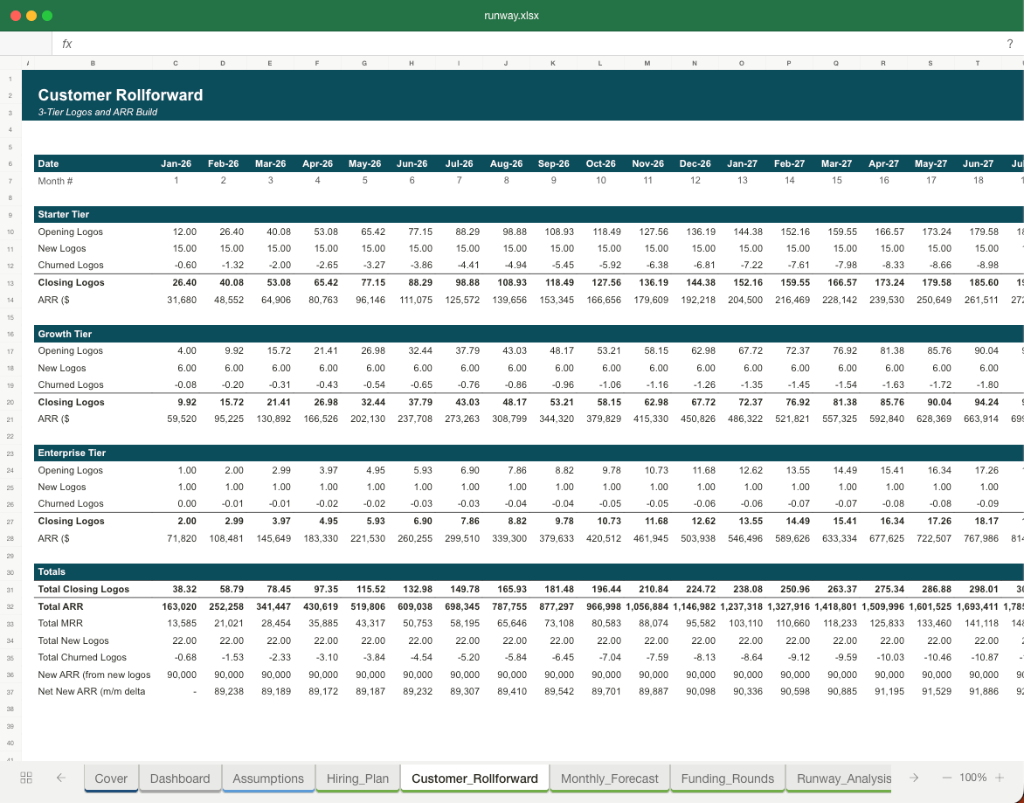
The model tracks open-source adoption, conversion to paid deployments, enterprise contracts, workloads, and expansion. It links cloud and support costs to usage, then forecasts gross margin, direct-sales capacity, R&D hiring, cash burn, and runway as the self-serve enterprise platform develops.
A turnkey financial model
Live formulas, no hardcoded values
Outputs are driven by live formulas, so the workbook updates from its assumptions instead of relying on hardcoded results.
All assumptions in one tab
Inputs are clearly marked in the Assumptions tab and separated from calculations, making it clear what to change and what to leave intact.
Statements always balancing
For integrated-statement models, the balance sheet, cash flow, and supporting schedules tie through properly.
Distinct schedules for clarity
Debt, working capital, taxes, and cash flow can get messy quickly. We group calculations in clear schedules, not across disconnected tabs.
No hidden macros or external links
There are no unexplained external workbook links or macros to undermine auditability or portability.
Changes flow through the model
Update a key driver and see the impact carry through the forecast, financing, and return outputs. We never use hardcoded numbers in formulas.
About Pruna AI
pruna.ai
How to build a detailed financial model for Pruna AI
A complete walkthrough of the business, drivers, and assumptions behind the downloadable Pruna AI model - distilled from its pitch deck and publicly available information.
Product & value proposition
- Core product: "AI Optimization Engine" - a software library/SDK that combines multiple efficiency methods (pruning, quantization, hardware compilation, Triton, CUDA graphs, layer fusing, architecture search, parameter tuning).
- Integration: 2 lines of code for ML Engineers; fits into existing MLOps stacks (Databricks, Giskard, Dremio, vLLM).
- Supported modalities: NLP/LLMs (Llama 3, Mistral, Phi), Image/Video Generation (Stable Diffusion), Computer Vision (ViT, MobileNet, YOLO, ResNet), Audio (Whisper, Kaldi).
- Key value claims:
- LLM GPU memory: 25% of original (4x reduction)
- LLM latency: 33% of original (3x speedup)
- Speech-to-text latency: 50% of original (2x speedup)
- LLM carbon emissions: 33% of original (3x reduction)
- Proven on 6,500+ AI models on Hugging Face (#1 ranking claimed).
- Open-source: >6,700 models published, >200k monthly downloads, >270 research papers underpinning the tech.
- Roadmap (slide 4): progression from open-source / 3rd-party API reliance → AI Optimization Engine → Self-Serve AI Enterprise Platform.
Market
- 42% of enterprises deployed AI in 2023; additional 40% stuck in experimentation. Top barriers: limited AI skills (32%), high price (21%).
- AI Software Revenue 2025: $100B.
- Generative AI Market 2024: $20B, growing at 35% per year.
- Generative AI Market 2030: $110B.
Revenue model
Likely structure: B2B SaaS - annual subscription or usage-based pricing tied to volume of model optimization runs or compute saved. Enterprise contracts with professional services for onboarding. Rationale: consistent with MLOps tooling comps (Weights & Biases, Hugging Face Enterprise, OctoAI).
Traction & metrics
- Open-source adoption: >6,700 models on Hugging Face, >200k monthly downloads.
- Research credibility: >270 research papers.
- Hugging Face ranking: #1 for AI optimization (6,500+ models).
- Backers/supporters visible on slide 11: includes AWS, Meta, NVIDIA, Daphni VC, French government (eagle logo), and others.
Competition / moat
Not explicitly shown in deck. Implied moats:
- Academic depth: Co-founder Stephan Günnemann is a TU Munich ML professor with >30 PhDs in research group; Bertrand Charpentier created scikit-network (>500k downloads).
- Open-source distribution: 200k+ monthly downloads creates developer mindshare and a land-and-expand motion.
- Breadth of methods: combines pruning + quantization + compilation + architecture search in one engine vs. point solutions.
- #1 on Hugging Face claimed as a distribution moat.
Team & funding ask / use of funds
- 4 co-founders:
- Rayan Nait Mazi - CEO; MEng Centrale Paris, MPhil HKUST; 3rd-time founder.
- John Rachwan - CTO; ML MSc TUM summa cum laude; former AI Team Lead at Design AI (acq. by Helsing); won EDA Defence Innovation Prize 2021.
- Bertrand Charpentier - Chief Scientist; PhD in ML at TUM; ML research at Twitter, Stanford, Telecom Paris.
- Stephan Günnemann - Chief Strategy Officer; Professor of ML at TUM; leads research group of >30 PhDs; partnerships with Google, Siemens, BMW.
- Seed raised: $6M.
- Use of funds: Hiring to 15 people, focused on ML Research Engineers.
Recommended financial model
- Archetype + why: B2B SaaS ARR model with an open-source / PLG (product-led growth) funnel layer. Pruna has a classic OSS-to-enterprise conversion motion: free open-source tool drives developer adoption → enterprise licenses for production deployments. Model should capture free-to-paid conversion alongside direct enterprise sales. Secondary usage-based component likely as platform scales (compute savings as pricing metric).
- Forecast horizon & granularity: 5-year model (Year 1–5), monthly granularity for Year 1–2, annual thereafter. Seed-stage company; monthly burn tracking is critical.
- Key drivers & assumptions:
| Driver | Value |
|---|---|
| Monthly OSS downloads (base) | 200,000 |
| OSS download growth MoM | 8% |
| OSS-to-trial conversion rate | 0.5% |
| Trial-to-paid conversion rate | 15% |
| Average ACV (SMB tier) | $15,000 |
| Average ACV (Enterprise tier) | $80,000 |
| SMB:Enterprise revenue mix | 60:40 |
| Net Revenue Retention | 115% |
| Gross margin (software) | 75% |
| Headcount at model start | 15 |
| Seed capital raised | $6M |
| Monthly burn (15-person team) | ~$300k |
| Runway from seed | ~18–20 months |
| Enterprise sales cycle | 3 months |
| Direct enterprise sales hires (Y1) | 2 AEs |
| AE quota | $400k ARR |
- Scenarios (Base / Bull / Bear - which variables flex):
- Base: OSS downloads grow 8% MoM; 0.5% OSS-to-trial; 15% trial-to-paid; ACV $15k SMB / $80k Enterprise; NRR 115%.
- Bull: Download growth 12% MoM; OSS-to-trial 1%; trial-to-paid 20%; enterprise deals close faster (2-month cycle); NRR 130% as customers expand usage across model types.
- Bear: OSS growth slows to 4% MoM; conversion 0.3% → 10%; enterprise sales cycle elongates to 6 months; NRR 100% (flat expansion). Primary risk: commoditization by cloud providers (AWS, NVIDIA) bundling optimization natively.
- Required sheets / outputs:
- Assumptions - all drivers in one editable block.
- PLG Funnel - monthly OSS downloads → trials → paid SMB conversions.
- ARR Bridge - new ARR, expansion (NRR), churn, net new ARR by month/year.
- P&L - revenue, COGS, gross profit, S&M / R&D / G&A opex, EBITDA.
- Headcount Plan - role-by-role hiring plan, salary by geography (Germany/France blended rates).
- Cash & Runway - monthly cash burn, ending cash, runway months, next raise trigger.
- Scenario toggle - Base / Bull / Bear switch driving all above sheets.
- KPI Dashboard - ARR, MRR, monthly downloads, paying customers, gross margin %, runway.
Frequently asked
Is the Pruna AI financial model free?+
Yes. The Pruna AI model is a free Excel (.xlsx) download with live formulas. Sign up with your email and the workbook is yours to keep, review, and edit.
What's included in the model?+
A 5-year monthly forecast with P&L, cash flow and runway, valuation (exit multiple plus a DCF cross-check), MOIC/IRR returns, and unit economics, with live formulas throughout.
How was this model built?+
It was built from Pruna AI's pitch deck and publicly available information, then structured to investment-banking standards as a fully editable Excel model.
Can I change the assumptions?+
Yes. You can change assumptions and the live formulas will recalculate in the downloadable Excel model.
Have more financial modelling questions? Contact us

Created by ex-finance professionals
Hey, I’m Alex and I created Finamodel.
Over my years in the finance industry I kept building the same models over and over again. Same structure, same assumptions, different logo. So I started building frameworks to turn them into clean, reusable templates.
Every model here is one I’d actually use for a client, and I personally vet each one before it goes up.
I’m not an expert in every industry, but I’ve built enough models to know what belongs in one. And when something is completely foreign to me, I reach out to my network for experts to work on our models with us.
Having a template library on hand cuts a first build from hours to minutes.
Need help finding your model? You’ll find me in the Finamodel app!
Other AI/ML Startup Financial Models
Browse another startup in the same category.

AI Rudder
AI Rudder provides multi-lingual conversational AI for B2C customer engagement - automating outbound and inbound voice/chat interactions at scale.

Aisera
AI Service Experience platform that automates IT, HR, and customer service workflows via conversational AI and automation.

Amberscript
AI + human hybrid transcription and subtitling platform targeting B2B customers in Europe

Apheris
Privacy-preserving federated ML platform enabling enterprises to train AI on distributed data without sharing raw data.

Arcane
AI copilot for marketing teams that automates data analysis, reporting, and repeatable tasks via a chat interface and scheduled workflows.

Artisan
AI-powered "digital workers" (branded Artisans) that autonomously perform role-specific tasks - starting with outbound sales - and are delivered as SaaS subscriptions.

Artisan Series A
AI-native B2B SaaS platform consolidating the enterprise software stack with human-like "Artisan" AI employees that automate role-specific workflows

Bigblue
Tech-enabled e-commerce fulfillment platform for European D2C brands - "Amazon-standard" delivery without Amazon.