 PVcase Financial Model
Climate/Energy Startup Financials (Free Excel Download)
B2B SaaS platform for solar PV project design and engineering - automates ground-mount, rooftop, and energy yield modelling workflows.



professionals from Deloitte
Used by professionals from






About this model
PVcase develops solar-design software for ground-mount, roof-mount, and energy-yield modelling. Its products automate layout, cabling, shading, and simulation for solar developers and engineers, with claims including dramatically faster design and improved project capacity and energy output.
The platform serves a global solar-development market and operates in more than 60 countries. Its commercial model is recurring software licensing for design teams, with a product suite that can expand from an initial workflow into adjacent design and yield-analysis tools.
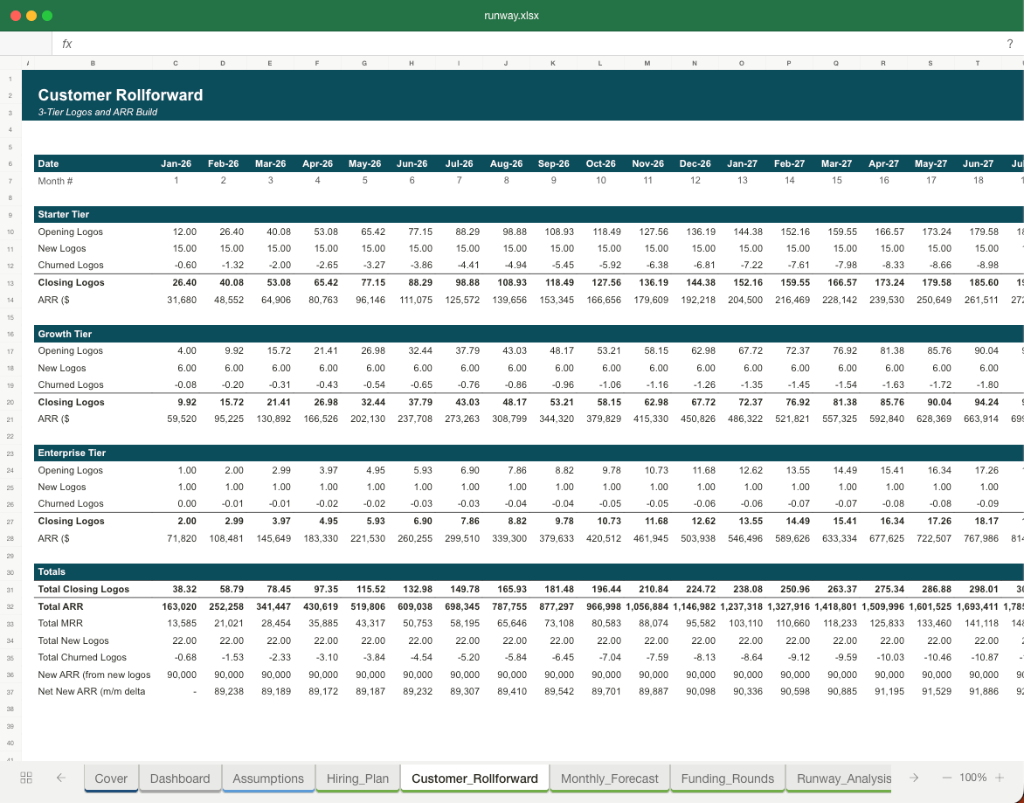
The model should build SaaS revenue around customer logos or design seats, subscription value, product adoption, renewals, and cross-sell between Ground Mount, Roof Mount, and Yield. Include implementation and support costs where relevant, then connect sales hiring, R&D, gross margin, and cash runway to the ARR and retention assumptions.
A turnkey financial model
Live formulas, no hardcoded values
Outputs are driven by live formulas, so the workbook updates from its assumptions instead of relying on hardcoded results.
All assumptions in one tab
Inputs are clearly marked in the Assumptions tab and separated from calculations, making it clear what to change and what to leave intact.
Statements always balancing
For integrated-statement models, the balance sheet, cash flow, and supporting schedules tie through properly.
Distinct schedules for clarity
Debt, working capital, taxes, and cash flow can get messy quickly. We group calculations in clear schedules, not across disconnected tabs.
No hidden macros or external links
There are no unexplained external workbook links or macros to undermine auditability or portability.
Changes flow through the model
Update a key driver and see the impact carry through the forecast, financing, and return outputs. We never use hardcoded numbers in formulas.
About PVcase
pvcase.com
How to build a detailed financial model for PVcase
A complete walkthrough of the business, drivers, and assumptions behind the downloadable PVcase model - distilled from its pitch deck and publicly available information.
Product & value proposition
Three software products:
PVcase Ground Mount
- 30x faster designs vs. manual
- 11% increase in capacity
- 9% more precise cable lengths
- 13% increase in energy production
- Operates in 60+ countries
PVcase Roof Mount
- Automatic layout generation
- Rapid 3D building preparation
- Accurate shade loss modelling
- Adapt models to flat or sloped roofs
- Automated and semi-automated stringing
PVcase Yield
- Cloud-based energy yield simulation
- 10+ years of R&D experience
- No size limitations; faster modelling
- Integration with PVcase Ground Mount
- Physics-based simulation for bifacial and HSAT systems
Core value prop: 30x design time reduction vs. manual; drives design standards across regional offices; best-in-class customer service; positioned for full lifecycle (early design through post-construction).
Customer testimonial: Lasse Nieswitz, Team Lead Design Engineering, STEAG Solar Energy Solutions (SENS) - cites ease of training new engineers in two weeks.
Market
- Global solar PV installations projected to reach 857 GW by 2029.
- 2015–2021: average ~21 GW/year additions growth.
- 2022–2029: average ~84 GW/year additions growth projected - 4x PV installations growth 2022–2029.
- US tailwind: $369B Inflation Reduction Act (2022) for Energy Security and Climate Change.
- EU tailwind: 2030 Climate Target Plan - 55% emissions decrease below 1990 levels.
Revenue model
- SaaS subscription model per product module (Ground Mount, Roof Mount, Yield); typical for engineering design software - per-seat or per-project licence. Rationale: company describes itself as SaaS (COO bio references "IaaS and SaaS"), and software tools of this type universally sold as annual subscriptions.
- Likely tiered by seats or by project volume (number of MW designed), common in solar design software (e.g., Helioscope, Aurora Solar comparable). No pricing shown.
- Channels: direct sales (CSO with 15+ years senior sales leadership); likely inbound via product reputation.
Traction & metrics
- 60+ countries - geographic reach of PVcase Ground Mount.
- Customer reference: STEAG Solar Energy Solutions (SENS) - named enterprise customer.
- No revenue figures, ARR, customer count, MRR, growth rates, or churn in deck.
Competition / moat
Problem framing:
- Industry pain points: slow manual processes; inaccurate designs not fit for construction; fragmented software (no single tool covers full lifecycle); inconsistency across offices/regions; poor customer service.
Moat claimed:
- 30x speed advantage over manual workflow.
- Full-lifecycle positioning (design → yield simulation → post-construction) - differentiates from point solutions.
- Cross-regional standardisation capability.
- 10+ years R&D in yield simulation (PVcase Yield).
Team & funding ask / use of funds
Leadership team:
- David Trainavicius - CEO; 10+ years solar engineering; repeat founder (prior solar company).
- Toma Dile - COO; 10+ years HR/Operations; 5+ years in international IaaS/SaaS.
- Douglas Geist - CSO; 15+ years senior sales leadership.
- Adam Pazarauskas - CPO; 7+ years solar engineering + software product management.
Recommended financial model
- Archetype + why: B2B SaaS ARR model. PVcase sells subscription software (3 modules) to solar engineering firms and EPCs globally. The right model tracks seats/licences → ARR → net revenue retention → cash flow. The solar market growth slide (4x installations 2022–2029) sets the macro demand driver that feeds a bottoms-up seat expansion story.
- Forecast horizon & granularity: 5 years (2023–2027), monthly for Year 1, quarterly thereafter. 2022 as base/historical anchor if data can be sourced.
- Key drivers & assumptions:
| Driver | Value | Source |
|---|---|---|
| Starting customer count | ~150–300 enterprise/SME accounts; rationale: 60+ countries, enterprise sales motion, 2022 deck | - |
| Average seats per customer | 5–20 seats; rationale: team-based tool used per office/region | - |
| Average selling price (ASP) per seat per year | $2,000–$5,000; rationale: comparable solar design SaaS (Helioscope ~$1,500–$3,000/yr/seat; Aurora Solar similar) | - |
| New logo growth rate | 30–50% YoY; rationale: 4x installations market growth provides strong top-of-funnel tailwind | - |
| Net Revenue Retention (NRR) | 110–120%; rationale: multi-module upsell path (Ground Mount → Roof Mount → Yield) | - |
| Gross margin | 75–85%; rationale: pure software, low COGS | - |
| CAC (blended) | $8,000–$20,000 per customer; rationale: enterprise B2B sales, CSO-led team | - |
| S&M as % of revenue | 35–50% in growth phase | - |
| R&D as % of revenue | 20–30%; rationale: 10+ yr R&D moat to maintain; 3 product lines | - |
| G&A as % of revenue | 10–15% | - |
| Module mix (Ground Mount / Roof / Yield) | 60% / 25% / 15% initially; Yield growing as cloud product matures | - |
| Geographic revenue split | US 40%, Europe 40%, ROW 20%; rationale: policy tailwinds in both US (IRA) and EU (2030 plan) | - |
| Market growth multiplier (macro) | 4x PV installations 2022–2029 (~20% CAGR) | - |
- Scenarios (Base / Bull / Bear):
- Base: 35% logo growth, NRR 115%, ASP stable, gross margin 80%.
- Bull: 50% logo growth (IRA + EU policy accelerates enterprise adoption), NRR 125% (Yield module upsell), international expansion into ROW.
- Bear: 20% logo growth (sales cycle elongation, macro slowdown), NRR 105%, pricing pressure from new entrants, higher S&M spend needed.
- Flex variables: new logo adds, NRR, ASP/pricing, module attach rate.
- Required sheets / outputs:
- Assumptions - all drivers in one place, toggle for scenarios.
- ARR Bridge - beginning ARR + new ARR + expansion − churn = ending ARR (monthly/quarterly).
- Revenue - ARR recognised to revenue (assume annual contracts, straight-line).
- P&L (Income Statement) - Revenue → Gross Profit → EBITDA → Net Income.
- Headcount & Opex - by department (S&M, R&D, G&A); tie to hiring plan.
- Cash Flow - operating cash; burn/runway; fundraise timing.
- Balance Sheet - lightweight; cash, deferred revenue, equity.
- KPI Dashboard - ARR, MRR, customer count, NRR, LTV/CAC, gross margin, CAC payback months, Rule of 40.
- Market Sizing - top-down GW installation growth → addressable engineering hours → software licence opportunity (to contextualise revenue targets).
Frequently asked
Is the PVcase financial model free?+
Yes. The PVcase model is a free Excel (.xlsx) download with live formulas. Sign up with your email and the workbook is yours to keep, review, and edit.
What's included in the model?+
A 5-year monthly forecast with P&L, cash flow and runway, valuation (exit multiple plus a DCF cross-check), MOIC/IRR returns, and unit economics, with live formulas throughout.
How was this model built?+
It was built from PVcase's pitch deck and publicly available information, then structured to investment-banking standards as a fully editable Excel model.
Can I change the assumptions?+
Yes. You can change assumptions and the live formulas will recalculate in the downloadable Excel model.
Have more financial modelling questions? Contact us

Created by ex-finance professionals
Hey, I’m Alex and I created Finamodel.
Over my years in the finance industry I kept building the same models over and over again. Same structure, same assumptions, different logo. So I started building frameworks to turn them into clean, reusable templates.
Every model here is one I’d actually use for a client, and I personally vet each one before it goes up.
I’m not an expert in every industry, but I’ve built enough models to know what belongs in one. And when something is completely foreign to me, I reach out to my network for experts to work on our models with us.
Having a template library on hand cuts a first build from hours to minutes.
Need help finding your model? You’ll find me in the Finamodel app!
Other Climate/Energy Startup Financial Models
Browse another startup in the same category.

Abatable
Robo-advisor platform for sourcing and managing high-quality carbon removal offsets, targeting asset managers.
Bower
Mobile app that rewards consumers for scanning and recycling consumer packaging at existing bins, monetised by CPG brand subscriptions and consumer data.
Bramble Energy
UK deep-tech company commercialising a PCB-based hydrogen fuel cell stack (PCBFC™) for portable power and mobility applications.

Cervest
AI-powered Climate Intelligence platform that quantifies physical climate risk at the asset level, delivered as a freemium SaaS product.

Clockworks Analytics
B2B SaaS platform providing automated fault-detection and diagnostics (FDD) analytics for commercial and institutional building portfolios.

Dandelion Energy
Dandelion Energy installs residential geothermal heat pump systems (ground-source HVAC) with in-house financing, targeting US homeowners on fossil-fuel heating.

Emitwise
B2B SaaS platform automating corporate carbon footprint tracking, reporting, and reduction using machine learning.
Fisker
Fisker is an asset-light, design-led EV company merging with Spartan Energy Acquisition Corp. in a SPAC transaction to fund the launch of the Fisker Ocean SUV.