 Recraft Financial Model
AI/ML Startup Financials (Free Excel Download)
AI image generation tool for professional designers - vector art, icons, 3D, and illustrations in brand-controlled styles.



professionals from Deloitte
Used by professionals from






About this model
Recraft is an AI artboard for professional designers, generating and editing true SVG vectors, icons, 3D images, and raster illustrations. Users control references, brand colours, complexity, strokes, fills, and designer-curated visual styles, then vectorise, modify, or export work.
Its product-led motion uses a free tier and paid Creator and Professional subscriptions, alongside managed enterprise packages for brand setup, growth, and support. Within roughly 45 days of launch it had 75,000 registered users and 2.5 million generations, with Product Hunt recognition.
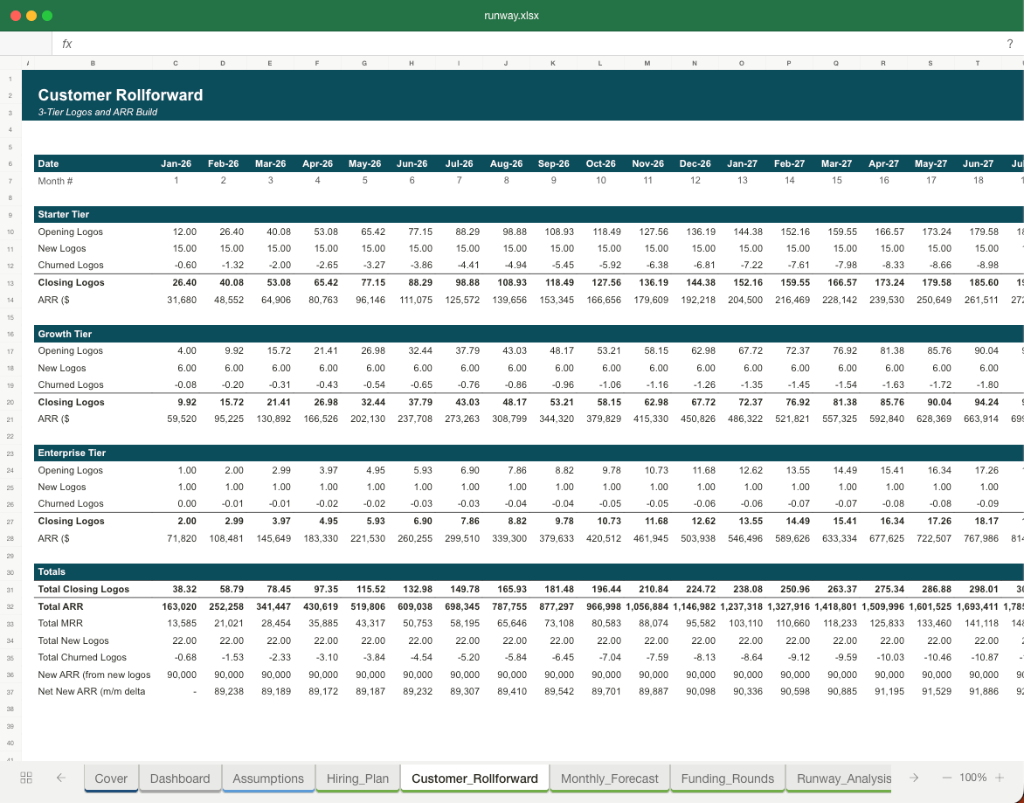
The model tracks registrations, activation, paid conversion, seats, generation volume, and enterprise contracts. It links model inference and storage to COGS, then forecasts retention, expansion, product-led acquisition, managed-service delivery, gross margin, hiring, cash burn, and runway.
A turnkey financial model
Live formulas, no hardcoded values
Outputs are driven by live formulas, so the workbook updates from its assumptions instead of relying on hardcoded results.
All assumptions in one tab
Inputs are clearly marked in the Assumptions tab and separated from calculations, making it clear what to change and what to leave intact.
Statements always balancing
For integrated-statement models, the balance sheet, cash flow, and supporting schedules tie through properly.
Distinct schedules for clarity
Debt, working capital, taxes, and cash flow can get messy quickly. We group calculations in clear schedules, not across disconnected tabs.
No hidden macros or external links
There are no unexplained external workbook links or macros to undermine auditability or portability.
Changes flow through the model
Update a key driver and see the impact carry through the forecast, financing, and return outputs. We never use hardcoded numbers in formulas.
About Recraft
recraft.ai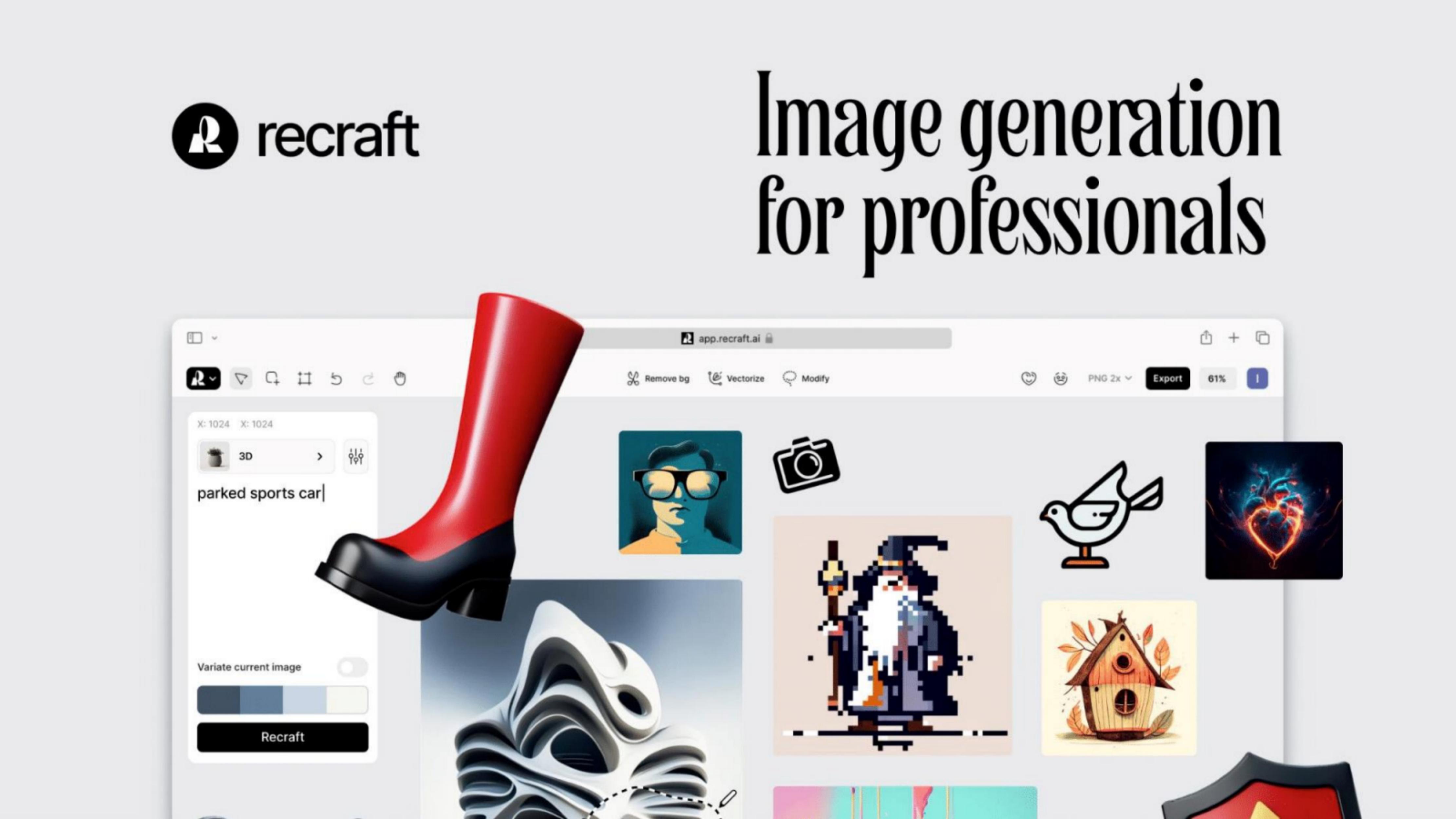
How to build a detailed financial model for Recraft
A complete walkthrough of the business, drivers, and assumptions behind the downloadable Recraft model - distilled from its pitch deck and publicly available information.
Product & value proposition
- Web-based AI artboard at app.recraft.ai
- Generates and edits vector art (true SVG), icons, 3D images, and raster illustrations
- Professional controls beyond text-to-image: visual references, brand colors, complexity level, stroke weight, fill type
- Style presets curated by industry designers - Line Art, Flat 2.0, Cartoon, Doodle, Grain, Pixel Art, Psychedelic, Hand-Drawn, Glow, 80s, 3D render, icon sets
- Post-generation tools: Remove BG, Vectorize, Modify, export PNG 2x
- Free tier available with commercial license on launch
- Differentiator claimed: proprietary model built specifically for vector art; "smooth gradients" vs. broken gradients from competitors; superior quality vs. Midjourney, Adobe, Canva, Lexica, Stability.ai
- Data flywheel: labeling pipelines with designers + product analytics feed back into next model training
Market
Deck frames the market by three addressable customer segments rather than a TAM dollar figure:
| Segment | Size | 2023 spend | 2025 target |
|---|---|---|---|
| Outsource designers | 300K | $20–50 / standard edition | AI tools replacing outsource |
| SMB | 10M | $100–3,000 (templates, stock, outsource) | Personalized unique AI designs |
| Enterprise | Not sized | $10,000–∞ | Personalized unique AI designs |
No TAM/SAM/SOM dollar figures stated. No third-party market size data cited.
Revenue model
Two revenue tracks:
Track 1 - Subscription (self-serve)
- Tiers (in stacking order): Early Recrafter → Creator → Professional
- Early Recrafter features: unlimited recrafts, commercial license, unlimited projects, private images
- Specific price points not shown in deck for any tier
Track 2 - Enterprise (managed services)
- Tiers: Brand Setup → Brand Growth → Brand Support
- Brand Setup includes: Logo, Icon Set, Mockup
- Enterprise pricing not disclosed in deck
Channel: direct / PLG (product-led; free tier drives signups; ProductHunt launch as acquisition channel)
Traction & metrics
All figures as of approximately mid-July 2023 (~45 days post-launch on 31 May 2023):
- Total registered users: 75,000
- Total recrafts (generations): 2.5M
- Time to 1M recrafts: 20 days post-launch
- Time from 1M to 2M recrafts: 15 additional days
- Daily repeat users: growing from 109 at launch week → 1,559 mid-period → 2,818 at end of charted period
- Daily recrafts: growing from 12,053 at launch → 63,323 mid-period → 72,982 → 104,242 at end of charted period
- Cumulative user growth by day (selected): Day 1: 4,380 → Day 5: 10,789 → Day 20: ~27,785 → Day 30: ~43,635 → Day 46: 74,105
- ProductHunt: Product of the Day #2, Product of the Week #5; 942 upvotes; 23 reviews; 1.0K followers
Unit economics
- No CAC, LTV, churn, or gross margin figures disclosed.
- Inference costs: $25k/month and described as growing - only cost datapoint given.
- FM training experiments: $150k/month.
- Per-run FM training cost: $350k/run.
Competition / moat
Named competitors: Midjourney, Adobe, Canva, Lexica, Stability.ai
Claimed differentiation:
- Only product built natively for vector art generation (true SVG output)
- Smooth gradient rendering vs. broken gradients in alternatives
- Professional brand/style controls not available in general-purpose tools
- Data moat: designer-labeling pipelines + product analytics loop back into proprietary foundation model training
- Style presets maintained to reflect current design trends by industry-level designers
Team & funding ask / use of funds
Team: Not individually named in deck; no founder bios shown.
Existing investors:
- Khosla Ventures
- Elad Gil
- Nat Friedman
- AI Grant (Batch 1)
- Mariam Naficy, Edward Lando, Marc Bhargava (angels)
Current raise: $10M
Use of funds:
- Foundation Model training - $350k/run for training runs; $150k/month for experiments
- Inference infrastructure - $25k/month (growing)
- Hires: Product Designer, 2× Front-End Engineer, 2× Full-Stack Engineer, 2× ML Engineer, Product Manager, Community Manager, Graphic Designer, outsource designers and labelers
- Goal: cross $1M ARR and prove GTM motion
Recommended financial model
Archetype + why: SaaS ARR model with usage/seat-based subscription tiers + enterprise revenue line. The business has two distinct revenue streams (self-serve subscription PLG and managed enterprise) with materially different CAC, ACV, and sales motion. A pure usage model is not appropriate because pricing is tier-based, not per-generation. A 3-statement model is premature - no balance sheet or COGS structure in the deck. Start with a revenue + burn / runway model.
Forecast horizon & granularity: Monthly, 36 months (mid-2023 through mid-2026). Year 1 monthly granularity is essential given the steep early growth curve; Years 2–3 can flex to quarterly if needed.
Key drivers & assumptions:
*User acquisition*
- Launch cohort: 75,000 registered users in ~45 days
- Implied daily signups at peak: ~1,500–2,000/day
- New user growth rate post-launch: assume deceleration from ~3% daily to ~0.5% monthly by Month 6 as ProductHunt spike normalizes - typical for PLG launches
- Monthly organic new user additions: 5,000–15,000/month in steady state, based on daily repeat user trend
*Conversion (free-to-paid)*
- Free-to-paid conversion rate: 2–5% - consistent with PLG benchmarks for design/creative tools (Figma, Canva precedents); no deck data
- Paid tier mix (Creator / Professional / Enterprise): 70% / 25% / 5% initially, shifting toward Enterprise over time as GTM matures
*Pricing (not disclosed in deck)*
- Subscription ARPU: $15–$30/month for Creator; $50–$100/month for Professional - calibrated to stated 2023 outsource-designer spend of $20–$50 and competitive pricing for Midjourney ($10–$30) and Adobe Firefly tiers
- Enterprise ACV: $10,000–$50,000 - consistent with deck's "$10,000–∞" enterprise spend benchmark; assume average $20k/year
*Costs*
- Inference COGS: $25k/month at ~2.5M recrafts/month; scale as recrafts-per-user × user count; ~$0.01 per recraft in variable inference cost
- FM training experiments: $150k/month - treat as fixed R&D OpEx
- FM training runs: $350k/run; 1 run per 6 months post-raise
- Headcount: ~10–12 hires post-raise; blended fully-loaded cost $150k/year = ~$1.5M–$1.8M/year in people costs
- Gross margin: 60–70% at scale - typical for AI SaaS with significant inference costs; higher end as user base scales and inference efficiency improves
*Revenue milestone*
- $1M ARR milestone stated as post-funding goal; treat as Year 1 exit rate target
Scenarios (Base / Bull / Bear - which variables flex):
| Variable | Bear | Base | Bull |
|---|---|---|---|
| Free-to-paid conversion | 1.5% | 3% | 5% |
| Monthly new signups (steady state) | 3,000 | 8,000 | 20,000 |
| Avg subscription ARPU | $15/mo | $25/mo | $40/mo |
| Enterprise deals (Year 1) | 2 | 5 | 15 |
| Inference cost per recraft | $0.015 | $0.010 | $0.006 |
| FM training cadence | 3 runs/year | 2 runs/year | 1 run/year |
Required sheets / outputs:
- `Assumptions` - all drivers with / tags, scenario toggles
- `Users` - free user cohorts, conversion funnel, paid subscriber count by tier
- `Revenue` - subscription MRR/ARR by tier + enterprise ACV × deal count
- `COGS & Gross Margin` - inference costs (usage-linked) + direct hosting
- `OpEx` - R&D (FM training + experiments), headcount, G&A
- `P&L` - monthly contribution margin, EBITDA, net burn
- `Runway` - $10M raise against monthly burn; months to $1M ARR milestone
- `Dashboard` - KPI summary: MRR, ARR, users, paid conversion, gross margin %, monthly burn, runway
Frequently asked
Is the Recraft financial model free?+
Yes. The Recraft model is a free Excel (.xlsx) download with live formulas. Sign up with your email and the workbook is yours to keep, review, and edit.
What's included in the model?+
A 5-year monthly forecast with P&L, cash flow and runway, valuation (exit multiple plus a DCF cross-check), MOIC/IRR returns, and unit economics, with live formulas throughout.
How was this model built?+
It was built from Recraft's pitch deck and publicly available information, then structured to investment-banking standards as a fully editable Excel model.
Can I change the assumptions?+
Yes. You can change assumptions and the live formulas will recalculate in the downloadable Excel model.
Have more financial modelling questions? Contact us

Created by ex-finance professionals
Hey, I’m Alex and I created Finamodel.
Over my years in the finance industry I kept building the same models over and over again. Same structure, same assumptions, different logo. So I started building frameworks to turn them into clean, reusable templates.
Every model here is one I’d actually use for a client, and I personally vet each one before it goes up.
I’m not an expert in every industry, but I’ve built enough models to know what belongs in one. And when something is completely foreign to me, I reach out to my network for experts to work on our models with us.
Having a template library on hand cuts a first build from hours to minutes.
Need help finding your model? You’ll find me in the Finamodel app!
Other AI/ML Startup Financial Models
Browse another startup in the same category.

AI Rudder
AI Rudder provides multi-lingual conversational AI for B2C customer engagement - automating outbound and inbound voice/chat interactions at scale.

Aisera
AI Service Experience platform that automates IT, HR, and customer service workflows via conversational AI and automation.

Amberscript
AI + human hybrid transcription and subtitling platform targeting B2B customers in Europe

Apheris
Privacy-preserving federated ML platform enabling enterprises to train AI on distributed data without sharing raw data.

Arcane
AI copilot for marketing teams that automates data analysis, reporting, and repeatable tasks via a chat interface and scheduled workflows.

Artisan
AI-powered "digital workers" (branded Artisans) that autonomously perform role-specific tasks - starting with outbound sales - and are delivered as SaaS subscriptions.

Artisan Series A
AI-native B2B SaaS platform consolidating the enterprise software stack with human-like "Artisan" AI employees that automate role-specific workflows

Bigblue
Tech-enabled e-commerce fulfillment platform for European D2C brands - "Amazon-standard" delivery without Amazon.