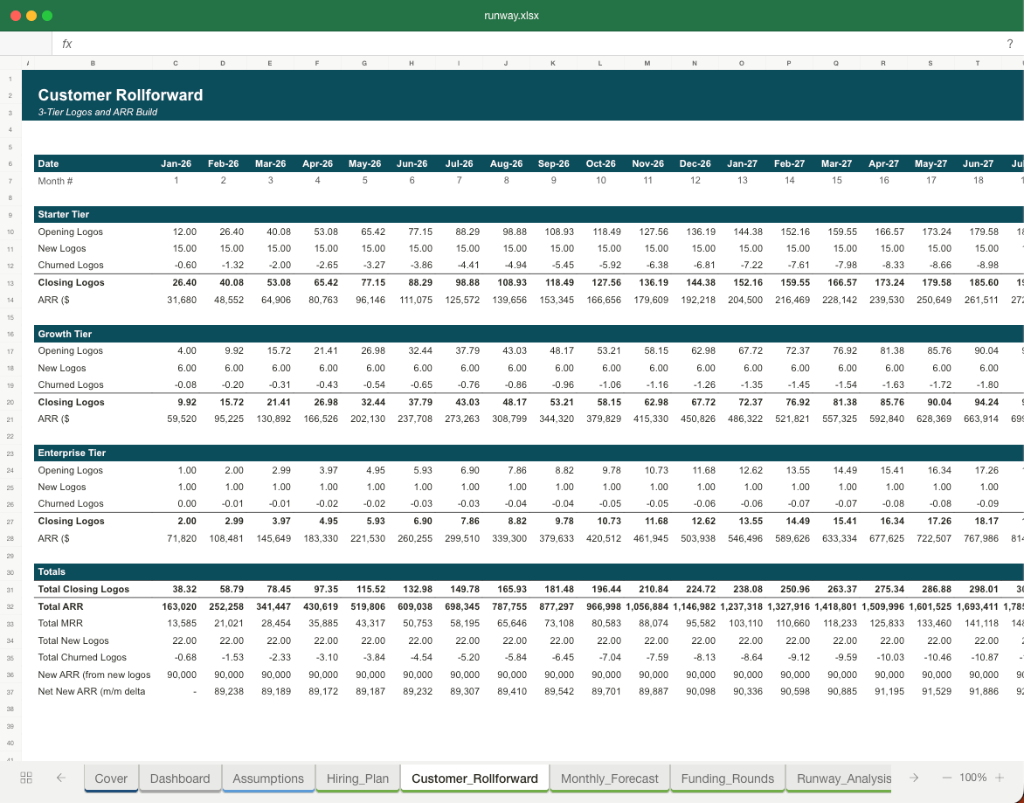
 Seam Social Financial Model
Crypto/Web3 Startup Financials (Free Excel Download)
Seam Social is a UGC marketplace layered on a customizable social profile platform, replacing ad revenue with mini-app and theme sales.



professionals from Deloitte
Used by professionals from






About this model
Seam Social combines a customisable social-profile platform with a user-generated-content marketplace. Rather than relying on advertising, it allows creators to sell mini apps, themes, and templates, giving users a way to personalise profiles and creators a direct path to monetise their work.
The US-first company was raising a seed round in August 2023 after joining the Variant Founder Fellowship. A planned Web3 or token component should be treated as future product context, not as established revenue. The immediate commercial engine is creator supply meeting user purchases in the marketplace.
Model users, active creators, listings, paid conversion, average purchase value, and GMV by mini apps, themes, and templates. Apply the platform take rate and show creator payouts separately, then include payments, moderation, infrastructure, and acquisition costs. User growth, creator activation, conversion, GMV per buyer, take rate, and retention should control scenarios.
A turnkey financial model
Live formulas, no hardcoded values
Outputs are driven by live formulas, so the workbook updates from its assumptions instead of relying on hardcoded results.
All assumptions in one tab
Inputs are clearly marked in the Assumptions tab and separated from calculations, making it clear what to change and what to leave intact.
Statements always balancing
For integrated-statement models, the balance sheet, cash flow, and supporting schedules tie through properly.
Distinct schedules for clarity
Debt, working capital, taxes, and cash flow can get messy quickly. We group calculations in clear schedules, not across disconnected tabs.
No hidden macros or external links
There are no unexplained external workbook links or macros to undermine auditability or portability.
Changes flow through the model
Update a key driver and see the impact carry through the forecast, financing, and return outputs. We never use hardcoded numbers in formulas.
About Seam Social
seam.so
How to build a detailed financial model for Seam Social
A complete walkthrough of the business, drivers, and assumptions behind the downloadable Seam Social model - distilled from its pitch deck and publicly available information.
Product & value proposition
- Customizable social profile pages ("Cards") with modular mini apps (blocks/widgets) built by users and third-party developers.
- 19 mini apps available at time of deck; 6 user-built (UGC) live.
- Contrast to ad-driven platforms: no mass DAU requirement, no data capture incentive, open/collaborative.
- FitCheck mini app (iMessage): reached #7 in iMessage App Store social category.
- Social graph and profile layer for Polygon web3 games (one game is top 10).
- Token launch planned ("Seam token").
Market
- No traditional TAM/SAM/SOM breakdown presented.
- Comparable market caps cited as reference TAMs:
- iOS App Store: $635b
- Facebook: $720b
- EPIC Games: $32b
- LEGO: $12b
- Source attributed to Apple's Data.
- No SAM or SOM figures provided.
Revenue model
- UGC marketplace take-rate: users create, share, and sell mini apps, themes, and templates; Seam earns a cut.
- ARPU benchmark from deck: ads yield $0.51–$10.14/user/quarter (Reddit to Facebook); UGC marketplace yields $11.92–~$100/user/quarter (Roblox to Fortnite).
- Token component: "Seam token launch" mentioned as part of ask; tokenomics not specified.
- No explicit pricing tiers, listing fees, or take-rate percentage disclosed.
Traction & metrics
- Seam.so is live with pages created.
- D30 retention: 36%.
- FitCheck mini app: #7 in iMessage App Store social category.
- Web3 game integrations: social graph/profile for multiple Polygon games; one is top 10.
- Roadmap milestones hit by Q3 2023: Block SDK launched, first block remixed, referrals live, Pixels integration, friending, Quests, Wall block, gaming partnerships, weekly launch livestream, NFT-gated themes.
- No revenue, GMV, DAU, MAU, or paying user figures disclosed.
Unit economics
- ARPU benchmark referenced for UGC marketplace: $11.92–~$100/user/quarter (Roblox to Fortnite) - positioned as aspiration, not achieved.
- No CAC, LTV, payback period, or gross margin figures in deck.
Competition / moat
- Implicit competitive contrast: ad-driven platforms (Facebook, Reddit) characterized as data-extractive, requiring millions of DAU, feature-homogeneous, closed.
- Positioning: intersection of iOS App Store economics + gaming UGC (EPIC/Fortnite) + social graph (Facebook) + creative play (LEGO).
- No direct competitor grid or feature matrix. Moat claimed as open/collaborative platform + UGC flywheel.
- 4-step growth loop: attract via unique profiles → activate via mini apps → retain via quests/themes → users build UGC → repeat.
Team & funding ask / use of funds
- Team: Contact is Nick (nick@getseam.xyz; seam.so/nick). No team slide or bios in deck.
- Ask: "$_M seed" - dollar amount redacted/blurred in both text and image.
- Use of funds: hiring full-time engineers to build the marketplace.
- Other asks (non-cash): partnership intros with IP-focused NFT projects and web3 games; Seam token launch support, audits, legal advising, tokenomics.
Recommended financial model
- Archetype + why: UGC marketplace GMV + ARPU model - revenue is driven by marketplace volume (number of active creators × items sold × ASP × take rate), not subscriptions or ads. A secondary token/web3 economics layer exists but is undeveloped in the deck. Closest analogy is Roblox (creator marketplace take-rate) with a social graph overlay.
- Forecast horizon & granularity: 3 years monthly (Year 1–2) then quarterly (Year 3); pre-revenue stage so near-term focus is on user growth, creator activation, and GMV ramp.
- Key drivers & assumptions:
- Monthly active users (MAU): start from current user base (unknown, redacted); model 3 growth scenarios. Assume seed-stage, likely <50k MAU at deck date.
- D30 retention: 36%; use as anchor. D7 and D90 not in deck D7 ~55%, D90 ~20% based on consumer social benchmarks.
- Creator penetration (% of MAU who publish UGC): 5–15% based on Roblox/YouTube creator ratios.
- Average items listed per creator per month: 1–3.
- Average selling price (ASP) per mini app / theme: $1–$10; calibrate against Roblox (avg ~$0.50–$5 virtual item) and iMessage sticker packs ($1.99).
- Marketplace take rate: 20–30%; Apple App Store is 30%, Roblox is 30%.
- Token revenue: excluded from base case until tokenomics are defined; treat as upside scenario.
- Headcount / burn: seed capital used for 3–5 engineers; estimate $150–200k fully-loaded annual cost per engineer (US market).
- CAC: organic/referral-led (referrals, gaming partnerships, iMessage); assume low CAC ~$1–$5/user initially, rising as paid channels added.
- Scenarios (Base / Bull / Bear - which variables flex):
- Bear: slow creator adoption (2% penetration), low ASP ($1), 20% take rate; MAU growth 5% MoM.
- Base: 8% creator penetration, $3 ASP, 25% take rate; MAU growth 10% MoM.
- Bull: 15% creator penetration + token economy adds 20% revenue premium, $6 ASP; MAU growth 18% MoM.
- Key flex variables: creator penetration rate, ASP, token uplift, and MAU growth rate.
- Required sheets / outputs:
- Assumptions (all drivers with toggles for Base/Bull/Bear)
- User Funnel (Installs → MAU → D30 retained → creator cohort)
- GMV Build (creators × items × ASP)
- Revenue (GMV × take rate + optional token line)
- P&L (Revenue → gross profit → opex/headcount → EBITDA → net burn)
- Cash / Runway (seed capital deployed vs. monthly burn; months to next raise)
- Dashboard (KPIs: MAU, creator count, GMV, ARPU, burn rate, runway)
Frequently asked
Is the Seam Social financial model free?+
Yes. The Seam Social model is a free Excel (.xlsx) download with live formulas. Sign up with your email and the workbook is yours to keep, review, and edit.
What's included in the model?+
A 5-year monthly forecast with P&L, cash flow and runway, valuation (exit multiple plus a DCF cross-check), MOIC/IRR returns, and unit economics, with live formulas throughout.
How was this model built?+
It was built from Seam Social's pitch deck and publicly available information, then structured to investment-banking standards as a fully editable Excel model.
Can I change the assumptions?+
Yes. You can change assumptions and the live formulas will recalculate in the downloadable Excel model.
Have more financial modelling questions? Contact us

Created by ex-finance professionals
Hey, I’m Alex and I created Finamodel.
Over my years in the finance industry I kept building the same models over and over again. Same structure, same assumptions, different logo. So I started building frameworks to turn them into clean, reusable templates.
Every model here is one I’d actually use for a client, and I personally vet each one before it goes up.
I’m not an expert in every industry, but I’ve built enough models to know what belongs in one. And when something is completely foreign to me, I reach out to my network for experts to work on our models with us.
Having a template library on hand cuts a first build from hours to minutes.
Need help finding your model? You’ll find me in the Finamodel app!
Other Crypto/Web3 Startup Financial Models
Browse another startup in the same category.

0x Labs
0x Labs builds open exchange infrastructure (protocol, API, consumer app) for on-chain token trading across multiple blockchains.

1inch Network
DeFi aggregation protocol that routes crypto swaps across 100+ liquidity sources to deliver best rates and lowest gas fees.

Aether
Synthetic biology platform that builds searchable protein indexes to engineer novel molecular assemblers for high-value industrial products.
Alto
Self-directed IRA platform enabling retail investors to invest in alternative assets (private equity, debt, real estate, crypto) via tax-advantaged retirement savings.
Auki Labs
Decentralized peer-to-peer spatial positioning SDK for social AR - building the infrastructure layer to replace GPS and enable a persistent AR metaverse.
Awesome People Ventures Fund 2
Awesome People Ventures is a community-driven, decentralized early-stage Web3 VC fund raising Fund II.

Axelar
Cross-chain blockchain overlay network enabling universal transfer of assets, transactions, and state across all blockchain ecosystems.
BRD
BRD is a non-custodial crypto wallet app (consumer) and blockchain infrastructure API platform (enterprise) targeting mass-market crypto adoption.