 Signal AI Financial Model
Media/Gaming Startup Financials (Free Excel Download)
AI-powered "decision augmentation" platform that monitors global media, regulatory, and alternative data sources to surface real-time intelligence for enterprise clients.



professionals from Deloitte
Used by professionals from






About this model
Signal AI is an enterprise media-intelligence platform that ingests global content in more than 100 languages, including news, forums, regulatory sources, broadcast, radio, and internal data. Its AI enriches content with entities, sentiment, saliency, and topics to support crisis warning, regulatory, ESG, supply-chain, and market intelligence.
The offering is sold through annual SaaS subscriptions, API licences, and channel partnerships. Product tiers include Insights for monitoring and measurement, with Discovery and Influence positioned as future capabilities. Financial services, FMCG, energy, pharma, legal, accounting, agency, and technology companies are target customer segments.
Signal had 600-plus clients, 160 employees across London, New York, and Hong Kong, and $50 million of funding by its 2019 Series C. Its ARR chart lacks a readable scale. The model should build enterprise ARR, API revenue, expansion, data and hosting costs, sales efficiency, headcount, and retention scenarios.
A turnkey financial model
Live formulas, no hardcoded values
Outputs are driven by live formulas, so the workbook updates from its assumptions instead of relying on hardcoded results.
All assumptions in one tab
Inputs are clearly marked in the Assumptions tab and separated from calculations, making it clear what to change and what to leave intact.
Statements always balancing
For integrated-statement models, the balance sheet, cash flow, and supporting schedules tie through properly.
Distinct schedules for clarity
Debt, working capital, taxes, and cash flow can get messy quickly. We group calculations in clear schedules, not across disconnected tabs.
No hidden macros or external links
There are no unexplained external workbook links or macros to undermine auditability or portability.
Changes flow through the model
Update a key driver and see the impact carry through the forecast, financing, and return outputs. We never use hardcoded numbers in formulas.
About Signal AI
signal-ai.com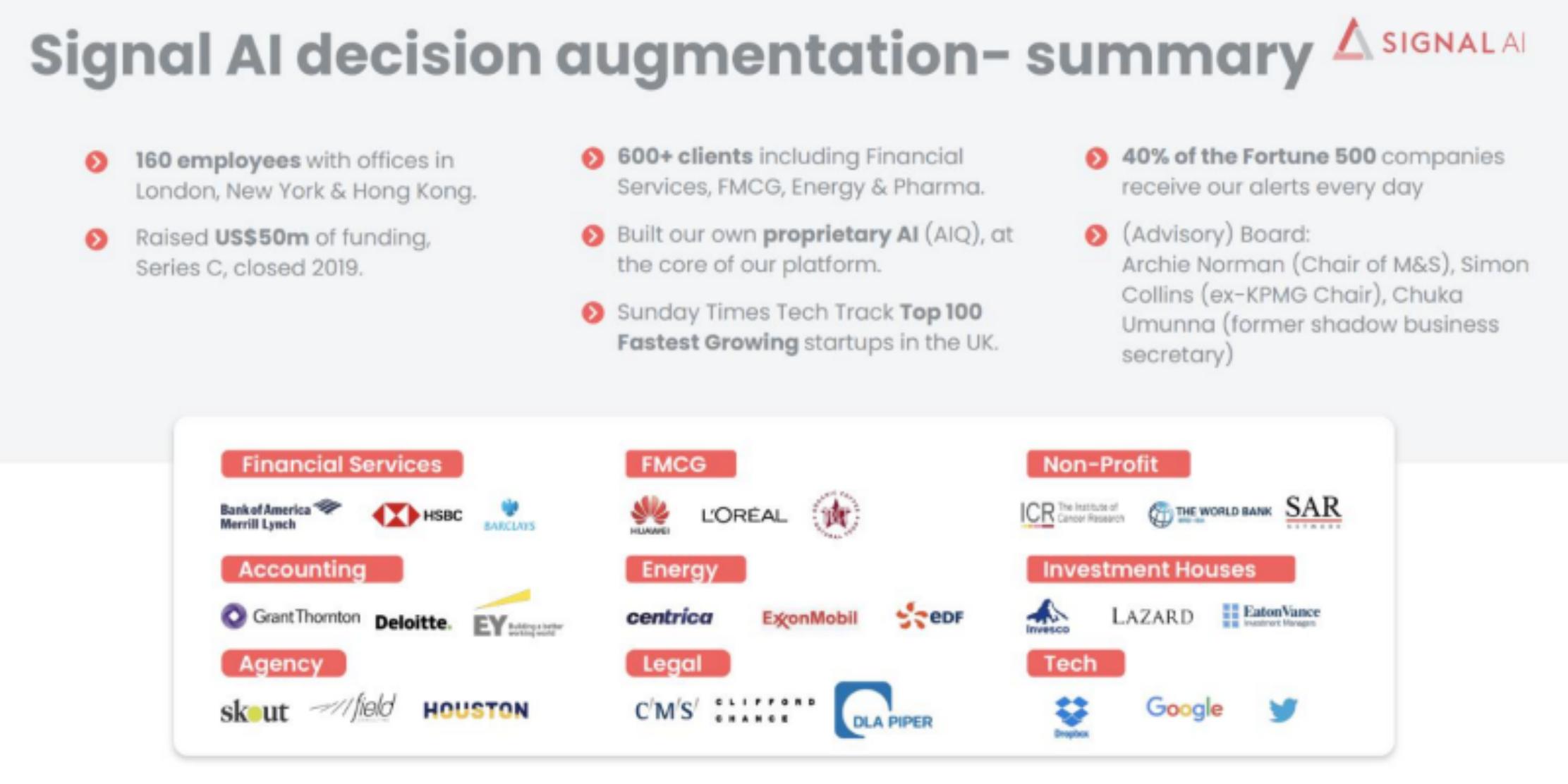
How to build a detailed financial model for Signal AI
A complete walkthrough of the business, drivers, and assumptions behind the downloadable Signal AI model - distilled from its pitch deck and publicly available information.
Product & value proposition
- Core platform (Signal AI / "AIQ"): proprietary AI engine that ingests global content in 100+ languages - news, forums/blogs, 2,000+ regulatory sources, broadcast, radio, and alternative/internal data - and enriches it with entity extraction (organisations, people, concepts), sentiment, saliency, and topic tagging.
- Delivered via SaaS and API (partnership channel also shown).
- Three product tiers (roadmap framing): Insights (Monitor/Measure - visualised analytics over collected data); Discovery (future - detection of new entrants, deals, M&A trends); Influence (future - influencer mapping and engagement).
- Value prop framed as "Waze for business decision-making": crisis early warning, regulatory risk, ESG/sustainability monitoring, supply-chain risk, prospecting.
- Flagship case study: co-created a "Global Trust Index" for EY using 15 ML-trained trust pillars.
Market
Deck presents three separate addressable markets that the Signal platform spans:
| Segment | Market Size | Source / Date | Note |
|---|---|---|---|
| PR & Comms (Media Intelligence) | $5B | Burton-Taylor 2023 | Direct channel |
| Risk & Compliance (RegTech) | $9B | RegTech Associates 2023 | Direct channel |
| Business Intelligence | $35B | Market Research Future | Ecosystem partners |
| Total TAM claimed | $50B+ | Combined | - |
Additional market-context data points from the deck:
- Media Intelligence spending for PR professionals: ~USD 4.5 bln, grew 7.2% in 2019.
- Risk & Compliance market expected to hit $64.55 Bn by 2027.
- ESG data-driven AUM could reach $1 bln by 2021; ESG indexes growing 35% per year; ESG data market growing ~20% per year.
- Supply chain analytics: USD 3.5 bln (2020) → USD 8.8 bln (2025), 19.8% CAGR.
No SAM or SOM figures provided. The $50B+ TAM is an additive sum of three third-party market-size estimates and should be treated as context, not addressable share.
Revenue model
- Primary: SaaS subscriptions (annual recurring revenue model).
- Secondary: API licensing.
- Tertiary: Ecosystem / channel partnerships (unnamed in deck).
- Customer segments: enterprise (Financial Services, FMCG, Energy, Pharma, Legal, Accounting, Agency, Tech).
- ARR is the key revenue metric tracked; the revenue chart (slide 19) shows quarterly ARR bars Q1 2015 – Q1 2019 with a client-count line overlay, but the ARR axis carries no currency or unit label - exact ARR quantum is not readable from the chart.
Traction & metrics
- Employees: 160, offices in London, New York, Hong Kong.
- Total funding raised: US$50m (Series C, closed 2019).
- Client count: 600+ at time of deck.
- Fortune 500 penetration: 40% receive Signal alerts daily.
- Revenue growth: ARR and client count grew consistently from Q1 2015 to Q1 2019; chart shows steep acceleration from Q3 2017 onward; exact ARR figures not labeled on chart axis.
- YoY growth (2018): 83% - this is the KBCM Top Quartile benchmark shown in the table; Signal's own 2018 figure was obscured/redacted in the slide image (teal block over the Signal column).
- Case study impacts: one agency saved 40,000 hours/year via automated reporting; one consulting firm grew deal pipeline 3x in Q4 tracking distressed firms; one advisory firm projecting £100M cost reduction by 2021 via automated tax-update surfacing.
- Recognition: Sunday Times Tech Track Top 100 Fastest Growing UK startups.
Note: The metrics table (slide 20) presents Signal's 2018 numbers alongside KBCM Top Quartile benchmarks, but the Signal column values are visually blocked in the available image. Only the KBCM benchmarks are readable. Signal's own values for the metrics below are NOT confirmed from the deck.
Unit economics
All figures below are KBCM Top Quartile benchmarks shown on the same slide as Signal's metrics - presented for comparison, not confirmed as Signal's own actuals (Signal column obscured in image):
- CAC Payback Period: 14 months (KBCM Top Quartile benchmark).
- LTV:CAC Ratio: 3x (KBCM Top Quartile benchmark).
- Net Revenue Retention: 110% (KBCM Top Quartile benchmark).
- Gross Margin (fully loaded): 70% (KBCM Top Quartile benchmark).
The deck narrative ("SaaS metrics are strong: now is the time to really scale") implies Signal's metrics are at or near these benchmarks, but the actual Signal values are not confirmed readable. For model assumptions, treat the KBCM quartile figures as directional proxies pending confirmation.
Competition / moat
- Incumbents: characterised as "billion-dollar" legacy players using "boolean" technology - slow and inaccurate.
- Signal's differentiation: AI-native (proprietary AIQ), 100+ language coverage, 2,000+ regulatory sources, human-AI feedback loop for continuous model improvement.
- Positioning matrix: Signal positioned as uniquely "Comprehensive Content + AI-Led" on a 2×2 (Human-Led vs. AI-Led × Narrow vs. Comprehensive Content).
- Named competitors: not shown in deck.
Team & funding ask / use of funds
- Advisory/Board: Archie Norman (Chair of M&S), Simon Collins (ex-KPMG Chair), Chuka Umunna (former shadow business secretary).
- Founding team / executive team: not named in available slides.
- Funding raised to date: US$50m (Series C, 2019).
- Growth axes stated: product upsell (Monitor → Discover → Influence), use-case cross-sell (PR&Comms → RegTech → Business Intelligence), geographic expansion (UK → US → APAC).
Recommended financial model
Archetype + why: SaaS ARR model with cohort-based NRR expansion. Signal is a classic enterprise SaaS business: subscription ARR, multi-year contracts with enterprise clients, upsell across product tiers and use cases, geographic expansion. The deck explicitly tracks ARR and SaaS unit economics (CAC payback, LTV:CAC, NRR, gross margin). A 3-statement wrap is optional but secondary; the core model is an ARR build.
Forecast horizon & granularity:
- 5-year forecast (2019–2024), quarterly for Years 1–2, annual for Years 3–5.
- Base year: 2019 (Series C just closed; earliest clean starting point with known data).
Key drivers & assumptions:
| Driver | Value |
|---|---|
| Starting ARR (Q1 2019) | Not labeled on chart - axis has no units |
| Starting client count (Q1 2019) | ~350–380 (estimated from chart line at Q1 2019) |
| Total clients at deck date | 600+ |
| YoY ARR growth (2018 actuals) | Not confirmed (Signal column obscured) |
| YoY ARR growth - model Year 1 | 70% |
| YoY ARR growth - model Years 2–3 | 50% / 40% |
| YoY ARR growth - model Years 4–5 | 30% / 25% |
| Net Revenue Retention | 110% |
| Gross Margin | 70% |
| CAC Payback Period | 14 months |
| LTV:CAC | 3x |
| New logo additions per year | derive from total client growth implied by chart; ~200 net new in 2018 period |
| Sales & Marketing % of revenue | ~35–40% |
| R&D % of revenue | ~20–25% |
| G&A % of revenue | ~10–15% |
| Headcount at model start | 160 |
| Revenue per employee | derive from ARR / 160 once ARR confirmed |
Scenarios (Base / Bull / Bear - which variables flex):
- Base: 70% → 50% → 40% → 30% → 25% YoY ARR growth; 110% NRR; 70% gross margin; geographic expansion (US, APAC) begins Year 2.
- Bull: Faster product upsell to Discovery/Influence modules, NRR expands to 120%+, US market scales faster; growth stays 80%+ through Year 3.
- Bear: Integration/sales cycle delays post-Series C, NRR compresses to 105%, growth slows to 40% in Year 1 due to enterprise sales cycles.
Required sheets / outputs:
- Assumptions - all drivers tagged or
- ARR Bridge - new ARR, expansion ARR, churned ARR per period
- P&L (SaaS-format) - ARR → recognized revenue (straight-line), gross profit, S&M, R&D, G&A, EBITDA, operating loss
- Headcount Plan - by department, tied to revenue targets
- Cash Flow & Runway - operating cash burn, Series C deployment, runway to next raise
- Unit Economics - CAC, LTV, payback, NRR, magic number
- KPI Dashboard - ARR, client count, NRR, gross margin, CAC payback, rule-of-40
Frequently asked
Is the Signal AI financial model free?+
Yes. The Signal AI model is a free Excel (.xlsx) download with live formulas. Sign up with your email and the workbook is yours to keep, review, and edit.
What's included in the model?+
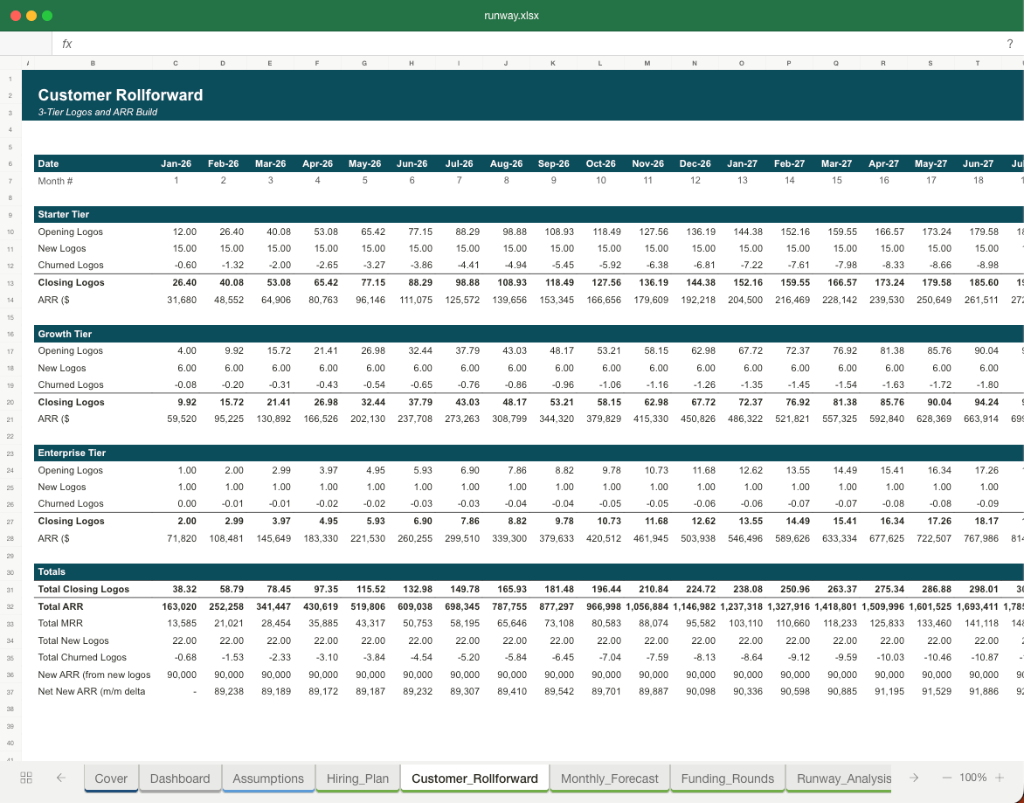
A 5-year monthly forecast with P&L, cash flow and runway, valuation (exit multiple plus a DCF cross-check), MOIC/IRR returns, and unit economics, with live formulas throughout.
How was this model built?+
It was built from Signal AI's pitch deck and publicly available information, then structured to investment-banking standards as a fully editable Excel model.
Can I change the assumptions?+
Yes. You can change assumptions and the live formulas will recalculate in the downloadable Excel model.
Have more financial modelling questions? Contact us

Created by ex-finance professionals
Hey, I’m Alex and I created Finamodel.
Over my years in the finance industry I kept building the same models over and over again. Same structure, same assumptions, different logo. So I started building frameworks to turn them into clean, reusable templates.
Every model here is one I’d actually use for a client, and I personally vet each one before it goes up.
I’m not an expert in every industry, but I’ve built enough models to know what belongs in one. And when something is completely foreign to me, I reach out to my network for experts to work on our models with us.
Having a template library on hand cuts a first build from hours to minutes.
Need help finding your model? You’ll find me in the Finamodel app!
Other Media/Gaming Startup Financial Models
Browse another startup in the same category.

Almost Friday
Almost Friday is a multi-platform comedy/lifestyle media brand built around the "Friday Beers" universe, monetising through apparel, brand partnerships, events, podcasts, and music.

Amagi
Cloud-native SaaS platform for TV/OTT channel creation, distribution, and ad monetization (FAST-focused)

Audoo
IoT + SaaS platform that captures real-time public music performance data and reports it to Performing Rights Organisations (PROs) to enable accurate royalty distribution.
Backbone
Backbone makes a mobile gaming controller (hardware) + unified software platform (Backbone app) that aggregates all game streaming services in one place.
Beacon Pines
Beacon Pines is a cute-and-creepy narrative adventure game set inside a magical storybook, developed by indie studio Hiding Spot Games.
Bear and Breakfast
A management/adventure video game where you play as a bear running a B&B cabin in the woods.
Bioshock
BioShock is a first-person action horror game pitched to a publisher for development funding - a game-development studio deal, not an operating startup.

Button City 2018
Indie narrative adventure game about cute animal kids saving their local arcade, targeting console and PC.