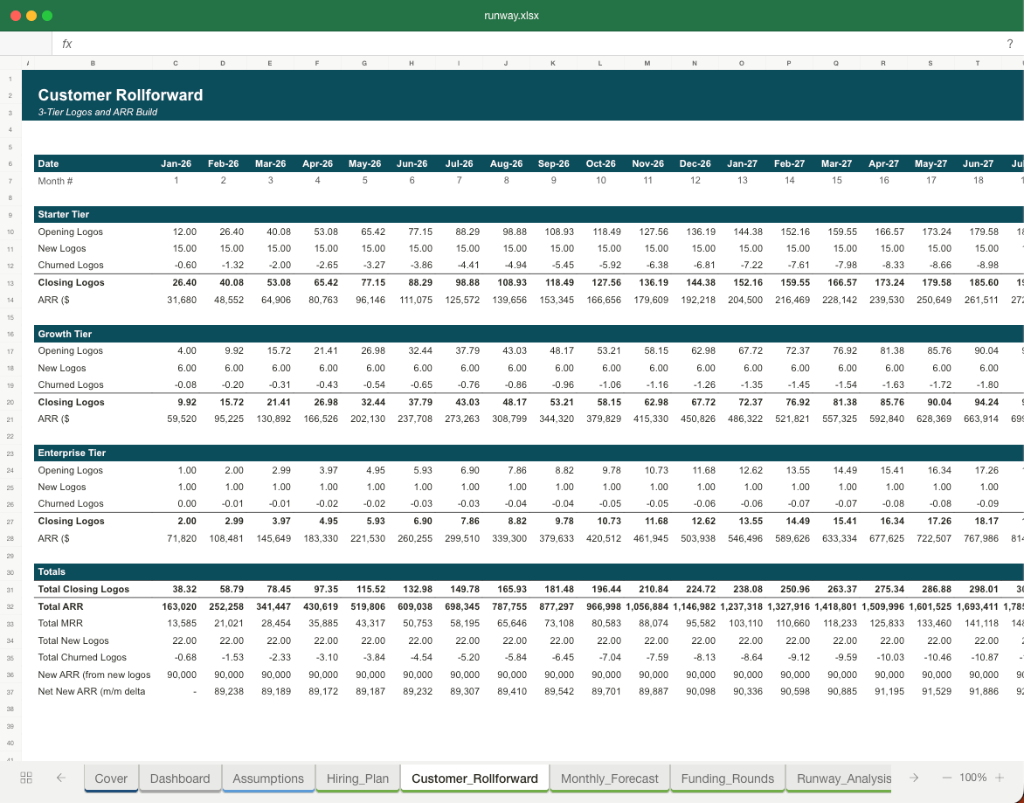
 Skyflow Financial Model
Fintech Startup Financials (Free Excel Download)
API-first Privacy Data Vault - a zero-trust cloud infrastructure layer that isolates, encrypts, and governs sensitive customer data (PII, payments, health) so enterprises can secure and use it simultaneously.



professionals from Deloitte
Used by professionals from






About this model
Skyflow is an API-first Privacy Data Vault that isolates, encrypts, and governs sensitive customer data such as PII, payments, and health information. It lets enterprises use regulated data while reducing their exposure to storing it directly in operational systems.
The product is zero-trust infrastructure, sold through compliance, security, and developer entry points. Its Stripe and Twilio-like positioning suggests an enterprise SaaS relationship with a meaningful consumption component as customers store more records and make more API calls.
The model should forecast enterprise accounts, contracted ARR, implementation timing, vault records, API usage, and expansion. Separate platform licences from usage revenue, then model cloud, security, and support costs against each; long sales cycles and renewal rates are especially important sensitivities.
A turnkey financial model
Live formulas, no hardcoded values
Outputs are driven by live formulas, so the workbook updates from its assumptions instead of relying on hardcoded results.
All assumptions in one tab
Inputs are clearly marked in the Assumptions tab and separated from calculations, making it clear what to change and what to leave intact.
Statements always balancing
For integrated-statement models, the balance sheet, cash flow, and supporting schedules tie through properly.
Distinct schedules for clarity
Debt, working capital, taxes, and cash flow can get messy quickly. We group calculations in clear schedules, not across disconnected tabs.
No hidden macros or external links
There are no unexplained external workbook links or macros to undermine auditability or portability.
Changes flow through the model
Update a key driver and see the impact carry through the forecast, financing, and return outputs. We never use hardcoded numbers in formulas.
About Skyflow
skyflow.com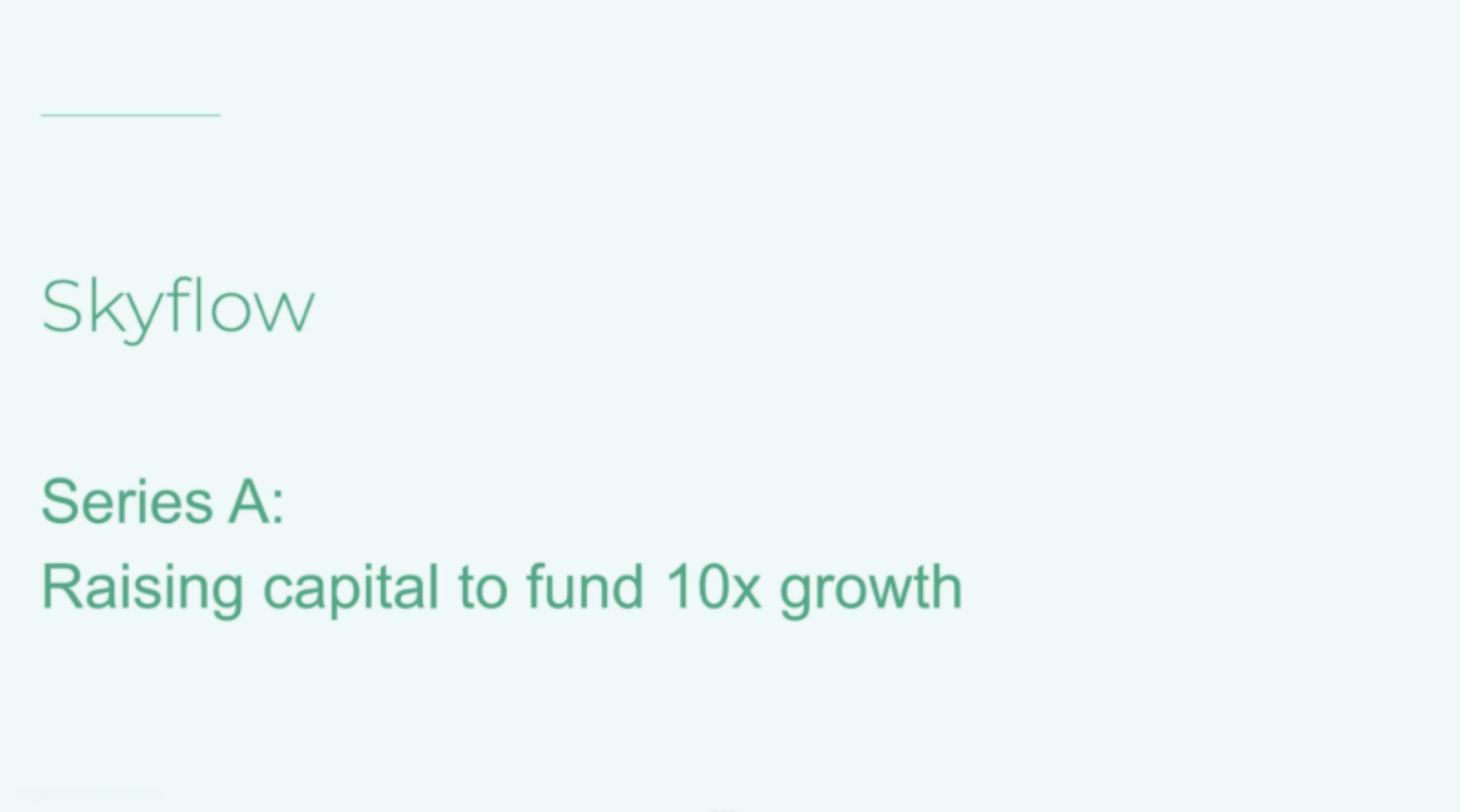
How to build a detailed financial model for Skyflow
A complete walkthrough of the business, drivers, and assumptions behind the downloadable Skyflow model - distilled from its pitch deck and publicly available information.
Product & value proposition
- Privacy Data Vault delivered as REST & SQL APIs
- Three vault archetypes: Payment Vault, Customer Vault, Patient Vault
- Core capabilities: polymorphic encryption, tokenization, access-control policy engine, data residency (US/EU/APAC), audit & provenance, cloud functions, multi-party data sharing, federated ML support
- Positioning: "Stripe for PII" - same simplicity/API abstraction that Stripe brought to card processing, Twilio to telephony
- Zero-trust architecture; designed for GDPR, CCPA, and data-residency compliance
- Sits between the customer's app backend and cloud services (AWS, Okta, etc.)
Market
Competitive framing only: Skyflow positions itself as "Privacy Cloud" alongside Salesforce (CRM Cloud), Okta (Identity Cloud), MongoDB (Database Cloud), Snowflake (Analytics Cloud) - implying an enterprise-cloud-category ambition, not a point-solution.
Revenue model
Implied from product architecture:
- API / consumption-based SaaS - comparable to Stripe/Twilio analogies cited on slide 12; likely priced per API call, per vault record, or per active customer record
- Enterprise subscription tiers possible for large-volume customers with compliance SLAs
- GTM entry points listed as: compliance failure, recent breach, cloud migration, new app build, microservices rewrite - suggesting land-and-expand via developer adoption leading to enterprise contract
Traction & metrics
- Founded: 2019
- Engineering headcount: 35+ engineers
- Prior funding: $7.5M from Foundation Capital
- Marquee logos shown as company background / talent origin: PayPal, Oracle, Lyft, Salesforce, MuleSoft, athenahealth - these appear to be founder/team pedigree logos, not confirmed paying customers
- No revenue, ARR, customer count, growth rate, or NRR disclosed
Competition / moat
- Moat framing: zero-trust vault was previously only buildable by Big Tech (implied by slide 10–11 referencing "leading tech companies had their own data vaults for years") - Skyflow democratizes this
- Competitive landscape not shown with named security/encryption competitors (no HashiCorp Vault, Protegrity, BigID, etc. called out)
- Differentiation claimed: polymorphic encryption, ability to run analytics & ML on fully encrypted data, developer-first APIs, multi-cloud data residency
- Positioning analogy vs. Stripe (payments) and Twilio (telephony) implies a platform/infrastructure moat once embedded in customer stacks
Team & funding ask / use of funds
- CEO: Anshu Sharma - VP Product Salesforce (Force.com, AppExchange, Identity); PM at Oracle; Venture at Storm Ventures; co-founded Suki AI and Clearedin; board member; MS UNC, B.Tech IIT
- CTO: Prakash Khot - EVP & CTO AthenaHealth; SVP Engineering Salesforce; built data & analytics platform; founder & CTO DimDim; Director CA Inc.; 3x founder with exits
- Extended team: VP Cloud Infrastructure (Salesforce), VP Data Cloud (Oracle), CTO & Co-founder Suki Healthcare AI, Self-Driving Cars at Lyft, Architect AthenaHealth, CMO Heroku, PM MuleSoft, Encryption Lead Engineer, Architects at Salesforce and Microsoft
- Seed raised: $7.5M from Foundation Capital
- Series A: amount not disclosed; stated purpose "fund 10x growth"
- Use of funds: not broken out in the deck
Recommended financial model
- Archetype + why: B2B SaaS ARR model with usage/consumption overlay. Skyflow is infrastructure SaaS with developer land-and-expand motion - ARR is the natural top-line metric; a consumption component (API calls, vault records) should layer underneath to capture the usage-based upside the Stripe/Twilio analogy implies.
- Forecast horizon & granularity: 5 years (Year 1–2 monthly, Year 3–5 annual). Series A raise implies 18–24 month runway to Series B milestones; monthly granularity in early years captures cash management for an infrastructure startup pre-profitability.
- Key drivers & assumptions:
| Driver | Value |
|---|---|
| Founding year | 2019 |
| Prior funding | $7.5M seed |
| Engineering headcount at deck date | 35+ |
| New logo adds per quarter (Yr 1) | 3–6 enterprise accounts |
| Average initial ACV | $80K–$150K |
| Net Revenue Retention | 115–130% |
| Gross margin | 70–80% |
| Sales cycle length | 3–6 months |
| CAC (blended) | $40K–$80K |
| LTV/CAC payback | 24–36 months |
| Headcount growth (engineering) | +8–12 engineers/quarter post-Series A |
| Opex as % revenue (Yr 1) | 400–600% (pre-scale) |
| COGS components | Cloud hosting (AWS multi-region), encryption compute, support |
- Scenarios (Base / Bull / Bear - which variables flex):
- Bear: slow enterprise sales cycles, 2 new logos/quarter, ACV $80K, NRR 110% - runway stress-test
- Base: 4 logos/quarter, ACV $120K, NRR 120%, gross margin 75%
- Bull: developer-led PLG virality, 8 logos/quarter, ACV $150K, NRR 135%, faster gross margin expansion
- Required sheets / outputs:
- Assumptions - all drivers, scenario toggle (Base/Bull/Bear)
- ARR Bridge - new ARR, expansion ARR, churn, net new ARR by quarter
- P&L - Revenue, COGS, Gross Profit, S&M, R&D, G&A, EBITDA
- Headcount Plan - Engineering, Sales, CS, G&A; drives opex
- Cash Flow & Runway - operating burn, Series A proceeds, months to zero
- Unit Economics - CAC, LTV, payback period, LTV/CAC ratio
- Dashboard - ARR, customer count, NRR, burn multiple, runway
Frequently asked
Is the Skyflow financial model free?+
Yes. The Skyflow model is a free Excel (.xlsx) download with live formulas. Sign up with your email and the workbook is yours to keep, review, and edit.
What's included in the model?+
A 5-year monthly forecast with P&L, cash flow and runway, valuation (exit multiple plus a DCF cross-check), MOIC/IRR returns, and unit economics, with live formulas throughout.
How was this model built?+
It was built from Skyflow's pitch deck and publicly available information, then structured to investment-banking standards as a fully editable Excel model.
Can I change the assumptions?+
Yes. You can change assumptions and the live formulas will recalculate in the downloadable Excel model.
Have more financial modelling questions? Contact us

Created by ex-finance professionals
Hey, I’m Alex and I created Finamodel.
Over my years in the finance industry I kept building the same models over and over again. Same structure, same assumptions, different logo. So I started building frameworks to turn them into clean, reusable templates.
Every model here is one I’d actually use for a client, and I personally vet each one before it goes up.
I’m not an expert in every industry, but I’ve built enough models to know what belongs in one. And when something is completely foreign to me, I reach out to my network for experts to work on our models with us.
Having a template library on hand cuts a first build from hours to minutes.
Need help finding your model? You’ll find me in the Finamodel app!
Other Fintech Startup Financial Models
Browse another startup in the same category.
Acin
SaaS and data subscription network for operational risk management at Tier 1 financial institutions

Ageras Group
B2B SME ecosystem - marketplace connecting SMEs with accountants + cloud accounting/payroll software + embedded financial services (lending, factoring, banking)

Airbase
Unified non-payroll spend management platform (corporate cards, AP/bill pay, expense reimbursement, approval workflows) for mid-market companies.

Altruist
Vertically integrated all-in-one platform for registered investment advisors (RIAs) - combining custodial, portfolio management, practice management, and client acquisition tools.
Amenitiz
All-in-one hotel management SaaS platform ("Shopify for hotels") for independent hoteliers - PMS, booking engine, channel manager, website builder, payments, and AI-driven revenue management.

Anrok
SaaS sales tax compliance platform - nexus monitoring, calculation, registration, filing, and remittance - built specifically for SaaS companies.
Arrival
Arrival is an EV manufacturer of commercial vans and buses using proprietary Microfactories and vertically integrated components, going public via SPAC merger with CIIG Merger Corp.

AtoB
AtoB is building financial infrastructure for commercial fleets, starting with a no-fee Visa fleet card for fuel and expanding into payroll, BNPL, and international.