 Sora Financial Model
Fintech Startup Financials (Free Excel Download)
Live, virtual, project-based high school targeting homeschool families seeking an accredited, community-driven alternative to traditional education.



professionals from Deloitte
Used by professionals from






About this model
Sora is a live, virtual, project-based high school for homeschool families seeking an accredited, community-driven alternative to conventional education. It combines online instruction with a model intended to be more engaging and flexible than a standard remote classroom.
The business is a direct-to-family education provider, not a software vendor. Monthly tuition is the core revenue source, with its pricing expected to sit between low-cost umbrella schools and premium online academic programmes.
The model should forecast student applications, enrolment, cohort intake, monthly tuition, retention, and seasonal capacity. Faculty, curriculum, student support, and technology delivery costs should be tied to active learners and class size, making the education-service gross margin explicit.
A turnkey financial model
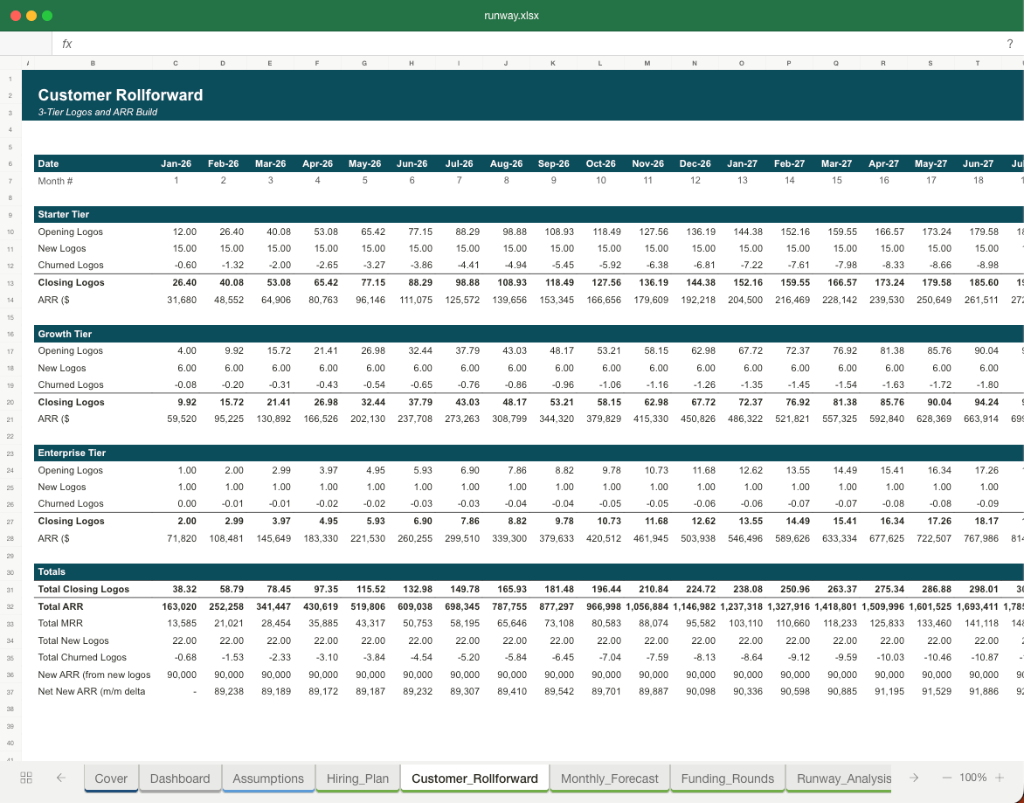
Live formulas, no hardcoded values
Outputs are driven by live formulas, so the workbook updates from its assumptions instead of relying on hardcoded results.
All assumptions in one tab
Inputs are clearly marked in the Assumptions tab and separated from calculations, making it clear what to change and what to leave intact.
Statements always balancing
For integrated-statement models, the balance sheet, cash flow, and supporting schedules tie through properly.
Distinct schedules for clarity
Debt, working capital, taxes, and cash flow can get messy quickly. We group calculations in clear schedules, not across disconnected tabs.
No hidden macros or external links
There are no unexplained external workbook links or macros to undermine auditability or portability.
Changes flow through the model
Update a key driver and see the impact carry through the forecast, financing, and return outputs. We never use hardcoded numbers in formulas.
About Sora
soraschools.com
How to build a detailed financial model for Sora
A complete walkthrough of the business, drivers, and assumptions behind the downloadable Sora model - distilled from its pitch deck and publicly available information.
Product & value proposition
- Fully accredited virtual high school operating on a cohort/house model.
- Curriculum is personalized and project-based (PBL), not lecture-driven.
- Self-paced personal learning plans built with expert guidance.
- Software-enabled but human-led: proprietary LMS for organization and tracking.
- Community focus: student houses, group projects designed to replicate peer social environment.
- Life-skills component (procrastination, habit formation, mentorship).
- Future programs: Work+Study (full tuition offset via real-world work, starting September); Learning Pods (academic engine for pandemic pods); White-Labeling for colleges.
Market
- 3% of US population homeschooled pre-COVID (~9.9M people; 31% being high school age ≈ 3.1M high schoolers).
- 7% of US families said they would prefer homeschooling if possible.
- 40% of families more likely to homeschool permanently after COVID lockdowns.
- Homeschool growth: 13K (1973) → 93K (1983) → 275K (1990) → 1.0M (1997) → 1.4M (2003) → 1.92M (2007) → 2.3M (2016) home-educated students in the US.
- Homeschool families skew higher income (>$70K), comparable to private school families.
- No explicit TAM/SAM/SOM dollar figures in deck.
- Implied addressable market: ~3.1M US high-school-age homeschoolers, growing rapidly post-COVID. Dollar TAM: if 3.1M students × $300–$400/mo average price → $11B–$15B/yr gross TAM; realistic SAM is the premium/structured-program segment.
Revenue model
- Monthly tuition subscription, per student.
- Sora's own price not stated in deck. Competitive pricing context:
- Stanford OHS: $2,690+/mo (high end)
- UT High School: $380/mo (mid)
- Generic umbrella school: ~$50/mo (low end)
- Sora likely positions between $380–$800/mo to be meaningfully better than UT but more accessible than Stanford; no deck confirmation.
- Future Work+Study program aims to fully offset tuition via student work placement revenue - revenue model for this not detailed.
- White-labeling for colleges mentioned as future revenue stream - not modeled at seed stage.
- Channels: primarily direct/organic (no paid acquisition channel described beyond hiring a Head of Growth).
Traction & metrics
- Testimonials from enrolled students and parents cited but no enrollment count, revenue figure, cohort size, or growth rate disclosed.
- Work+Study pilot starting in September - implies early/pre-launch stage at time of deck.
- No MRR, ARR, student count, churn rate, NPS, or retention figures disclosed in deck.
Competition / moat
- Competitive set identified:
- Stanford Online High School ($2,690+/mo) - traditional lecture, high exclusivity.
- UT High School ($380/mo) - video + test model, low engagement.
- Generic umbrella schools (~$50/mo) - legal/admin only, no academic support.
- Sora's differentiation: live/cohort community, personalized PBL curriculum, life-skills focus, software-enabled facilitation.
- Moat: network effects within cohort/house model; brand as the premium-but-accessible community-driven option; advisor network (Rocketship Education, Lambda School, Outschool, Connections Academy pedigree).
Team & funding ask / use of funds
Founding Team:
- Wesley Samples - BSBA Georgia Tech; Co-founder Elevate Media; Former Director Startup Exchange; Former VP Contrary Capital.
- Garrett Smiley - Former CS Georgia Tech; ran startup incubator; co-founded two charities (one in education); VP Contrary Capital; True Ventures Fellow.
- Indra Sofian - BSBA Georgia Tech; Co-founder Elevate Media; Former Director intern.community; Former VP Contrary Capital; Future Founders Fellow.
Faculty:
- Carolyn Reeves - STEM Learning Expert, Masters in Math, former software engineer.
- Brandy Daniels - Counselor, Masters from Emory, former CDC researcher, certified life coach.
- Michael Granado - Humanities Learning Expert, PhD candidate, long-time college professor.
Advisors:
- John Danner - Founder/investor at Rocketship Education, Lambda School, Outschool.
- Chris Mahoney - Head of School, Spark Academy / SPARK Charter School.
- Linda Lefttrict - VP and early employee, Connections Academy.
Funding ask:
- Target Capital: $2.5M seed round.
- Use of funds:
- 2× software engineers (LMS development)
- Head of Work+Study program
- Head of Growth + monthly marketing budget
- Curriculum Developer
Recommended financial model
- Archetype + why: Subscription / tuition enrollment model (B2C EdTech). Revenue is monthly recurring per enrolled student; model should track cohort intake, enrollment capacity, churn, and COGS (faculty + curriculum + software). Closest archetype: consumer subscription with cohort seasonality. Not SaaS (no software self-serve); not marketplace. A lightweight 3-statement is appropriate given seed stage with no disclosed traction.
- Forecast horizon & granularity: 3 years (Y1–Y3), monthly for Y1, quarterly for Y2–Y3. School operates on academic-year cycles so seasonality (September intake, mid-year adds, summer churn) must be captured.
- Key drivers & assumptions:
- Monthly tuition per student: ~$500/mo (between UT $380 and Stanford $2,690; premium community positioning); sensitivity: $300–$800/mo range.
- Starting enrolled students (Y1 launch cohort): 20–50 students; no deck data.
- Student growth rate (new cohorts per semester): 50–100% YoY in Y1–Y2, moderating to 30% in Y3 as capacity scales.
- Churn rate (annual): 15–20%/yr (homeschool families re-evaluate annually; no deck data).
- Faculty cost per student: ~$100–$150/mo fully loaded (ratio of 1 learning expert per 15–20 students); scales with enrollment.
- LMS / software COGS: ~$20–$30/student/mo once built; higher initially.
- Gross margin target: 60–70% at scale (comparable to online education peers); ~30–40% at seed-stage volumes.
- CAC: $500–$1,500 per student (content/community-led early, paid post-round); no deck data.
- LTV: 2–4 year average enrollment × $500/mo = $12K–$24K gross LTV.
- Work+Study revenue offset: modeled as $0 in base case (pilot only, no financials disclosed).
- Headcount from round use: 2× eng + 3× non-tech hires = $800K–$1.2M/yr salary burn post-hire.
- Runway on $2.5M raise: 18–24 months at seed-stage burn before revenue scales.
- Marketing budget: 15–20% of raise allocated to growth budget.
- Scenarios (Base / Bull / Bear - which variables flex):
- Bear: slow cohort ramp (20 students Y1, 50% annual growth), higher churn (25%), $400/mo price point; hits profitability late Y3 or not at all on $2.5M.
- Base: 40 students Y1, 80% YoY growth, 15% churn, $500/mo; cash-flow positive mid-Y3.
- Bull: 80 students Y1 (strong post-COVID demand), 100% YoY growth, $600/mo price, Work+Study reduces COGS; cash-flow positive late Y2.
- Primary flex variables: enrollment ramp, price/MRR per student, churn rate, CAC.
- Required sheets / outputs:
- Assumptions (all toggleable drivers)
- Enrollment Model (student intake, churn, ending enrollment by month)
- Revenue (MRR / ARR bridge)
- COGS & Gross Margin (faculty, LMS, content costs)
- Headcount & Opex (salaries, marketing, G&A)
- P&L (Income Statement)
- Cash Flow & Runway (monthly burn, cash balance on $2.5M raise)
- Unit Economics summary (CAC, LTV, LTV/CAC, payback period)
Frequently asked
Is the Sora financial model free?+
Yes. The Sora model is a free Excel (.xlsx) download with live formulas. Sign up with your email and the workbook is yours to keep, review, and edit.
What's included in the model?+
A 5-year monthly forecast with P&L, cash flow and runway, valuation (exit multiple plus a DCF cross-check), MOIC/IRR returns, and unit economics, with live formulas throughout.
How was this model built?+
It was built from Sora's pitch deck and publicly available information, then structured to investment-banking standards as a fully editable Excel model.
Can I change the assumptions?+
Yes. You can change assumptions and the live formulas will recalculate in the downloadable Excel model.
Have more financial modelling questions? Contact us

Created by ex-finance professionals
Hey, I’m Alex and I created Finamodel.
Over my years in the finance industry I kept building the same models over and over again. Same structure, same assumptions, different logo. So I started building frameworks to turn them into clean, reusable templates.
Every model here is one I’d actually use for a client, and I personally vet each one before it goes up.
I’m not an expert in every industry, but I’ve built enough models to know what belongs in one. And when something is completely foreign to me, I reach out to my network for experts to work on our models with us.
Having a template library on hand cuts a first build from hours to minutes.
Need help finding your model? You’ll find me in the Finamodel app!
Other Fintech Startup Financial Models
Browse another startup in the same category.
Acin
SaaS and data subscription network for operational risk management at Tier 1 financial institutions

Ageras Group
B2B SME ecosystem - marketplace connecting SMEs with accountants + cloud accounting/payroll software + embedded financial services (lending, factoring, banking)

Airbase
Unified non-payroll spend management platform (corporate cards, AP/bill pay, expense reimbursement, approval workflows) for mid-market companies.

Altruist
Vertically integrated all-in-one platform for registered investment advisors (RIAs) - combining custodial, portfolio management, practice management, and client acquisition tools.
Amenitiz
All-in-one hotel management SaaS platform ("Shopify for hotels") for independent hoteliers - PMS, booking engine, channel manager, website builder, payments, and AI-driven revenue management.

Anrok
SaaS sales tax compliance platform - nexus monitoring, calculation, registration, filing, and remittance - built specifically for SaaS companies.
Arrival
Arrival is an EV manufacturer of commercial vans and buses using proprietary Microfactories and vertically integrated components, going public via SPAC merger with CIIG Merger Corp.

AtoB
AtoB is building financial infrastructure for commercial fleets, starting with a no-fee Visa fleet card for fuel and expanding into payroll, BNPL, and international.