SPSplitBrick Financial Model
Fintech Startup Financials (Free Excel Download)
Fractionalized real-estate investing platform where users crowd-source property acquisitions and co-own shares ("Bricks") via per-property LLCs.



professionals from Deloitte
Used by professionals from






About this model
SplitBrick is a fractional real-estate investing platform where users crowd-source property acquisitions and co-own shares, or Bricks, through property-specific LLCs. It gives smaller investors access to direct property ownership and potential rental income.
The platform earns a 5% onboarding fee at acquisition, a 10% share of net rental profits, and may add a 1% commission on future Brick trading. There is no annual AUM fee, so transaction volume and property performance drive its economics.
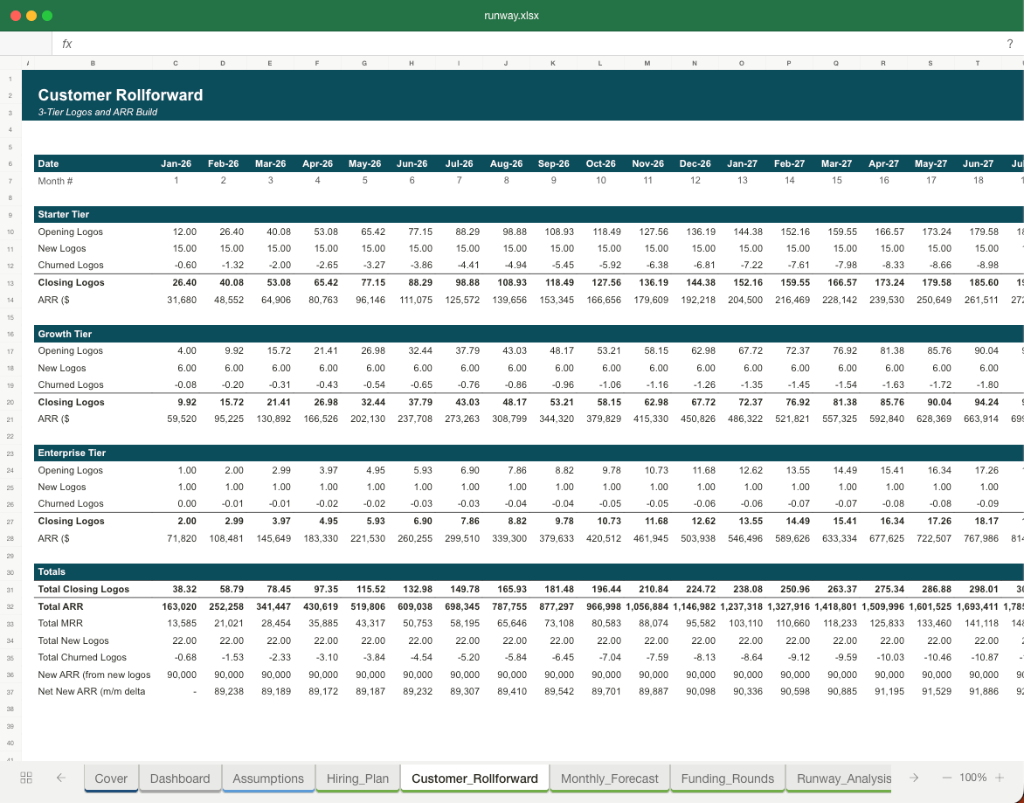
The model should forecast properties listed and funded, average acquisition value, onboarding-fee yield, occupied rental income, property expenses, and profit-share revenue. A future secondary-market module can add trading volume and commissions, while legal, property, and investor-servicing costs remain visible.
A turnkey financial model
Live formulas, no hardcoded values
Outputs are driven by live formulas, so the workbook updates from its assumptions instead of relying on hardcoded results.
All assumptions in one tab
Inputs are clearly marked in the Assumptions tab and separated from calculations, making it clear what to change and what to leave intact.
Statements always balancing
For integrated-statement models, the balance sheet, cash flow, and supporting schedules tie through properly.
Distinct schedules for clarity
Debt, working capital, taxes, and cash flow can get messy quickly. We group calculations in clear schedules, not across disconnected tabs.
No hidden macros or external links
There are no unexplained external workbook links or macros to undermine auditability or portability.
Changes flow through the model
Update a key driver and see the impact carry through the forecast, financing, and return outputs. We never use hardcoded numbers in formulas.
About SplitBrick
splitbrick.finance
How to build a detailed financial model for SplitBrick
A complete walkthrough of the business, drivers, and assumptions behind the downloadable SplitBrick model - distilled from its pitch deck and publicly available information.
Product & value proposition
- Users propose properties; other users bid collectively via a crowdfunding algorithm that discovers market price in real time ("ISO" - Initial SplitBrick Offering).
- Platform acquires the property; each property is held in its own LLC; ownership is pro-rata to Bricks held.
- Owners can trade Bricks (planned feature, pending legal completion) and govern properties via weighted democratic voting.
- Integrated with Plaid (banking verification) and Dwolla (transfers); 2FA via email/authenticator.
- Value prop vs. alternatives: lower fees than RealT/Here/Landa; full property-choice autonomy; no accredited-investor requirement.
Market
- 23% of Americans say real estate is the best way to grow personal wealth, yet only 12% actually invest in it.
- 40% of Americans have no financial investments; of those: 47% cite lack of funds, 19% don't know how to invest, 16% fear risk.
- 14.1M individual landlords own 1–4 units in the US (2018 data) - SplitBrick's target supply-side.
- No explicit TAM/SAM/SOM dollar figures in deck.
Revenue model
All fees are on a per-property basis:
- Onboarding Fee: 5% of property acquisition price (charged at ISO close).
- Profit Sharing Fee: 10% of net rental income/profits distributed to owners.
- Trading Commission: 1% per Brick trade (feature not yet live, pending legal).
- Annual AUM Fee: 0%.
- Gross Revenue Fee: 0%.
- Offboarding Fee: 0%.
Revenue events per property lifecycle: (1) acquisition → onboarding fee; (2) ongoing rental income → profit-share; (3) secondary Brick trading → commission.
Traction & metrics
- Revenue: $0 (no live transactions; MVP only).
- Email signup list: 96 prospective investors acquired via landing page (2022 Q3).
- Total invested by co-founders: $205k (bootstrapped from savings).
- MVP web + mobile platforms completed 2023 Q2.
- Demo data visible in app screenshots (NAV $1,935,890.81; sample properties in Philadelphia, Miami, Inglewood, Houston) - these appear to be test/demo data, not live AUM.
Unit economics
- No CAC or LTV figures in deck.
- Implied gross margin structure:
- Onboarding: 5% of property value (likely near-100% gross margin after due-diligence/legal cost).
- Profit share: 10% of net rental income distributed (platform skims before payout).
- Property manager fee shown in demo: 10% of gross rent; this is passed through to the elected property manager, not retained by SplitBrick.
- No explicit CAC, LTV, or payback period stated.
Competition / moat
Competitors named: RealT, Here, Landa. SplitBrick differentiators:
- Crowd-sourced property selection (vs. sponsor-curated at competitors).
- Democratic governance / voting rights (vs. no autonomy at competitors).
- Lower fee stack: 0% AUM, 0% gross revenue, 0% offboarding vs. RealT (1%/2%/10%) and Here (1%/25%/N/A).
- Real-time market price discovery algorithm for valuation (claimed novel).
- Open to non-accredited investors (vs. some competitors restricting to accredited).
Team & funding ask / use of funds
Team:
- Veb Anand (co-founder): CS + Business Economics, Caltech 2019; data science/software dev at analytics startup; equities analyst at hedge fund ($48B AUM).
- Pedro Ojeda (co-founder): Bioengineering Caltech + Immunology Harvard; founder of consulting firm; private real estate developer.
- James Fox (engineer): CS, University of Nebraska 2020; full-stack dev (BuilderTrend, Ideal Industries, QSRSoft).
- Maria Ojeda (legal): JD + LLM in Real Property Development, University of Miami; real estate acquisition/leasing counsel.
Funding ask:
- Target: ~$200k seed round.
- Use of funds: ~1 year runway + accelerated marketing ($5–10k) + legal work to enable Brick trading.
- Current burn: ~$160k/yr (1 FT dev $120k + legal/accounting ~$12k + other ~$15k + $0 marketing).
- Total self-funded to date: $205k.
Recommended financial model
- Archetype + why: Marketplace / platform P&L model. SplitBrick earns transaction fees on property acquisitions (onboarding) and a revenue-share on rental income, plus future trading commissions. This is closest to a real-estate marketplace with a recurring revenue tail (profit-share) per property on platform. Not SaaS (no subscription), not a REIT (they don't hold assets on balance sheet long-term in their own right), not a 3-statement operating model at this stage. A marketplace GMV model (total property value onboarded = GMV; fees = take rate) is the right frame.
- Forecast horizon & granularity: 5 years (2024–2028), monthly for Year 1 (pre-revenue ramp), annual thereafter. Company is pre-revenue so early months are burn-only.
- Key drivers & assumptions:
- Number of properties onboarded per month - start 0, ramp to 1–2/month by end of Year 1 post-marketing spend; rationale: 96 interested investors on list, single team, legal complexity limits throughput.
- Average property acquisition value (AUM per property) - $500k–$1M; rationale: demo properties in deck range from $289k to $4.2M market cap; mid-market single-family/condo likely target for MVP.
- Onboarding fee rate: 5% of acquisition price.
- Average gross annual rent per property - 6–8% of property value (cap rate); rationale: demo properties show cap rates of 1%–13%, with a mid-market assumption of 6%.
- Profit-share fee rate: 10% of net rental income; net rental income after property manager (10% of gross) and taxes/misc expenses.
- Trading commission: 1% per Brick trade - zero revenue until legal processes complete (Year 2+); trading volume 5–15% of Bricks outstanding per year.
- Brick price per property: property value / number of Bricks issued; deck demo shows 1,250–10,000 Bricks per property.
- Burn rate: $160k/yr fixed; add $5–10k marketing starting Year 1; headcount scale +1 dev in Year 2 at ~$120k, +marketing hire in Year 3.
- Raise: $200k seed; no mention of equity terms or valuation.
- Customer acquisition: email-list conversion (96 leads) → first ISO backers; organic + paid social thereafter; CAC not in deck.
- Churn / re-investment rate: low churn given illiquid positions until trading enabled; model as stickiness proxy.
- Scenarios (Base / Bull / Bear - which variables flex):
- Base: 1 property/month by Month 12; avg $600k property value; trading enabled Year 2.
- Bull: 3 properties/month by Month 12; avg $800k; faster legal resolution; trading live Year 1 H2.
- Bear: Legal delays push trading to Year 3; only 0.5 properties/month; burn exceeds $200k raise, requiring bridge.
- Required sheets / outputs:
- Assumptions - all drivers with Base/Bull/Bear toggles.
- Property Pipeline - monthly new properties onboarded, cumulative AUM on platform.
- Revenue Build - onboarding fee revenue, profit-share revenue, trading commission revenue, total net revenue.
- Opex / Burn - headcount, legal, marketing, other; total monthly burn.
- P&L - Revenue less Opex; path to breakeven.
- Cash / Runway - starting cash ($200k raise), monthly net cash flow, months of runway.
- Dashboard - KPIs: properties on platform, total AUM, monthly revenue, gross margin, runway.
Frequently asked
Is the SplitBrick financial model free?+
Yes. The SplitBrick model is a free Excel (.xlsx) download with live formulas. Sign up with your email and the workbook is yours to keep, review, and edit.
What's included in the model?+
A 5-year monthly forecast with P&L, cash flow and runway, valuation (exit multiple plus a DCF cross-check), MOIC/IRR returns, and unit economics, with live formulas throughout.
How was this model built?+
It was built from SplitBrick's pitch deck and publicly available information, then structured to investment-banking standards as a fully editable Excel model.
Can I change the assumptions?+
Yes. You can change assumptions and the live formulas will recalculate in the downloadable Excel model.
Have more financial modelling questions? Contact us

Created by ex-finance professionals
Hey, I’m Alex and I created Finamodel.
Over my years in the finance industry I kept building the same models over and over again. Same structure, same assumptions, different logo. So I started building frameworks to turn them into clean, reusable templates.
Every model here is one I’d actually use for a client, and I personally vet each one before it goes up.
I’m not an expert in every industry, but I’ve built enough models to know what belongs in one. And when something is completely foreign to me, I reach out to my network for experts to work on our models with us.
Having a template library on hand cuts a first build from hours to minutes.
Need help finding your model? You’ll find me in the Finamodel app!
Other Fintech Startup Financial Models
Browse another startup in the same category.
Acin
SaaS and data subscription network for operational risk management at Tier 1 financial institutions

Ageras Group
B2B SME ecosystem - marketplace connecting SMEs with accountants + cloud accounting/payroll software + embedded financial services (lending, factoring, banking)

Airbase
Unified non-payroll spend management platform (corporate cards, AP/bill pay, expense reimbursement, approval workflows) for mid-market companies.

Altruist
Vertically integrated all-in-one platform for registered investment advisors (RIAs) - combining custodial, portfolio management, practice management, and client acquisition tools.
Amenitiz
All-in-one hotel management SaaS platform ("Shopify for hotels") for independent hoteliers - PMS, booking engine, channel manager, website builder, payments, and AI-driven revenue management.

Anrok
SaaS sales tax compliance platform - nexus monitoring, calculation, registration, filing, and remittance - built specifically for SaaS companies.
Arrival
Arrival is an EV manufacturer of commercial vans and buses using proprietary Microfactories and vertically integrated components, going public via SPAC merger with CIIG Merger Corp.

AtoB
AtoB is building financial infrastructure for commercial fleets, starting with a no-fee Visa fleet card for fuel and expanding into payroll, BNPL, and international.