SLSpring Labs Financial Model
Fintech Startup Financials (Free Excel Download)
Secure data exchange protocol and product suite enabling financial institutions to share sensitive data without exposing the underlying data.



professionals from Deloitte
Used by professionals from






About this model
Spring Labs provides a secure data-exchange protocol and product suite that lets financial institutions share sensitive data without revealing the underlying information. It is infrastructure for collaboration where privacy, compliance, and data control are central constraints.
The company’s live PACE Network and MainNet products point to a B2B institutional network model, with additional middleware products expanding potential use cases. Commercially, participants are expected to pay recurring contracts or usage fees rather than consumer-facing charges.
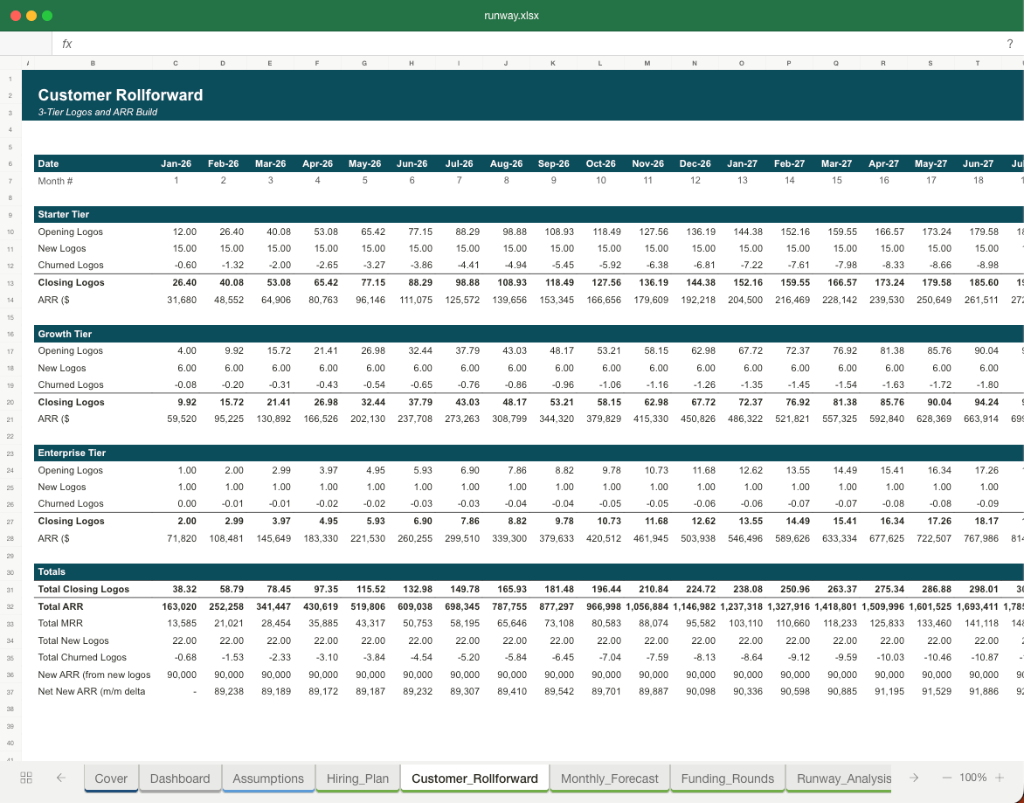
The model should forecast institutional participants, annual contract value, live network connections, query or API volume, and expansion into new products. Subscription and usage revenue should be separate, while implementation, security, data-governance, and network-operating costs determine gross margin.
A turnkey financial model
Live formulas, no hardcoded values
Outputs are driven by live formulas, so the workbook updates from its assumptions instead of relying on hardcoded results.
All assumptions in one tab
Inputs are clearly marked in the Assumptions tab and separated from calculations, making it clear what to change and what to leave intact.
Statements always balancing
For integrated-statement models, the balance sheet, cash flow, and supporting schedules tie through properly.
Distinct schedules for clarity
Debt, working capital, taxes, and cash flow can get messy quickly. We group calculations in clear schedules, not across disconnected tabs.
No hidden macros or external links
There are no unexplained external workbook links or macros to undermine auditability or portability.
Changes flow through the model
Update a key driver and see the impact carry through the forecast, financing, and return outputs. We never use hardcoded numbers in formulas.
About Spring Labs
springlabs.com
How to build a detailed financial model for Spring Labs
A complete walkthrough of the business, drivers, and assumptions behind the downloadable Spring Labs model - distilled from its pitch deck and publicly available information.
Product & value proposition
Spring Labs (legal entity: Springcoin, Inc.) has built the Spring Protocol - a patent-protected cryptographic data-sharing layer that lets institutions exchange sensitive information without revealing underlying data. Key properties: trustless & deterministic, data agnostic, graph analysis enabled, flexible entity resolution.
Four products built on the protocol:
- PACE Network - Detects loan stacking in the PACE (Property Assessed Clean Energy) lending industry. Live. Claims 100% industry coverage.
- MainNet - Fraud and income data sharing, income stability data between financial institutions. Live.
- Crypto Middleware - Identity verification, AML/KYC, synthetic-identity detection; bridges off-chain and on-chain ecosystems. In Development; Coming Q3 2021.
- Spring Index - Tokenized black/white lists for threat-data sharing between competitive parties. Early Development; Coming Q4 2021.
Market
No formal TAM/SAM/SOM slide. Two proxy figures cited in the competitive landscape:
- Give-to-Get data sharing models: >$85bn - context suggests this is market size or aggregate value of the incumbent model segment (label partially obscured in image).
- Screen scrapers & aggregators (example company): $13.4bn - appears to be the valuation of an example aggregator (Varo/Chime logos visible), not a market size figure.
No growth rate, CAGR, or addressable market breakdown provided.
Revenue model
Not explicitly stated in the deck. Inferred structure based on product descriptions:
- PACE Network and MainNet are "Live" - revenue likely B2B subscription or per-query/API-call fees paid by financial institution participants.
- The protocol is positioned as infrastructure; products on top presumably carry the commercial model.
- No pricing tiers, contract values, or revenue per customer disclosed.
Traction & metrics
- Total equity funding raised to-date: $38.75M.
- PACE Network: "100% industry coverage" in PACE loan stacking detection.
- MainNet: Live (no customer count, revenue, or query volume stated).
- No revenue, ARR, customer count, growth rate, or transaction volume figures provided.
Competition / moat
Competitive framing:
- Positioned against Give-to-Get bureau models (siloed, centralized, high infosec risk) and screen-scrapers/aggregators (high infosec risk, low consumer trust, no enterprise monetization).
- Moat articulated as: patent-protected cryptographic protocol, no active middleman (direct exchange), data ownership preserved, incentive design for participants to share, broad institutional coverage (claimed 100% PACE industry).
- No named direct competitors in the deck.
Team & funding ask / use of funds
Team:
- Adam Jiwan - Co-founder, Executive Chairman
- John Sun - Co-founder, CEO
- Anna Fridman - Co-founder
- Prior company building experience: Amount, Avant, Digital Disbursements, Future Finance.
Advisors: Sheila Bair (FDIC Chair), Nigel Morris (Capital One co-founder), Bobby Mehta (TransUnion CEO), Gary Cohn (Goldman Sachs President), Ray Lane (Oracle President / HP Chairman), Manolo Sanchez (BBVA Compass Chairman & CEO), Raj Date (CFPB Deputy Director), Brian Brooks (OCC Comptroller).
Funding: $38.75M total equity raised to-date. No current round size, valuation, or use of funds disclosed.
Recommended financial model
- Archetype + why: B2B SaaS / API data network model. Revenue is best modeled as recurring enterprise contracts (annual subscription or per-query fees) from institutional participants. Two revenue streams: (1) live products (PACE Network, MainNet) - fee-per-participant or per-API-call; (2) future products (Crypto Middleware, Spring Index) launching H2 2021. A network-effects layer matters: each new participant increases protocol value, so a participant-count driver is key. Not a 3-statement model at this stage - focus on ARR build, burn, and runway.
- Forecast horizon & granularity: 3 years (2021–2023), monthly for Year 1 (to capture H2 2021 product launches), quarterly for Years 2–3.
- Key drivers & assumptions:
- PACE Network participant count: start at 100% industry coverage as stated; monetize at $X/participant/year - no pricing in deck. Model sensitivity to $5K–$50K ACV.
- MainNet participant count: starting cohort unknown; assume 10–30 institutions at launch, grow 50–100% YoY.
- PACE Network ACV: $20K/institution/year as base case (placeholder; needs validation).
- MainNet ACV: $30K/institution/year (fraud/income data commands premium).
- Crypto Middleware launch: Q3 2021; assume 6-month sales cycle → first revenue Q1 2022.
- Spring Index launch: Q4 2021; assume longer sales cycle for threat-sharing product → first revenue Q2 2022.
- Gross margin: 70–80% (software/API model, minimal COGS).
- Revenue share or protocol fee: unclear if Spring charges a protocol fee in addition to product fees - flag as open question.
- Scenarios (Base / Bull / Bear - which variables flex):
- Bear: PACE Network saturates quickly (small industry), MainNet adoption slow (6 months delay), crypto products delayed to 2022; ACV at low end ($10K).
- Base: Steady participant ramp per above; crypto products launch on schedule; ACV at $20–30K.
- Bull: MainNet scales rapidly across 50+ institutions by end-2022; Crypto Middleware becomes primary revenue driver given market tailwinds; ACV achieves $50K+ with large bank deals.
- Required sheets / outputs:
- Assumptions - participant counts, ACV, growth rates, product launch timeline.
- Revenue build - by product (PACE, MainNet, Crypto Middleware, Spring Index); ARR waterfall.
- P&L - Revenue, gross profit, opex (headcount, R&D, S&M, G&A), EBITDA, net loss.
- Cash / Runway - starting cash (implied from $38.75M raised, unknown burn history), monthly burn, runway months.
- KPI dashboard - ARR, participant count by product, net new ARR, gross margin %.
Frequently asked
Is the Spring Labs financial model free?+
Yes. The Spring Labs model is a free Excel (.xlsx) download with live formulas. Sign up with your email and the workbook is yours to keep, review, and edit.
What's included in the model?+
A 5-year monthly forecast with P&L, cash flow and runway, valuation (exit multiple plus a DCF cross-check), MOIC/IRR returns, and unit economics, with live formulas throughout.
How was this model built?+
It was built from Spring Labs's pitch deck and publicly available information, then structured to investment-banking standards as a fully editable Excel model.
Can I change the assumptions?+
Yes. You can change assumptions and the live formulas will recalculate in the downloadable Excel model.
Have more financial modelling questions? Contact us

Created by ex-finance professionals
Hey, I’m Alex and I created Finamodel.
Over my years in the finance industry I kept building the same models over and over again. Same structure, same assumptions, different logo. So I started building frameworks to turn them into clean, reusable templates.
Every model here is one I’d actually use for a client, and I personally vet each one before it goes up.
I’m not an expert in every industry, but I’ve built enough models to know what belongs in one. And when something is completely foreign to me, I reach out to my network for experts to work on our models with us.
Having a template library on hand cuts a first build from hours to minutes.
Need help finding your model? You’ll find me in the Finamodel app!
Other Fintech Startup Financial Models
Browse another startup in the same category.
Acin
SaaS and data subscription network for operational risk management at Tier 1 financial institutions

Ageras Group
B2B SME ecosystem - marketplace connecting SMEs with accountants + cloud accounting/payroll software + embedded financial services (lending, factoring, banking)

Airbase
Unified non-payroll spend management platform (corporate cards, AP/bill pay, expense reimbursement, approval workflows) for mid-market companies.

Altruist
Vertically integrated all-in-one platform for registered investment advisors (RIAs) - combining custodial, portfolio management, practice management, and client acquisition tools.
Amenitiz
All-in-one hotel management SaaS platform ("Shopify for hotels") for independent hoteliers - PMS, booking engine, channel manager, website builder, payments, and AI-driven revenue management.

Anrok
SaaS sales tax compliance platform - nexus monitoring, calculation, registration, filing, and remittance - built specifically for SaaS companies.
Arrival
Arrival is an EV manufacturer of commercial vans and buses using proprietary Microfactories and vertically integrated components, going public via SPAC merger with CIIG Merger Corp.

AtoB
AtoB is building financial infrastructure for commercial fleets, starting with a no-fee Visa fleet card for fuel and expanding into payroll, BNPL, and international.