 StudySmarter Financial Model
Marketplace Startup Financials (Free Excel Download)
All-in-one AI-powered learning platform connecting students with study tools, content, and employers.



professionals from Deloitte
Used by professionals from






About this model
StudySmarter is an AI-powered learning platform offering flashcards, notes, quizzes, study plans, spaced repetition, and collaborative learning communities. It also connects its large student audience with publishers, universities, and employers through content and recruitment products.
The company reported more than three million users, 50 million flashcards, and five million created courses within roughly a year and a half. Its commercial model combines a likely consumer freemium subscription with employer recruitment access and potential university licensing, rather than relying on one revenue line.
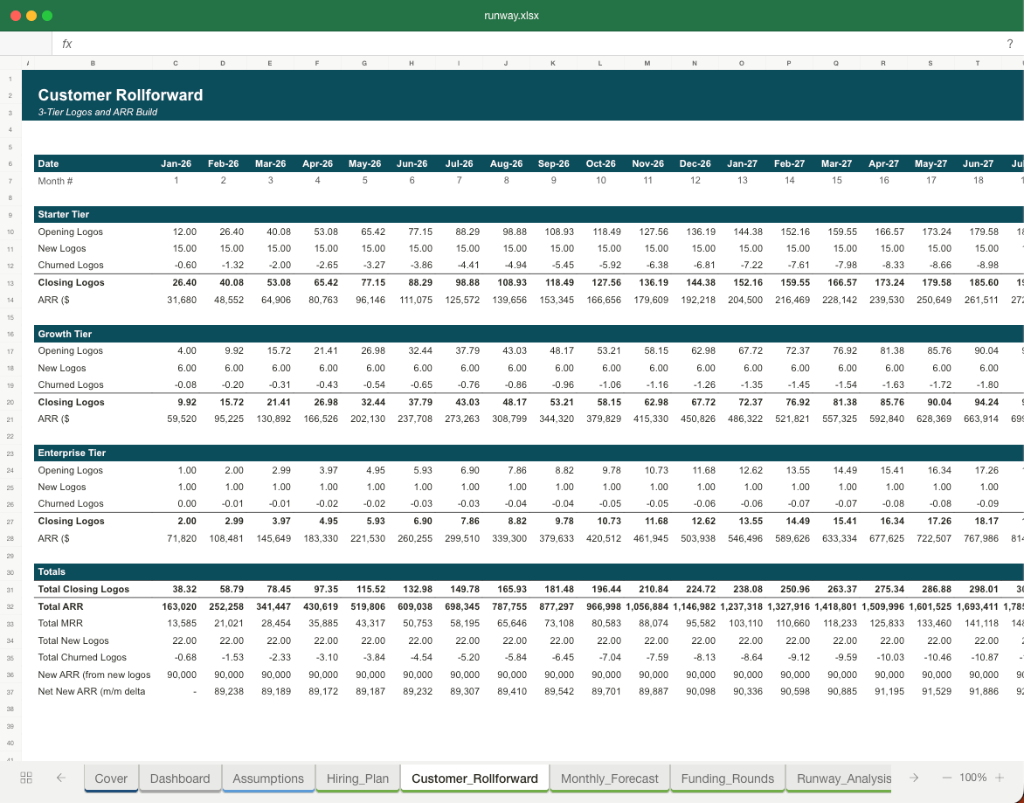
The model separates consumer and B2B engines. Free users, conversion, ARPU, churn, and premium features build subscription ARR; learner profile volume, employer campaigns, and pricing build recruitment revenue. User engagement, content sharing, employer demand, university contracts, and sales capacity determine the blended margin profile.
A turnkey financial model
Live formulas, no hardcoded values
Outputs are driven by live formulas, so the workbook updates from its assumptions instead of relying on hardcoded results.
All assumptions in one tab
Inputs are clearly marked in the Assumptions tab and separated from calculations, making it clear what to change and what to leave intact.
Statements always balancing
For integrated-statement models, the balance sheet, cash flow, and supporting schedules tie through properly.
Distinct schedules for clarity
Debt, working capital, taxes, and cash flow can get messy quickly. We group calculations in clear schedules, not across disconnected tabs.
No hidden macros or external links
There are no unexplained external workbook links or macros to undermine auditability or portability.
Changes flow through the model
Update a key driver and see the impact carry through the forecast, financing, and return outputs. We never use hardcoded numbers in formulas.
About StudySmarter
studysmarter.de
How to build a detailed financial model for StudySmarter
A complete walkthrough of the business, drivers, and assumptions behind the downloadable StudySmarter model - distilled from its pitch deck and publicly available information.
Product & value proposition
Content-agnostic learning platform covering the full study lifecycle:
- Content creation: AI-generated flashcards, notes, quizzes from uploaded lecture slides (NLP-powered magic marker).
- Study plan: Exam-date-driven goals, automated reminders, progress tracking.
- Spaced-repetition trainer: Cross-device (iOS, Android, Web).
- Community: Auto-matched learning groups; 80%+ of content shared across communities.
- Content library: Publisher partnerships (Pearson, Springer, Elsevier) + StudySmarter Originals (verified educator content).
- University B2B: White-label branded version, LMS-complementary, learning analytics for professors/admins.
- Employer recruitment: Data-driven matching of learners to employers (geography, course of studies, graduation date).
Market
- 3,000,000+ incoming students in the EU every year.
- Addressable segments stated: K-12 education, Higher Education, Corporate Learning.
- No TAM/SAM/SOM dollar figures provided. No market growth rate cited.
Revenue model
Two disclosed revenue streams:
B2C Freemium (implied)
- Platform is free for learners (millions of users acquired organically). Premium tier implied by freemium model but no pricing shown in deck.
- Revenue from subscriptions (e.g. StudySmarter Pro) is the standard consumer edtech model; not explicitly confirmed in deck.
B2B Recruitment / Employer Integrations
- Employers pay to reach learners via data-driven recruitment ads/integrations.
- Targeting attributes: geography & demography, course of studies, graduation date.
- Positioned as high-relevance (value-add for users), implying CPM/CPA or subscription-based employer access fees.
B2B University
- University-branded version and analytics tools - implies institutional licensing / SaaS per-seat deal. No pricing disclosed.
No revenue figures, ARPU, or pricing tiers disclosed in deck.
Traction & metrics
All from slide 16 unless noted:
- 3 mn+ users acquired within "only one and a half years".
- 50 mn+ created flashcards.
- 5 mn+ created courses.
- 80%+ of content shared across learning communities and private study groups.
- #1 app in German App Store (free charts) at time of deck - ranked above TikTok, WhatsApp, Instagram, YouTube.
- 370+ team members from 20+ countries.
- Awards: #1 German EdTech (30+ contenders), Best Digital Learning Solution (200+ apps), Best European EdTech (300+ startups), Best Study App Worldwide - Reimagine Education Award.
No revenue, MRR/ARR, retention rates, DAU/MAU, or growth rate figures provided.
Competition / moat
No direct competitor slide in deck. Moat described implicitly:
- Content flywheel: User-generated content (50mn+ flashcards, 5mn+ courses) creates a data and content network effect.
- NLP/AI layer: Automatic flashcard/quiz generation from uploads; spaced-repetition algorithm.
- Data profile: Unique learner data (course, geo, graduation date) monetisable via employer recruitment - a differentiated B2B revenue channel vs. pure EdTech competitors.
- Organic virality: App Store #1 ranking; recommendations from Apple, Google, schools, universities.
- Publisher relationships: Pearson, Springer, Elsevier content exclusivities/partnerships.
Team & funding ask / use of funds
- Four founders: Two tech, two business co-founders; founded out of university.
- Team size: 370+ people, 20+ countries.
- Investors: Owl Ventures, Left Lane Capital, Goodwater Capital.
- Contact: Maurice Khudhir, Co-Founder & CMO (maurice@studysmarter.de).
Recommended financial model
Archetype + why: B2C freemium SaaS + B2B marketplace hybrid. The platform has two distinct revenue engines that should be modelled separately:
- Consumer subscription (SaaS ARR): Free-to-paid conversion on a large registered user base - standard freemium cohort model with conversion rate, ARPU, and churn.
- B2B recruitment marketplace: Employer spend driven by learner supply (registered users, graduation pipeline) - CPM/CPA or annual seat-licence model.
- B2B university licensing: Per-institution or per-student SaaS licence.
The dominant value driver is the consumer funnel (3mn+ users), so the SaaS ARR model is the primary archetype; B2B streams are secondary revenue lines.
Forecast horizon & granularity:
- 5 years (Year 1–5), monthly in Year 1, quarterly in Years 2–3, annual in Years 4–5.
- Consumer model: monthly cohort build.
Key drivers & assumptions:
*User growth*
- Registered users base: 3,000,000.
- Monthly new user registrations: ~150,000–300,000/month given "1.5 years to 3mn" trajectory; needs current run-rate.
- Monthly user growth rate: 5–10% MoM early stage, decelerating to 3–5% by Year 2.
*B2C freemium conversion*
- Free-to-paid conversion rate: 2–5% (typical EdTech freemium benchmark).
- Monthly ARPU (premium subscribers): €5–€10/month (benchmark: Duolingo, Quizlet pricing).
- Monthly churn rate: 3–6% (EdTech consumer; seasonality around academic year).
- Gross margin on B2C subscription: 70–80% (SaaS content delivery, low marginal cost).
*B2B recruitment*
- Number of employer clients: 50–200 in Year 1, scaling with user/grad supply.
- Average annual contract value (employer): €5,000–€20,000 (mid-market HR software benchmark).
- Revenue per learner reached (CPA model alternative): €5–€15 per qualified lead.
- Gross margin on B2B: 60–75%.
*B2B university*
- Number of university contracts: 10–50 in Year 1.
- ACV per university: €10,000–€50,000 depending on student headcount.
- Gross margin: 70–80%.
*Cost structure*
- Headcount: 370 people - cost base is significant; salary per head: €60,000–€80,000 avg fully-loaded (European tech).
- R&D / AI infrastructure: 30–40% of total opex.
- S&M: primarily organic/viral - low paid CAC, but content seeding and publisher deals add cost.
- G&A: 10–15% of opex.
Scenarios (Base / Bull / Bear - which variables flex):
- Base: 5% MoM user growth, 3% free-to-paid conversion, €7 ARPU, 4% churn; B2B recruitment scales linearly with user base.
- Bull: 8% MoM user growth, 5% conversion, €10 ARPU, 2.5% churn; university licensing accelerates (50+ contracts by Year 2).
- Bear: 3% MoM user growth, 2% conversion, €5 ARPU, 6% churn; B2B recruitment slower to monetise.
Required sheets / outputs:
- Assumptions - all drivers in one place with Base/Bull/Bear toggles.
- User Cohort Model - monthly registrations, active users, paid subscribers, churn waterfall.
- B2C Revenue - subscriber count × ARPU, net of churn.
- B2B Revenue - employer recruitment + university licensing separately.
- P&L - revenue, COGS, gross profit, opex (R&D / S&M / G&A), EBITDA.
- Headcount Plan - 370 starting base, hiring plan by function.
- Unit Economics Summary - blended CAC (if any), LTV, LTV:CAC, payback.
- KPI Dashboard - registered users, paid subscribers, conversion rate, MRR/ARR, employer clients, NRR.
Frequently asked
Is the StudySmarter financial model free?+
Yes. The StudySmarter model is a free Excel (.xlsx) download with live formulas. Sign up with your email and the workbook is yours to keep, review, and edit.
What's included in the model?+
A 5-year monthly forecast with P&L, cash flow and runway, valuation (exit multiple plus a DCF cross-check), MOIC/IRR returns, and unit economics, with live formulas throughout.
How was this model built?+
It was built from StudySmarter's pitch deck and publicly available information, then structured to investment-banking standards as a fully editable Excel model.
Can I change the assumptions?+
Yes. You can change assumptions and the live formulas will recalculate in the downloadable Excel model.
Have more financial modelling questions? Contact us

Created by ex-finance professionals
Hey, I’m Alex and I created Finamodel.
Over my years in the finance industry I kept building the same models over and over again. Same structure, same assumptions, different logo. So I started building frameworks to turn them into clean, reusable templates.
Every model here is one I’d actually use for a client, and I personally vet each one before it goes up.
I’m not an expert in every industry, but I’ve built enough models to know what belongs in one. And when something is completely foreign to me, I reach out to my network for experts to work on our models with us.
Having a template library on hand cuts a first build from hours to minutes.
Need help finding your model? You’ll find me in the Finamodel app!
Other Marketplace Startup Financial Models
Browse another startup in the same category.

Acquco
Amazon brand aggregator - acquires third-party Amazon seller businesses at attractive multiples, then scales them via proprietary growth playbooks and technology.
Arive
Premium q-commerce app delivering lifestyle and branded products in under 30 minutes across German cities.

Audience Town
Vertical data and advertising platform targeting home movers across the entire home journey - pre-move through post-move.

AudioMob
Non-intrusive in-game audio ad platform bridging music/brand advertisers to mobile game publishers.

Authoritive
Two-way messaging platform that turns creator expertise into scalable, push-delivered learning experiences via SMS/WhatsApp.

Avo
Building amenity and office perk platform delivering same-day grocery/pantry/goods to residential and commercial tenants via a white-label marketplace.
beehiiv
Newsletter platform for creators to build, grow, and monetize email audiences - SaaS subscription + native ad network revenue.
Borzo
Global same-day logistics marketplace connecting B2B merchants with crowdsourced couriers for last-mile delivery