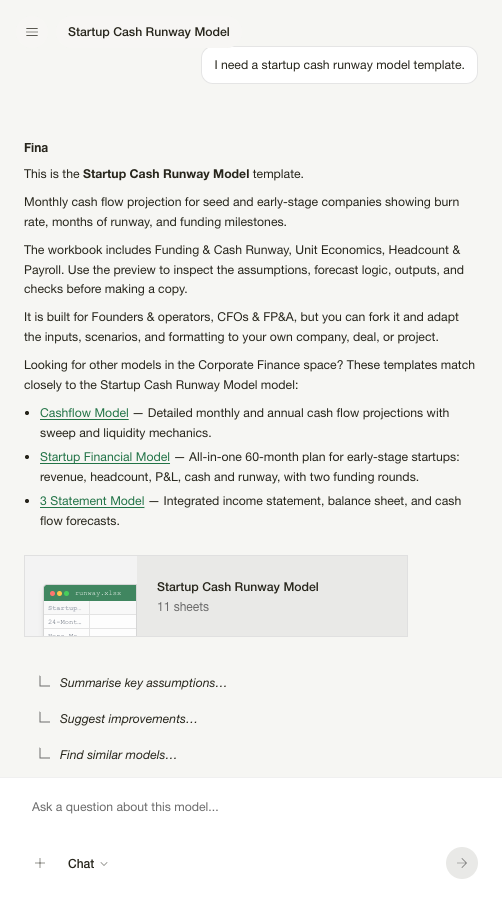
 TensorWave Financial Model
AI/ML Startup Financials (Free Excel Download)
AMD-backed GPU cloud provider offering AI compute infrastructure as an alternative to NVIDIA-dominated hyperscalers.



professionals from Deloitte
Used by professionals from






About this model
TensorWave provides AI compute infrastructure for customers running GPU-intensive workloads. Its commercial model is driven by available capacity, contracted cloud usage, and workload consumption, making utilisation and infrastructure economics more important than a conventional seat-based SaaS metric.
Customers can commit capacity for predictable workloads or expand usage as training and inference demand grows. Revenue therefore depends on GPU supply, deployed capacity, pricing, workload mix, contract duration, and the ability to maintain service performance as demand scales.
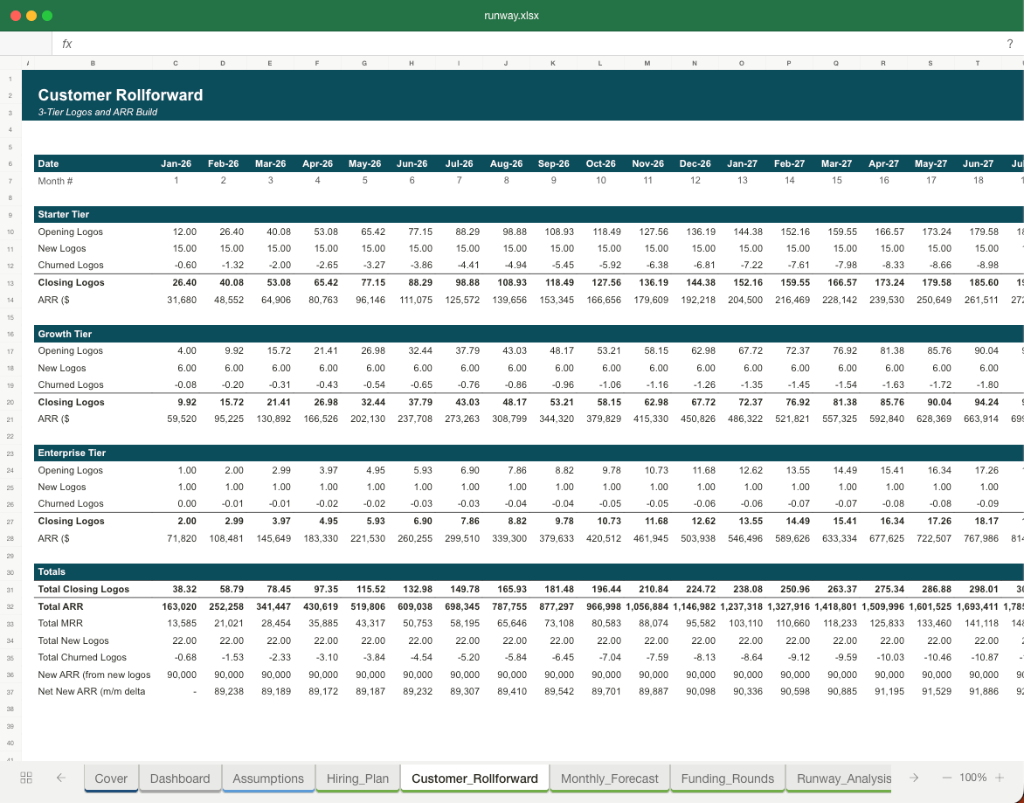
The model forecasts GPU capacity, utilisation, customer workloads, contracted and on-demand revenue, and churn. It connects cloud and infrastructure COGS, equipment investment, depreciation or lease costs, gross margin, sales capacity, working capital, cash burn, funding needs, and runway.
A turnkey financial model
Live formulas, no hardcoded values
Outputs are driven by live formulas, so the workbook updates from its assumptions instead of relying on hardcoded results.
All assumptions in one tab
Inputs are clearly marked in the Assumptions tab and separated from calculations, making it clear what to change and what to leave intact.
Statements always balancing
For integrated-statement models, the balance sheet, cash flow, and supporting schedules tie through properly.
Distinct schedules for clarity
Debt, working capital, taxes, and cash flow can get messy quickly. We group calculations in clear schedules, not across disconnected tabs.
No hidden macros or external links
There are no unexplained external workbook links or macros to undermine auditability or portability.
Changes flow through the model
Update a key driver and see the impact carry through the forecast, financing, and return outputs. We never use hardcoded numbers in formulas.
About TensorWave
tensorwave.com
How to build a detailed financial model for TensorWave
A complete walkthrough of the business, drivers, and assumptions behind the downloadable TensorWave model - distilled from its pitch deck and publicly available information.
Product & value proposition
- AMD MI300X GPU cloud - the first RoCE v2 clusters in production
- Official AMD MI300X Launch Partner, fully supported by AMD
- Proprietary exclusive Inference Engine for dominant inference performance
- Building Reference Architectures for RoCE v2 clusters alongside AMD and Edgecore
- No code changes needed to migrate from NVIDIA: PyTorch/TensorFlow workloads run natively on AMD ROCm
- Strategic hardware partner: Edgecore
- AMD MI300X specs vs NVIDIA H100 SXM:
- FP32: 120 TFLOPS vs 67 TFLOPS (1.8x)
- GPU Memory: 192 GB HBM3 vs 80 GB (2.4x)
- Memory Bandwidth: 5.2 TB/s vs 3.35 TB/s (1.6x)
- Interconnect: Infinity Fabric vs NVLink/NVSwitch
- 1.4x better performance vs H100 on Meta Llama 2 70B; up to 2.1x FP16 latency improvement
Market
- Global AI market forecast to cross $1 trillion by 2028, reaching $1.8T by 2030; CAGR +36.6%
- 2021: ~$0.0T, 2022: $0.1T, 2023: $0.2T, 2024: $0.3T, 2025: $0.4T, 2026: $0.6T, 2027: $0.8T, 2028: $1.0T, 2029: $1.4T, 2030: $1.8T
- 76% of enterprises plan to increase AI spend next fiscal year; only 3% plan to decrease
- AI Processors and Data Center market revenue:
- 2019: $2B, 2020: $4B, 2021: $7B, 2022: $11B, 2023: $16B, 2024: $24B, 2025: $29B, 2026: $38B
- 92% of models on HuggingFace are PyTorch-exclusive
- 74% of ML papers in 2023 use PyTorch/TensorFlow
Revenue model
- GPU-as-a-Service: rent AMD MI300X GPU capacity to AI/ML customers (inference and training workloads)
- Channels: direct enterprise sales implied (B2B); AMD partnership drives referrals
Traction & metrics
- Official AMD MI300X Launch Partner (Dec 2023)
- First RoCE v2 cluster operational
- Cloud providers described as "booking for 2025" with "long lead times" - framing unmet demand
Competition / moat
- Primary competitor: NVIDIA HGX ecosystem (H100 SXM)
- Broader hyperscaler competition implied (AWS, Azure, GCP)
- Moat claims:
- First-mover as AMD MI300X launch partner with official AMD support
- Exclusive Inference Engine
- First RoCE v2 cluster (vs NVLink/NVSwitch lock-in)
- Superior hardware specs on memory and bandwidth
- CUDA lock-in is weakening - PyTorch/ROCm portability removes switching cost for customers
Team & funding ask / use of funds
- Darrick Horton - Co-Founder, CEO; infrastructure & cloud executive; ex-Lockheed Martin Skunkworks engineer
- Piotr Tomasik - Co-Founder, COO; multiple-time technical co-founder; 3x exits (Influential, LetsRolo, ActiveSide)
- Jeff Tatarchuk - Co-Founder, CGO; serial entrepreneur; multiple companies sold/acquired
- Team credentials: 6 companies founded; $65M+ raised across previous ventures; decades delivering Cloud, AI/ML, B2B SaaS, FinTech to Fortune 500
- Previous employer logos: Meta, PayPal, Venmo, IBM, Lockheed Martin
- Described as "Built the Largest Tech Startup in Nevada By Valuation" (source: PitchBook)
Recommended financial model
- Archetype + why: GPU-as-a-Service capacity revenue model - revenue driven by GPU count × utilization rate × hourly rate. Similar structure to colocation/cloud IaaS. Not SaaS (no subscription/seat pricing shown). Not marketplace. 3-statement with capex-heavy balance sheet and debt/lease schedule is appropriate given hardware-intensive build-out.
- Forecast horizon & granularity: Monthly for Year 1–2 (capacity ramp is lumpy; need to track CapEx tranches and utilization build), quarterly for Year 3–5. Five-year horizon appropriate for hardware investment return cycle.
- Key drivers & assumptions:
| Driver | Value / Tag |
|---|---|
| GPU cluster size at launch (# MI300X GPUs) | 512–1,024 GPUs; typical bare-metal GPU cloud starting cluster size |
| GPU acquisition cost per MI300X | ~$15,000–$20,000/GPU list price at time of deck (early 2024) |
| Utilization rate (reserved + spot blended) | 60% Year 1, ramping to 85% by Year 3; enterprise GPU cloud benchmarks |
| Avg hourly rate per GPU | $3.50–$5.00/hr; AMD MI300X positioned at discount to H100 (~$4–6/hr market) |
| Revenue mix: inference vs training | 70% inference / 30% training; deck emphasizes inference superiority |
| Customer contract type: reserved vs spot | 60% reserved (6–12 month commits), 40% spot; enterprise-oriented positioning |
| Gross margin | 40–55%; GPU cloud peers CoreWeave/Lambda at ~45–55% before D&A |
| Power / data center opex per GPU/month | ~$300–400/GPU/month (power, cooling, colo); industry standard |
| Headcount ramp | 15–20 FTEs Year 1 rising to 50+ by Year 3; B2B enterprise sales + infra ops |
| CapEx: GPU cluster build-outs | Modeled as discrete tranches tied to fundraising / demand triggers |
| Depreciation: GPU useful life | 3–4 years straight-line |
| AMD partnership / launch partner benefits | Official launch partner status - may imply favorable pricing or allocation priority; quantum not disclosed |
| Edgecore hardware partner | Strategic partner for RoCE v2 cluster hardware |
- Scenarios (Base / Bull / Bear - which variables flex):
- Base: 800 GPUs at launch, 70% utilization by end Y1, $4/hr avg rate, 45% gross margin
- Bull: Faster cluster expansion (2,000+ GPUs by Y2), 85%+ utilization driven by AMD allocation advantage, premium rate ($5/hr+) from inference engine differentiation
- Bear: Demand slower to convert (50% utilization Y1), NVIDIA supply unlocks reducing scarcity premium, AMD MI300X adoption slower than projected, rate pressure to $3/hr
- Required sheets / outputs:
- Assumptions - all drivers, toggle for scenario
- GPU Capacity & Revenue - cluster ramp, utilization, blended rate, revenue by workload type
- Income Statement - revenue, COGS (power, colo, bandwidth), gross profit, opex, EBITDA, D&A, EBIT
- CapEx & Depreciation Schedule - GPU tranches, useful life, accumulated D&A
- Balance Sheet - CapEx-heavy; debt/lease obligations if financed
- Cash Flow Statement - operating CF, CapEx, financing (equity raises)
- Unit Economics - revenue per GPU, gross profit per GPU, payback on GPU cost
- Runway / Funding Bridge - cash runway to next raise given CapEx burn
Frequently asked
Is the TensorWave financial model free?+
Yes. The TensorWave model is a free Excel (.xlsx) download with live formulas. Sign up with your email and the workbook is yours to keep, review, and edit.
What's included in the model?+
A 5-year monthly forecast with P&L, cash flow and runway, valuation (exit multiple plus a DCF cross-check), MOIC/IRR returns, and unit economics, with live formulas throughout.
How was this model built?+
It was built from TensorWave's pitch deck and publicly available information, then structured to investment-banking standards as a fully editable Excel model.
Can I change the assumptions?+
Yes. You can change assumptions and the live formulas will recalculate in the downloadable Excel model.
Have more financial modelling questions? Contact us

Created by ex-finance professionals
Hey, I’m Alex and I created Finamodel.
Over my years in the finance industry I kept building the same models over and over again. Same structure, same assumptions, different logo. So I started building frameworks to turn them into clean, reusable templates.
Every model here is one I’d actually use for a client, and I personally vet each one before it goes up.
I’m not an expert in every industry, but I’ve built enough models to know what belongs in one. And when something is completely foreign to me, I reach out to my network for experts to work on our models with us.
Having a template library on hand cuts a first build from hours to minutes.
Need help finding your model? You’ll find me in the Finamodel app!
Other AI/ML Startup Financial Models
Browse another startup in the same category.

AI Rudder
AI Rudder provides multi-lingual conversational AI for B2C customer engagement - automating outbound and inbound voice/chat interactions at scale.

Aisera
AI Service Experience platform that automates IT, HR, and customer service workflows via conversational AI and automation.

Amberscript
AI + human hybrid transcription and subtitling platform targeting B2B customers in Europe

Apheris
Privacy-preserving federated ML platform enabling enterprises to train AI on distributed data without sharing raw data.

Arcane
AI copilot for marketing teams that automates data analysis, reporting, and repeatable tasks via a chat interface and scheduled workflows.

Artisan
AI-powered "digital workers" (branded Artisans) that autonomously perform role-specific tasks - starting with outbound sales - and are delivered as SaaS subscriptions.

Artisan Series A
AI-native B2B SaaS platform consolidating the enterprise software stack with human-like "Artisan" AI employees that automate role-specific workflows

Bigblue
Tech-enabled e-commerce fulfillment platform for European D2C brands - "Amazon-standard" delivery without Amazon.