 The Atlas Financial Model
Marketplace Startup Financials (Free Excel Download)
Free online community for city officials that monetises by selling govtech vendors access to that audience



professionals from Deloitte
Used by professionals from






About this model
The Atlas is a free online community where city officials discover case studies, follow issues, and ask peers about government solutions. It addresses a fragmented procurement and knowledge-discovery process by organizing a focused audience for civic and government technology.
The platform had 12,000 city users in less than a year and generated $300,000 of ARR from vendors seeking access to that audience. Its next phase is a marketplace where vendors can list solutions and city governments can request information or transact directly.
The model begins with vendor subscription and sponsorship ARR. Paying vendors, contract value, renewal, and city-user growth determine the current business, while vendor listings, buyer intent, transaction value, and take rate can add marketplace revenue later. Audience engagement, vendor retention, sales-cycle reduction, and marketplace activation are the key drivers.
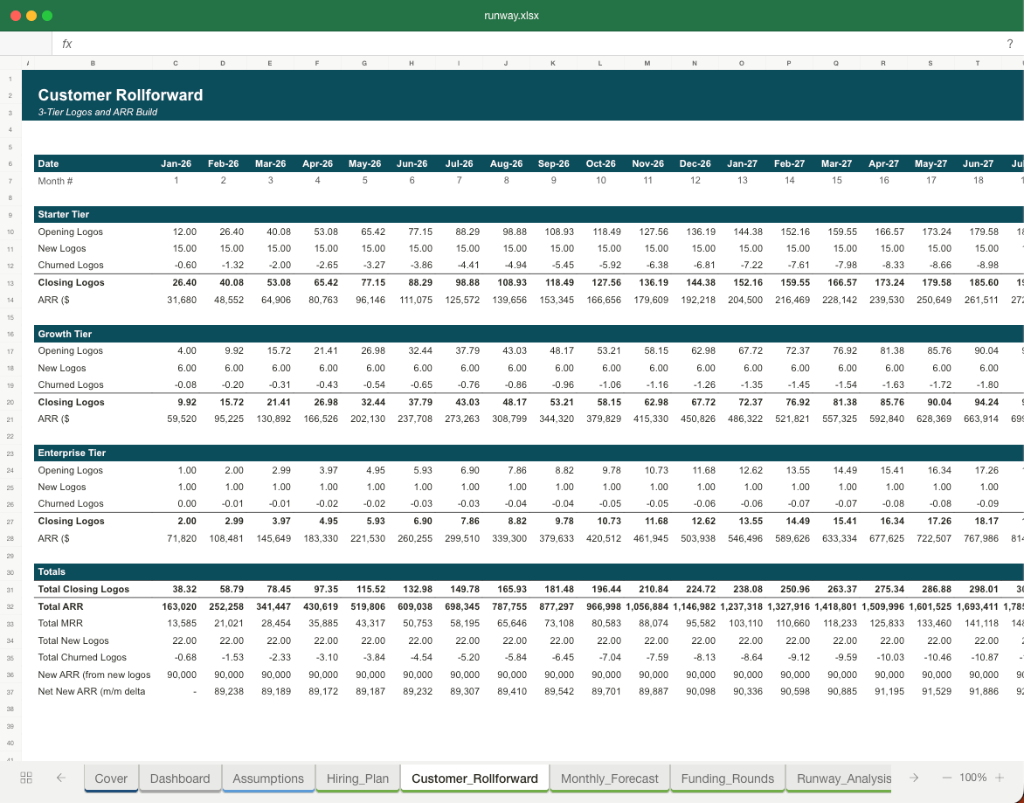
A turnkey financial model
Live formulas, no hardcoded values
Outputs are driven by live formulas, so the workbook updates from its assumptions instead of relying on hardcoded results.
All assumptions in one tab
Inputs are clearly marked in the Assumptions tab and separated from calculations, making it clear what to change and what to leave intact.
Statements always balancing
For integrated-statement models, the balance sheet, cash flow, and supporting schedules tie through properly.
Distinct schedules for clarity
Debt, working capital, taxes, and cash flow can get messy quickly. We group calculations in clear schedules, not across disconnected tabs.
No hidden macros or external links
There are no unexplained external workbook links or macros to undermine auditability or portability.
Changes flow through the model
Update a key driver and see the impact carry through the forecast, financing, and return outputs. We never use hardcoded numbers in formulas.
About The Atlas
the-atlas.com
How to build a detailed financial model for The Atlas
A complete walkthrough of the business, drivers, and assumptions behind the downloadable The Atlas model - distilled from its pitch deck and publicly available information.
Product & value proposition
- Free platform where city officials browse case studies, follow topics, and post questions
- Solves the problem that government officials have no structured way to discover solutions - forced to use Pinterest, conference booths, cold emails
- "What we're building next": a marketplace layer where vendors can list products and city governments can transact directly (e.g. "Buy Now" / "Request More Info" for a Siemens stormwater product)
Market
- TAM: $1.6 trillion in annual local government spending (US cities)
- Categories of spend shown: wastewater, air quality, drinking water, solid waste, noise pollution, energy management
Revenue model
- Current: B2B SaaS / sponsorship sold to companies (govtech vendors) who want access to the city-official audience; reported as ARR
- Next phase: Marketplace / transactional layer - vendors list products, cities buy or request info directly through The Atlas
- City-side is free (supply-side subsidy model, analogous to a B2B media/marketplace)
- Pricing per contract not disclosed in deck
Traction & metrics
- 12,000 city users on the platform, achieved in <1 year
- $300K ARR from paying company (vendor) customers
- 66% decrease in B2G (business-to-government) sales cycle for vendor customers
- No revenue growth rate or cohort data shown
Competition / moat
- Moat framing: incumbents are conferences, cold email, and ad-hoc discovery (Pinterest cited) - no direct competitor named
- Network effect implied: more city users → more valuable to vendors → more vendor revenue funds platform growth
- No competitive matrix shown
Team & funding ask / use of funds
- CEO: Elle Hempen - 5 years government experience, former city consultant, UCLA MBA
- COO: 5 years government experience, former city consultant, Rice University Civil Engineer
- CTO: Former Recovery Brands, full-stack engineer / data architect
- Advisors / affiliations: White House OSTP, EPA, City of London
Recommended financial model
- Archetype + why: B2B SaaS / marketplace hybrid ARR model. Revenue is currently subscription/sponsorship ARR from govtech vendors (supply-side free, demand-side paid). The "next" product is a transactional marketplace. Model should support both revenue streams: (1) vendor subscription/sponsorship ARR, (2) marketplace GMV with take-rate.
- Forecast horizon & granularity: 3 years monthly (Year 1–2 monthly, Year 3 quarterly roll-up). Company is pre-Series A with <1 year of ARR history - monthly granularity is essential to track ramp.
- Key drivers & assumptions:
*Supply side (city users - free):*
- City user base: 12,000; monthly new user growth rate
*Demand side (paying vendors - ARR):*
- Number of paying vendor accounts: implied ~$300K ARR / unknown ACV
- Net new vendor logos per month
- Annual contract value (ACV) per vendor
- Logo churn rate
- Expansion / upsell rate
*Marketplace (next phase):*
- GMV per transaction
- Take rate
- Launch quarter
*Cost structure:*
- Headcount: 3 co-founders confirmed; additional hires
- COGS (hosting, infrastructure)
- S&M spend (govtech conference sponsorships, content)
- R&D (engineering for marketplace build)
- Scenarios (Base / Bull / Bear - which variables flex):
- Bear: vendor ACV stays low ($10K), churn 20%, marketplace delayed 12 months
- Base: vendor ACV ~$15–20K, churn ~12%, marketplace live in 6–9 months, moderate GMV ramp
- Bull: vendor ACV expands to $30K+, marketplace take-rate revenue matches subscription ARR by Y3, city user growth accelerates via partnerships
- Required sheets / outputs:
- Assumptions - all drivers in one place with scenario toggle
- City User Growth - monthly free-side supply funnel
- Vendor ARR - logo count × ACV, MRR bridge (new + expansion − churn)
- Marketplace GMV & Revenue - GMV, take-rate revenue (activate once launched)
- P&L - blended revenue, COGS, gross profit, OpEx by category, EBITDA
- Headcount plan - by function, tied to OpEx
- Cash & Runway - burn, cash balance, months of runway (critical for fundraise context)
- KPI Dashboard - ARR, city users, vendor count, NRR, CAC payback, gross margin
Frequently asked
Is the The Atlas financial model free?+
Yes. The The Atlas model is a free Excel (.xlsx) download with live formulas. Sign up with your email and the workbook is yours to keep, review, and edit.
What's included in the model?+
A 5-year monthly forecast with P&L, cash flow and runway, valuation (exit multiple plus a DCF cross-check), MOIC/IRR returns, and unit economics, with live formulas throughout.
How was this model built?+
It was built from The Atlas's pitch deck and publicly available information, then structured to investment-banking standards as a fully editable Excel model.
Can I change the assumptions?+
Yes. You can change assumptions and the live formulas will recalculate in the downloadable Excel model.
Have more financial modelling questions? Contact us

Created by ex-finance professionals
Hey, I’m Alex and I created Finamodel.
Over my years in the finance industry I kept building the same models over and over again. Same structure, same assumptions, different logo. So I started building frameworks to turn them into clean, reusable templates.
Every model here is one I’d actually use for a client, and I personally vet each one before it goes up.
I’m not an expert in every industry, but I’ve built enough models to know what belongs in one. And when something is completely foreign to me, I reach out to my network for experts to work on our models with us.
Having a template library on hand cuts a first build from hours to minutes.
Need help finding your model? You’ll find me in the Finamodel app!
Other Marketplace Startup Financial Models
Browse another startup in the same category.

Acquco
Amazon brand aggregator - acquires third-party Amazon seller businesses at attractive multiples, then scales them via proprietary growth playbooks and technology.
Arive
Premium q-commerce app delivering lifestyle and branded products in under 30 minutes across German cities.

Audience Town
Vertical data and advertising platform targeting home movers across the entire home journey - pre-move through post-move.

AudioMob
Non-intrusive in-game audio ad platform bridging music/brand advertisers to mobile game publishers.

Authoritive
Two-way messaging platform that turns creator expertise into scalable, push-delivered learning experiences via SMS/WhatsApp.

Avo
Building amenity and office perk platform delivering same-day grocery/pantry/goods to residential and commercial tenants via a white-label marketplace.
beehiiv
Newsletter platform for creators to build, grow, and monetize email audiences - SaaS subscription + native ad network revenue.
Borzo
Global same-day logistics marketplace connecting B2B merchants with crowdsourced couriers for last-mile delivery