TFThe Flame in the Flood Financial Model
Media/Gaming Startup Financials (Free Excel Download)
Procedurally generated survival/exploration video game set in a flooded river world, with a companion dog and raft navigation, developed by The Molasses Flood LLC.



professionals from Deloitte
Used by professionals from






About this model
The Flame in the Flood is a procedurally generated survival game from The Molasses Flood. Scout and her dog travel a flood-prone river wilderness by raft and on foot, scavenging, crafting, and surviving hazards in a concept described as “Toobin’ meets Oregon Trail.”
The title is a premium digital release on Steam and consoles. A Chuck Ragan soundtrack can provide ancillary sales or streaming income, while raft skins, ornaments, and decals suggest possible DLC or cosmetic options; no price, platform split, or channel plan is disclosed.
This should be a title-level P&L rather than a subscription model. It needs development and launch marketing cost, unit sales by storefront, platform deductions, soundtrack or cosmetic attachment, and post-launch sales decay. The research is a pre-release project deck and contains no pre-orders, wishlists, revenue, or user traction.
A turnkey financial model
Live formulas, no hardcoded values
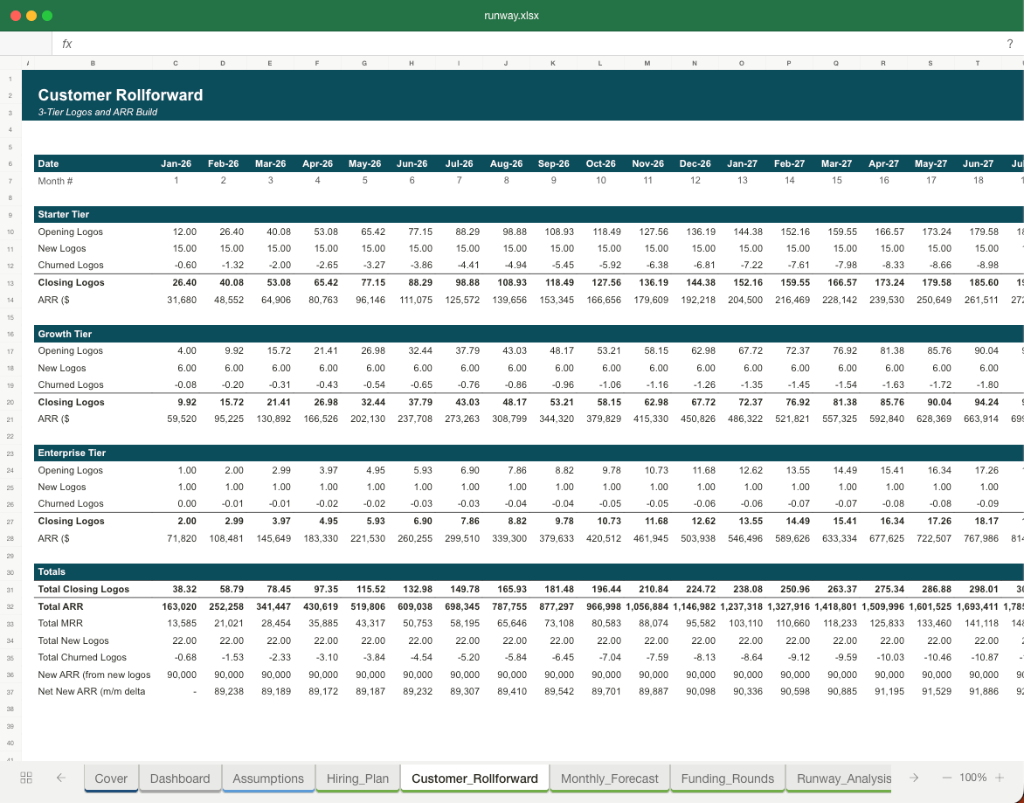
Outputs are driven by live formulas, so the workbook updates from its assumptions instead of relying on hardcoded results.
All assumptions in one tab
Inputs are clearly marked in the Assumptions tab and separated from calculations, making it clear what to change and what to leave intact.
Statements always balancing
For integrated-statement models, the balance sheet, cash flow, and supporting schedules tie through properly.
Distinct schedules for clarity
Debt, working capital, taxes, and cash flow can get messy quickly. We group calculations in clear schedules, not across disconnected tabs.
No hidden macros or external links
There are no unexplained external workbook links or macros to undermine auditability or portability.
Changes flow through the model
Update a key driver and see the impact carry through the forecast, financing, and return outputs. We never use hardcoded numbers in formulas.
About The Flame in the Flood
How to build a detailed financial model for The Flame in the Flood
A complete walkthrough of the business, drivers, and assumptions behind the downloadable The Flame in the Flood model - distilled from its pitch deck and publicly available information.
Product & value proposition
- Game title: "The Flame in the Flood"
- Developer: The Molasses Flood LLC
- Genre: Procedurally generated survival / stealth / exploration game
- Core loop: Player travels by raft or on foot down a procedurally generated river world; crafts traps, creates distractions, leverages systemic wildlife AI to scavenge supplies and shelter
- Tagline: "Toobin' meets Oregon Trail"
- World: "Riverlands" - a forgotten, flood-prone wilderness populated by dangerous wildlife (wolves, boars), memorable NPCs (e.g. Magnolia's Shop), and environmental hazards
- Player character: "Scout" + companion dog "Aesop's Hound"
- Player vessel: Raft ("Piece of Ship") with customisable storage, decals, ornaments, skins
- Soundtrack: Chuck Ragan & The Molasses Flood - press coverage in Rolling Stone, Esquire, New Noise Magazine
- Visual style: Illustrated, painterly - concept art and preproduction asset sheets throughout
Revenue model
Not explicitly stated in deck. Based on game type and era:
- Primary revenue: digital game sales (Steam, consoles) - one-time purchase price; typical indie price point $14.99–$19.99 at launch
- Secondary revenue: soundtrack sales/streaming - Chuck Ragan partnership suggests a commercial OST release
- Potential: DLC / cosmetic skins (slide 7 references "player skins, player ornaments, player decals")
- No pricing, no platform splits, no channel strategy disclosed in deck.
Traction & metrics
Note: The game was eventually released in early access January 2016 and full release February 2016. That information is not in this deck.
Competition / moat
Not explicitly stated. Implicit moats from the deck:
- Pedigree team: six founders with AAA credits at Irrational Games (BioShock Infinite), Bungie (Halo 2/3/ODST), Harmonix (Rock Band), EA (Medal of Honor)
- Procedural generation differentiator: no two playthroughs identical
- Original soundtrack by a recognised folk-punk artist (Chuck Ragan)
- Distinctive art direction: hand-illustrated, not pixel art - unusual for survival genre at the time
Team & funding ask / use of funds
Team:
- Bryn Bennett - Tech/Founder; ex-Tech Director Freedom Force 2, Lead Programmer Titan Quest, Programmer Rock Band series
- Chad LaClair - Art/Design/Founder; ex-Senior Level Builder BioShock Infinite, Designer Medal of Honor: Airborne
- Damian Isla - Mastermind/Tech/Founder; ex-Project Lead Third Eye Crime, Lead AI Programmer Halo 2/3/ODST, AI Programmer BioShock Infinite
- Forrest Dowling - CEO/Design/Founder; ex-Design Lead BioShock Infinite, Designer Homefront
- Gwen Frey - Art/Founder; ex-Senior Technical Animator BioShock Infinite and Marvel Heroes
- Scott Sinclair - Director/Art/Founder; ex-Art Director BioShock 1 & Infinite, primary artist Guitar Hero 1, Eyetoy Anti-Grav, Rock Band 2, Art Lead Freedom Force vs the Third Reich
Recommended financial model
- Archetype + why: Indie game launch P&L model (unit-sales-based). Revenue is driven by unit sales at launch + long tail, with a secondary soundtrack revenue stream. No subscription or recurring component. Classic one-time-purchase indie game economics.
- Forecast horizon & granularity: 3 years post-launch; monthly for Year 1 (captures launch spike + tail decay), quarterly for Years 2–3.
- Key drivers & assumptions:
- Launch window (Kickstarter campaign end / Early Access date / Full release date)
- Units sold at launch (first 30 days)
- Launch price
- Platform revenue share
- Sales decay curve: rapid post-launch decline, ~60–70% of lifetime sales in first 90 days
- Discount/sale uplift: Steam sales events driving volume spikes at ~50–75% discount
- Kickstarter backer units (if applicable): pre-sales recognised at launch
- Soundtrack revenue
- Headcount / burn rate: 6 founders + contractors
- Dev cost to ship
- Marketing / PR spend
- Scenarios (Base / Bull / Bear - which variables flex):
- Bear: Low launch awareness, 30k units in first 30 days, price $14.99, limited Steam visibility
- Base: 100k units in first 30 days, $14.99 launch, one major Steam sale in Year 1
- Bull: Strong Kickstarter backing + console port announcement, 250k+ units, $19.99 launch, console platform deal
- Required sheets / outputs:
- Assumptions sheet (all drivers, scenario toggle)
- Unit sales model (monthly units by platform: PC/Mac/Linux, console)
- Revenue build (gross revenue, platform cut, net revenue; game + soundtrack)
- COGS & gross margin (minimal for digital; hosting/distribution costs)
- OpEx (dev salaries/contractors, marketing, G&A)
- P&L (EBITDA, net income)
- Cash flow & runway (burn pre-launch, payback post-launch)
- KPI summary (units sold, ASP, net revenue per unit, breakeven unit count)
Frequently asked
Is the The Flame in the Flood financial model free?+
Yes. The The Flame in the Flood model is a free Excel (.xlsx) download with live formulas. Sign up with your email and the workbook is yours to keep, review, and edit.
What's included in the model?+
A 5-year monthly forecast with P&L, cash flow and runway, valuation (exit multiple plus a DCF cross-check), MOIC/IRR returns, and unit economics, with live formulas throughout.
How was this model built?+
It was built from The Flame in the Flood's pitch deck and publicly available information, then structured to investment-banking standards as a fully editable Excel model.
Can I change the assumptions?+
Yes. You can change assumptions and the live formulas will recalculate in the downloadable Excel model.
Have more financial modelling questions? Contact us

Created by ex-finance professionals
Hey, I’m Alex and I created Finamodel.
Over my years in the finance industry I kept building the same models over and over again. Same structure, same assumptions, different logo. So I started building frameworks to turn them into clean, reusable templates.
Every model here is one I’d actually use for a client, and I personally vet each one before it goes up.
I’m not an expert in every industry, but I’ve built enough models to know what belongs in one. And when something is completely foreign to me, I reach out to my network for experts to work on our models with us.
Having a template library on hand cuts a first build from hours to minutes.
Need help finding your model? You’ll find me in the Finamodel app!
Other Media/Gaming Startup Financial Models
Browse another startup in the same category.

Almost Friday
Almost Friday is a multi-platform comedy/lifestyle media brand built around the "Friday Beers" universe, monetising through apparel, brand partnerships, events, podcasts, and music.

Amagi
Cloud-native SaaS platform for TV/OTT channel creation, distribution, and ad monetization (FAST-focused)

Audoo
IoT + SaaS platform that captures real-time public music performance data and reports it to Performing Rights Organisations (PROs) to enable accurate royalty distribution.
Backbone
Backbone makes a mobile gaming controller (hardware) + unified software platform (Backbone app) that aggregates all game streaming services in one place.
Beacon Pines
Beacon Pines is a cute-and-creepy narrative adventure game set inside a magical storybook, developed by indie studio Hiding Spot Games.
Bear and Breakfast
A management/adventure video game where you play as a bear running a B&B cabin in the woods.
Bioshock
BioShock is a first-person action horror game pitched to a publisher for development funding - a game-development studio deal, not an operating startup.

Button City 2018
Indie narrative adventure game about cute animal kids saving their local arcade, targeting console and PC.