 Tricolor Financial Model
Fintech Startup Financials (Free Excel Download)
Technology-powered used-car dealership and auto lender serving credit-underserved US Hispanic consumers



professionals from Deloitte
Used by professionals from






About this model
Tricolor is a technology-powered used-car dealership and auto lender serving credit-underserved Hispanic consumers in the US. It integrates vehicle sourcing, reconditioning, retail sales, loan origination, and servicing rather than treating financing as a separate referral product.
The company operates dealerships and reconditioning centres while funding auto loans through securitisations. Vehicle margin and credit performance are therefore linked: the quality, pricing, and affordability of each car sale affect both upfront profit and the future loan portfolio.
The model should forecast vehicles acquired and sold, average selling price, reconditioning cost, retail gross profit, loan penetration, average balance, APR, and securitisation funding. Delinquencies, losses, recoveries, servicing costs, and inventory turns need separate schedules to reflect the two-engine business.
A turnkey financial model
Live formulas, no hardcoded values
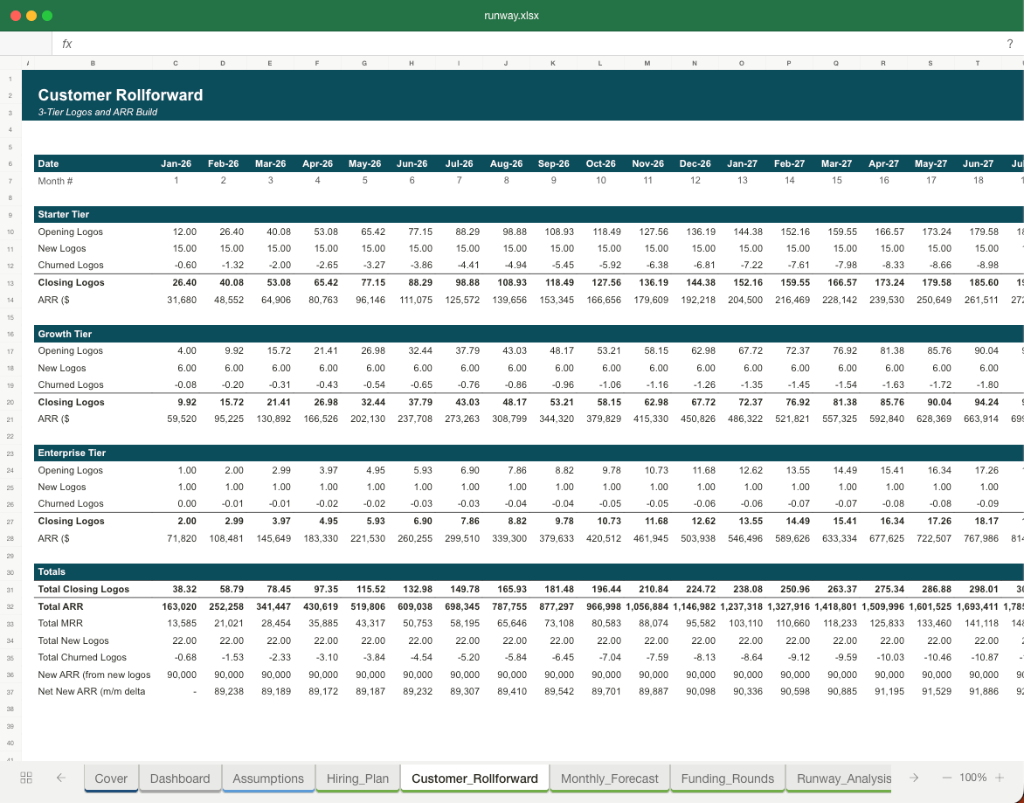
Outputs are driven by live formulas, so the workbook updates from its assumptions instead of relying on hardcoded results.
All assumptions in one tab
Inputs are clearly marked in the Assumptions tab and separated from calculations, making it clear what to change and what to leave intact.
Statements always balancing
For integrated-statement models, the balance sheet, cash flow, and supporting schedules tie through properly.
Distinct schedules for clarity
Debt, working capital, taxes, and cash flow can get messy quickly. We group calculations in clear schedules, not across disconnected tabs.
No hidden macros or external links
There are no unexplained external workbook links or macros to undermine auditability or portability.
Changes flow through the model
Update a key driver and see the impact carry through the forecast, financing, and return outputs. We never use hardcoded numbers in formulas.
About Tricolor
tricolor.com
How to build a detailed financial model for Tricolor
A complete walkthrough of the business, drivers, and assumptions behind the downloadable Tricolor model - distilled from its pitch deck and publicly available information.
Product & value proposition
Three bundled pillars:
- Certified Vehicle Quality - 150-point inspection, free 12/12 powertrain warranty, average $1,800 reconditioning investment per unit
- Affordable Credit-building Loans - proprietary full-stack finance platform, transparent POS tool; has established credit for 28% of borrowers with no prior credit history
- Superior Customer Experience - 4.5-star rating, omni-channel (physical lots + mobile app "Tricolor Copilot"), pre-qualification and fast-lane document upload
Technology stack: proprietary AI/ML across supply chain procurement, loan origination/underwriting, customer care/servicing, and sales POS. Data flywheel: 100+ non-conventional attributes per applicant, 16M+ total data points.
Market
- US Hispanic population: 61M (~1 in 5 Americans); growing at 7.6x non-Hispanic rate; median age 28
- US Hispanic GDP: $2.6T, ranked #8 globally; grew 72% vs. non-Hispanic US economy 2010–2018; Hispanics account for 82% of US workforce growth since the financial crisis
- 31% of Hispanic households have no or limited access to affordable credit
- Hispanic automotive spend: $44B annually; 11% of all US vehicle sales; vehicle purchases doubled 2010–2020
- Hispanics are 125% more likely than the general population to use a mobile device when researching a car
Revenue model
Two integrated revenue streams:
- Vehicle sales - retail used-car sales through 45 dealerships across 18 markets; vehicles reconditioned in-house (8 reconditioning centers); average reconditioning cost ~$1,800/unit
- Auto loan origination & servicing - proprietary full-stack finance platform; loans securitised via ABS (7 completed transactions with J.P. Morgan, Credit Suisse, Wells Fargo as ABS partners); CDFI-certified lender
Channels: physical dealerships + digital/mobile (Tricolor Copilot app, pre-qualification funnel, online inventory). No pricing/interest rate specifics disclosed.
Traction & metrics
- 75K+ loans originated (cumulative)
- 45 dealerships, 18 markets
- 4.5-star customer rating
- 7 ABS transactions completed (J.P. Morgan, Credit Suisse, Wells Fargo)
- 16M+ total data points collected on customers
- 100+ non-conventional attributes collected per applicant
- 28% of borrowers with no prior credit have had credit established via Tricolor loans
- CDFI certification awarded November 2019
Unit economics
- Average reconditioning cost: ~$1,800 per unit
- 50% of purchasers have a FICO score; >12% of those have FICO above 650 (implying ~88% are sub-650 / thin-file)
- Average customer US residency: 15 years
Competition / moat
Moat framing:
- Proprietary data advantage: 100+ non-conventional attributes, 16M+ data points driving ML underwriting for a borrower population legacy lenders cannot score
- Data network effects / virtuous cycle: more users → more data → smarter product → more users
- Flywheel: scale → lower cost structure → lower prices → better selection + customer experience → more traffic → more supply chain leverage
- Vertical integration: owns reconditioning, retail, origination, servicing - difficult to replicate piecemeal
- CDFI certification - regulatory credential and access to lower-cost capital
- Only issuer in subprime auto ABS with no-file/thin-file borrowers
Team & funding ask / use of funds
Recommended financial model
- Archetype + why: Integrated used-auto dealer + specialty auto lender (two-engine model). The vehicle sales side is a DTC retail/inventory P&L (units sold × gross profit per unit); the finance side is a loan portfolio model (origination volume, interest income, loss provision, NIM). These must be built together because Tricolor bundles them - the loan is the product. Closest archetype: Auto Lender + Used-Car Retail 3-Statement model with a separate loan-book / ABS waterfall schedule.
- Forecast horizon & granularity: 5-year annual (Year 1 quarterly for operating detail); loan vintage tracking required for loss provisioning.
- Key drivers & assumptions:
*Retail / Vehicle side:*
- Units sold per dealership per month
- Number of dealerships (currently 45)
- Average selling price per vehicle
- Gross profit per vehicle (selling price minus acquisition + reconditioning cost of ~$1,800)
- Reconditioning cost per unit: ~$1,800
*Lending / Finance side:*
- Attachment rate (% of vehicle sales that take a Tricolor loan)
- Average loan size
- Average loan term
- Interest rate / APR charged
- Cost of funds (ABS funding cost)
- Net Interest Margin
- Annualised net charge-off rate
- Loan loss provision as % of originations
- Average loan balance outstanding (function of origination volume × average term)
*Operating:*
- Headcount / SG&A per dealership
- Nearshore shared services cost advantage vs. fully US-based
- Marketing / CAC
- Scenarios (Base / Bull / Bear - which variables flex):
- Base: 45 dealerships flat → +5/yr from Y3; attachment rate 85%; NCO 11%; NIM 13%
- Bull: Dealership expansion +10/yr; attachment rate 90%; NCO 9% (ML improvement); NIM 14%; funding cost compression as ABS program matures
- Bear: No new dealerships; NCO spikes to 15–18% (macro stress on subprime borrowers); funding markets tighten (ABS spread widens); vehicle gross margins compress
- Required sheets / outputs:
- Assumptions & Toggles (all drivers, scenario selector)
- Retail P&L (units × GPU → gross profit; SG&A → EBITDA per dealership and consolidated)
- Loan Book Schedule (originations, repayments, losses, ending balance by vintage)
- Income Statement (combined: vehicle gross + interest income − cost of funds − provision − opex)
- Balance Sheet (receivables/loan portfolio as primary asset; ABS debt as primary liability)
- Cash Flow Statement (operating CF, capex for reconditioning centers/lots, ABS issuance/repayment)
- ABS / Funding Waterfall (simplified: collateral pool, advance rate, OC %, excess spread)
- Unit Economics Summary (gross profit/unit, NIM, NCO, CAC if estimable)
- Dashboard (KPIs: total units, loan book, NIM, NCO rate, revenue, EBITDA)
Frequently asked
Is the Tricolor financial model free?+
Yes. The Tricolor model is a free Excel (.xlsx) download with live formulas. Sign up with your email and the workbook is yours to keep, review, and edit.
What's included in the model?+
A 5-year monthly forecast with P&L, cash flow and runway, valuation (exit multiple plus a DCF cross-check), MOIC/IRR returns, and unit economics, with live formulas throughout.
How was this model built?+
It was built from Tricolor's pitch deck and publicly available information, then structured to investment-banking standards as a fully editable Excel model.
Can I change the assumptions?+
Yes. You can change assumptions and the live formulas will recalculate in the downloadable Excel model.
Have more financial modelling questions? Contact us

Created by ex-finance professionals
Hey, I’m Alex and I created Finamodel.
Over my years in the finance industry I kept building the same models over and over again. Same structure, same assumptions, different logo. So I started building frameworks to turn them into clean, reusable templates.
Every model here is one I’d actually use for a client, and I personally vet each one before it goes up.
I’m not an expert in every industry, but I’ve built enough models to know what belongs in one. And when something is completely foreign to me, I reach out to my network for experts to work on our models with us.
Having a template library on hand cuts a first build from hours to minutes.
Need help finding your model? You’ll find me in the Finamodel app!
Other Fintech Startup Financial Models
Browse another startup in the same category.
Acin
SaaS and data subscription network for operational risk management at Tier 1 financial institutions

Ageras Group
B2B SME ecosystem - marketplace connecting SMEs with accountants + cloud accounting/payroll software + embedded financial services (lending, factoring, banking)

Airbase
Unified non-payroll spend management platform (corporate cards, AP/bill pay, expense reimbursement, approval workflows) for mid-market companies.

Altruist
Vertically integrated all-in-one platform for registered investment advisors (RIAs) - combining custodial, portfolio management, practice management, and client acquisition tools.
Amenitiz
All-in-one hotel management SaaS platform ("Shopify for hotels") for independent hoteliers - PMS, booking engine, channel manager, website builder, payments, and AI-driven revenue management.

Anrok
SaaS sales tax compliance platform - nexus monitoring, calculation, registration, filing, and remittance - built specifically for SaaS companies.
Arrival
Arrival is an EV manufacturer of commercial vans and buses using proprietary Microfactories and vertically integrated components, going public via SPAC merger with CIIG Merger Corp.

AtoB
AtoB is building financial infrastructure for commercial fleets, starting with a no-fee Visa fleet card for fuel and expanding into payroll, BNPL, and international.