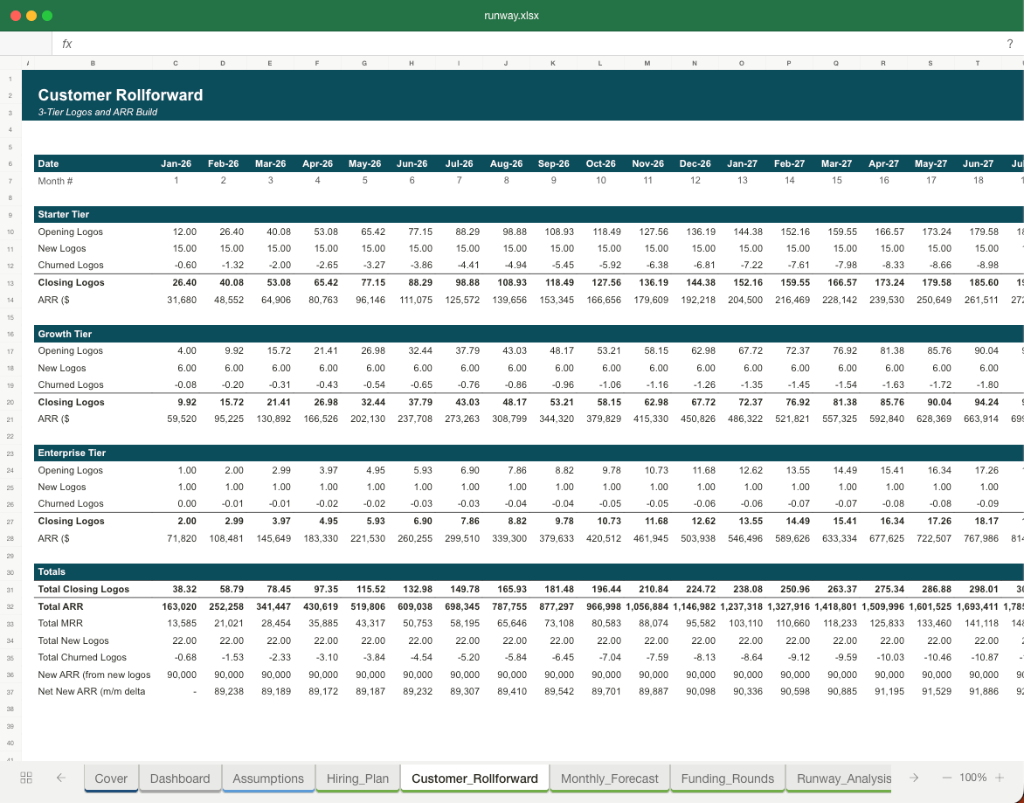
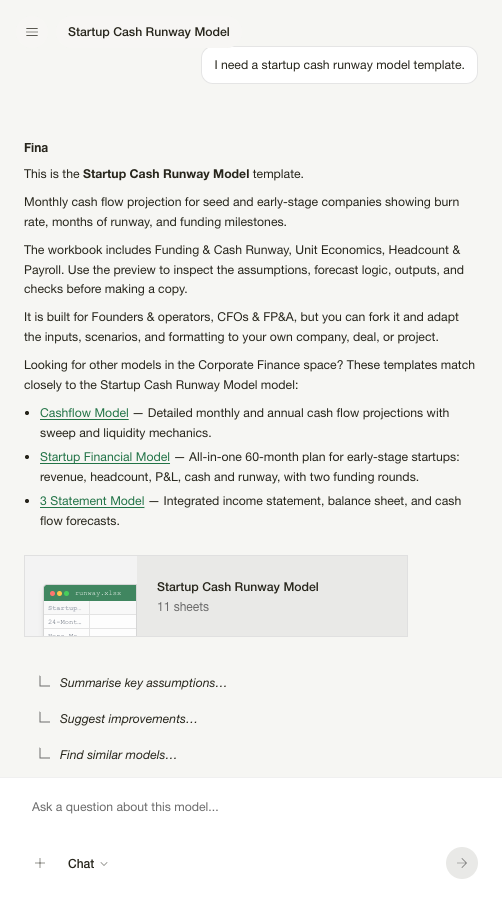
 Upflex Financial Model
Marketplace Startup Financials (Free Excel Download)
Asset-light B2B SaaS + marketplace platform giving companies on-demand access to a global network of flex coworking spaces for hybrid workforces.



professionals from Deloitte
Used by professionals from






About this model
Upflex is an asset-light platform that gives enterprises access to a global network of flexible workspaces. Employers manage plans, billing, access, and utilization through one system, while employees use an app to search, book, check in, and receive support.
The network covered 6,000 locations in 80 countries across more than 705 brands. Upflex combines enterprise subscription revenue with a likely take rate on workspace bookings, and can offer a white-label app for organizations seeking their own employee experience.
The model separates predictable employer SaaS from booking GMV. Contracted employees, plans, ARPU, and retention build recurring revenue; active users, booking frequency, average spend, and take rate build transaction income. Network coverage, workplace utilization, operator economics, and enterprise sales productivity drive the hybrid model.
A turnkey financial model
Live formulas, no hardcoded values
Outputs are driven by live formulas, so the workbook updates from its assumptions instead of relying on hardcoded results.
All assumptions in one tab
Inputs are clearly marked in the Assumptions tab and separated from calculations, making it clear what to change and what to leave intact.
Statements always balancing
For integrated-statement models, the balance sheet, cash flow, and supporting schedules tie through properly.
Distinct schedules for clarity
Debt, working capital, taxes, and cash flow can get messy quickly. We group calculations in clear schedules, not across disconnected tabs.
No hidden macros or external links
There are no unexplained external workbook links or macros to undermine auditability or portability.
Changes flow through the model
Update a key driver and see the impact carry through the forecast, financing, and return outputs. We never use hardcoded numbers in formulas.
About Upflex
upflex.com
How to build a detailed financial model for Upflex
A complete walkthrough of the business, drivers, and assumptions behind the downloadable Upflex model - distilled from its pitch deck and publicly available information.
Product & value proposition
- Single platform ("One MSA, One Platform, One Bill") for employers to procure, manage, and invoice flex workspace from 705+ brands.
- Employee-facing mobile app: search, book, geo-fence check-in, 24/7 chat support.
- Employer dashboard: user-role management, team-based plans and billing, SSO / Active Directory, reporting and utilization analytics.
- Unified reporting: user-level booking data + aggregated utilization, exportable, third-party sensor data integration.
- White-label app option available.
- Sustainability angle: 100% asset-light, plants a tree per booking.
Market
- TAM: Office Real Estate by 2025 = $2.6 Trillion.
- SAM: Flex Office by 2025 = $111 Billion; described as "Flex Office revenue to grow from $29B in 2020 to $111B by 2027".
- SOM: Upflex revenue target by 2025 = $300M - "We aim to capture 0.3% of SAM".
- Supporting data points: 52% of employees want to work from a nearby coworking/alternative to HQ; 82% of employers will increase distributed work post-pandemic.
Revenue model
- Primary: B2B SaaS subscription - employers purchase plans/seats for employees; team-based billing per business unit.
- Secondary: Marketplace take-rate / transaction fee on bookings made through the platform (implicit from "billing/reconciliation clearinghouse" positioning and operator partnerships) - exact take-rate not stated.
- White-label app licensing likely an upsell - pricing not disclosed.
- Supply side: Upflex aggregates 705+ brands / 6,000 locations; WeWork is exclusively on Upflex - revenue share / listing fee structure not disclosed.
Traction & metrics
- Network size: 6,000 locations, 80 countries, 900 cities, 705+ brands.
- Network growth: +200 new locations/month (slide 4) / 170 new locations/month (slide 5); 40% network growth in 2020.
- Long-term target: 30,000 locations within 3 years.
- Supply breakdown: North America 2,200 | Europe 2,100 | Asia 680 | South America 250 | Oceania 150 | Africa 120.
Competition / moat
- Positioning: "Sole asset-light technology platform" for hybrid office globally.
- Competitive advantages stated: largest flex inventory globally (6,000 spaces); exclusive WeWork relationship; single MSA / consolidated billing vs. managing multiple vendors; add new locations on-demand (+200/month).
- No direct competitor comparison slide in deck.
Team & funding ask / use of funds
- CEO Christophe Garnier: 20 years technology/strategy, repeat VC-backed founder, 8 years coworking management.
- COO Andre Jacquet: ex-Regional President/VP/Country Manager at Dyson, Microsoft, Apple; ex-CMO Brightstar (Softbank) and Sony Ericsson.
- CPO Ginger Dhaliwal: 20+ years operations/CX/software development, 6 years coworking ops, PMP certified.
- CSO Vincent Lottefier: 30+ years commercial real estate strategy, 25 years at JLL across Europe/Americas/Asia Pacific.
- CTO Pierre Davidoff: 25+ years technology leadership, large-scale web/mobile, ML/cloud/devops.
Recommended financial model
- Archetype + why: B2B SaaS + Marketplace GMV hybrid model. Upflex has two interlinked revenue streams - a recurring subscription/seat fee charged to enterprise employers (SaaS ARR logic) and a transactional take-rate on bookings flowing through the platform (marketplace GMV logic). The model must capture both, with the SaaS layer driving predictable revenue and the GMV layer capturing volume upside as network scales.
- Forecast horizon & granularity: 5 years (2021–2025), monthly for Year 1 then quarterly for Years 2–5. Monthly detail needed to track enterprise customer ramp and booking volume build.
- Key drivers & assumptions:
*Supply side (network)*
- Locations at start: 6,000
- Monthly location adds: 170–200
- Target locations in 3 years: 30,000
*Demand side (enterprise customers)*
- Avg. employees per client:
- Avg. seats purchased per client:
*SaaS revenue*
- Annual contract value (ACV):
- Net revenue retention:
- Churn:
*Marketplace / transaction revenue*
- Bookings per active seat per month:
- Monthly GMV = active seats x bookings/seat x ABV
*SOM target*
- Upflex revenue by 2025: $300M - use as Bull scenario ceiling; Base ~$150–200M
*Cost structure*
- COGS:
- S&M:
- R&D:
- G&A:
- Scenarios (Base / Bull / Bear):
- Bull: Achieve $300M revenue by 2025 (0.3% SAM capture per deck); seat attach rate 25%, ABV $30, take-rate 20%
- Base: $150–175M by 2025; seat attach rate 20%, ABV $25, take-rate 17%
- Bear: $75M by 2025; slower enterprise adoption, seat attach rate 12%, churn 15%
- Key flex variables: new enterprise logos/month, seats per client, booking frequency, take-rate
- Required sheets / outputs:
- Assumptions - all drivers with scenario toggle (Base/Bull/Bear)
- Network Build - location count over time, by region
- Enterprise Customer Build - logos, seats, ARR, churn waterfall
- GMV & Transaction Revenue - bookings volume, ABV, take-rate
- Revenue Bridge - SaaS + Transaction + (White-label if applicable)
- P&L - Revenue, COGS, Gross Profit, OpEx by line, EBITDA
- Headcount - hiring plan linked to revenue milestones
- Cash Flow & Runway - if raise size ever disclosed
- KPI Dashboard - locations, enterprise clients, active seats, GMV, ARR, gross margin %
Frequently asked
Is the Upflex financial model free?+
Yes. The Upflex model is a free Excel (.xlsx) download with live formulas. Sign up with your email and the workbook is yours to keep, review, and edit.
What's included in the model?+
A 5-year monthly forecast with P&L, cash flow and runway, valuation (exit multiple plus a DCF cross-check), MOIC/IRR returns, and unit economics, with live formulas throughout.
How was this model built?+
It was built from Upflex's pitch deck and publicly available information, then structured to investment-banking standards as a fully editable Excel model.
Can I change the assumptions?+
Yes. You can change assumptions and the live formulas will recalculate in the downloadable Excel model.
Have more financial modelling questions? Contact us

Created by ex-finance professionals
Hey, I’m Alex and I created Finamodel.
Over my years in the finance industry I kept building the same models over and over again. Same structure, same assumptions, different logo. So I started building frameworks to turn them into clean, reusable templates.
Every model here is one I’d actually use for a client, and I personally vet each one before it goes up.
I’m not an expert in every industry, but I’ve built enough models to know what belongs in one. And when something is completely foreign to me, I reach out to my network for experts to work on our models with us.
Having a template library on hand cuts a first build from hours to minutes.
Need help finding your model? You’ll find me in the Finamodel app!
Other Marketplace Startup Financial Models
Browse another startup in the same category.

Acquco
Amazon brand aggregator - acquires third-party Amazon seller businesses at attractive multiples, then scales them via proprietary growth playbooks and technology.
Arive
Premium q-commerce app delivering lifestyle and branded products in under 30 minutes across German cities.

Audience Town
Vertical data and advertising platform targeting home movers across the entire home journey - pre-move through post-move.

AudioMob
Non-intrusive in-game audio ad platform bridging music/brand advertisers to mobile game publishers.

Authoritive
Two-way messaging platform that turns creator expertise into scalable, push-delivered learning experiences via SMS/WhatsApp.

Avo
Building amenity and office perk platform delivering same-day grocery/pantry/goods to residential and commercial tenants via a white-label marketplace.
beehiiv
Newsletter platform for creators to build, grow, and monetize email audiences - SaaS subscription + native ad network revenue.
Borzo
Global same-day logistics marketplace connecting B2B merchants with crowdsourced couriers for last-mile delivery