 VergeSense Financial Model
AI/ML Startup Financials (Free Excel Download)
AI-powered computer vision sensors that measure workplace occupancy and social distancing compliance in real time.



professionals from Deloitte
Used by professionals from






About this model
VergeSense uses AI sensors to measure workplace occupancy and inform office planning. Enterprise customers deploy the system across buildings and desks, turning physical-space utilisation into data for workplace, real-estate, and facilities teams.
Its economics combine recurring software subscriptions with hardware deployment. Accounts can expand as more sites, floors, desks, and planning workflows adopt the platform, while sensor procurement, installation, support, and replacement affect the gross-margin profile.
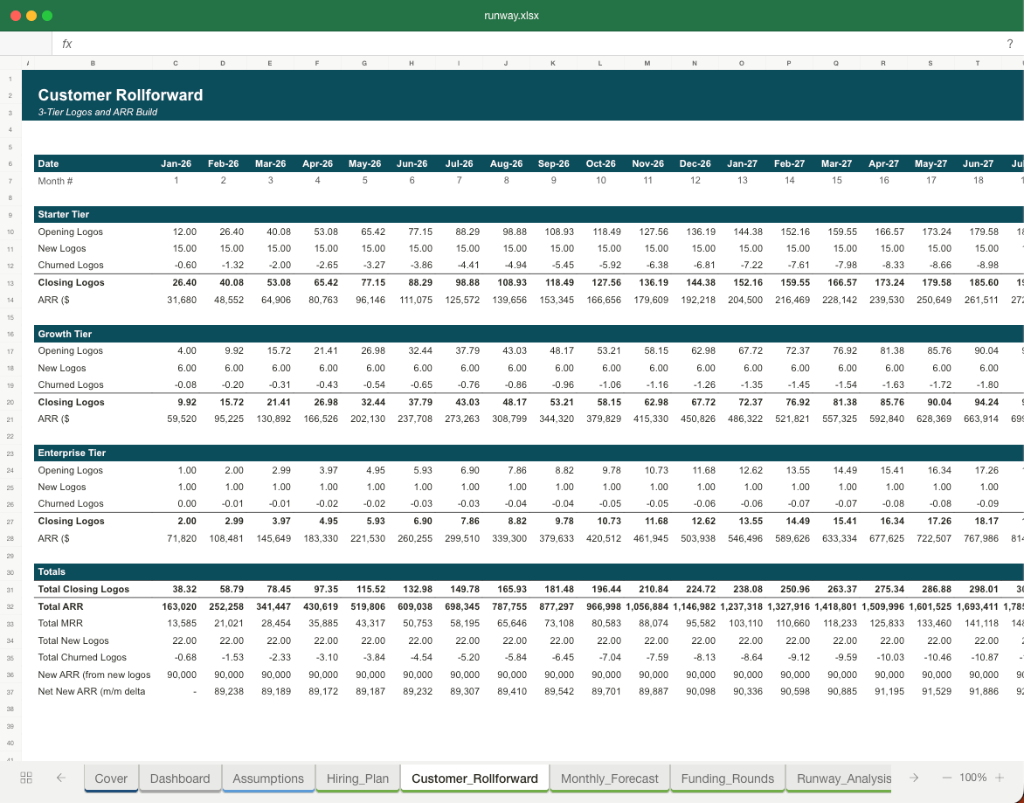
The model builds revenue from customer cohorts, sites, sensors, and subscription price, separating hardware and recurring streams. It tests rollout pace, expansion, churn, hardware COGS, installation and support capacity, sales productivity, product investment, cash flow, and runway.
A turnkey financial model
Live formulas, no hardcoded values
Outputs are driven by live formulas, so the workbook updates from its assumptions instead of relying on hardcoded results.
All assumptions in one tab
Inputs are clearly marked in the Assumptions tab and separated from calculations, making it clear what to change and what to leave intact.
Statements always balancing
For integrated-statement models, the balance sheet, cash flow, and supporting schedules tie through properly.
Distinct schedules for clarity
Debt, working capital, taxes, and cash flow can get messy quickly. We group calculations in clear schedules, not across disconnected tabs.
No hidden macros or external links
There are no unexplained external workbook links or macros to undermine auditability or portability.
Changes flow through the model
Update a key driver and see the impact carry through the forecast, financing, and return outputs. We never use hardcoded numbers in formulas.
About VergeSense
vergesense.com
How to build a detailed financial model for VergeSense
A complete walkthrough of the business, drivers, and assumptions behind the downloadable VergeSense model - distilled from its pitch deck and publicly available information.
Product & value proposition
- AI-powered computer vision sensors mounted in offices to count people and measure social distancing.
- Software platform with dashboards for: social distancing scoring, occupancy compliance monitoring, smart cleaning planning, and hands-free meeting room check-in.
- Core use case framing is COVID-19 re-entry: help enterprises comply with local occupancy limits and reduce unsafe interactions.
- API integration layer for auto check-in and connections to third-party workplace platforms.
Revenue model
Not explicitly in deck. Inferred from product structure:
- Hardware + SaaS subscription model: sensor hardware sold or leased per space/floor, plus recurring software fee per seat or per building. Standard for workplace IoT/analytics vendors.
- Integration partner channel (JLL, Robin, Serraview, OfficeSpace, Comfy, iOffice, Teem, Spacewell) likely drives enterprise deals.
- No pricing tiers, per-unit ASP, or contract values disclosed.
Traction & metrics
- No revenue, customer count, or growth figures in deck.
- Dashboard demo data shown for "Building 14" - these are illustrative product screenshots, not company traction metrics.
- Social Distancing Score: 4.8/10
- Average Distance: 7.2 feet; Minimum Distance: 2.2 feet; Total Unsafe Interactions: 183
- Peak Occupancy Rate: 65%; Average Occupancy Rate: 30%
- 8 named integration partners shown: Spacewell, Comfy, iOffice, OfficeSpace, JLL, Robin, Teem, Serraview.
Competition / moat
- Proprietary AI/computer vision sensor hardware (not off-the-shelf).
- Integration ecosystem with 8 workplace platform partners.
- Insight engine layered on top of raw occupancy data (scored outputs vs. raw feeds).
Recommended financial model
- Archetype + why: B2B SaaS + hardware (sensor) revenue model - two revenue streams: (1) sensor hardware (one-time or amortized over contract), (2) recurring SaaS subscription per building/floor/seat. This is the standard workplace IoT model and matches VergeSense's product structure (sensors + software platform + API integrations). Not a fundraising deck, so model should focus on operating P&L and unit economics build-up, not deal mechanics.
- Forecast horizon & granularity: 3–5 years annual; Year 1 monthly for cash flow visibility. Hardware COGS and SaaS gross margin split should be modeled separately.
- Key drivers & assumptions:
- Number of enterprise customers
- Average buildings per customer
- Sensors per building
- Hardware ASP per sensor
- SaaS ACV per building
- Hardware COGS %
- SaaS gross margin
- Sales cycle
- Churn
- CAC
- Integration partner channel mix
- Scenarios (Base / Bull / Bear - which variables flex):
- Bear: slow COVID re-entry adoption, hardware deal delays, churn 15%+
- Base: steady enterprise re-entry demand, moderate expansion, 7% churn
- Bull: COVID-driven urgency pulls forward demand, platform stickiness drives upsell to ongoing occupancy analytics post-pandemic, churn <5%
- Required sheets / outputs:
- Assumptions - all drivers above with toggle for Base/Bull/Bear
- Revenue build - hardware units × ASP + SaaS buildings × ACV, separated by cohort year
- COGS & gross profit - hardware COGS vs. SaaS hosting/support costs, blended GM%
- OpEx - R&D, S&M, G&A
- P&L (3-statement or standalone income statement + cash flow)
- Unit economics summary - CAC, LTV, LTV:CAC, payback period
- Headcount plan (linked to OpEx)
Frequently asked
Is the VergeSense financial model free?+
Yes. The VergeSense model is a free Excel (.xlsx) download with live formulas. Sign up with your email and the workbook is yours to keep, review, and edit.
What's included in the model?+
A 5-year monthly forecast with P&L, cash flow and runway, valuation (exit multiple plus a DCF cross-check), MOIC/IRR returns, and unit economics, with live formulas throughout.
How was this model built?+
It was built from VergeSense's pitch deck and publicly available information, then structured to investment-banking standards as a fully editable Excel model.
Can I change the assumptions?+
Yes. You can change assumptions and the live formulas will recalculate in the downloadable Excel model.
Have more financial modelling questions? Contact us

Created by ex-finance professionals
Hey, I’m Alex and I created Finamodel.
Over my years in the finance industry I kept building the same models over and over again. Same structure, same assumptions, different logo. So I started building frameworks to turn them into clean, reusable templates.
Every model here is one I’d actually use for a client, and I personally vet each one before it goes up.
I’m not an expert in every industry, but I’ve built enough models to know what belongs in one. And when something is completely foreign to me, I reach out to my network for experts to work on our models with us.
Having a template library on hand cuts a first build from hours to minutes.
Need help finding your model? You’ll find me in the Finamodel app!
Other AI/ML Startup Financial Models
Browse another startup in the same category.

AI Rudder
AI Rudder provides multi-lingual conversational AI for B2C customer engagement - automating outbound and inbound voice/chat interactions at scale.

Aisera
AI Service Experience platform that automates IT, HR, and customer service workflows via conversational AI and automation.

Amberscript
AI + human hybrid transcription and subtitling platform targeting B2B customers in Europe

Apheris
Privacy-preserving federated ML platform enabling enterprises to train AI on distributed data without sharing raw data.

Arcane
AI copilot for marketing teams that automates data analysis, reporting, and repeatable tasks via a chat interface and scheduled workflows.

Artisan
AI-powered "digital workers" (branded Artisans) that autonomously perform role-specific tasks - starting with outbound sales - and are delivered as SaaS subscriptions.

Artisan Series A
AI-native B2B SaaS platform consolidating the enterprise software stack with human-like "Artisan" AI employees that automate role-specific workflows

Bigblue
Tech-enabled e-commerce fulfillment platform for European D2C brands - "Amazon-standard" delivery without Amazon.