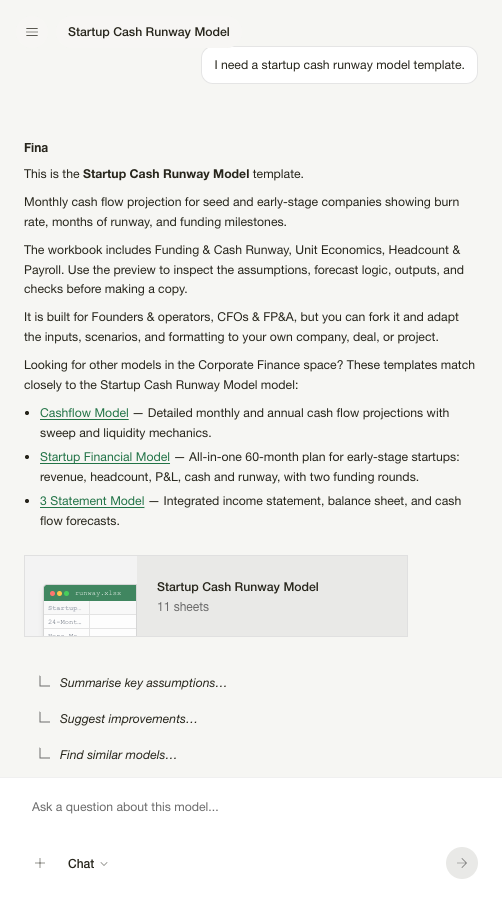
WIWilco Financial Model
EdTech Startup Financials (Free Excel Download)
Gamified hands-on skills platform for software engineers, delivered via quest-based simulations of real company environments.



professionals from Deloitte
Used by professionals from






About this model
Wilco is a gamified hands-on skills platform for software engineers, using quest-based simulations of real company environments. It lets developers practise workplace workflows rather than only consume instructional content, connecting learning to practical engineering capabilities.
The company has a B2B2C model: a community and product-led freemium funnel feeds paid enterprise licences for teams. It was raising $6 million at seed stage, while management dashboards and enterprise customisation show that employers, not individual developers, are the main monetising customer.
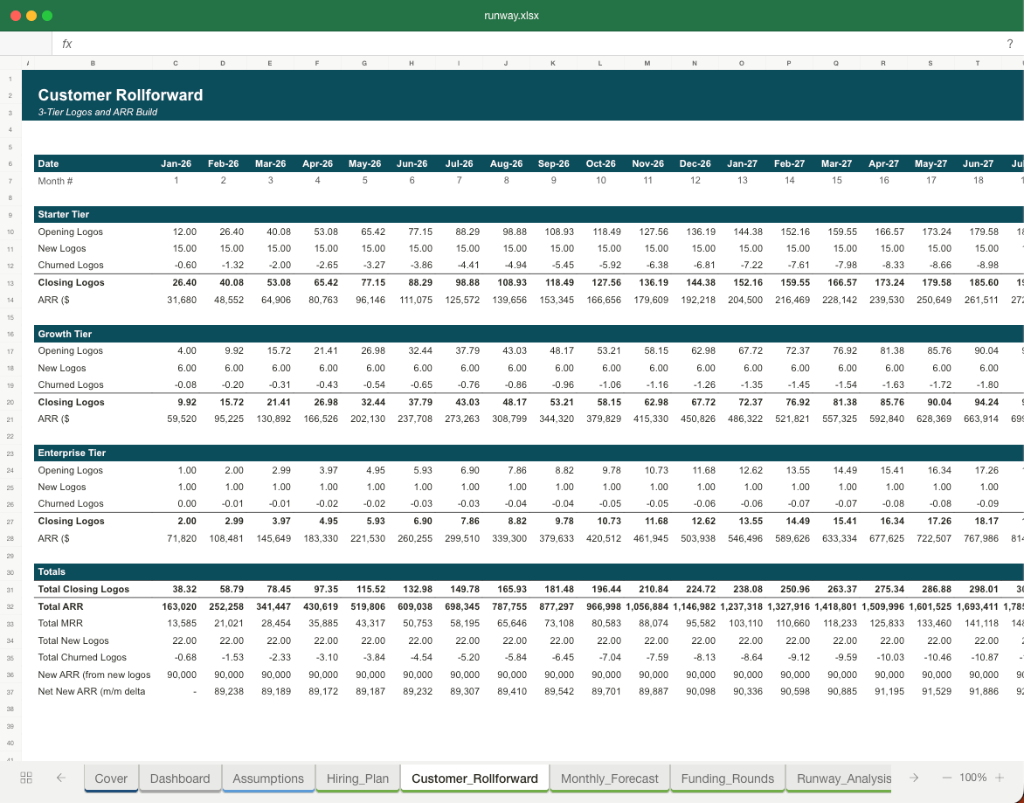
The model follows community MAU, enterprise pipeline conversion, customers, engineers enrolled, licence value, expansion, renewal, and churn. Simulation development, content, sales cycles, customer outcomes, gross margin, and product investment determine ARR growth and cash runway.
A turnkey financial model
Live formulas, no hardcoded values
Outputs are driven by live formulas, so the workbook updates from its assumptions instead of relying on hardcoded results.
All assumptions in one tab
Inputs are clearly marked in the Assumptions tab and separated from calculations, making it clear what to change and what to leave intact.
Statements always balancing
For integrated-statement models, the balance sheet, cash flow, and supporting schedules tie through properly.
Distinct schedules for clarity
Debt, working capital, taxes, and cash flow can get messy quickly. We group calculations in clear schedules, not across disconnected tabs.
No hidden macros or external links
There are no unexplained external workbook links or macros to undermine auditability or portability.
Changes flow through the model
Update a key driver and see the impact carry through the forecast, financing, and return outputs. We never use hardcoded numbers in formulas.
About Wilco
trywilco.com
How to build a detailed financial model for Wilco
A complete walkthrough of the business, drivers, and assumptions behind the downloadable Wilco model - distilled from its pitch deck and publicly available information.
Product & value proposition
- Developers join a "fantasy company" and complete game-like quests that simulate real production scenarios (debugging, monitoring, code review, crisis response, project management, soft skills).
- Quests run through the engineer's actual IDE and toolchain (GitHub, Jira, Slack, VS Code, MongoDB, etc.) via Wilco's Quest Orchestration Engine.
- Three quest tiers: Wilco-built (common stacks), company-custom (proprietary curriculum), community-built (open ecosystem).
- Management dashboard provides visibility into engineer growth and progress.
- XP system tracks progression; referral/invite loop built into product.
Market
- Implied market: global software engineer workforce and the corporate L&D budgets spent on developer upskilling.
- Problem quantified only qualitatively: online courses have <4% completion rate; large enterprises spend heavily on internal academies; mid-market relies on "trial by fire".
Revenue model
- Not explicitly stated in deck. No pricing slide present.
- Implied structure from GTM and product design:
- B2B seat license or team subscription sold to engineering managers at mid-market companies; rationale: management dashboard feature, enterprise customisation, testimonial from CTO.
- Freemium community edition as PLG acquisition layer; rationale: "Release our community edition allowing every developer to play and create quests" is a stated use-of-funds goal.
- Potential content-partner revenue share or marketplace fee for third-party quest creators; rationale: community quest ecosystem and content partner validation slides (slides 9, 15).
- No ASP, ARPU, contract length, or billing cadence disclosed.
Traction & metrics
- Monthly active users: REDACTED
- Beta users source: REDACTED
- Content partners: REDACTED
- Product is live (app.wilco.gg referenced in UI screenshot).
- Customer testimonial from Jorge Garcia, Co-Founder & CTO of Hello Iconic - confirms product is in use and solves mentorship-load problem.
- No revenue figures, growth rates, or cohort data disclosed.
Competition / moat
- 2x2 matrix (axes: Theoretical ↔ In-Depth, Low Scale ↔ High Scale).
- Wilco positions in the top-right: High Scale + In-Depth - the only player in that quadrant.
- Competitors mapped:
- Internal training programs (ThoughtWorks, Pivotal Labs, Swim): In-Depth but Low Scale
- On-site bootcamps (Lambda, Dev Boot Camp, Hack Reactor, App Academy): Low Scale + Theoretical
- Mentoring platforms (Codementor): Low Scale + Theoretical
- MOOCs (edX, Coursera, Udemy, Udacity, Pluralsight): High Scale but Theoretical
- Moat claimed: proprietary Quest Orchestration Engine; community flywheel; deep tool integrations; customisable curriculum.
Team & funding ask / use of funds
- On Freund - Co-Founder & CEO: Operating Partner PICO, Global Head of WeWork Labs, VP Engineering & VP Product at WeWork, VP Engineering at Handy.
- Alon Carmel - Co-Founder & CPO: Senior PM at WeWork ($1B product), top-10 PM in Israel, TechCrunch50 winner, Seedcamp.
- Shem Magnezi - Co-Founder & CTO: 15+ yrs engineering, Staff Engineer at WeWork, Senior Engineer at Facebook.
- Ask: $6M seed
- Runway / period: Redacted (shown as orange block in slide image).
- Use of funds:
- Release community edition (open quest creation).
- Build team: engineering, product, game design, growth.
- Reach target WAU and weekly quests played (numbers redacted).
- Secure top-tier content partnerships (number redacted).
Recommended financial model
- Archetype + why: B2B SaaS ARR model with a PLG/freemium community funnel feeding into a paid enterprise tier. Wilco monetises companies (seats/teams), not individual developers directly - so the driver tree is: community MAU → enterprise pipeline conversion → ARR. A pure consumer subscription model is not appropriate given the management-dashboard and enterprise-customisation features.
- Forecast horizon & granularity: 3 years monthly (Yr 1–2 monthly detail; Yr 3 quarterly roll-up). Seed stage - operational model more important than terminal value.
- Key drivers & assumptions:
*Acquisition funnel*
- Community MAU: redacted baseline; seed at 1,000 MAU growing 15% MoM post-community-launch, rationale: early-stage PLG with strong engineer referral loop.
- MAU → enterprise lead conversion rate: 2–5% of MAU generate enterprise inbound, rationale: typical PLG B2B conversion benchmark.
- Enterprise sales cycle: 30–60 days, rationale: mid-market SaaS norm.
*Revenue*
- Average seats per enterprise deal: 20–50 seats, rationale: target is engineering teams at mid-market companies.
- ACV per seat: $200–$400/seat/year, rationale: comparable developer-tools SaaS (Pluralsight ~$400/seat; early-stage discount to land).
- Net Revenue Retention: 110–120%, rationale: seat expansion as teams grow + upsell to custom quest packs; typical for usage-based dev tools.
- Community/freemium tier: $0 (PLG engine only; monetise at enterprise layer).
*Cost structure*
- Gross margin: 70–75%, rationale: primarily cloud infra + quest-engine hosting; low marginal cost per user once quests built.
- S&M: 40–50% of revenue in Yr1–2 (PLG-heavy, lower CAC than pure sales-led); declining to 30% by Yr3.
- R&D: 35–45% of revenue in Yr1–2 (engineering-first product; quest engine + integrations are core); declining to 25% by Yr3.
- G&A: 15% of revenue, rationale: lean seed-stage overhead.
*Headcount*
- Use-of-funds implies heavy Yr1 hiring across eng, product, game design, growth.
- Seed team grows from ~5 (founders + 2) to ~15–20 by end of $6M runway.
*Cash*
- $6M raised; runway months redacted - 18–24 months, rationale: standard seed sizing for a ~15-person team at Israeli/US burn rates.
- Scenarios (Base / Bull / Bear - which variables flex):
- Bull: MAU growth 20% MoM, seat conversion 5%, ACV $350, NRR 120%.
- Base: MAU growth 15% MoM, seat conversion 3%, ACV $250, NRR 110%.
- Bear: MAU growth 8% MoM, seat conversion 1.5%, ACV $200, NRR 100%; enterprise sales cycle extends to 90 days.
- Required sheets / outputs:
- Assumptions - all drivers above, scenario toggle (Base/Bull/Bear).
- PLG Funnel - community MAU → enterprise leads → closed ARR.
- ARR Bridge - new ARR, expansion, churn, net new ARR by month.
- P&L - revenue, COGS, gross profit, S&M, R&D, G&A, EBITDA.
- Headcount Plan - roles, hire dates, fully-loaded cost.
- Cash Flow & Runway - cash in, burn, ending cash, months of runway.
- KPI Dashboard - MAU, paying seats, ARR, MRR, NRR, burn multiple, CAC payback.
Frequently asked
Is the Wilco financial model free?+
Yes. The Wilco model is a free Excel (.xlsx) download with live formulas. Sign up with your email and the workbook is yours to keep, review, and edit.
What's included in the model?+
A 5-year monthly forecast with P&L, cash flow and runway, valuation (exit multiple plus a DCF cross-check), MOIC/IRR returns, and unit economics, with live formulas throughout.
How was this model built?+
It was built from Wilco's pitch deck and publicly available information, then structured to investment-banking standards as a fully editable Excel model.
Can I change the assumptions?+
Yes. You can change assumptions and the live formulas will recalculate in the downloadable Excel model.
Have more financial modelling questions? Contact us

Created by ex-finance professionals
Hey, I’m Alex and I created Finamodel.
Over my years in the finance industry I kept building the same models over and over again. Same structure, same assumptions, different logo. So I started building frameworks to turn them into clean, reusable templates.
Every model here is one I’d actually use for a client, and I personally vet each one before it goes up.
I’m not an expert in every industry, but I’ve built enough models to know what belongs in one. And when something is completely foreign to me, I reach out to my network for experts to work on our models with us.
Having a template library on hand cuts a first build from hours to minutes.
Need help finding your model? You’ll find me in the Finamodel app!
Other EdTech Startup Financial Models
Browse another startup in the same category.

Green Flower Media
Cannabis education platform offering streaming video content, professional certificate programs, and college/university partnerships.

Labster
Web-based virtual science lab platform that replaces or supplements physical labs for higher ed and high school students.
Lambda School
Online coding bootcamp that charges $0 upfront and takes 17% of income for 2 years once a graduate earns $50k+, capped at $30k total.

Learn.xyz
AI-powered mobile learning app that lets anyone create and consume short lessons on any topic in seconds.

Our Future
Short-form video business news and education platform targeting Gen Z, positioned as the missing media brand for that demographic.
Paper
Paper.co sells a cloud-based tutoring/academic-support platform ("Platform as a Service") to K-12 school districts on an annual subscription basis.

Pilgrim Soul
Cannabis brand positioned as the "creativity" category king - proprietary live resin blends, branded journals, and content ecosystem targeting the Creative Class.
Pluralsight Acquisition
Proxy/shareholder vote presentation defending the Vista Equity Partners take-private acquisition of Pluralsight at $20.26/share (all-cash).