 Xyte Financial Model
AI/ML Startup Financials (Free Excel Download)
Full-stack SaaS servitization platform enabling B2B device/equipment manufacturers (OEMs) to cloudify, commercialize, and operate their hardware as a subscription service.



professionals from Deloitte
Used by professionals from






About this model
Xyte provides cloud connectivity and device-management infrastructure for connected products. Its enterprise customers can manage devices and service workflows remotely, allowing manufacturers and operators to add cloud functionality without building every element of the underlying platform themselves.
Revenue expands with the number of connected devices, customer deployments, and service use cases. The company therefore resembles device-focused SaaS: recurring subscriptions create a base, while device usage and cloud activity can add a consumption-driven component.
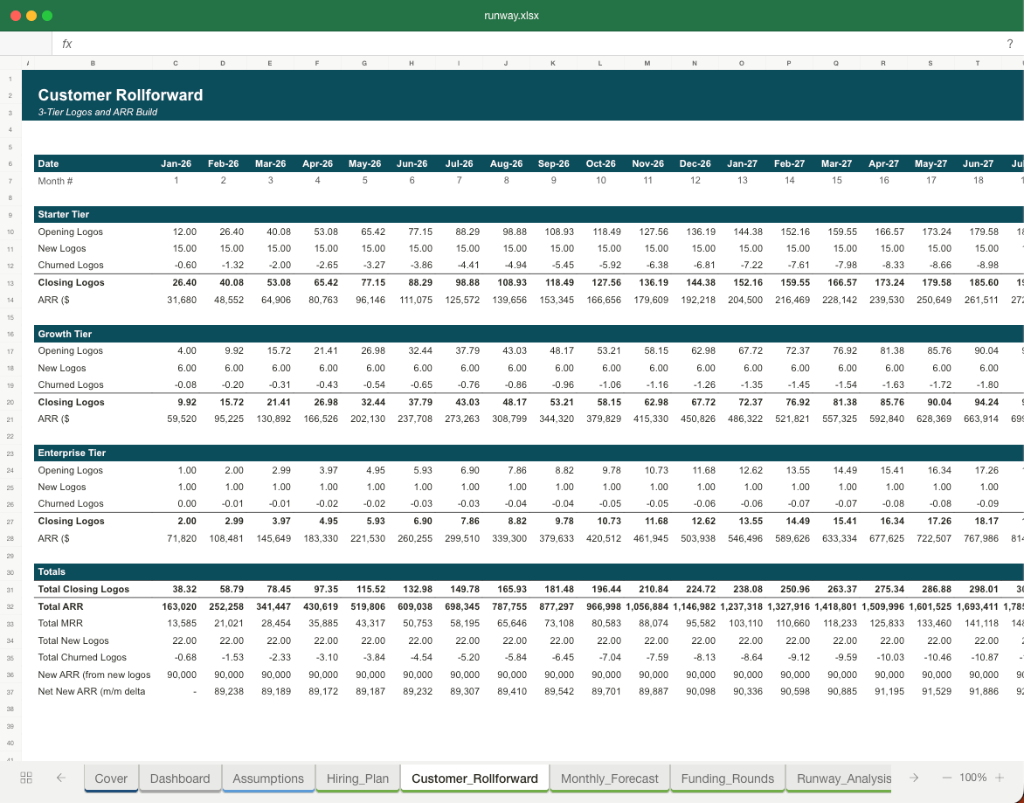
The model follows enterprise cohorts, devices activated, subscription price, usage, expansion, and churn. It links cloud hosting and device-management costs to activity, then forecasts gross margin, customer support, sales capacity, engineering headcount, cash burn, and runway.
A turnkey financial model
Live formulas, no hardcoded values
Outputs are driven by live formulas, so the workbook updates from its assumptions instead of relying on hardcoded results.
All assumptions in one tab
Inputs are clearly marked in the Assumptions tab and separated from calculations, making it clear what to change and what to leave intact.
Statements always balancing
For integrated-statement models, the balance sheet, cash flow, and supporting schedules tie through properly.
Distinct schedules for clarity
Debt, working capital, taxes, and cash flow can get messy quickly. We group calculations in clear schedules, not across disconnected tabs.
No hidden macros or external links
There are no unexplained external workbook links or macros to undermine auditability or portability.
Changes flow through the model
Update a key driver and see the impact carry through the forecast, financing, and return outputs. We never use hardcoded numbers in formulas.
About Xyte
xyte.io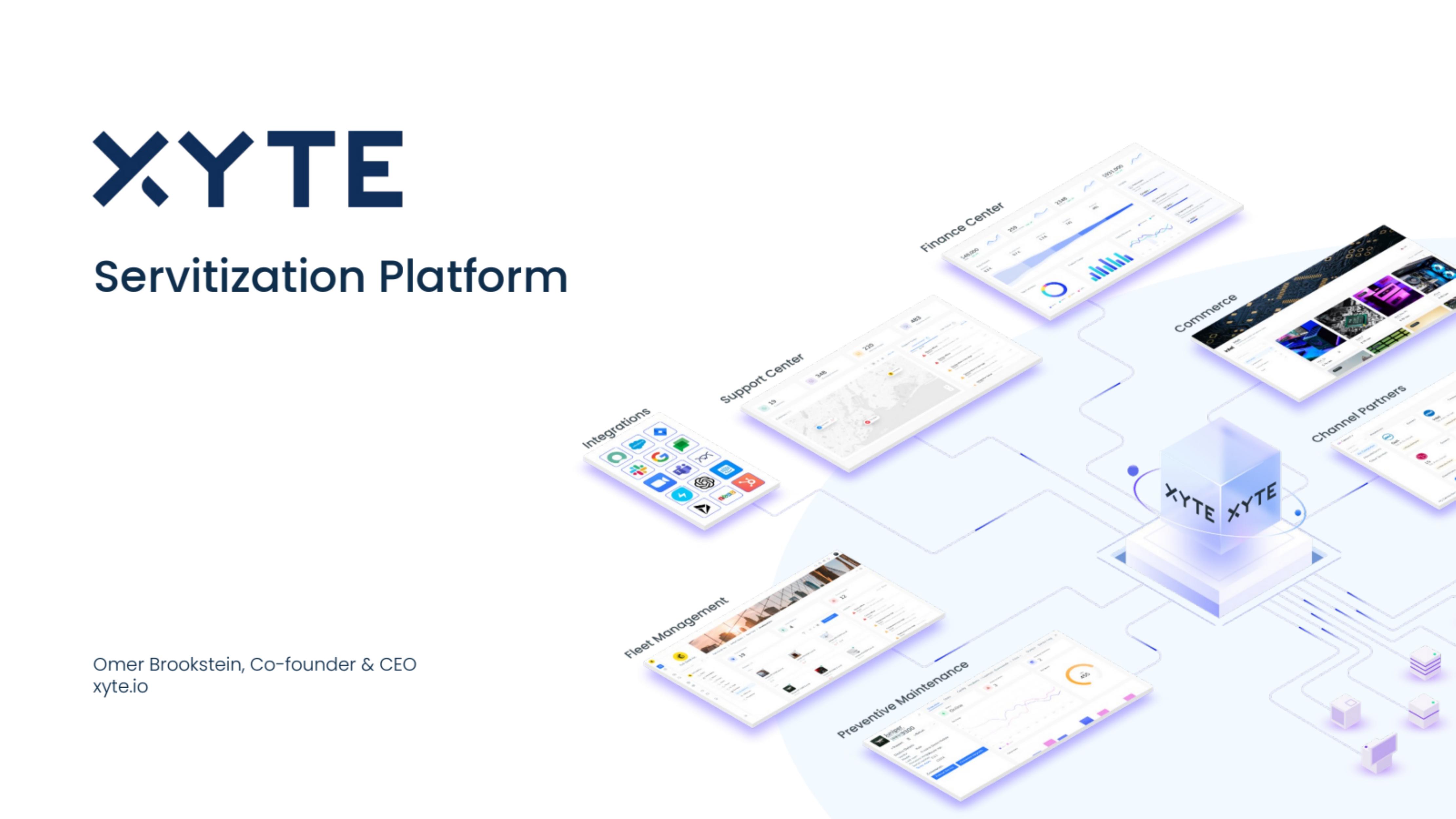
How to build a detailed financial model for Xyte
A complete walkthrough of the business, drivers, and assumptions behind the downloadable Xyte model - distilled from its pitch deck and publicly available information.
Product & value proposition
Xyte is a full-stack "servitization" platform - a vertical software stack that lets device and equipment OEMs:
- Cloudify their products (remote monitoring, config, firmware updates, fleet management, preventive maintenance).
- Commercialize via subscriptions (eCommerce storefront, tier-based pricing, usage-based billing, premium feature toggles, digital app store).
- Operate end-to-end (support ticketing, partner/channel management, analytics, ERP integrations, finance center).
Value prop framing: "Tesla-ize" the value chain - give OEMs direct visibility from factory to end-user, eliminating the visibility black hole that exists once devices leave the warehouse. Positioned as a new product category sitting at the intersection of IoT/Fleet Management, Monitoring/MSP, and Subscription Management & Billing.
Two dedicated interfaces: back-office platform for the OEM/manufacturer, and an end-user-facing portal.
Market
- TAM: $1,196B total addressable market across six verticals:
- Medical: $365B
- Renewable Energy: $240B
- Workplace Technology: $231B
- Industrial & Robotics: $210B
- Food & Beverage: $80B
- Smart Buildings & Utilities: $70B
- Market thesis: Hardware OEMs are under margin pressure and are committing to shareholders to shift to recurring/subscription models; large OEMs (Apple, Cisco, Dell) build this capability in-house; mid-market and SMB OEMs need an off-the-shelf solution.
Revenue model
Three active revenue streams + one future stream:
- Core platform fee - Fixed, tier-based subscription charged to the OEM. Tiers correspond to number of connected devices (Tier 1 / Tier 2 / Tier 3 visible in forecast chart).
- Seats / value-added services - Optional premium modules for OEMs, channel partners, and subscribers (e.g., Support Seats at $99/month).
- Digital products fulfillment fee - Usage-based fee on digital product/service transactions processed through the Xyte commerce layer (e.g., premium feature unlocks, app store transactions).
- Lending - Future stream, TBD.
GTM: Sales-led for enterprise and mid-market; self-service coming for SMB. Land-and-expand motion: land on device cloudification, expand into commercialization and support modules as device count grows. Channel partner expansion baked into the platform.
Pricing examples visible in product UI mocks:
- Support Seat: $99.00/month
- MRR visible in mock dashboard: $28,399 / $48,000 (product demo data, not company actuals)
Traction & metrics
- Founded: 2020.
- Team: 26.
- Total funding: $37M. Investors: Intel Capital, Samsung NEXT, BlackRock, S Capital VC, Mindset Ventures.
- Customers: Redacted in overview dashboard ("XX").
- New ARR (last three quarters): Redacted ("$XX – $XX").
- EOY 2023 ARR target: Redacted ("$XX").
- Immediate pipeline: Redacted ("$XX", weighted: "$XX").
- Traction chart: ARR and customer count growing from Sep 2022 → March 2023, with dashed projection to June 2023. Actual values blurred/redacted in image.
- Pipeline logos visible on slide 14: Samsung, HP, Siemens, Lenovo, Bosch in Qualified Pipeline; Schneider Electric, Quanix and others in Onboarding; Intel, Volvo, and others in Customers column.
- Customer study (redacted name): Device count progression 100 → 380 → 1,250 → 5,000 → +20,000 as customer moves through product cloudification and as-a-service commercialization phases; ARR values alongside each stage are blurred.
Unit economics
- Implicit signal: Customer study (slide 18) shows device count multiplying 200x from initial account to mature as-a-service stage, implying strong NRR/expansion within accounts as more devices and modules are added. Time from account initiation to tier traversal: ~6 months; to 5 Support Seats: ~4 months after that.
- Customer retention rate visible in product mock: 79%, +2.5%.
Competition / moat
Competitive positioning: Xyte occupies a new category at the intersection of three existing spaces - IoT/Fleet Management (Particle, ThingWorx, KAA, ThingsBoard, Azure IoT Hub), Monitoring/MSP (ATERA, Domotz, HP OpenView, Zabbix, OvrC), and Subscription Management & Billing (BlueSnap, CloudBlue, Recurly, Stripe, Zuora, Chargify). No single competitor addresses all three.
Moat claims:
- First and only full-stack platform covering cloudification + commercialization + operations.
- Fully federated multi-tenancy: OEMs, channels, and end users each see only their devices; OEM controls all sub-tenant hierarchies.
- Network effects: platform becomes more valuable as channel partners and ecosystem expand.
- Switching cost: once OEM's devices are cloudified and commerce is live on Xyte, migration is structurally complex.
- Named enterprise validation: Intel, Volvo, Schneider Electric in pipeline/onboarding.
Randy Klein (former CEO/President of Crestron Electronics) on the board is a domain credibility signal.
Team & funding ask / use of funds
Founders:
- Omer Brookstein, Co-founder & CEO - 8200 Elite Intelligence Unit Major; former CTO of Crestron Israel.
- Boris Dinkevich, Co-founder & CTO - IAF Technology Unit; former CEO of 500Tech.
Board: Omer Brookstein, Boris Dinkevich, Randy Klein (former CEO Crestron Electronics), Roi Bar-kat (Head of Intel Capital Israel), Haim Sadger (Founding Partner S Capital, former Sequoia Partner), Aya Peterburg (Founding/Managing Partner S Capital).
Leadership team: VP Sales (Andrew Gross), VP Marketing (Lital Grossman), VP R&D (Tal Reis), VP Business Operations (Aya Schickler), VP Product (Ran Zaksh).
Funding raised: $37M total.
Recommended financial model
Archetype + why: SaaS ARR model with tiered-device cohort expansion mechanics. Xyte charges OEMs a tier-based platform fee (keyed to connected-device count) plus per-seat and usage-based add-ons. The expansion motion - where each customer's ARR grows as device fleet scales through tiers - makes a cohort/NRR-expansion model the right frame. This is not a simple seat-count SaaS; the key unit is OEM accounts × devices per account × tier.
Forecast horizon & granularity:
- 4 years: 2022–2025 (matching the deck's own forecast chart).
- Monthly for Year 1, quarterly for Years 2–4 (given early stage and lumpy enterprise deals).
Key drivers & assumptions:
*Customer acquisition:*
- New OEM customers per quarter
- Average sales cycle
- Pipeline-to-close rate
*Revenue per customer:*
- Core platform fee by tier:
- Tier 1 (entry):
- Tier 2 (mid):
- Tier 3 (enterprise):
- Tier 1 anchored to device counts ~100–380 devices, Tier 2 ~380–1,250, Tier 3 ~1,250–5,000+
- Seat revenue: $99/month per Support Seat; average seats per customer
- Digital products fulfillment (usage-based):
*Expansion / NRR:*
- Tier traversal cadence: ~6 months between Tier 1 → Tier 2 for the customer study
- Net Revenue Retention
- Churn
*Revenue composition (from forecast slide 25 structure):*
- Core platform fee (largest component, dominant in 2022–2023)
- Seats revenue (growing layer)
- Monitoring license revenue (separate SKU, grows with device count)
- Digital products revenue (smallest in early years, ramps as app store / commerce launches)
*Headcount & costs:*
- 26 employees at deck date;
- R&D-heavy profile given product complexity
- Gross margin
Scenarios (Base / Bull / Bear - which variables flex):
- Base: New OEM wins per quarter ramp as assumed; NRR ~125%; device-tier expansion at 6-month cadence.
- Bull: Pipeline converts faster (Samsung, HP, Lenovo close); average contract value skews Tier 3; digital products revenue inflects early; NRR 140%+.
- Bear: Enterprise sales cycles lengthen (9–12 months); tier traversal stalls; digital products stay negligible through 2025; NRR ~110%.
- Key flex variables: new logo wins per quarter, time-to-tier-expansion, average platform tier at signing, seat attach rate.
Required sheets / outputs:
- Assumptions - all drivers above, clearly tagged or; scenario toggle (Base/Bull/Bear via CHOOSE).
- Cohort model - monthly cohort of new OEM customers, tier migration schedule, per-tier ARR, seat/usage add-ons; produces MRR → ARR waterfall.
- Revenue build - total ARR by stream: Core Platform Fee, Seats, Monitoring Licenses, Digital Products; reconciles to Revenue (recognized) vs. ARR (booked).
- P&L - Revenue, COGS (hosting/infra per device), Gross Profit, S&M, R&D, G&A, EBITDA, Net Income. Annual 2022–2025.
- Headcount plan - by function (R&D, Sales, Marketing, BizOps, G&A); feeds S&M and R&D lines.
- Cash & runway - starting cash (derived from $37M raised less burn to date), monthly burn, runway; flags when next raise needed.
- KPI dashboard - ARR, MRR, New ARR, Churn ARR, Net New ARR, NRR, Customer count by tier, Avg contract value, Devices connected.
- Sensitivity table - Revenue/ARR at Y3 vs. (a) new logos/quarter and (b) avg platform tier at signing.
Frequently asked
Is the Xyte financial model free?+
Yes. The Xyte model is a free Excel (.xlsx) download with live formulas. Sign up with your email and the workbook is yours to keep, review, and edit.
What's included in the model?+
A 5-year monthly forecast with P&L, cash flow and runway, valuation (exit multiple plus a DCF cross-check), MOIC/IRR returns, and unit economics, with live formulas throughout.
How was this model built?+
It was built from Xyte's pitch deck and publicly available information, then structured to investment-banking standards as a fully editable Excel model.
Can I change the assumptions?+
Yes. You can change assumptions and the live formulas will recalculate in the downloadable Excel model.
Have more financial modelling questions? Contact us

Created by ex-finance professionals
Hey, I’m Alex and I created Finamodel.
Over my years in the finance industry I kept building the same models over and over again. Same structure, same assumptions, different logo. So I started building frameworks to turn them into clean, reusable templates.
Every model here is one I’d actually use for a client, and I personally vet each one before it goes up.
I’m not an expert in every industry, but I’ve built enough models to know what belongs in one. And when something is completely foreign to me, I reach out to my network for experts to work on our models with us.
Having a template library on hand cuts a first build from hours to minutes.
Need help finding your model? You’ll find me in the Finamodel app!
Other AI/ML Startup Financial Models
Browse another startup in the same category.

AI Rudder
AI Rudder provides multi-lingual conversational AI for B2C customer engagement - automating outbound and inbound voice/chat interactions at scale.

Aisera
AI Service Experience platform that automates IT, HR, and customer service workflows via conversational AI and automation.

Amberscript
AI + human hybrid transcription and subtitling platform targeting B2B customers in Europe

Apheris
Privacy-preserving federated ML platform enabling enterprises to train AI on distributed data without sharing raw data.

Arcane
AI copilot for marketing teams that automates data analysis, reporting, and repeatable tasks via a chat interface and scheduled workflows.

Artisan
AI-powered "digital workers" (branded Artisans) that autonomously perform role-specific tasks - starting with outbound sales - and are delivered as SaaS subscriptions.

Artisan Series A
AI-native B2B SaaS platform consolidating the enterprise software stack with human-like "Artisan" AI employees that automate role-specific workflows

Bigblue
Tech-enabled e-commerce fulfillment platform for European D2C brands - "Amazon-standard" delivery without Amazon.